Marv Wayne, MD: Video Airway Cases (10/27/23)
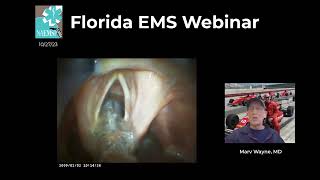
Recorded webinar (10/27/2023) in which Dr. Marv Wayne presents and narrates a series of prehospital video laryngoscopy cases to teach airway technique. He emphasizes the role of the hyoepiglottic ligament in exposing the glottis, demonstrates common failure modes (loss of lift/"weak wrist", airway clutter from vomitus/food, rapidly developing post-burn swelling, severe epiglottitis), and reviews equipment choices (UEscope with ~5° blade angulation, Glidescope history, bougie use). He also describes program-level practices: automatic video recording, supervisor review, checklist/CQI workflow, and metrics (IGEL use with 15–20% converting to intubation, ~100 IGEL/year, cricothyrotomy ~1 per 4.3 years).
Questions this video answers
The hyoepiglottic ligament (engage-and-lift maneuver).
UEscope blade with approximately 5° angulation at the tip.
Between 15% and 20% of IGEL placements were subsequently intubated.
About 100 IGEL placements per year (he reviewed 512 placements across multiple years).
About one cricothyrotomy every 4.3 years (on average).
Chapters
All right, welcome everybody to another Friday. It's 11am where it's almost Halloween almost that we're getting towards the end of the year here. And we have a great lineup through the rest of the year. We're going to be taking obviously a break during Thanksgiving and during Christmas. But today we actually have a friend of the podcast, Dr. Marv Wayne, hailing from the great northwest up at Whatcom county ems. And what I did was I asked Marv, Marv records all of his intubations and he's got probably thousands of these things. So he was kind enough to pick out some, some great airway cases and he's going to share them with us today. For those of you who don't know, he runs a lot of the airway courses at the national conferences. He's the one who introduced me to the UE Scope back when nobody even knew what the UE Scope was. So.
Marv, if you want to make some further introductions. Thank you. And take it away.
Yeah, Peter, can you see my screen? Great. So anyway, good morning everybody. I'm the. The old guy from the long away place for you, for Florida and where it's 39 degrees. So Peter and I have talked a lot through the years and I've sent him a lot of my unique videos. We've been doing video recording for 18 years. We did some research with Glidescope and others and we've published several publications. So this morning we're going to do Mars marvelous airway videos. I didn't exactly get the title or give the title, but I had help from others. So let's start with a question. What is the most important ligament in the body? And if you ask the orthopod, it's acl, if you ask the surgeon is the ligamentum flavum. But if you ask me, it's the most important ligament in the body is the hyoepiglotic ligament. So I'm using some of these pictures with permission. Andy McCoy and I do the NMSP course and we talk a lot about this. And here's a reference from the folks up in Hennepin and others, including Richard Levitan, who believes in epiglottoscopy and not intubation because the key is the what you do and how you control the epiglottis. And we'll talk about what is the epigenetic epiglottis and what is the hyoboglottic ligament. Well, we all know what the epiglottis is. It's the thing that closes over the the glottic opening, when we swell so our pelvum doesn't drain down into our bronchi. And that wouldn't be a very good thing. So again, engage it. Little handshake here, and it opens that airway for you. Okay, so we're going to, as we go through these cases and we learn a little bit more about this ligament, we're going to see how it affects positively and in some cases, negatively, the acquisition of that airway. Okay. If we look at it on the side, you can see where does your Mac blade want to go? It wants to go in the space above, and so that the space will then lift, you engage the ligament, and I will see if this actually will work. Sometimes it does, and sometimes it doesn't. There we go. You engage it. A little handshake, a little lift, a little further engagement. And now your clotic opening is complete. So that's the hl, the most important ligament in the body as far as I'm concerned. All right, now, I have no idea what happened there. And we'll just skip on down.
Okay?
All right, another. This is what happens when you do it and you lose it. There's. There. There's the epiglottis. There's the glottic opening we're trying to get to. Oh, that's beautiful. You can drive a truck in there. And now as they go to intubate, watch what frequently happens. I call it the weak wrist syndrome, because when they do that, they begin to go, ah, that one's pretty good. But now they start letting their wrist drop. It's just a little bit. This isn't too bad. Did it really go through the cords while they lifted? They made sure, but it wasn't the ideal view. So now let's look at the marvelous cases again. Thank you, Peter, for calling it that. We had a 10 month, though. Medics responded, EMS responded, police responded. It was in an area where there's a fair amount of drug use, unfortunately. Mom smokes lots of fentanyl, and there's a question of where the toxicologic event occurred. But any case, patient was found down. The patient was not breathing. 10 month old. First responders PD they, because of the location, just gave the kid Narcan. Wasn't sure how much to give. They squirted about a half of an intranasal container in. Unfortunately, it had been quite a while, apparently, that the baby wasn't breathing effectively. BLS put an eye gel, ALS got a femoral IO. The blood sugar was 60. They weren't sure, what to do. So they started dripping a little D10. We don't use D50, we use D10. There were three no shocks, CPR, a lot of vomitus in the airway to start with. And the Igel didn't seem to be working effectively because of that. And they, because of age and environment, they made the decision to transport. So let's see what happens. This is a 10 month old.
And this is. Peter, can you can add this? I know you don't have that many 10 month old pediatric video intubations. So there we are. Epiglott. The high epigotic lumen is beautifully engaged. The tube is slid into place. Remember the bronchus kind of bends to the right, so you always want a corkscrew to the right. All right, let's look at that one. Let's look at another one. 75 year old with choking, severe respiratory distress. They were having a great deal of difficulty bagging and they thought, well, they're having trouble bagging. Eye gel might not be the answer here. So they went ahead and started and intubated. This is. Oh, what is that? Anybody want to guess?
Because you know, this unfortunately was this mass of whatever. And now they're trying to both suck it and on the other end They've got a McGill and out it came. After it came out, they were able to open up the airway again, engage the ligament. But as you will see, they start getting the tube in and they relax the wrist. This is a common theme that we have now. And as they drop it, you see the ligament. They should be engaging that ligament. It should be a relationship. Well, okay, they pulled that stuff out. What is it? See, it's not something I would ever have in my life because I'm a vegetarian. This was steak. This is what was removed from the airway. So model number one, chew your food, you know, before you try to swallow it. All right.
That's a lot of steak. That's a lot of steak. Marvel. Yeah, I don't know.
Yeah, yeah, man. See again, vegetarianism has some benefit. Although there's other things you can get in an airway and you'll see that in a second. So have I not taught you the first time to chew? Let's see what happened on this one. This one is. It's one sort of. Everybody doesn't necessarily believe me, but this is real. Now, what is this again? Couldn't forget the dates on here. The dates have been changed for hipaa. The timing is the only thing that's legitimate and that's the. The clock timer on the uiscope. How the segment we we've edited, obviously, because there it runs continuously. We don't allow them to turn on or off the. The video. So what is this? Hmm. Peter. I think you know.
But what's that look like?
Food.
Yep. Anything in particular?
Sushi.
Nah, this is. Yeah. Not. We don't have good sushi where I live. But it could be. It could be. No, it could be. So. But we do have a lot of is. So they. Now they got to pull this out. And so they're always never sure of whether to grab it with the damn McGills, because everybody talks. Just grab it with the McGills. Well, sometimes. You know, one time it was a tumor. So they have to be a little bit careful. So now they carefully dissect this out, which they did.
And they. They. Because there's no way they could ventilate the patient. There was some thought about, you know, are we going to have to crack the patient? They had the equipment available, which is basically a scalpel, a bougie, and a. And a tube.
And they finally get it out. I'm sorry to take. It takes a little longer. But I think it's important to see how much volume of material was there. And there's still.
What are they using?
Marvel at this point, using their fingers. Suction and Miguel. All three.
Okay.
And they have a great view. And in the tube goes. And does anybody want to guess what that is?
That was a peanut butter sandwich.
And it gets worse because we got him in the hospital and we broke them. And we could get pieces of peanut butter all the way down the trachea into the right main stem. Pieces of peanut butter. He obviously didn't do well. He was pretty much too far down. He had severe anoxic brain injury. So. Damn it, chew your food. Ah, this is another one. This is the one. This is one of our actually earlier patients that we were videoing. And they got out. Patient with a cardiac arrest. And they couldn't bag again. Couldn't bag. They obviously CPR was the first thing they were doing. And then they went in with the video and they see this.
Aha.
Kind of a gelatinous material. Believe it or not, there is CPR ongoing. For some reason. You don't see a lot of motion on this patient. For whatever reason. It's kind of gelatinous looking. Any. Anybody want to venture a guess on this one? I think the people in Whatcom county just pick up the weird, as they say, to put in their mouth.
Well, Caviar.
Caviar. No, we don't have caviar here. We're poor folk. We're a hot dog and except I'm a vegetarian. We're a hot dog in cocktail. They find again, this is where they grab with their fingers because it looked like a tumor. And then they engage the ligament. See the ligaments engage. You got to be able to see the epiglottis. And again we have an engagement and we then intubate. Well, that was grapefruit. That was a piece of grapefruit. Piece of grapefruit, yeah.
Mark, can I, Mark, can I, can I stop you for a second?
Sure.
Because you know, which, which equipment are you using that you're able to, that you're engaging with? Are using hyper angulated blade. Are you using a standard blade with a video? What's the equipment here?
Okay, so again a disclosure. I don't get money from many of the people companies that work with airway devices, but we, we went, we've been working with UE scope for about another first generation. On the second generation device, the Blade has a 5, 5 degree angulation at the tip. They make a variety of blades. They have one is an absolute standard Mac blade. They make one that has the five degree angulation and that's the one that we use. We originally started working with glidescope. You know the, the folks that. Jack Pacey who developed the glidescope lives across the border from me. I mean I'm on the U.S. canadian northwest border and we've got to be good friends and we did a lot of work with them. We took, they took a ranger for us and put a video recording system into it so that we could, we could, you know, record our videos and then evaluate and such similar. What we're doing now. The quality is much better now, but you know, evolution of time. And we take every one of those. We then they're reviewed by the supervisor and they're done as approximately as possible. They're edited. We're using that 5 degree angulation, which is a little tricky as you're going to see when you're going to see a bougie in a, in a, a case or two. And it gets to be a mild problem with the bougie. And so you'll, you'll see and we're, we're kind of looking around on the market for something that might be more adjustable. Inner surgical has one that's got a little more malleability to it, if that's the right word. But that's, we're, doing. So we, we record, edit. Then we have a review, a whole chart review chart process where the supervisor first sits down with the individual and goes through the intubation following a checklist. Then we take that, then goes to the supervising physician for the service and the medical director being me. And then we, we use lots of these in ce. We've got one I didn't show. Unfortunate. It happens. And I went and looked at our data. It was one, the first one in 600 intubations where they actually can see the esophagus being intubated. I'm honest enough to admit that. And we'll tell you more. It didn't end up affecting the outcome because of the degree of injury, but it was something we have just almost never seen. And they get bumped out falling, whatever. But this one was.
Visualized on video. And this is what we call the ultimate learning opportunity. But I'm going to show you a case in a few minutes.
The reason I asked my question is because I was wondering using, you know, certain types of videos as far as engagement of the ligament, obviously the technique differs now, right? So that, that's really what the point of my question.
Okay, I'm sorry, I went. I want my. I want Marv long winded on your simple question. The answer is we're using the 5 degree angle. Now the question whether that is there is also the straight Mac. They now make a Mac on the UE scope. They make. They even have a hyper angulated one which I'm not sure is available in this country. But in any case, we got used to it. We like it. We've not had problems with it.
Okay, go ahead. Awesome.
All right, thank you. Sorry about that.
Now my next motto is dry fast, drink whiskey and take chances on a motorcycle. So this gentleman decided that he would take a turn at about three times the speed it should. It gives you a little facial example there. They were kind enough to get a nice look at the face which impacted a concrete abutment. There's teeth hanging in. So this was not just a straightforward airway. You've got broken jaw, you've got swollen soft tissue, you've got the tongue which I can't tell almost I had trouble figuring out where we were. Oh, there we are. There's that magic high lipopagic ligament. And again, remember the ligament. Now they had a really hard time because of the jaw displacement getting a correct position. So here's the bougie and we're having him work on bougie more often. But this is the Problem with the even slightly hyper angulated blade. The bougie wants to go posterior even though we're in a position where it should be perfect. So they just pulled back. Always remember when in doubt, pull back because you're usually too deep, too deep. Now we're where we need to be and then the tube will slide in over the bushy. All right, now let's look at a few burned airways. By the way, feel free to stop and ask questions, heckle, whatever you feel it's appropriate and I'm going to do my very best. I should. We should have time at the end I hope for comments or questions. All right, now some for some burned airways. Whatever reason we seem to collect these as Peter know he had me do the talk. We had a New Year's Day fire a few years ago. There were four people in the house, actually there were five. Dad and a guest were in the living room and they broke out to the front. Two children and mom were trapped in the bedroom where they had both some flame exposure but a lot of gaseous products of combustion exposure. And I happened to be paged out to the scene because I live just a few blocks away. I was able to get there pretty quickly. All that you will see were performed by pre hospital provider. All these by the. All these videos. None of them are done by ER docs who sometimes work in the field and sometimes don't. So this is again 13 year old female. This picture was. Peter was kind enough to pull off the Internet. So this isn't HIPAA or any issue. This is just a about that age child with about that degree of burn, high CO level. The question was hydroxycobalamy is a discussion of another day. But they all obviously got high flow oxygen. So this is the 13 year old products of combustion in the airway and this is what's coming out of her lungs. This massive material. So you can already see that the airway burn that with sloughing of the epithelial tissues and you can see you're going to see it more pronounced even on the mom.
So again.
Lots of, lots of grumis, lots of. This one was done with the child breathing. She was sedated with ketamine and for a variety of reasons, one of which is we got four patients, two ambulances and two medic units rather and people made a decision which ones they paralyzed and which ones they didn't and the crew did and a little bit grimacy. But there it goes through the courts. All right, now this is a 10 year old about a 30% burn. Again, these pictures are just off the Internet. There are no proprietary HIPAA issues here.
And this is the 10 year old. Now this gets interesting and I'm actually watching this when I'm over the shoulder and look at the swollen airway.
This is, this is, this is a. Wow. We really need to get a tube in now. We can't wait. You know, should we have used the bougie maybe? It's very easy to say all this when there isn't fire around you and people are trying to put out fire. So remember the, the airway corkscrew is to the right. The bevel on the tube is a corkscrew to the right. And this is a six tube. And I said to the medic, I said just gently keep pushing and gently keep push. Turning to the right, the right way. Gentle. Keep going, keep going. And the guys went, there we go. And we popped through. My fear was if we, huh.
If I'm not mistaken, I remember this, these videos. The sequence was that on that the earlier video on the scene, it was a smaller tube.
Yeah.
There was no swelling of the arytenoids.
Yeah.
But now. So this is important for everyone to know that this is why the airway, you know, the advanced airway should happen early, which you guys did, except that you replaced the two with a larger one. And that's that, that's the swelling that happened only 20 minutes later. Right?
Correct. Peter. I was trying to again limit the number of videos, but yes, the really lesson on this one, maybe I should have put that for all the more reason. The real lesson on that one was the fact that we should have put a bigger tube in in the first place. I was, you know, as I said, we had four patients. This was a less experienced medic who never intubated 10 year old except at children's in Seattle during our training. And you know there's a lot of fear factor that goes on in these types of environment. So yes, the tube fell out and then re intubation. But by the time reinubation occurred, you see what the conditions were. Two points. Point you make very eloquently that the swelling will only get worse. So intubate early. An eye gel, unfortunately, while it may be useful, probably won't be able to do all the things you need it to do because of the swelling that occurs beneath. Okay. This was mom. You can see her findings. She, she got RSI mainly because she was moving around a lot even though her CO was relatively high. This is all up to life. Pack, by the way, and you see the sequencing. And I want you to watch the amount of material coming out of her glottic opening. This just gives you an idea though. This is on scene, this is not. Later, all right, you can start seeing how much swollen she had, by the way. One of our fire captains literally broke through the window and carried out these people in the midst of fire and gaseous products.
We were able to kind of. This one wasn't an ideal H E L engagement, but they were able to kind of sneak it over and get it in. But look at all the material coming out of the lung. This took a little longer than, than ideally we would have liked.
So. But they got over, they got to see now they're beginning to engage the ligament how important that is. And they're in. So very important.
How about, how about smoking, drinking and smoking in bed? I know none of you live in communities where people do that because nobody smokes anymore, right? And nobody drinks anymore. Well, maybe not. So this is a gentleman who set his bed on fire without intention. And we do in delayed sequence. So a lot of the video is slightly sped up for the purposes we do the delayed sequence. So when you teach, you tell people there's carbonaceous products of combustion. But I can't just, I don't just teach, I show. You can physically see these and see this early swelling. And again, Hal is beautifully engaged. The tube is placed and your watch tube is being rotated to the right as it goes down the, and down and through the trachea. A lot of times you put the tube in straight. You immediately find that you hit the, the back of the tracheal rings, which essentially is. You're hitting the, the front of the heart. Okay, let's see. This one will work.
There we go again. Another smoking in bed.
Again, you immediately start seeing all the carbonaceous materials. This one's really got a lot of airway clutter. And.
If this doesn't make them again, hyoepagotic ligament is beautifully engaged. No, I'm not just showing only the good ones. I got lots of bad ones I could show you. But this again proves my initial point how important that is. Again, there's swelling and they had to get it through. And I don't know what happened here. Let's see if this just duplicates itself, which I think it does, hopefully. Yep, there it does.
So.
All right, now this is, I call the ultimate nightmare. I had to hold this case for several years for medical legal purposes. It's a 48 year old male seen at 2 hours earlier in the ER for a sore throat. And he was worked up and, you know, they thought probably was viral, it didn't, quote, unquote, look terrible. He actually ate and drank something before he left.
Because he'd had difficulty swallowing. And I think we gave him some steroids or something. I don't remember every detail.
But the family called when he got home because he was getting worse, drooling, shortness of breath, and on arrival of ems, he was in cardiorespiratory arrest. Now what do you do?
And if any of you have ever seen this before, feel free to shout out what you did and what happened. So those are the pillars sucking your way in.
And then you see some kind of a rosette looking red mass. Anybody want to guess what that is?
If you're putting it in the chat, I. I'm not seeing the chat right now, so that's okay.
That's a big old swollen epiglottis.
Yeah.
Huh.
Yeah.
That's. Ever got Titus. Well, to make the long story short, they made three tries at trying to slip, lift that, and then put the tube in. It looked like it was going in. It didn't end. Tidal and everything else did. And they cut his neck at that point. Unfortunately, pretty much by the time they got there, he was deceased. So that's why I held the case for medical, legal reasons for a while. And then it was cleared that family moved on, was no longer in the community. And so I'm now using it. But the point it makes is this must have been a very insidious disease process because once it's there and there, it's no longer there. Again, just to look at that. Now let me see if I can stop it. Whoops.
I won't. We'll just go back.
You have to hover over the video. If you hover over the video with your mouse. If you hover.
Yeah.
Then you. Then you can. There you go. You can. You can move it along. There you go.
Yeah, I wanna. I wanna see if I can stop it, which I should be.
Yeah, you could just press pause. Yeah.
Yeah. All right. So I talked to an anesthesiology colleague in my. I guess I gave a. Showed this at. At a talk in Israel, which both Peter's family, who he lost members, and my family live. The comment she made was, I've had one of these. She said, I took the longest straight blade I could find, shoved it all the way in, like, as far as I could, and I lifted and I was able to find an Airway isn't that interesting now. Yeah. The other thing obviously crank, but you know, all this going on same time. This was fairly far out in the county and he was pretty deceased by the time they got there.
But and also just for everyone's knowledge, Superglottic would not work here at all either.
No, absolutely not.
Right.
And that's part of the problem is that alternatives are limited. And I don't know how many cricothyroid automates Peter do you do in your system a year.
It's funny, I just did a CQI on one from last week, but it's probably less than in. In an agency where we see about 14000 calls. We did maybe a two or two or three. We had a hot dog at Costco recently choked my hot dog at Costco. But very few.
Yeah, well, we want. I went back and looked. It was like looking at the data from this ESOVA Geo innovation. I went back and looked and we do one every 4.3 years.
Partially because they are able to, for the most part, they're able to use video and to. To get it out. So let's finish up because Peter gave me exactly the right amount of time. So what did we learn? A checklist is your best memory. We used the Antevi app system. We are all of our protocols and everything are integrated. And no, Peter didn't pay me anything for that. I pay him. Lead with suction. We do the salad technique which you don't always see in these videos just because that part doesn't get picked up. Lead with suction, video with recording. The way to go. It should be auto record accepting that you have to edit because medics won't turn something on and they will always forget, quote unquote to turn it on. The hyoepiglottic ligand is the most important ligament in the body as far as I'm concerned. Certainly for intubation. Supraglottic airway and bougie are your teddy bear when you need help. And I'm still around for teddy bears. And a systematic follow up and review is learning, not punishment. So this is from Andy McCoy, my colleague at the University of Washington. It is child's play at times or it's the ultimate sphincter spasm that you can experience. So thank you. Perfect.
All right. Awesome. Thank you, Marv. That was amazing.
Sure.
A lot of people were like, you know, had a little elevated heart rate on some of those videos. We would love to see. We have some great experienced folks on this call. Any. Any Comments from anyone as far as there was a question about recording, you know I think that we don't, we don't do it enough. I think it should be a mandatory thing but anyone, Matt or anyone want to comment on what you guys are doing out there and any comments? Brett? I see Brett, big airway guy, New Jersey.
Yeah Peter. I could just make one comment Marv. That was a great presentation. Do you guys use I'm not sure what video Ringoscope you guys use. We use the McGrath EMS which doesn't record where the process trying to vet whether we're going to use a recording device but when we use our hyper angulated blade we actually marry it up with the glidescope rigid stylet and we find tremendous success using that hyper angulated rigid stylet. So it's in the airway bag and they use it pretty frequently for some of these real difficult intubations with a lot of success. And we just looked at our data over all of 22 and 23 and we're at about 91% first pass success rate for all comers in the out of hospital arena. So let me answer it quickly. We use the UE scope we've looked at everything I get stuff sent to me that isn't even FDA approved in this country yet to look at it is the most and again no money involved is the most cost effective Peter I think uses it I know Andy McCoy uses it shoreline and Fort Worth and others it is a variety of blades they're disposable it's very cost effective it's exceptionally good recording very high fidelity recording and relatively easy to download. That's what we use as far as hyper angulated we work with Glidescope for 12 years or something and we devised evaluated multiple different formats for them they're hyper angulated is harder to learn I'm not sure the differential so we're using the 5 degree excess angulation on the UE scope and each of those have advantages and disadvantages so as I said offline I'm more than happy to talk with anybody and I am more than happy to share. I can't give you the video because just of the lawyers yell at me but I certainly can share with you a short overview answer questions. My email is pretty simple. It's M W A Y N E M Wayne and I'm going to spell this at whatcom W H A T C O M Whatcom county all one word Watcom and county or one word us or my gmail is MA Wayne the number two at Gmail. So yeah, and I'm, I'm very motivated to help others because so many have helped me through the years and got some of my folk on here today. And I am fortunate. I work with the team.
Well, we got a big crowd here because of these videos. Let me bring in Jonathan. You had, you came on camera. Do you want to comment? South Metro and Denver.
Yeah, no, I actually so appreciate this. The topic and the videos are absolutely fantastic. You know, obviously this is a hot button topic for us right now. Our crike rate is significantly higher in part from our educational program. But it's been a good point for review. Absolutely fantastic. And I look forward to reaching out. Just absolutely love the presentation. So thanks so much.
Thanks, Jonathan. And then let's end it with Matt before we move over to Paul's webinar.
Hey guys. Matt Levy. Marv, thank you so much. Fantastic. We emulate almost exactly your process that you're doing here in Howard County, Maryland. Two quick points to add without being a pitch for any particular device. The reason we went to Uescope was because it was the only device we could find that would default Walt to recording when we powered the scope on so we weren't losing any videos. We like Marv. We started with glidescope about a decade and a half ago, went through all the iterations of them, defibrillated them, ran them over, did all those things you shouldn't do to medical devices along the way. And what we realized was we were losing airways, losing recordings of airways. The last thing is that we have a built out a QA process, a CQI process where we meet. It was every two weeks, it's now monthly, where we review every airway as a team. Because about 80, I would say about 95, 90% of our airways are all video at this point. There's one or two random ones that aren't. So learn a lot about it. If you're not looking at your airways, you really should. You learn a lot of things about how your system is and isn't performing. So thank you.
One last comment.
Peter. Yeah, take it down. Yep, go ahead.
One last comment. It is not first pass. It's total anoxic time is the terminology I use. So 210 second intubation attempts is no worse, no better than 125 second intubation attempts. So we look at what we call anoxic period. How long was that patient? We consider not being adequately ventilated. We're also using some technique to ventilate through the tube or trying on a few Patients as we intubate. That's been variably successful. Thank you, Peter. Thank you for all you've done to motivate others to do great things.
Thank you so much. Really appreciate you coming on again. You've been great. And just by the showing today, people really enjoyed it by the comments. So everyone, thanks for coming on. I just put the link in the chat to pop over to the Eagles webinar. You can get another 1.5 CMEs for the physicians.
For the paramedics, the EMS. I'm sorry, we. We don't have CEUs yet. We're working on that. But see you guys on the other side.
Yeah, is it too late to ask one last question?
Go.
No, go right ahead. Yeah, everyone's popping over, but yeah, go ahead.
Let me ask you guys that use video laryngoscopes, you know, pretty successfully if you have a hundred cases that require some sort of airway intervention. And I'll say starting with a, you know, LMA or supreme, whatever, up to intubation, what percent of those will be intubations versus a bridge device?
Oh, I got that number.
We looked at 512. All of our BLS providers do IGEL. Okay, essentially all. And I looked at that number and we looked at 512 IGEL placements. We do about 100 a year. And the number that get actually intubated of those is somewhere between 15 and 20%.
So you're saying if you do a hundred, if you have 100 airway courses cases, that 15 to 20% of those will be intubated?
Yes, but again, we use Igel for cardiac arrest mostly, obviously, because it's brs and some of those patients go on to be deceased in the field. Then you got to go to 100 completely separate category related to trauma, asphyxia. I mean, you know, a lot of other causes, but we do. I don't remember all of our numbers, but we've been playing around. But the bottom line is the is education, reevaluation or shoot me. Education, evaluation, reevaluation. Do well. What you do well.
And without the video, like Matt was saying, and like Marv, you do, the problem never gets fixed. Because as Josh Kimbrell mentioned, I was on a call recently where great medic, been doing it for a long time. He. He pulls out a Miller on this, on this, you know, guy at a nursing home. And. And we're looking him like, what are you doing? He like, this. This is what I do. It was one of those things where like, he just, he just did what he knew that he does. And we all have those folks in our systems for sure. Can't teach an old dog new tricks, right? That's what they say.
Hey, what can I say?
We gotta keep.
Thanks, guys. Thank you, guys.
Yeah. No, thank you. We are honored. Do me a favor. Everyone click on this link because I'm going to be shutting this down. Click on the link I just sent you and then you can get over there. Thanks, Michael.
More from Peter




Melissa Olen MSN, FPN-C, CCRN: Sudden Cardiac Arrest Training in Schools (Project ADAM) 4/25/25



Pediatric Hospital Readiness: How Teamwork & CPR Metrics Drive Better Outcomes



Chelsea Kadish, MD & Kyle Goodknight, EMT-P, RT: Pediatric CPAP in EMS (3/14/25)