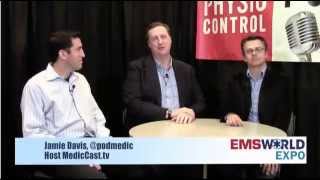
Dr. Peter Antevy discusses the Hand Tevy Pediatric Dosing System, which has been adopted across multiple states and agencies since its debut. The MedicCast feature helped spread awareness, and research shows it increases clinician confidence when treating pediatric cardiac arrests.
Questions this video answers
EMS World Expo, November 2014.
Nine states ("in just the last year and a half").
"Probably over 65 agencies already."
ACIP (presented last week) and NAMSP (presenting).
South Florida (including Orlando/Disney World), Disney cruise ships, Pinellas County, Honolulu (Hawaii), West Virginia, Washington State, Oklahoma, Texas, New York.
Chapters
I bring you the last of the segments we recorded at EMS World Expo last year in November with Dr. Peter Antevey, who created the now renowned Hand Tevy Pediatric medication and dosing system for PALs and pediatric critical care. Now, we first talked with Peter when he debuted his system almost two years ago, and he came back on the show to talk with us about how the mediccast helped spread the word on his new system and where he's come to today. So check out this segment on the power of podcasting and the mediccast in particular. It's also a really great product you heard about first here on the show.
In a conference segment just like this.
Welcome back to our segment here from the Physio Control podcast studio at EMS World Expo 2014. And I'm really excited because we actually have one of our product picks from a previous year coming back here on the show and I thought I'd bring.
Them on because they're kind of a.
Success story for us and we're excited about that success. I went by your booth and your booth looks fantastic.
Thank you.
So, Dr. Peter Antevey from the Hand Tevy Pediatric Dosing System.
Yes, sir.
So tell us a little bit about what you're doing there because that's exciting.
Well, first of all, big thank you to both of you guys. Ever since we were your product pick, we saw a major boost, not only in kind of brand awareness, if you will, but people had heard the podcast, seen the podcast, and it made a bigger difference that it was something that was picked by a third party, if you will, respected third party people. And so I just wanted to thank you guys for that. It made a tremendous difference. And now we've just kind of. It was like a meteor. It started from that.
Wow.
Yeah, it was really great.
That's awesome.
It was really cool.
Tell Chris some of the places that are now using your system to help with pediatric emergencies.
So we're now in nine states in just the last year and a half. We pretty much have all of South Florida covered. We have Orlando, all of Disney World. All the Disney cruise ships are with us. Pinellas County, Honolulu, Hawaii. We're getting them up and running. We're in West Virginia, Washington State, Oklahoma. We're in Texas. We're in. We're in New York.
Probably over 65 agencies already. And it's been an amazing ride. We have a lot of research that has come out. We presented at ACIP last week. We're presenting at namsp. We're presenting research. So now it was a Concept.
The early believers helped us out then. The research behind it has been amazing from Children's of Minnesota to the folks at Denver Health. And all of a sudden now the folks who were kind of like not the early adopters, they heard the concept, now they see the research and then it's just really a beautiful progression. Because I'm an evidence based research guy, you can't come to me with nonsense. And so I always knew that moving forward we'd have to do a lot of research. And we're doing a heck of a lot of research now. And at the end of the day we're making things better. We're getting that thought. We never would have gotten saved before. We had a drowning a few months ago in Miami Dade. The kid was down for six minutes. There was pulmonary edema. When they got to the scene, they stayed on scene. They got a ROSC back on scene and the kid walked out of the hospital. He was in a coma for like nine days. He walked out of the hospital perfectly normal.
Wow.
Wow. And again, that wasn't me who did that. That was the unbelievable medic who said, we are going to stay on scene like we do for the adult patient. We'll stay on scene for the kid. And you know, we know what happens when kids die, right? Families, the parents get divorced, people become suicidal. I mean, we see it all the time. So I think every life saved for me is not just a life saved, it's a family saved, the community and so forth.
But that's because the confidence your system gave that medic to say, I can stay here on the scene. So often it's that scoop and run, quick, get to the children's hospital because I don't know what the heck I'm doing.
But that's why when you, when you guys saw the product initially, you didn't see it as another widget. Now that we're years into it, people see that it's a culture change, it's a mindset change and it's a big confidence boost. So that they do say we are going to stay. Even though I have never trained these people. This is like a captain training a paramedic or so forth. They hear it, they say, wow, I can do it now. I know it. Because I think the decision to stay on scene happens right when you're getting on your rig. Like when you're, when you're in route there. It's happening, am I going to stay or not? And if you make the decision that you're not going to stay, you're not going to stay. Yeah. So we've seen, you know, hundreds and hundreds of paramedics now come to me and say, I feel like for the pediatric arrest, like I do for the adult arrest. Yes. And that's. And so, I mean, the big push I'm trying to make is that the ACLs and the PALs, they're really the same course, and we ought to teach just one course. The pediatric people are going to hate me for that. But I really. Now, I believe that if we convince people that peds and adults are two separate things, then they will treat them differently, and we shouldn't be doing that. So that's my big push now.
Well, Peter, it's great to have you on. Thank you so much for telling us a little bit about how we had a small part in that.
I think you had to come up with a great idea.
We just happened to notice it and.
Recognize it for what it was. And it's exciting that something we did was able to springboard that into something great for you guys. And I wish you continued success.
Thank you. And from the bottom of my heart, my wife's heart, I'm not a businessman. My wife runs the business part of it, and thank God for her. But if it's not for folks like you, it would be a guy like me with just a dream and not the ability to kind of make that move. Because to go from your garage now we have an office and distribution, it's not easy to do without support from people who matter. So thank you again.
Well, thank you so much.
And I think the other. When you said it's not a widget, I think the power that we can bring to this is that.
I'm going to use. I mean, I'm the end user, too. I mean, I think that's part of it. And we recognize that every time I go through the showroom floor and so. But also recognizing you're Peter and Tevy, I mean, if you're not gonna say, you know, I came up with this idea and it's kind of crazy, but I did it. And I think that that also lends a little bit too. So don't undersell yourself.
But I think that, again, it's so simple. It's so simple. But it is a culture change, too, and I really applaud you for everything you've done.
Thanks, Chris. I appreciate it. And thank you, Jamie. Appreciate it.
Thank you.
Appreciate it.
Thanks a lot.
Thank you.
Thank you.
So we want to thank all of you for checking out this segment. We'll be back to wrap up the show here at EMS World Expo.