Michael W. Hubble PhD, MBA - ETCO2 Guided Defibrillation (12/13/2022)
Michael Hubble presents a study of 324 cardiac arrests showing ETCO2 levels predict whether a first shock will work. Bystander CPR increased success odds 4.1 times. No one survived the first shock when ETCO2 was below 20 mmHg, suggesting paramedics might delay defibrillation and do CPR longer until CO2 levels rise.
Questions this video answers
324 patients and 869 shocks.
Mean ventilatory rate ≈ 11 breaths per minute; mean ETCO2 ≈ 33 mmHg.
Layperson (bystander) CPR (adjusted OR 4.1) and ETCO2 (adjusted OR 1.03 per mmHg).
AUC ≈ 0.644; optimal ETCO2 threshold ≈ 27 mmHg when bystander CPR was performed and ≈ 32 mmHg without bystander CPR.
No patient with ETCO2 <20 mmHg experienced a successful first shock (one outlier due to hyperventilation).
Chapters
Busy schedule today, but thanks everybody. Welcome to our usual show here on Tuesday morning. And what I want to do was do a quick introduction. Before I do that, I just want to remind everybody that we do have a CME number for today. If someone would do me a favor and just put it in the. I can't, I never can remember how to do this with the, with the, with this program, the teams. But in. If you could chat for me that we've got.
15346. It will be the CME code for today. 15346. That would be nice again if someone can put it. I guess this is the chat thing over here. Show conversation, meeting check. Okay. This is a little clock going off to remind me time to start here. Okay, There you go. All right, so.
There you go. Thanks John, really appreciate that.
Okay, you're saying your query, but it would be due to restream. Okay, got it. Okay, got it. Thanks a lot. Thanks a lot then, Angus. All right, so today's talk is going to be really kind of interesting in a lot of ways and we have a long standing academician in the world of ems, Mike Hubble coming on. He's been at this since like golly, so probably been 42 years or something like ridiculous like that. Right, Mike? So and so anyways. But yeah, you've been, you've published, you know, lots of papers and you've been, you know, just been outstanding contributor. And tell me, where are you based right now? You're up in North Carolina, right. For a while you were in Asheville, if I remember. And then what are you doing? You're up in Chapel Hill, I think, if I remember correctly.
Yes, I was a professor in the UNC system out in the western part of the state. I retired from there in 2018 and moved back home. I'm now in Chapel Hill and working a little bit over at Wake Tech with the good folks at Wake County. And Wake county ems.
Yeah. Good. And then you guys have been doing really progressive stuff over there. So it's fantastic that you're doing a lot of the academic arm. As you can see, he's a PhD. So Dr. Hubble's not only a realm that but he's been a long standing professor as well. And then is Ginny coming on with you, Dr. Rehnquitz?
I'm here. I had a technical difficulty. Sorry.
That's great and great to have you on and now Jenny, but you've been a department chair, you know, and in the realm of healthcare administration. Right. Or where at The Methodist, was it at Methodist University in Fayetteville. I remember.
Sorry.
I tried to retain all this stuff, but it's a lot of information coming in.
So tell me you did pretty good. Yeah. Currently I am the division chair of both graduate and undergraduate programs and healthcare administration. And prior to that for somewhere near 17 years I was an EMS program director.
Okay, fantastic. And then I understand that you actually I've always was understanding that the people who got the FAEMS had been board certified and were taking it. Got that designation after that. But you've received that as well, correct? Faems, Yep.
There is a professional track for non physician delegates that are members of naemsp. And so it's. It's pretty much the same criteria minus all the medical director stuff.
Got it. Well, you're lucky that the medical director stuff is not pleasant. A lot of things they make us learn and all that to take this test. But it's great to have you on board. So let's go ahead and launch in. Anybody have any questions or anything to say before we get into this talk? But what's really cool is that they recently published a paper on this subject of end tidal CO2. And you'll see it's. It's kind of, it's. It's a correlation. Correlation study. But it's actually has a lot of roots to it, especially for those of you have in the past looked at, you know, looking at the amplitude or median frequency of ventricular fibrillation and there's a correlation here and it's a really cool one and it raises a great question. So if you don't mind, go ahead Dr. Hubbell and Dr. Reinkwitz and let us know about what you found.
Well, thank you, Dr. Pepe. We are indeed honored by the invitation and appreciate the opportunity to share our work with your group. We'd like to begin by acknowledging our co authors and their respective EMS agencies that provided the data for. So we had a lot of help in pulling all this together.
We know that from the Larson, going back to the Larson and Eisenberg paper from the early 90s that survival declines about 7 to 10% per minute until defibrillation of witnessed VF. So subsequent to that, guidelines recommend an immediate defibrillation whenever it's recognized as V fib on the cardiac monitor. However, prolonged VF results in myocardial ischemia. That makes defibrillation less likely. And we know that repeated defibrillations interrupt chest compressions. It further destabilizes the myocardium and it's also associated with some post resuscitation myocardial dysfunction. Therefore, immediate defibrillation may not always be the ideal solution. And instead the optimal timing of defibrillation should probably be based on the probability of a sh.
Which we believe is likely to be a function of V fib duration.
Now unfortunately, aside from EMS witnessed V fib, the duration of V fib is often unknown to everyone that's out practicing in the pre hospital setting. So what we need then is some type of a surrogate measure of myocardial readiness to defibrillation. So what we hypothesized was that we could actually use n carbon end tidal carbon dioxide as a biomarker to kind of guide us on the timing of shock delivery. Virtually every Cardiac monitor in EMS nowadays has end tidal CO2 on it. So this just may be another use for that particular function of the cardiac monitor.
So in terms of how we conducted this study, as Dr. Hubble said earlier, we collected retrospective cardiac arrest data from for North Carolina counties, we included all adult patients greater than or equal to 18 years of age who had a non traumatic cardiac arrest prior to EMS arrival and who received one or more defibrillations by ems. Then of course we collected demographic EMS response treatment outcome variables. We got all that from the medical record. In terms of exclusions, EMS witness arrests were excluded because an immediate defibrillation there might be indicated. And then of course, patients who received a shock prior to EMS arrival, in other words, they were shocked into ROSC or they were shocked into a persistent non shockable rhythm were also excluded.
Who's driving the slides?
It's already advanced.
Oh, I'm sorry.
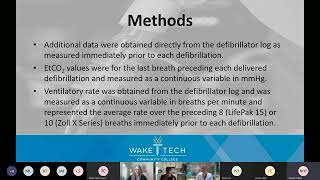
Additional data were obtained directly from the defibrillator log and as measured immediately prior to each defib. And then our ETCO2 values were for the last breath preceding each defibrillation. And then they were subsequently measured as a continuous variable in millimeters of mercury. Our ventilatory rate was also received from the defibrillator log and it was measured as a continuous variable in breaths per minute. And then we represented that as an average over the preceding eight to 10 breaths prior to each defibrillation, depending on which cardiac machine LifePak 15 or ZOLL was being used at the time.
So we analyzed first shock and succeedent shock separately.
So the cumulative number of shocks or the total number of shocks delivered included AED shocks that might have been delivered prior to EMS arrival. So first shocks were defined as those who received an EMS shock but did not receive any electricity prior to that or prior to EMS arrival on scene. Whereas succident shocks were described as all of the shocks that came after the first, which may or may not have included a shock by an AED that makes sense.
For our first shock, we.
Determined adjusted odds ratios using a binary logistic regression model. So in other words, did they receive it? Yes, no. To control for our confounding variables which included, you know, age, gender, non Caucasian, restaurants, race, witnessed arrest, the receipt of layperson cpr, EMS response time, defib energy.
V fib episode type, which there are three Primary VFIB is when VFIB is the first presenting rhythm on EMS arrival. Secondary would be an ems, an episode of VFIB following a previously pulseless or non shockable rhythm and then RE arrest obviously is the first rearrest following a period of rosc.
So we also wanted to look at drugs including epinephrine and sodium bicarbonate.
So once EPI or bicarb were administered, all of the subsequent shocks were coded as having having had prior EPI or bicarb administration. And then of course, we've already spoken about ventilatory rate and ETCO2.
Succeeding shocks were analyzed using generalized estimating equation, which we used to control for repeated measures. Shock success was defined in terms of ROSC at the next pulsar rhythm check following a defibrillation.
The area under the curve of the receiver operating characteristic was used to assess the predictive utility of using the biomarker of end tidal CO2 for successful defibrillation. And then we looked at the optimal threshold of end tidal CO2 successful to defibrillation using what's called a concordance probability method. In other words, the point where sensitivity and specificity kind of come together.
So our total Data set included 324 patients that were available for analysis, and among those, they received a total of 869 shocks. Roughly about 18% of those were first shocks.
63% were witnessed arrest and nearly half of those received bystander CPR. About 21% received an AED shock prior to EMS arrival. And in terms of the advanced airway, BIADs were used in about 34 of the patients and about 15% were endotracheal intubation. Overall, the mean ventilatory rate was 11 breaths per minute and the mean end tidal CO2 was 33. Nearly all of the shocks were preceded by epinephrine and about half were preceded by sodium bicarbonate. And this just kind of reflects the disproportionate number of succeeded shocks in the data set in comparison to first shocks.
In the adjusted analysis for the first shock, only layperson CPR with an odds ratio of 4.1 and end tidal CO2 with an odds ratio of 1.03 per millimeter of mercury were predictive of shock success. However, these variables were not predictive of succeedent shock success. Only V fib rearrest was predicted of successful succeedent shock, which is likely just a surrogate marker for an EMS witnessed arrest followed by an immediate defibrillation.
We noted that only one patient with an end tidal CO2 of less than 20 was successfully defibrillated on the first shock. Within this group of less than 20 CO2 levels, only about 12% ultimately attained ROSC at some point during the resuscitation, so this kind of reflects a poor prognosis for patients with initial presenting low ETCO2 levels. Upon further investigation, the one patient in that low CO2 level, the less than 20 group we discovered, was inadvertently hyperventilated at a rate of about 40 breaths per minute and his end tidal CO2 was actually 5, so this patient is somewhat of an outlier. We also observed a clear pattern between patients with and without bystander cpr. The proportion of patients attaining ROSC rose with increasing values of end tidal CO2 when bison or CPR was performed, with ROSC rates doubling virtually every 10 millimeters of mercury of CO2 until we approached in a plateau around 30 to 39 millimeters of mercury. In comparison, the probability of successful defibrillation remained relatively unchanged across all of the groupings of the end tidal CO2 above 20 who did not receive bystander CPR. So this pattern, we think, kind of underscores the importance of bystander CPR and out of hospital cardiac arrest.
In terms of our model, the area under the curve was only moderate at about 0.644 and we calculated the OD optimal threshold for defibrillation using the concordance probability method we found was 27 when bystander CPR was performed and 32 without.
So previous studies of CPR prior to defibrillation have provided mixed results.
Some of these prior investigations have demonstrated that survival is improved by a period of impressions prior to defibrillation, but only when EMS response time was greater than, say four or five minutes. However, two other studies found no improvement in outcomes in CPR.
When CPR was performed, say 1 1/2 to 3 minutes prior to defibrillation, regardless of the length of the response time.
We looked at a meta analysis by Simpson et al.
He pulled the results of studies by Wick, Baker and Jacobs and found that neither benefit nor harm in.
Delaying defibrillation was present for a brief period of cpr. So these conflicting results notwithstanding, all of these protocols are time driven and.
They attempted to improve myocardial metabolism with a fixed duration of CPR prior to defibrillation. So because of that these these formulae don't represent an individualized strategy.
Where high quality chest compressions of unknown and of course likely varying duration may be required to restore the myocardium. So what we need is a patient centric rather than a time or protocol centric approach to when we provide defibrillation as opposed to just doing it at a specific at a general point in time.
Savistano showed a series of 207 cumulative shocks delivered to 62 patients and found that no shock was success with an ETCO2 less than 7 millimeters of mercury and no shock was unsuccessful when the ETCO2 was greater than 45 millimeters of mercury.
Chakoti et al reported on the first shocks of 75 patients and observed that no shock was successful for an ETCO2 less than 11 and 60% of shocks were successful when the ETCO2 was greater than 40.
So this this sorry successful defibrillation in prior studies has been defined as one that resulted in an organized electrical rhythm and that's problematic because it that may have included PEA and not just VFIB or vtac.
So.
Our study defined a successful shock restricted to those that resulted in both an organized rhythm and a documented pulse.
Also.
When we excluded we had a patient with iatrogenic hyperventilation. But in our data set no patient with an ETCO 2 of less than 20 experienced a successful first shock and only 30% of those who received layperson CPR were successfully defibrillated when the etcot was greater than 40.
We attribute those differences into our outcome definitions that I just talked.
So in contrast to the previous studies, our model controlled for covariates known to influence TCO2 and patient outcomes, which we believe provided a more accurate estimate of the independent predictive value of using End Tidal CO2 as a biomarker for shock success.
Most important, among those potentially confounding covariates were ventilatory rate and Drug Administration. As Dr. Hubble pointed out.
Our study is subject to the usual and customary limitations of a retrospective study. We had some issues with sample sizes in some of the end tidal CO2 categories and of course there's always the potential for unmeasured compounders confounders. Roughly half of the cases were excluded because of missing data, which may have produced some selection bias and also reduced statistical power to detect some small effect sizes in some of the subgroups. Of particular concern is extent of the missing end tidal CO2 for the first shocks, which is to be expected because we only used end tidal CO2 data from advanced airway. So a logical solution would BE to obtain CO2 levels from BVM prior to advanced airway placement. But a study from Toronto just came out a couple of months ago and they found that the end tidal CO2 values obtained from a BVM were not predictive of defibrillation success. They were kind of stuck with using advanced airways. Perhaps the greatest limitation is that our observational design is that we were only able to quantify the relationship between the tidal CO2 value and the probability of successful defibrillation at the point in time at which the shock was actually delivered. A more useful metric would be the likelihood of a successful conversion to ROSC when we delay defibrillations up to some threshold of end tidal CO2.
With some basic CPR prior to the defibrillation.
So in conclusion, we determined that.
The first defibrillation administered to patients experiencing cardiac arrest prior to EMS arrival who had end tidal CO2 values less than 20, those were almost universally unsuccessful in restoring spontaneous circulation.
And we did identify differences in patients responses to defibrillation based on whether or not they had received layperson CPR despite their equivalent end tidal CO2 values.
So if they received layperson CPR, then the likelihood of successful defibrillation increased as their end tidal CO2 value increased. But in contrast, there was little to no increase in the likelihood of successful defibrillation beyond an ETCO 2 of 20 if those patients had not received layperson CPR.
So the big key takeaway is that.
This could be an important biomarker for how we treat cardiac arrest in EMS and in general. But we need more studies. We need to identify the actual threshold value that is predictive of myocardial readiness for successful defibrillation and then also to evaluate the clinical effect of what it means to delay defibrillation in favor of chest compressions until this threshold value is obtained.
All right, if you don't mind, we probably should have cut you off about five or ten minutes ago. Jenny, are you guys anything else you want to say before I. Because we're going to have to get off here in just a couple minutes. So anything else you want to say?
Okay. Does anybody out there have some questions? I have some comments, but I want to see if anybody else out there has any questions because I only have a couple minutes left.
Not hearing none off top my so far. So again, the CME number for today is 1-534-615-3346. So let me tell you a few things is that this totally makes sense. So the first question that comes to mind in your systems, are you using active compression decompression, ITD or both in your system?
So I don't think they're using any of those technologies that I'm aware of.
Okay. Because it's really unusual for most EMS providers to see end tidal CO2s over 20 with using the, you know, the generic, you know, the generic approaches that we've always used. It's rare to see, if you ask the average person on the street, it's rare to see, for them to see 20 to 25. We're starting to see that with people who have actually literally controlled truly controlled ventilation properly because it's not just ventilatory rate. We've always made a point that it's the tidal volume that you're doing so that people can, you can move blood through the chest during cpr and also rate of delivery and also rate of release. And there's so many factors there and I suspect those were not even controlled or being done appropriately by the rescuers, which you've seen. Then there's the quality CPR. All those things affect the end tidal CO2, and it is interesting that you were able to get these higher levels or find them out. And I have to go back and see what that was, but probably was related to bisector cpr, which prolongs a little bit of perfusion and so on. So anyways, I'd like to get back with you some time and go over this because the timing of it, but it just seems like it's unusual for us to see Those end tidal CO2s up in that level. What we are seeing pretty regularly in systems that do use end tidal CO2 and the active compression decompression ITD are end tidals that are in the 30 range or so. And we're actually seeing almost normalization of end tidal CO2 is when we've added in the head up CPR. What are you doing even in a Sisley case, as I remember, are you on carry Bachista? What are you guys seeing there when you've done the head up things? Because this is What I'm saying is this may be the way to go to prime the pump first and then it'd be more amenable to shocking as long as you're. Because you're. You're balancing time to defibrillation versus, you know, the profusion. I think you're on the right track here, by the way, so. But. Yeah, come on out, Paul, can you hear me? Yes, I can hear you now. Yeah.
Yeah, I thought just basically to echo what you said, I mean, we're just not. When you're doing actual compression, decompression and heads up, it's really rare Any, any end tidal CO2 less than 20 is making me think that there's some sort of.
There's.
There's a problem.
There's a, there's a Igel. That's not fitting right. You're not getting good suction, you got a flow issue. There's something going on. So it's really rare to see end titles less than 20 when you're doing that.
Yeah.
Where.
And the other thing is, where have you. What has your been experience. Have you. Are you regularly seeing. If you're just doing standard CPR out there, supine cpr, Are you. Are you. Were you when you were doing that, seeing anti CO2s above 20 on a regular basis? No, it's.
It's. You get them. But I mean, that would be, that would be your, you know, your ideal cardiac arrest.
Right.
Your guy that codes at the gym or the doctor's office or something and they immediately get bystander cpr. And you know that those kinds of issues are the ones where you get that it's.
Yeah.
I mean, you get. Certainly do get end titles with regular cardiac arrest and regular treatments that are. That are that high. But it's. I would say it's not the, it's not the usual. At least not that I've seen.
Yeah. Anybody else want to comment on that before I turn this over, which I got to do in about one minute? Anybody else? Abdul said, were the patients ventilator with an advanced airway placed or not? I think you addressed that already, if I remember correctly. Yeah, the patient right there. I see your answer. And thanks a lot then. So. Hi, Abdul, by the way. Hope you're doing well.
What was the next question? Someone else had a question?
No, I think Dr. Hubble and I were answering that question in the chat simultaneously, which was that we don't typically use Ventilators in911 EMS services in North Carolina. And the typical standard ventilation rate Post innovation is six to eight breaths a minute.
So in the laboratory, standard cpr, even when it's performed optimal, you know, and we also have data from, by the way, from humans as well, that match it. Usually you're only doing about 15 to 20% of normal cardiac output in cerebral perfusion. And, you know, but if you start using some of the other adjuncts we mentioned, then it starts moving up to 30%, 40% abnormal, and then that's reflected in the end tidal. So the end tidal is just a good tool to use here. And again, in the laboratory, we're seeing totally normalized blood flows in cerebral perfusion pressures when you do that combination of the acd, ITD and gradual elevation of the head after it's been primed there. So there may be a lot to this. And this is really a good piece to attach to what we may need to be looking at in the future as well. So. And I think. Yes, go ahead, Kerry.
Again, I think also I think this is a great marker of your flow. You know, we talk about cardiac arrest. It's all about flow dynamics.
Yeah.
If you combine this with say, cerebroximetry, I think that's. That's very powerful.
Exactly. Yeah, exactly. And the other thing is that I think also you're going to see much better performance and better Intel CO2s if people are doing ventilation. Right. And ventilation is so many. There's like seven factors that people don't control for and so that someday I'll have to come back, give you guys a talk about that, and it'll help a lot under the circumstances. So. Okay, so what, Joe, what are you saying? There AI in defib may integrate the data. Yep, exactly. All right, well, listen, I got to go over to the other meeting and. And Mike, just double check your email right now and see if. If you got that, if you got the invite or not. Okay, so.
Still don't see it, Dr. Pepe.
All right, I'll try to do it when I'm. I got to go get on it right now, so I'm going to have to see. Thank you very much, everyone. It will see you back next week. This is fantastic stuff and as usual, really appreciate your thanks for all the good work you guys are doing up there. Really appreciate it. Okay, so with Hope, someone's going to transfer all you guys over. I'm not sure who does that. Maybe.
You know, hopefully, you know, if he's back, you know, Ingus is going to do that. I don't know if anybody else does that, but we'll hopefully get John because it'll be a good show today. So thank you so much. I'm hanging up. Take care of.
Mike. Ginny.
Good job.
Yeah, thank you very much.
Thanks Joseph. Happy Hanukkah.
Happy Hanukkah to you as well.
Waiting on Angus to do the switchover.
All right, one second everybody. I'll try to get the restream going here. Sorry about that. I'm juggling meeting.
This meeting draft. I'm going to try to send a compose something to someone and send them a invitation to this thing in the meantime while doing that. But on the agenda so far I wanted to start off with Jim to sort of reiterate the report about the drug shortages. We had a little.
You know, we did a review yesterday across the state of Florida to see if we were missing any of those important things like amoxicillin or Tylenol and so on that were missing in other states.
Hello? Yeah.
More from Peter




Melissa Olen MSN, FPN-C, CCRN: Sudden Cardiac Arrest Training in Schools (Project ADAM) 4/25/25



Pediatric Hospital Readiness: How Teamwork & CPR Metrics Drive Better Outcomes



Chelsea Kadish, MD & Kyle Goodknight, EMT-P, RT: Pediatric CPAP in EMS (3/14/25)