Mike Humphrey & Adam Perrett: Preventing Rearrest after ROSC (7/29/24)
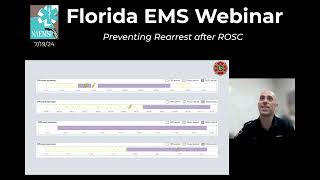
Webinar presentation by Mike Humphrey and Adam Perrett (Lethbridge Fire & Emergency Services) describing their data-driven QA/QI program to reduce rearrest after return of spontaneous circulation (ROSC). They review case analyses (218 adult arrests; 31% ROSC across 2022–2023), identify hypotension as a common precursor to rearrest, and describe protocol changes (early push-dose epinephrine and norepinephrine infusion, concurrent fluids/pacing) plus clinical handover improvements with the receiving ED.
Chapters
Welcome, everybody. It is Friday, July 19th. This is Peter Antevi and Tanner Smita coming to you with the Florida EMS webinar. And today we have an amazing treat. I met these two gentlemen.
Along the way, probably several years now. We've met really at the, at the ZOLL conferences. And I've been enamored by the work that they've done with their data collection and then not just understanding their data, understanding trends in their data, and then figuring out an implementation to the problem. And that's exactly what you're going to hear about today.
Where my country and Adam Perrette, they're from Lethbridge, which is in Alberta, a province in Canada, and they are one of the highest performing agencies that I've ever met. And when I, when I heard what they were doing, I said, please, this is months ago. I said, can you please come on the webinar? And we have them here today. So without any further ado, Mike and Adam, if you want to make some further introduction, and then we'll go ahead and get started. Can't wait to hear your talk.
Perfect. Good morning, everybody. Thanks for joining us today. And thanks, Peter, for inviting us to give this talk. My name is Adam Parrott. I'm the medical training officer for Lethbridge Fire and Emergency Services. And I'll just leave it at that because we do have a bit of an introduction just built into our presentation. We're trying something new with this one, so we're going to try that.
Do you want to, do you want to, do you want to say something, Mike, or we're good to go?
Oh, I'm like, go ahead.
I was waiting for the intro page.
All right, let's, let's wait for the introduction page then.
I don't want to enter myself twice.
So we'll start right away here then. And what we'll do is we're going to talk about case review and some of the things that we're doing here in Lethbridge. And so what we'll do today is we'll kind of go through our introductions and our backgrounds of what it is, what happened with our service and how we, how we got to where we are, some of the initial trends and how that led to a protocol change. And then finally, the newest thing that we're working with is clinical handover with our, with our care center. And so I am Adam Parrott. I'm the medical training officer with Lethbridge Fire Emergency Services. My main role and responsibilities here at Lethbridge are to facilitate all medical Training that runs through our department to ensure that our members stay with our licensing, meeting all those requirements. And then I'm the co lead with Mike here with our cardiac survivability program.
Hi, I'm Mike Humphrey. I'm the EMS Operations Officer at Lethbridge Fired Emergency Services. My primary role here is to identify issues, trends or concerns within EMS and within our community and make sure our paramedics have strategies in place to deal with them.
And so just so we get this out of the way right away, we have no conflicts of interest. Everything we're going to talk about and show you today is our experience with using Zoll X Series Advanced and the integration with Zoll online. I believe it used to be called Case Premium, Case Review or Case Review Premium in the States. And so this is just kind of what we've done with this and what we looked at. We do know there's many options out there for different monitors, but we just don't have a working knowledge of all those. And then I want to make sure to mention as well that Mike and I are not a research team. And so we're actually a QA QI program that we've kind of recognized that we found a need for some stuff. So as Dr. Antoni said, we are from Lethbridge, Alberta, Canada, and that's the third largest city in Alberta. And we can see just on the very bottom there where we circled, we're about an hour, hour and 15 minutes north of the Montana border. And so that's kind of where we sit is right down in the southern part of our province.
We are a all hazard fully Integrated Fire Service. We've got about 190 frontline members. So 149 of them are advanced care paramedics, 29 are primary care paramedics. And I think that's EMTP advanced and an EMT intermediate for a lot of places. And then 12 medical first responders. Those 12 have all been advanced care or primary care paramedics at some point in time in their career. In 2023, we did just under 24,000 EMS calls and then an additional 3,000 fire calls. And what we've been able to do since January 2022 to December 2023, we've collected 218 adult cardiac arrests and we have about a 31% ROSC rate. And so what happened for us or where we kind of all started from, Mike and I, were we came into our positions relatively at the same time. And we had this great program that we ended up working with and so on October 14, 2021, excuse me, that was kind of the first call that Mike and I started to evaluate and say what went well, what didn't go well, and how can we reproduce some of the good things. And so this was a standard response with our service of an ambulance and a fire truck for a 79 year old female who was witnessed cardiac arrest in a private residence. Our engine was there first and the nozzle person jumped out of the truck, went running into the house to see if it was a cardiac arrest and to start care if that was the case. The ambulance arrived about 40 seconds later. They were able to get all of the equipment, bring it into the house and work really as a really good cohesive team. And so what initially happened was the patient was in a PEA rhythm. And so our members started to go down that typical PEA algorithm. They end up getting a ROSC back and into a sinus rhythm. They then started noticing they were getting longer and longer runs of VTACH with a pulse. It had synchronized cardioversion twice. Patient went back into. And that's. So the top line is the initial rhythm or the rosc. Then the bottom line there is this cardioversion. And then they started to notice that the patient was having longer, longer runs of pulseless V tach. And so they did CPR again, defib, and again got a second ROST back on this patient. And as they were packaging, we had a really high performing crew there. And they noticed that the heart rate goes from about 100 beats per minute down to about 45. They started to treat aggressively with norepinephrine infusion and pacing a little bit of fluid challeng well. And they were able to get a sustained ROSC all the way to the hospital. And so you see that top line is the defib, the second defib. And then the bottom line is where they started the pace and get the ROSC back. And so this crew did an amazing job. And so what we looked at is we said this helped to inform what our high performance CPR system looked like. And so we said if this, if this member, these members can do such a good job without any formal training, without any formal kind of program push behind it, we can have all of our members perform at that level. And once we ended up putting on this formal program program and we had all of our members operating at this role, we really started to notice this increase in ROSC and our staff really started to perform at an extremely high level. And so one of the things that we noticed. Go ahead Mike?
Yeah. So one of the initial trends that we noticed was. Sorry. First off, after this call, we committed to performing 100% cardiac arrest reviews and then feedback to our members, usually within 24 to 48 hours. So we looked at our first 20 ROSCs, and in doing this, we recognize a pattern of hypotension that was present in 12 of those 20 cases. So over the next two slides, we have 11 of those 12 hypotensive cases. And I just want to explain what exactly you're looking at here. So these colored bars you're seeing are the event summaries of individual cardiac arrests, where yellow is a CPR period, purple is a ROSC period, and then there's a rearrest, and yellow is another CPR period. So we notice that hypotension is a sign that a rearrest is imminent. Go ahead.
Oh, sorry. Can you jump one back slide there? So we looked at the duration of that purple section, that rosc, and we basically just measured it. And. And what we notice is that the Ross period of a hypotensive patient would last anywhere usually between two and nine minutes. And interestingly, all the PCRs read the same. We did CPR, we got ROSC. We started package the patient up, moved them to the ambulance, started CPR in the ambulance.
Go to the next slide.
What we notice is that these four patients actually were hypotensive, but they had sustained Ross because. And the only thing that was different on these cases is that they received early vasopressors. So we had a couple high flyers that were delivering early vasopressors right away. And I think you can see that maybe there's a difference here in the care of these patients.
So what was.
Go ahead, Adam.
And so this was our past protocol. This was. We looked at our protocol that we. That we had, and it's a little bit confusing, but all you have to know on the left side.
Do we get a rosc? Yes. Is the patient hypotensive? Yes. Jump over to the right slide. And what you see is basically the protocol is normal saline, 500 mil bolus to a max of 2 liters, and then online medical consultation for norepinephrine infusion. What we found is that that process takes much longer than 10 minutes. And so our patients. The protocol just didn't meet the patient pathology needs. So we changed our protocol.
Go ahead.
We brought this trend to our medical director, Dr. Orr, and he really empowered us to craft a protocol that met the patient pathology. And so we needed to create a protocol that was implementable within 60 seconds of the ROSC. So basically it's a kitchen sink protocol. So we're going to give, if the patient's hypotensive below 90 systolic, we're going to, we're going to do concurrent fluid, vasopressors and pacing if applicable. So our protocol is 20 mics of push dose epi Q2 minutes until we get a BP above 90 or we start a norepinephrine infusion. And this is what our event summaries look like now. So you can see these are all hypotensive patients and you can see a much longer sustained roscoe. What you'll notice in this, in some of these slides is blue is mechanical cpr. That's the auto pulse. So we kind of implemented that about the same time. But you know, it's not push dose magic. You do get some rear rests. But what we can see is that our, our rear rest rate and our prolonged ROSC is, is much longer. So our rear rest rate went from about 50%.
And the prevalence of hypotension was 50%. So you can see if the patient was hypotensive, they always re arrested. And we had an arrival to ED with a pulse of 50%. After implementation, our rearrest rate dropped to about 23% and then our arrival to ED with pulses was just under 90. 90% of. It's 87.5% now.
So this is a, this is a draft of what the protocol in our, in our province is going to look like in 2025. It' you can see here is.
You immediately obtain a set of vitals Q1 minute on blood pressures. And then you can see is the patient hypotensive? Yes. Normal saline bolus and concurrent push dose epinephrine as a bridging mechanism to get to norepinephrine. So this will be going live in the province. This happens to be our pediatric protocol, but our adult protocol will be looking very similar to this.
And so, you know, it's, it's not only important what you do, but it's just as important how you do it. And so this is an operational, this is an operational performance. So what you're seeing here is, is, is called vital signs trends and it's a hypotensive Ross patient. So the vertical axis is the vital sign value. The horizontal axis is time. And so the first third of that call before the vertical blue line is CPR artifact. And then you can see right where it's annotated rosc. That's where ROSC occurs.
And then after rosc you're going to see a dark blue line and that's the heart rate. And then the three lines below that are systolic blood pressure, mean arterial pressure and diastolic pressure. And what I'll know, what you'll notice here is that within five seconds of the Ross, that blood pressure is starting. So they were prepared for the Ross. The blood pressure comes back within 30 seconds. And within that first 60 seconds of that Ross they noticed that the patient was hypotensive, about 80 systolic. And they immediately deliver push dose epinephrine. They gave four push dose epinephrines. And then, and that's kind of what we call the EPI wave. So you'll see big swings in blood pressure up and down. And then kind of right after 13, 19 is when they transition to a norepinephrine infusion. And what's interesting about this is that as the patient becomes normal, tensive heart rate actually comes down. And this patient is much more hemodynamically stable with that norepinephrine infusion.
And so one of the things that we noticed is that, or that we started to recognize after that is that our rearrest rate goes down, our arrival to emergency department goes up, and all of a sudden we've taken these critically sick patients from their living room and we're now dropping them on the doorstep of an emergency room. And this was happening with more and more frequency. And the truth was, what was happening at that hospital was just not equipped to handle these increased sick patients. And so we were able to capture these four patients here. And all of these four patients all had a sustained ROSC with our crews. They were critically sick, but they were stable. And during clinical handover at the hospital, they rearrested. And so whatever we were doing wasn't working. And so when we have a rearrest in the hospital, what we're doing is we are breaking the chain of survival. And we're all very familiar with what the chain of survival is. We have very little control over everything we can do prior to EMS and hospital team working together. Right. So telephone CPR is really important and we can have all the protocols in place we want, but we really have a limited option of what we can do to control that bystander cpr. We have a public education program, but again, we have very limited control of somebody performing CPR and public access defibrillation, the exact same thing. They are available they're there for use. But if somebody chooses not to use it or doesn't know how to use it, we have very little access to that or very little control over that. What we're going to do is we'll look at a couple of these case studies as to what went wrong in the clinical handover and how we were able to fix this. This is a patient that you can see CPR is going along, you can see all of the epinephrine given, and that big blue line there again is where we sustained rosc. And you can see that they are critically sick. Blood pressures are quite low. And it's a stark contrast to the one that Mike just showed you where this one looks like. There was only four blood pressures taken. That's not the case. So they were doing auscultated blood pressures. These are just the four NIBPs that they were able to get. And one of the things that we protocolized here in Lethbridge was that people love to use nibp, even on critically sick patients. It's what we kind of revert back to because that's what we do all the time. And so we've told our staff, if you're getting what's called an NIBP timeout, so you hit the button and it just takes too long and it comes back and it says timed out, or it is taking an extremely long period of time to come back, we are to count that patient as a critically hypotensive patient and treat them as such. And so they really did do quite a few more blood pressures than what we get here. And you can see that last line there that says clinical handover. So our members were using push dose EPI in this case, sustaining this patient to get there, a very, very sick patient. But what happened was they got close to the hospital and they transitioned their mindset from patient care to transfer of care. And so they started to load the patient up, they started to discontinue what they were doing, and it was by no means their fault. What we know is that when you get task orientated, you all of a sudden can't concentrate on more than one thing at a time. And so they were concentrating on getting this patient out of their ambulance because of how sick they were and getting them into the emergency department to have more sustained care. When that happened, you can see at the very end there a rapid drop in pulse rate and they went right into cardiac arrest. And this patient was not able to come back. So the other case study we're Going to look at is, if anyone's not familiar, this is our Acuvent data. So Accuvent is a product that we use with the Zollect series advance. And this will give you real time BVM feedback for tidal volume, respiration rate and end tidal CO2. And it puts it on the screen for you. It is an absolutely fantastic tool. And you can see the first kind of third of that call. We're pretty good at keeping the tidal volume between about 400, 450 mils of air per breath. The rate is really good rate at about 8 to 10 breaths per minute. And then something happens at 20:10. And so you can probably guess that's where clinical handover started to happen. And so we all of a sudden start moving into the hospital. Somebody who's not familiar with the equipment, who is starting to do multiple things at once, takes over the airway and you can see what happens, right? The respiration rates at some point go Almost up to 40 breaths per minute. We're looking at tidal volume of close to 950, sometimes 1000mils of air per breath. And we know what happens when that, when that goes right, that we're hyper inflating these patients. And this is one of the H bombs. And so this is the same patient. And so this patient was being paced. And norepinefusion, I think we kind of told a story about that earlier today. And what you can see is if you look at the time there, and we look at 2014 on that top line, so 201450 is when the PACER gets turned off and the norepinephrine infusion stops. And this is during the handover in the trauma bay. And if we look at that bottom line, 2608, and that's CPR starting again. And so we recognized this and we said, okay, there is a problem here. We're coming in, we're having these critically sick patients, and we're turning everything off and stopping everything. It takes too long for the hospital staff to wrap their brain around what was going on in that patient pathology. And so again, we went to the hospital and we went to build a team with them. There was no one that was to blame in these situations. It was just a system problem. And so we wanted to fix the system. And so we were quite lucky. We have a very great clinical educator at our hospital.
That was willing to work with us and was really impressed by what it was that they were able to see. And so this is the program we came up with.
Yes, we ran a few sims at the hospital with the staff and really tried to come up with defined roles of how we're going to do clinical handovers. So I'm not going to read all of these, but the ER team, that's just a list of a cascade of events that they're going to do when, when we're bringing in a Ross patient and so you can see one of them is, hey, get the norepi out and ready to go. One thing that we're going to make sure that we do is all of our info patches are going to include use of vasopressors.
The next thing is that when we arrive to the hospital.
What we're going to do is we're going to keep that patient in care of our members that have the sustained Ross while we give verbal handover to the ER staff so that they're not task oriented and they can wrap their brain around. What? What? Or wrap their brain around the present pathology.
And then right before clinical handover, after we've told the story, I guess I'll just highlight here is that we're going to take that last blood pressure, we're going to adjust our vasopressor if we need to, we're going to do a deadly cardiac rhythm check, deliver electrical therapy. We're also then going to brief the RT on our vent strategy and have them get feel with the accuvent before we move the patient over. So after all that we're able to move the patient over and then we'll be able to switch over to all their equipment and then final questions can be asked and answered. And so what does this look like in, in the data?
So this was actually a successful handover after we did this. And so Adam, can you just use your mouse and write over arrival to crh. So right.
More from Peter




Melissa Olen MSN, FPN-C, CCRN: Sudden Cardiac Arrest Training in Schools (Project ADAM) 4/25/25



Pediatric Hospital Readiness: How Teamwork & CPR Metrics Drive Better Outcomes



Chelsea Kadish, MD & Kyle Goodknight, EMT-P, RT: Pediatric CPAP in EMS (3/14/25)