Neuroprotective CPR - Dr. Keith Lurie (9/6/2022)
Dr. Keith Lurie presents neuroprotective CPR, a bundled approach combining active compression-decompression, an impedance threshold device, and head-up positioning. A registry analysis of 227 patients showed higher neurologically intact survival when started rapidly, with benefit lasting up to 18 minutes. Florida EMS leaders discuss how to implement it in the field.
Chapters
Okay, welcome, everybody. This is another Tuesday edition of the Florida EMS webinar. And as you know, we bring in just incredible authors and innovators from around the globe. We started here in the U.S. now we're moving across the globe to bring in really the best research specific to ems. And really today is a person who has really been a mentor to me for the, for many, many years. His name is Keith Lurie, and Keith is a professor of emergency medicine and internal medicine. But more importantly, he's really dedicated his career to innovations in cardiac arrest and really helped us out in EMS significantly. So. I know, I see we have Dr. Paul Pepe on the phone. So, Paul, you've known Keith for quite a while. Do you want to say a couple of words and then Keith will get right into your presentation?
Absolutely. So, I mean, I think most of us know that he's just an incredible creative genius, but it's his understanding of the physiology and more importantly, you know, doing this work in the laboratory very methodically over the last 20 to 25 years. And it really is paying off now, as we're seeing with the lives being saved, literally, you know, and then someone would say he's got, you know, a conflict of interest because he was the inventor of this stuff and so on, but, you know, just like in your case, you know, it just, you're doing the right thing. And it's. He's not, he's not doing this for entrepreneurial purposes. He's doing it to save lives. And it's just been, if you work side to, there's no one that's more ethical and more appropriate than Keith and I. Just, you know, just we owe him a lot in ourselves. And I think this talk is going to prove why we've come so far. So thank you so much then.
Thanks, Paul and Keith, without any further ado, take it away. Thank you so much for joining us today, Peter.
Paul, thank you so much for those overly kind words. I'm really excited to present to this group in Florida today because Florida has really been the hotbed for the science and technology of neuroprotective CPR. As you're going to see over the next 20 minutes or so, the plan is that I will review a little bit of the history of how we got to this point. Then the key goal today is to talk about a paper that was just published in Resuscitation showing for the first time improved outcomes linked to neuroprotective cpr. And then I'll talk a little bit about the future. The Entire talk can be shared by Peter with all of you and others. And then over the course of the talk, Paul is going to make a few comments here and there given his long standing expertise in the field. And I just feel so fortunate to be able to have worked with so many people in Florida, from Peter and Paul to Ken Shepky to Armando Cliff to Paul Adams to groups in Palm Beach County, Miami, and then more recently Kerry Bacista and his team in St. John's County. So I'm just going to jump into it. We're going to move pretty quickly today.
So disclosures you already heard about. I am a co inventor of some of the technologies and if you want to reach out to me, here's my contact information. If you want to take a little bit of a deeper dive, here are some references which are available online over the past several years which go into the physiology of neuroprotective CPR and perhaps even more importantly for you, how to implement this on the streets. Why are we here? Well, whether it's in Florida or Minneapolis, where I am calling in from, or anywhere in the United States, cardiac arrest remains the leading cause of death. And less than 10% of people survive neurologically attacked. In fact, in 2021, the CARES, outcomes, CARES and national databases, you know, 7.2% neurologically attacked, survival effectively unchanged for more than 50 years. But it doesn't have to be that way. And you're going to see some data generated in Florida and other sites around the country that demonstrate that very effectively. So what is neuroprotective cpr? Well, it was a word or phrase coined by the man that's shown in the slide just to the right of Cary Bacista. His name is Jason Benjamin. On May 19th of 2021, Jason had a cardiac arrest and the firefighter shown in this picture saved him. They performed 24 minutes of neuroprotective CPR, combination of suction cup based treatment. They use manual ACDCPR active compression, decompression cpr, an impedance threshold device and a head up positioning device called the Eliguard. During that period of time he was actively pushing the rescuers away. And finally after multiple shocks, epinephrine, amiodarone and double sequential defibrillation, he ends up in the icu and he's thinking to himself that night, why am I alive? I should be dead. I'm a former EMT. For 10 years I've been harvesting lungs for heart and lung transplantation. For the last 15 years. I get most of these organs from People who just had five or 10 minutes of CPR. So why the heck am I alive? I went back and talked to Cary Bacista, and the team learned how he was treated, and he said to them, you can't call this a bundle of care. You got to give it a cool name. How about neuroprotective cpr? And we like that cool name.
What is this all about? Well, as you know, Ken Shepke and Peter and others in Palm beach county began several years ago by elevating the head and thorax with a whole body elevation shown in a with the Jerryrig system. While that showed that you could improve the number of people alive to hospital admission, we realized over time that this was not the ideal way to go. Because as a cardiologist and electrophysiologist who does tilt table studies, I can tell you that over time, blood is going to run downhill from the head on the heart down into the feet, and that ultimately is not going to be good. We developed over the course of time in animals first and then in humans, a better position, which is to have the head elevated in the optimal position about 24 cm above the horizontal plane, the heart about 9 cm. With position B, you have lower intracranial pressure, lower right atrial pressure, higher cerebral and coronary perfusion pressures, higher end tidal CO2, which is the only thing you can really track.
Noninvasively. And we're seeing almost normal end tidal CO2 in pigs and people. And most importantly, we're increasing neurologically attack survival in pigs. Based upon that, we proceeded to move on to humans. Let's review this physiology a little bit. This is an important slide from a pig study. We took a bunch of pigs. Some of them were treated with conventional standard CPR. After 8 minutes of untreated ventricular fibrillation, none of those pigs could be resuscitated and they had terrible cerebral perfusion pressures. You can see in this graph, Active compression, decompression CPR with a suction cup device and an impedance threshold device gave you much better cerebral perfusion pressure, better survivals in pigs. But only when we did controlled elevation of the head and thorax first, starting out in a low position with the pigs with about 12 cm of elevation, priming the whole system for a couple of minutes to get blood circulating, and then slowly elevating in a controlled manner to a height of 24 centimeters for the head and about nine for the heart, do we actually normalize cerebral perfusion pressure and see a six fold higher improvement in neurologic attack survival. In fact, this is a synergistic benefit. Paul, why don't you share with us your thoughts about this since you've really been driving this point home now for a couple of years.
Yeah, I think what's really great about this is that actually just shows you're returning to normal value. So look at this slide over on the left, normal values, you go into cardiac arrest. As you can see, the cpr, at least for the first little while, gives you some flow, but it's only about what we're producing is probably 15, 20% of normal. In an optimal situation, if the animal or the person has been down, we know this in humans alone, for example, then you're getting more with the ACD, ITD, you're getting more like 40, 50% of normal flow in that situation. We already know that. We did a clinical trial with the ACD and ITD dramatically improved survival rates, up 50% even at a year later with neurologically intact survival. So we know that's good. What's profound here, looking at this graph, is that you said synergistic. You're right, it's not just the itd. And you really get a big jump once you get that head up. So really we've done the clinical trial, now we're just optimizing it by elevating the head gradually over a period of time. And it's made a tremendous difference.
Paul, thanks so much for your comments related to this figure. It's really foundational from the physiologic perspective. If you want to take a deeper dive, here are some of the animal studies that have been published by this greater team so far. Again, you'll have access to the slide deck.
I would say a real breakthrough occurred in July of 2020. We had understood the physiology. We had created a technology that you could deliver nor particular CPR with. You needed some sort of suction cup based device, you needed an impedance threshold device and you needed a patient positioning system. But the gentleman on the left in this picture, Wayne Kiewicz at the time was the fire chief of Richfield Fire in Minnesota. And the man on the right, Paul nystrom, was the Ms. Medical Director for Edina, Minnesota.
On July 1st, the man on the left had a cardiac arrest. It was at home, it was witnessed and within 15 minutes after getting what's seen on this whiteboard, he was swearing when he found out he had had a cardiac arrest. But he was completely intact neurologically, even though they initially thought it was refractory VF and he'd require multiple shocks. When we debriefed with him less than three weeks later, and this picture was taken on July 21st with a fire department, we learned what they did. They started with high quality manual chest compressions right away. And Chief Kiewicz's son learned how to do bystander CPR by the dispatcher, dispatch cpr, high quality CPR by the first responders and then within three minutes he had an eye gel, an itd.
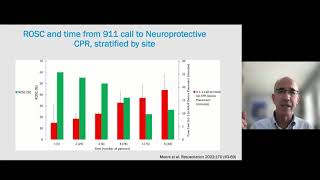
He was inside the Eliguard, as it were, the patient positioning system and the Lucas was performing cpr. When we realized what they had done, we realized that they had really developed a way to rapidly deliver neuroprotective CPR akin to rapidly delivering an aed. So we said, how the heck did you do this? Well, they did it in their own very simple way. They took all of the technology needed for first responder BLS providers, bag valve mask, HEPA filter, itd, supragliatic airway, and they had a positioning system. They wrapped it all up, they bundled it together with a chest compression system and a defibrillator and they're off and running. It just required in this case, two people carrying three devices. Not the whole truck, not half the truck, not the drugs. Simply focusing on the first critical five minutes of cardiac arrest. We step back and say, wow, this is amazing. We haven't looked at the registry data which we've been collecting from the very beginning to see whether or not time to neuroprotective CPR is important. My colleague Dr. Joanna Moore from the University of Minnesota and Hennepin Department of Emergency Medicine has been collecting data and ahead of CPR registry. Now along with Dr. Kerry Bacista, Dr. Pepe and others, we looked at that data. That data resulted in a paper. Faster time to automated head up CPR increases the probability of spontaneous recovery. What we observed was a striking relationship. Red is the time from 911 to the start of neuroprotective CPR or the head of CPR device surrogate. And ROSC is in Green Site 1, which was the Dyna Minnesota could get there rapidly. They did what I just showed you with that backpack approach with a BLS backpack and they had a 60% ROSC rate. And they've had a 60% ROSC rate actually ever since they implemented neuroprotective CPR in site six. The head of CPR device was delivered by and large by a late arriving EMS supervisor or by ALS crews and their rostrates weren't nearly as good. So we learned from this, the criticality of time to placement of this technology. But there's another element as well here, and it has to do with the pit crew approach. Paul, you want to comment on that?
I think what's this? In some respects, when I first heard about this, I'm going, well, duh, it's like in an aed, the faster you get there, the better off it is. But on the other hand, we've also learned over the years, if you don't get things done quickly on scene, that also compounds things. So it's one thing to get there from the time of your 91 call in seven or eight minutes, which is, I think, the average, by the way, which we should point out later on. But then when you get on scene, how long does it take you get it done. Using this pit crew approach is important. So it's not just remember, response time is just a surrogate variable for how fast you get the therapy done. And in this case, they really proved it and they've improved upon it. So I think that's, you know, the second point about this, Keith, is that this is not an ALS function. Your comment I thought was really good. What you said. They didn't require drugs or anything. This is a basic life support function that anybody could do. The neighborhood fire truck, it could be the lifeguard in the future or someone in the emergency department setting it up, whatever it may be. I think that's what the important thing is. This is a BLS function now and anybody could do it. And, you know, all these devices are neuro. They're FDA cleared. You could do it tomorrow, you know, so that's great.
I appreciate that. And I think it does take this PITCU approach. Now, these sites range from Edina, Minnesota, Anoka County, Minnesota, Little Rock, Arkansas. We had Germantown, Tennessee, Palm beach county and Miami. So we took data from these sites to that collected high quality data, including time from 911 to EMSCPR and time from 911 to the patient positioning device, the ELIGUARD. And we said, okay, how good is that relative to high quality conventional CPR controls? And that's the essence of the paper that I really want to focus on for the next few minutes. This paper just came out. In Resuscitation. You can see the Paul and Ken and Peter and Armando and all these folks who, you know well participated in this evaluation. What we did is we took those 227 patients and we matched them with a relatively sophisticated statistical approach called propensity score matching. We matched the patients that had the neuroprotective CPR with a four to one match from controls from three high performing studies or the systems with high performing studies with high performing systems. And so you can see this in the next slide. We took the ROC prime study and NIH study with over 8,000 patients. The Rock ALP study was just a VF study, also NIH study with over 3,000 patients. The rescue trial, which compared active compression decompression with an impedance threshold device to conventional cpr. And we took patients from those three studies and we matched them with the ACE CPR registry or the Automated Control Elevation CPR Registry. You're going to hear me flip back and forth between HCPR neuroprotective CPR and head up CPR because the language is still being resolved. But at the end of the day, we had 222 patients that were matched really well with 860 patients for age, sex, witness, rest, bystander CPR, EMS, witnessed rhythm and 911 to EMS CPR. So all those key variables that we know are critical to outcomes we match, what did we find? We found that we can match them very well. Here are the variables on the left, the characteristics I just mentioned, including rhythm. And you can see that about 18% of the patients had VF. About 41% had bystander CPR. 43% were witnessed. Most were male, average age about 65. The results were actually extremely exciting, which is why Peter and others asked me to talk today. This is a bit of a complicated slide, but I'll walk you through it. 911 call to start of neuroprotective CPR. That left column, CCPR is conventional CPR, NPCPR, neuroprotective CPR. And the odds ratio is the likelihood of a benefit if it's positive with neuroprotective cpr. Let's just say you got there quickly in less than eight minutes and you started this whole approach, which is what they did in the case of Wayne Kiewicz. Then you would see that in the control group exactly matched, there's about a 7.5%.
Neurologically intact survival versus a 30% regardless of the presenting rhythm. And that's really important. As Paul talked about, duh, this is like an aed, except for duh. This is also something that can be used in all rhythms. That 30% is all rhythms. If you get to applying this technology in less than 11 minutes, you have a three times higher likelihood of neurologically attacked survival. 22% versus 8%. And it was statistically significant up to less than 18 minutes. Which means that most systems in Florida, most systems across the United States could benefit from neuroprotective CPR if it was applied by first responders. So another way to look at these data is in a more conventional way. So if you just plot the percentage of patients with good neurologic outcomes against time to the neuroprotective cpr. And the gray is a conventional match control. So the patients in gray had the exact same characteristics as the one in red. At any given point in time you can see a profound benefit up to 18 minutes with the head up CPR treatment. Now this is all patients, the VF patients. It was actually quite amazing. You had a 50% neurologic, 50% hospital discharge rate and these patients did well neurologically if you get the technology on and get it started in less than 12 minutes. What about the non shockable patients, the 80 plus percent? This is what we saw here. We saw about 8 to 10% survival, the hospital discharge if you had a non shockable rhythm compared to controls. We've not seen this before in any of our clinical trials, but one could argue that there aren't enough patients, just 227 patients. Dr. Moore, Dr. Pepe, Dr. Bacista, Dr. Antevi, all of us have continued to enroll patients in the registry and we've enrolled patients and most recently we've looked through 2021, December 2021 to say what were the outcomes if you took the patients just from sites that apply this early. Now the data you're looking at right now is from all sites early or late application of neuroprotective cpr. But suppose you had sites that just said our protocol is first in deploy rapidly. Well, there were five such sites and they had about 460 plus patients. The site that I'm going to show you first is Edina, Minnesota because they have some of the best outcomes that I've ever seen. This is a town, about 50,000 people a little to the west of Minneapolis. For six years from 2013-19 they used Lucas and the ITD alone with a 12.5% overall survival rate and Utstein bystander CPR 47%. These are witness patients with a VF arrest and they got bystander CPR. They implemented neuroprotective CPR and over the last two years overall survival, all rhythms, all patients, 18 plus percent survival with an amazing Epstein bystander CPR rate of 77.8%.
But what about if we just focus for a moment on the 80% of patients that have not ever had a shock because they don't have a shockable rhythm. I'm going to show you some data that Dr. Pepe and Dr. Bacista are going to be presenting in October and November at the American College of Emergency Physicians and the AHA Resuscitation meeting now. And just as a little preview. So non shockable rhythms from the sites shown on this slide compared to conventional CPR from these high quality EMS performing systems from the NIH studies matched in this case for the same thing. Age, sex, bystander CPR, widdhn duress time from 911 to EMSCPR. Now as an electrophysiologist I often like to say this is a back of the room.
Finding. If I'm standing in the cath lab and I see somebody with flat line, I don't have to get up close to the monitor. I know what to do. If I see somebody with a heart rate of 250, I don't have to be up close to the monitor from the back of the room. I can make the diagnosis from the back of the room. The slide is extraordinary. Survival at hospital discharge. If you can apply neuroprotective CPR in less than 11 minutes or less than 16 minutes gives you a profoundly higher survival with favorable neurologic function rate compared to conventional cpr. This association was even stronger for good neurologic function as shown in this slide.
In the interest of time, I just want to conclude by saying that neuroprotective CPR enhances venous return from the brain, lowers icp, helps preserve brain function, we harness gravity to get venous blood out of the brain. We have to overcome gravity to pump blood uphill and you can't pump blood uphill with a pair of hands. So please don't try to do this with a pair of hands or a jerry rigged system. You can hurt somebody potentially or if you do it as they have done in these multiple early adopting systems, they've helped a lot of people correct and rapid initiation of neuroprotective CPR is associated with improved survival outcomes regardless of the initial rhythm after hospital cardiac arrest. Thanks so much Peter for giving this opportunity.
Keith, that was just an incredible talk. This is something that I think many of us around the state really want to do. We're very fortunate that we have a friend of EMS up at the state level and he happens to be on this call. So Dr. Shepke, I'm going to pitch it over to you so you could Talk about perhaps what the state of Florida is doing to make this type of technology available to people like us down on the street level.
Sure.
Thanks.
And Dr. Laurie, thank you for a fantastic lecture and for all the innovations. I have to say that you've really made such an impact in the field of cpr and these are probably some of the most important advances we've seen in at least a half a century. So for those of you here in Florida, we just put out, using grants from the state, dozens of these things around the state. So if you're interested in getting this technology first, let me tell you, there's definitely a learning curve. You have to do this as one of the first steps. The device is a bit large, you have to look at storage, but it works. So if you're serious about trying to put in something to improve your out of hospital cardiac arrest, this is definitely something I think you should be looking at. And keep in mind that we can help. We do have our matching grant program and we also have other monies towards under our fiscal year, each year that we can use on things like this. So our next matching grants program will come up October, November range will come out and you can apply for some of that money from our EMS trust fund. So we can get you this equipment if that's one of the things that you're looking for.
Back to you. Awesome. Thank you so much, Ken. This type of technology, in my opinion, and Paul alluded to it earlier, needs to be put in by the people who get there first. And that could be police department, that could be the fire response who are coming in as a BLS response first before the tiered response of the ems, the paramedic coming in later. So kudos to what you for what you've done and just thank you so much for coming on our webinar today and just discussing this amazing paper. And thank you for all you do for this profession.
Appreciate you, Peter. If I can make a kind of a final comment. This is going to be incredible that we are able to get back asystole patients. And I think it's going to be when I present the data in October. You'll see it's pretty impressive what we found with asystole cases along let alone the peas those are, those were a little easier to get back. All right.
I think to your point, Paul, it's good to finally have something that'll move the needle. Right. For years we've been doing the same thing and finally we can do something better.
This is really is going to move the needle. So nice comment, Peter.
So I want to thank everybody for this opportunity today to share this exciting data, much of it generated in Florida. And I look forward to continuing the journey with everyone. So thanks so much.
Appreciate it. Thanks for coming on the show, Keith. We really appreciate you.
More from Peter




Melissa Olen MSN, FPN-C, CCRN: Sudden Cardiac Arrest Training in Schools (Project ADAM) 4/25/25



Pediatric Hospital Readiness: How Teamwork & CPR Metrics Drive Better Outcomes



Chelsea Kadish, MD & Kyle Goodknight, EMT-P, RT: Pediatric CPAP in EMS (3/14/25)