Nikhil Williams NRP, FP-C, C-NPT: Ketamine for Refractory SE (12/15/2023)
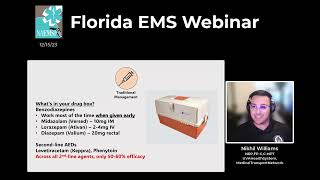
Nikhil Williams, a critical care paramedic, reviews ketamine as a treatment for refractory seizures that don't respond to standard drugs like benzodiazepines. Ketamine blocks NMDA receptors and may reduce the need for intubation and vasopressors. Current evidence is mostly case reports and animal studies; RCTs are pending to establish its role.
Questions this video answers
December 15, 2023.
Nikhil (Nick) Williams — critical care paramedic, University of Virginia.
Peter Antevy (host), Dr. Paul Pepe, Dr. Ken (Ken Schepke) Schepke.
About 3 million people per year.
About 10 to 41 per 100,000 per year.
Chapters
Welcome, everybody. We are on December 15th. It's a Friday at 11:00am Eastern Standard Time. And very exciting talk today. Nikhil Williams, who is a flight medic. When I saw this paper, I was super excited to see it, number one, because it deals with ketamine and anything dealing with ketamine we love. But the fact that he actually wrote a paper with his colleagues on refractory status is something that.
We feel very, very confident needs to be the standard of care. And you'll hear not just from, from Nikhil, but at the very end, we're going to bring in Dr. Pepe and Dr. Schepke to talk about the, the paper that the ink is still drying and we're looking forward to being published very shortly. So without any further ado, Nikhil, thank you so much for joining us.
Yeah, absolutely. Thanks for having me. Take it away. All right, so my name is Nick Williams. I am a critical care paramedic from the University of Virginia. I also write for St. Fisher's Church of Evidence Based Medicine on Facebook. About three, four years ago, we really started to get interested in ketamine's application for refractory status epilepticus. I actually had a patient when I was working for Inova Children's Hospital in Northern Virginia where I was ordered to administer it, had no clue why I was giving ketamine for a child that had seized through 3, 4, 5 different antiepileptic drugs. And that kind of led me down a rabbit hole to where we are today. So me and some of my colleagues, John Friedman, Lindsey Morgan and Jeff Siegler, published our findings recently in our medical journal. And we're just going to talk about that today. So of course, some disclosures, these opinions are my own. They don't reflect the University of Virginia Health System or the or the university and the patient population we're talking about here. So it's not a small amount of people in the United States experience seizures. We only have about 3 to about 3 million people per year are diagnosed with epilepsy. And that number grows yearly. Of those 3 million, we know about 10 to 41 per 100,000 are going to end up in status epilepticus at some point that year. Particularly with children, there's a much higher number of children that'll end up in that status state. And of the children and adults that go into status, 29 to 43% end up in refractory status epilepticus. And then we also have supra refractory, which is even a lower sample Size. For EMS providers, it's important we consider these numbers just because many times when we get dispatched for a patient who is having a seizure, oftentimes we arrive and it has already stopped. Most seizures will stop on their own. It's the seizures that persist that we should be fairly concerned about because they have a pretty high chance of proceeding into status.
So when we start discussing where ketamine kind of falls into these algorithms, there's really kind of five things we have to discuss first before we get into the data. The first of them being when seizures manifest, why they happen. It's important to note that any seizure has some sort of underlying imbalance before symptoms will manifest. So we're going to have some pre excitation of neurons. This can be from hypoxia, hypoglycemia, trauma, sepsis, any sort of underlying congenital malformation. There's any number of things that can elicit this pre excitation of our neurons, where glutamate, which is our primary excitatory neurotransmitter, is going to be primed to put the body into that convulsive state.
With that pre excitation, we're then going to have a lack of inhibition. Either the excitation will overpower our inhibitory neurons, or we're just going to have an inadequacy. This can again be to any number of factors. But our. Our primary inhibitory neurotransmitter is going to be gaba. Anytime there's this imbalance, eventually we're going to get to the point where there's a small discharge from one isolated area and one of two things happens. Either that becomes a depolarizing synchronization and we manifest into partial seizures, or maybe focal absence seizures, or we get really large unsynchronized bursts of activity across multiple regions of the brain. And that's what's going to kind of manifest more as our generalized seizures. That is, EMS providers are more used to seeing ultimately the stimulation is going to progress until those symptoms manifest. But there's kind of a sixth part, and I think this is where as EMS providers, we kind of have to step up the education and making sure that we understand that the longer a seizure goes on, the worse this imbalance is going to get between GABA and glutamate. And the worse that imbalance gets, the less effective our frontline medications are going to be as that seizure activity persists. So when we talk about this kind of excitatory inhibitory pathway, gaba, glutamate I like to think of it as the throttle and the brake. I think that's the, the best analogy there is. So when we talk about the excitatory pathway in glutamate, this is the gas pedal in your car, Glutamate is what's kind of propagating the seizure activity. It's propagating that electrical activity from one neuron to the other. And GABA is kind of pressing on the brakes to kind of make sure that we don't do anything crazy. It's there to prevent the vehicle from running from us. It's there to guide us in the right direction. When we look at our, our action potential over here and we see this resting membrane potential and then the depolarization state, GABA and glutamate are what are maintaining that balance. And that balancing act is what allows us to really operate normally. But when that imbalance manifests due to illness, that's where we start to run into problems. When maybe the throttle overpowers the brake or the brake, maybe it's not doing its job.
So traditional management, of course, the first thing is we need to recognize a seizure is happening for us in the pre hospital environment. You know, when we're called, we don't know necessarily what's going on until we arrive on the scene. So really it's kind of up to the bystander to really identify a seizure is occurring and contact us on our arrival. Of course we're going to go into our ABCs, you know, suction the airway, position them, you know, maybe get some oxygen on while we're getting our medications drawn up. When we're finally ready to administer our first line medications, we want to be giving those within the first 15 minutes of the seizure. For EMS providers this can be challenging. Particularly our rural providers, if a patient is seizing and perhaps entering status and we're still on the way to them. That can really make things challenging for getting our first line medications on board within a recommended period of time, if a seizure continues to persist despite adequate administration of our first line agents, we're going to go into what's called an urgent antiepileptic drug or a second line antiepileptic drug. The nomenclature is used interchangeably. Generally this is between 15 to 20 minutes of now kind of battling these seizures. Generally after two doses of a first line drug. If those have been ineffective, we should be moving to another option at that point, if a seizure is still refractory to now a first and second line agent, now we're kind of Entering, you know, those super refractory seizures and, and we're really kind of getting into the weeds of what medication comes next. At any given time during this management, we should be addressing underlying causes. So perhaps there's some hypoglycemia we can correct, perhaps there's some hypoxia. This is a pregnant patient. Of course we can first administer a first line drug, follow that up with some Mag sulfate. If this is an eclamptic seizure at any given time, we can address those things. But it's important to note that all seizures when we encounter them, we should be rapidly giving our immediate antiepileptic drug or first line agent. Those first line agents for most of us are benzodiazepines. In some settings, particularly with young children and infants, we may see barbiturates. Our second line agents are going to be phenytoin, fosphenytoin, levotiracetam or Keppra. Again, maybe you'll see some barbiturates and valproic acid. These are kind of the four big ones we think of when we think, okay, well our benzos didn't work. What's next? Our third line agents are where again, things kind of get dependent on where you are and what you have access to. But Keppra is also considered a third line agent. This is where propofol starts to come in. While not necessarily strongly recommended as an antiepileptic, at sustained anesthetic doses, it has anti epileptic qualities. And then again, we're looking at that valproic acid. But in the last few years, what we found across multiple trials, specifically these three ESET Concept and Eclipse, is across all second line agents that we have for seizures. Particularly when we're talking about Keppra and phenytoin, we really don't have one drug that works better than the other. Across all of them, they're only about 50 to 60% effective in the rates we administer them. So there's not really any strong recommendation for, of what drugs we should be giving as second and third line agents as it is. What we do know is that our first line medications, primarily benzos, work really well when we give them early. So I'm not sure how many of you still have the old school tackle box here. Some areas around me still have it, but around me we, we tend to carry Versed in these tackle boxes. I think most EMS agencies around the country generally have either Ativan or Versed as their first line benzo. Versed seems to be favored more given that it is more successful when administered im. The data shows that these doses of Versed, Ativan and Valium generally have about the same level of efficacy. Some patients with persistent seizures and routine breakthrough seizures will often have what's called a diastat or a home emergency diazepam to administer rectally. Some places have begun to move away from this. There's some auto injecting IM rescue medications now for epileptic patients. We're starting to see really kind of come into the pre hospital realm, but for the most part you may still see a diastat here or there, but that these may be things we see as EMS providers as we arrive on scene, we get into our drug box, we drop our versed, we give it, okay, well maybe the Versed didn't work this time and now we're left wondering, all right, well, do we just keep giving doses of Versed or do we start to transition into a second line antiepileptic? Well, seldom do we have them. Of the second line epileptics that I personally know of existing in the field, I know Keppra is carried by some agencies, phenytoin by even less. But in my interactions with most EMS providers, they aren't necessarily equipped with second line ample antiepileptics. It's kind of a rarity.
So for our pre hospital challenges dealing with all these different things, in addition to having some limitations on medications we have access to, we also have some limitations that aren't necessarily seen in the hospital. It may take us a while to arrive to this patient. The median ambulance response time in the US is seven to 14 minutes. Of course, if you're in a rural area, that may be greater. If you're in an urban area and traffic conditions are bad, it may be greater. These are all things that can affect a delay in care on this patient who's experiencing a seizure. Time estimation is actually something that data has shown pre hospital providers are pretty, pretty poor at. Not necessarily because we don't know how to do it. It's more so because we have to rely so much on bystander data as well as all the other influences of what's going on on a scene. It can be very difficult to pin down. When did the seizure start? How long did that seizure activity continue? Did it stop? What was the length of time that it did stop? If it restarted? It's difficult to quantify all of that while you're also trying to do patient care in a pre hospital environment. When we start to run into medication limitations, we start to deviate from the established recommendations from societies like the American Epilepsy Society or even various protocol regions. If we aren't equipped with second line agents, a lot of times we end up readministering the first line agent multiple times. This can is both a deviation from what we are recommended to be doing, but it's also a delay in escalation because if we don't have those second line agents on hand, perhaps we're delaying what would have worked if we had had it. And the last thing is kind of mitigations of adverse effects. You know, benzos and other other antiepileptic drugs are not without any sort of risk. Many of them are CNS depressants. They are associated with hemodynamic and airway collapse and high doses. So we really want to be cognizant of that in the hospital. Speaking more towards the ER, a lot of data in the last five years has come out showing that when EMS is bringing patients into the ER, especially those that are still actively seizing, there's about a 30 to 50% of cases that'll as well deviate from these recommended standards. Those standards being, you know, one to two adequate doses of a first line rescue medication such as a benzo. And if those first one to two doses don't work, or it's been about that 15 to 20 minutes, at that point we really should be escalating because in after we give one to two doses of a benzo, if it hasn't been effective, it's probably not going to be effective after that 15 to 20 minute mark as that imbalance between excitatory and inhibitory influence persists. Many of these patients that arrive at the ER end up getting three to five or more doses of a benzo before there's ever an escalation to a second line agent. And what we're finding is EMS providers may administer one to two doses of a benzo, but when they arrive at the er, they may be, you know, getting this reset of the algorithm where now the ER is giving another, you know, two to three doses of a benzo and before escalating. And to me this really kind of shows there may be a poor impact of EMS handoff reports. When, you know, providers in the hospital get a sick patient. It can be very, excuse me, it can be very difficult to really understand and cognizize what those EMS providers are saying. Adjust your care plan around it. Send someone over to the Pyxis or whatever box in the ER is going to have that second line Medication. Having the nursing staff and the support staff that are aware of these second line escalations and when they should be advocating for it. There's a lot of backend logistic work that needs to happen. And with most of the challenges we're facing in both the pre hospital and ER environments these days, it can be difficult to have staff on hand that are acquainted with these processes or even have the time, given the patient load, to have all this cognitive load. So we really need to make sure that even in the ER we have more readily accessible second line agents to kind of prevent this delay in care.
So the name of the game comes down to these four items. For me, this is kind of what we identified in our research when we started looking at ketamine is number one. We really want to prevent any delay in care or any delay in escalation of that care. We want to promote adherence to the recommended algorithms, which is one to two doses of that first line agent. No more. Let's go on to the second line medication. Repeated dosing of that first line medication, primarily benzos, has a pretty high association with adverse effects, primarily airway collapse as well as hemodynamic collapse. And above all, we want to mitigate the time seizing. The faster we get those seizures under control, the better. And enter ketamine. This is where it starts to get interesting. This is where we really were kind of shocked by the data that currently exists. But we also identified some limitations. So when we start to look at the seizure pathway, this is a figure from our recent publication. When we look at the top, at the orange neuron there, that's an excitatory presynaptic neuron. As the depolarization comes down that neuron, it's going to release glutamate into that synaptic cleft. That glutamate is going to bind to NMDA and AMPA receptor channels. It's going to propagate that positive electrical charge by allowing cations to then move into a postsynaptic neuron. And that will increase the membrane potential in that postsynaptic neuron, allowing that next to polarization to go off. This is what propagates our electrical activity on the right, the green neuron. This is our inhibitory neuron, our GABAergic neuron, if you would. GABA is going to bind to a GABA A receptor channel and take negatively charged chloride and allow it into that postsynaptic neuron, keeping the charge down, preventing that depolarization. When we look at where our medications work, overlaid on this figure, ketamine is going to work on that red number 5 by binding to that NMDA receptor channel, and it's going to prevent any further movement of cations through that channel. If we go back to our analogy of the throttle and the brake, while GABA is putting the brakes on the seizure and our benzos and barbiturates are out here making sure that we're trying to slow down that electrical activity. If we think of when we're giving ketamine or other second line agents, we're kind of doing a flanking maneuver. Now we're addressing the throttle. So when we think about slowing a car down, we want to hopefully first take our foot off the throttle and then put our foot on the brake. You know, if we're addressing seizures, we should be trying to do the same thing if they remain persistent. So we want to make sure that we're addressing a different part of the seizure pathway when we're medicating our patients.
So when we look at the data, and I believe I cited some data from Shepke, who's here, I'm excited to talk with you about it. But in what we first found was in 2015, there was this big major review that was done looking at a large amount of Data. It was 20 plus years of data across animal studies, observational findings, case studies, a couple of retrospective studies, and that have been done prior to 2015. And while they found that there was enough data to say that ketamine's anticonvulsant effects were well defined, there were almost no studies detailing any sort of dosing ranges, no studies detailing any sort of, you know, ill effects, adverse effects. This was all prior to a lot of research on ketamine coming out for other uses such as pain control, you know, sub associative dosing, ptsd. Ketamine has such a wide range of research tied to it now that we have a much better idea of its, of its effects and we have a much better idea of what it does at different dosing ranges. And 2020 is where we start to see a lot of the retrospective data really pick up. So in across a number of studies in Neuro ICUs, we see that the trend with ketamine is either a decrease or complete cessation in seizure activity when given as a third line agent. Very few of these studies are addressing ketamine as a second line agent. There is a pre hospital study from 2020. This is Shepky's study. Actually. It was a small sample size, 16 patients, but they were Administering ketamine following an initial dose of a benzo and they actually had a 93% cessation of seizures with that approach. Granted a small sample size, that was really exciting data to find.
Looking at further studies, the trend in the ICU setting was fairly consistent. We had decreased need for vasopressors, cessation or large decrease in seizure burden. And we really had a mitigation of adverse effects that would otherwise be associated with other drugs such as Keppra or further benzos.
So the data we have now, you know, we found about 6,970 articles that we thought were very, very positive and promising showing ketamine for this purpose. It's primarily comprised of retrospective observational animal data and case studies. What we lack right now are RCTs. In these studies, rarely is ketamine given as a second line. However, it was routinely given as a third line agent. We know that when infused at an anesthetic dose, the rates of seizure termination go up substantially. We also found that there was very few adverse effects. There were a couple instances of hypertension, a couple of tachycardia, one. Across everything I read, I found one instance of delirium with these patients. None of them required medication and they all self corrected, which is again very promising for an EMS provider perspective. And we didn't have any change in icp. So this is a pretty promising safety profile. I think it really speaks because ketamine will release endogenous catecholamines, but it does have some myocardial depressant effects in patients who are catecholamine depleted. That said, we know that most patients who are seizing are actually experiencing a catecholamine surge in the initial 15 to 20 minutes of a seizure. So when we're giving ketamine to a seizure patients, I think it may be somewhat unlikely that they're going to experience immediate hemodynamic collapse that we would expect to see maybe with a sepsis patient or trauma patient.
So we know that ketamine really addresses mitigation and it has a lot of advantages for us. So it's got a pretty excellent safety profile for the EMS provider. We know it decreases needs for vasopressors, we know it decreases our need for intubation and for people in the pre hospital realm, many of us already carry it. You know, ketamine shortage right now aside, most of us would routinely normally stock it. There's really not a lot of re education needed. We're talking about a different route of administration at a relatively comparable dose to what we're already using it for. And it doesn't require refrigeration, which is another big plus, especially for departments that may be more rural or maybe are smaller and don't have robust funding to afford refrigeration units. That's a really, really big advantage. So it both, it kind of presents itself as an earlier available second line agent and I think that's where it's really headed right now.
So in terms of dosing, this is where again, with some rct, hopefully we will have more information. But it seems to me that based on the research we had, we know an anesthetic level of dosing is going to appropriately saturate those NMDA receptors. And to achieve that, we can get by with 2 to 3, you know, milligram per kilo IM, perhaps 1 milligram per kilo IV. Notably, we should be dosing an ideal body weight. We know that this is a lipid soluble drug. It'll act very quickly. If we're giving really large doses to patients who may be heavier, without consideration for ideal body weight, the risk of that, of those negative hemodynamic effects really goes up. So we really want to do our best to prevent that. In the hospital setting, we have studied a number of different dosing ranges. Anesthetic doses all the way up to 10 milligrams per kilo per hour have been studied. They really haven't shown any efficacy compared to the one to two milligram per kilo per hour range. I know when we first rolled out ketamine at my current place of work, we started with an infusion. We would start at 10 to 100 mics per kilo per minute, titrate up by 10 mics every 2 to 3 minute until cessation of the seizures. I work in critical care transport, so I have the luxury of having many, many pumps. For most prehospital providers, that may not be the case. But an initial bolus upfront given as a slow IV push I think would also be appropriate and accomplish the same thing. Notably, when we are talking about seizures that are persisting, we risk airway collapse the longer the seizures go on, independent to any of our interventions. So for agencies that have RSI or the E, which may RSI these patients, giving ketamine as the induction agent is likely going to be a valuable change in practice that may eliminate seizures while you're trying to take the airway. And some agencies have switched to, you know, a delayed sequence intubation approach, as it may be referred to, where they'll administer their induction agent prior to giving paralysis and they'll wait a couple minutes to see the patient's response. Some agencies, and I'll say anecdotally, I've had success with this with patients who are progressing into that refractory status. We've administered ketamine and actually been able to just kind of allow them to metabolize and not end up with an ET tube. So that's been a promising finding, at least anecdotally.
So now we kind of get to the, the sad side of it, which are our limitations. Of course, what we lack right now is RCT data. There are no systemic reviews right now. What we really need is RCT is on two levels right now. We need RCTs that address just ketamine being used as a second line agent. And then we need RCTs that will pit ketamine against another second line agent such as Keppra or phenytoin. So we don't necessarily know if ketamine is going to work better than other already well established and recommended second line agents. I think that the data is promising, that it may, but again, without that randomized controlled data, it's difficult to say definitively.
Once we kind of have those RCTs on both fronts of just using ketamine, following benzodiazepines and comparing ketamine to other second line agents. @ that point, with systemic review, I'm hopeful that we'll see some more routine recommendation and universal guidelines, perhaps from the American Epilepsy Society or even at a, at a regional level.
So if anybody would like to read more, this is my email. Please feel free to email me and I'm happy to send you a PDF of our publication. It's currently in press. I'm hoping it comes out in the next issue. But I appreciate you guys having me here and hope that this was a good presentation for you.
All.
Okay, well, we only have a couple minutes, but thank great presentation before Paul's got to leave. Paul, you and Ken are on. I know you got to go first, so Paul let me go first. But Ken really started this whole thing, this crazy idea, years ago. And that's the first time I ever met Ken Chepky when he was talking about ketamine. It's been a. It's been a great relationship ever since. But Dr. Pepe, you want to go first and then I'll let Ken end.
It? Yeah. The only thing I can say is that, that.
We'Re sort of. What I heard today is this issue about receptors and downregulation up regulations of others where ketamine works. Ken could talk about that a little bit better than I because he's one that came up with this. Being a brilliant biochemist himself. What I will say is that we do have a study in progress that's been going on for seven years. We have a lot of information out which I can't tell you about. But essentially what I'll infer is that ketamine is highly effective as a so called rescue drug. And one might even suggest that it could even end up being a first line drug for us if it is in certain circumstances like one someone got benzos before we got there, you know, like a kid from the parent in diastat or whatever or even the fact that the long, if they've been in status epilepticus for the long periods of times that he described in the talk just now that it may be that's where it's going to be more effective. At that point in time as seizures go on, the ketamine, you know, ends up being the drug of choice. One thing I have to say though is that the earlier the intervention, the better the results, just as everything. So it's going to be absolutely valves. Okay. But anyways, I think just for now the main thing is that one thing it would be kind of fun about our methodology, I want to tell you is that we actually looked at things that you'd be concerned about. Blood pressure, end tidal CO2 and oxygen saturation, glucose levels, do they have fever, etc. And then compare that before and after the ketamine as we I'll mention that in our study and you'll see it's going to end up being a very, very, very useful thing. We presenting Research Achievement Award just with the 20 patients that you heard mentioned before at the Society for Critical Care Medicine and had great neuroscientists in the audience and they said they look forward to seeing more patients and we have more patients and hopefully you'll hear from us pretty.
Soon. Okay, that's exciting. Thanks for sharing.
Awesome. All right, thanks Paul. And now let me bring on the man himself. So Ken, talk about ketamine, talk about this whole process and I mean this is the first paper that's ever going to be put out with this large data set with ketamine, thanks to you. So go.
Ahead. Yeah, thanks. And Paul's absolutely right. We, we can't specifically talk about that paper yet because of the embargo process. But so I'll just talk about how this began. You know, seven years ago, I had a paramedic call me and said, hey, doc, I got a patient. We've already given max doses of midazolam and we're still on route to the hospital. What can we do? And I'm thinking, well, what else we carry? And I was already aware of ketamine's effects on the NMDA receptor. And let me just say that without going too nerdy into all the biochemistry and pathophysiology of this, which is stuff I love, but makes other people's eyes glaze over.
I reasoned ketamine should work. And I said, you know what? I gave an over the phone order, go ahead and give him ketamine intravenously. And it worked. And that's when we changed our protocol right then and there. So since then, we have a whole lot of patients that we are going to be presenting that has significant amounts of data. But just to summarize it, just the vast majority of seizure medications, at least the frontline ones, work on the off switch, the GABA switch. Stimulate the off switch, turns off the brain, turns off the seizure. The problem that you present, you're absolutely right, is the off switches start to disappear. The longer you have a seizure, those off switches go away. So it's even less likely that the standard seizure medications are going to work the longer the patient's in the. In the seizure. But the on switch, the nnda, the excitatory switch, that actually increases the longer the seizures going on. So longer seizures going on, the more likely it's something that blocks the on switch is what ketamine.
Does.
Absolutely. So if you block the on switch, that's the same as an off switch. And that's basically what I reasoned seven years.
Ago. Hello? Can you guys hear me? I'm.
Sorry. It sure looks like that's. That's what's going on.
So I would tell you, if you already carry ketamine, it does have a great safety profile. We had good experience. And you'll. You'll get to learn more about our experience, which will probably be the largest street hospital study on, on this particular topic.
Today. Yeah, I'm excited to read in your. I'm absolutely with you there about the whole neurochemistry. It makes other people's eyes glaze over. But for me, it's. It's fantastic. It's the.
Best. All right, well, Nick, great, great presentation. I'm going to give you the last word. So you have a lot of people. This is probably the most people we' ever had on a Friday webinar. So congratulations on that. I'm going to give you the last word. What would you tell folks who are listening to you today who have ketamine, who don't have ketamine yet? We all obviously treat seizures. Give us your final word and take us.
Away. I think that like any drug, it's only as good as the education we put behind it. It's certainly promising and I'm really excited to see where it goes. But if it's all you've got and your benzos aren't working for you, I think that if your medical director's on your side, it is a great tool to have in your.
Toolbox. Well said. Well said. And hopefully everyone takes that to heart. We are happy to share our protocols. Our protocols mirror what the dosing that Nick put up there. So if anybody wants our protocols, please let us know. And let's see, we've got a couple of comments here. Andrew had a patient refractory to Versed, turned out had a brain tumor. Would ketamine still be a good option? So thoughts on that? And we actually have a case on this. But Nick, what do you say about.
That? I think absolutely, of course there's nuance based on, you know, we don't necessarily know what type of tumor it is, where it's at, you know, but I think for, for any patient that's really ultimately failing to respond to first line benzos in the absence of any other drug, and perhaps even if you have them on hand, ketamine may be what ultimately breaks that seizure because again, it's addressing that other part of the seizure pathway which the. Those will.
Die. Yeah. And we actually had exactly the same case, remember? He's probably asking that because ketamine was thought to have an increase in icp, which has been debunked. And so ketamine would be a good. Would be good in that situation. We actually had a case for that. And Hellman. Yes. I will put, I will put my protocols here in the chat in the meantime for everybody else, thank you for joining us.
More from Peter




Melissa Olen MSN, FPN-C, CCRN: Sudden Cardiac Arrest Training in Schools (Project ADAM) 4/25/25



Pediatric Hospital Readiness: How Teamwork & CPR Metrics Drive Better Outcomes



Chelsea Kadish, MD & Kyle Goodknight, EMT-P, RT: Pediatric CPAP in EMS (3/14/25)