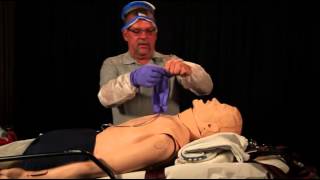
Jeff Meller demonstrates OG and NG tube placement for adults and pediatric patients. Measure from the xiphoid process to the angle of the jaw to determine insertion depth (about 50 cm for OG tubes). Verify placement by injecting 60 cc of air with a syringe while listening over the stomach, and use low intermittent suction around 20 mmHg to avoid gastric injury.
Questions this video answers
8 French
About 50 centimeters
About 55 centimeters
60 cc
Approximately 525 millimeters of mercury (mmHg)
Chapters
Hello, Jeff Meller here. Today we're going to talk about gastric tube placement. Palm Beach County Fire Rescue carries a couple of different types of gastric tubes.
On our adult sized gastric tubes we carry Salem sump tubes. A Salem sump tube is a multi lumen tube or a dual lumen tube in that when you connect this to suction and provide vacuum to this side of the tube. This is an air inlet to allow air in to assist you in removing the gastric contents. They are measured in size, French. And they also have markings on the tube that tell you depth placement, and that's measured in centimeters. We also carry feeding tubes. This one happens to be an 8 French feeding tube. This is for our smaller patients, our pediatric patients. And this tube is a single lumen tube measured in French. And these smaller tubes do not have depth markings on them. The indications for the placement of a gastric tube is any time that gastric insufflation impedes the patient's respiratory effort and or our ventilatory effort, patients in cardiac arrest or respiratory arrest that we've endotracheally intubated, placement of a gastric tube is a really good idea. A couple of the contraindications for gastric tube placement is patients with known esophageal disease. If they have a disease process called esophageal varices, which is basically varicose veins inside the esophagus. You would not want to place a gastric tube of any type because you may cause a rupture of one of those varicose veins inside the esophagus, which would cause massive hemorrhage. We also have the option of placing the tube nasogastrically or orogastrically. Nasogastric tube placement is contraindicated in patients with head injury, mid face injury or basilar skull fracture. As we may have fractured the cribriform plate, the patient may have fractured their cribriform plate. So placement of a nasogastric tube in those situations is contraindicated. Basically, if you can get a king airway in them or an endotracheal tube in them, if one tube will go down their oral cavity, then two tubes will fit down their oral cavity. How do we measure these? First we find the xiphoid process. We start with the xiphoid process. Here we go to the angle of the jaw or the corner of the ear. If we're going to place the tube orogastrically, we would take the tube and go to the corner of the mouth and hold it with our fingers. And basically you can see that the patient is measuring at approximately 50cm. We can place it here once again at the xiphoid process. Go to the angle of the jaw or the corner of the ear and go to the tip of the nose. If we are measuring for a nasogastric tube for this patient, it's approximately 55 centimeters. If you choose to place a nasogastric tube in an unconscious patient, you want to go and attempt to choose the, the largest nares. Generally speaking, Generally speaking, it's going to be the right nares. Your right mainstem bronchus is larger than your left and your, generally speaking, your right nares is larger.
Your right nares is larger than your left. Using full bsi. And anytime we're operating around an airway, we should be using sleeves.
Gloves and full facial protection.
So we're going to protect ourselves. Anytime we're working with an airway, whether we're intubating, placing a king airway, utilizing anything to do with an airway where we can become exposed is we want to protect ourselves at all times. So go ahead and gear up with the appropriate.
Equipment. Gowns are not contraindicated in this either.
And I would go ahead and begin to use full facial protection. Now, for the purposes of this video and only this video, so you can still hear me speak, I'm going to remove the full facial protection. And this is for the operation of this video only.
Once again, we want to size the appropriate size gastric tube. We want to measure it from the xiphoid process to the corner of the ear and then to the corner of the mouth. For an oral gastric tube for this patient, it's about 50 centimeters. I want to then go ahead, lube it with a water soluble lubricant. Patient is unconscious. I'm going to go ahead and stick my finger in their mouth. If there's no possibility that they're going to bite me, I'm going to go ahead and guide the gastric tube midline down the patient's esophagus and attempt to place the gastric tube down to the 50 centimeter mark. Once I place the tube down to the 50 centimeter mark, I would go ahead and attempt to secure it.
Put some tape.
Put some tape on the side of the patient's face.
Go ahead and take this tape here, separate it here.
We can use this split piece of tape to coil.
Around the gastric tube to make sure that it is secure. Take the other piece that we had split, go around the gastric tube and attempt to secure it.
So that it does not go deeper, doesn't migrate further down the esophagus or come out. Once we've secured the tube, we obviously want to check for placement. And with a use of a gastric tube, we have to use a special syringe called a tumi syringe. Tumi syringe is a cone shaped syringe. It's not the typical luer lock syringes that we're used to. With most of the needles that we use, we Want to withdraw 60cc's of air. Connect this to the suction port.
Not the air port, but we want to connect this to the suction port of the gastric tube.
Place our stethoscope over the patient's stomach.
And aggressively inject air in there. And we're going to listen for bubbling to make sure that we have placement, that we verify our placement with our gastric tube. If at any time during the insertion of this tube, whether it be a nasogastric tube or, or an orogastric tube, if your patient exhibits a cough reflex, immediately withdraw the gastric tube because you've entered the trachea with it. Once we verified placement.
With the gastric tube, we can go ahead and attempt to relieve the gastric distention. Now, currently, right now our department is using an Escort 2 monitor. As with our Escort 2 suction machine. Obviously, this is the on and off switch and this is a regulation or regulator for the volume or the amount of suction that we're going to create. When this button is in the in position, the machine is generating approximately 525 millimeters of mercury of vacuum. That's obviously way too much vacuum to be placing on our gastric tube. So what we recommend is that you pull this.
Step down or regulator device. By doing such, you've reduced the vacuum to 120 millimeters of mercury of vacuum. And we would go ahead and then connect our suction tubing to the.
To the.
Gastric tube with the use of the TP or the connector piece here. And we would go ahead and suction. We would go ahead and suction and reduce the gastric distension with this. A word of caution, general. Gastric tube suctioning is under the low intermittent suction, which is about 20 millimeters of mercury of vacuum. Currently, right now, with our Escort 2 suction units, you're generating 120 millimeters of mercury of vacuum with this. So you do not want to leave this connected at all times. You want to attempt to remove the gastric contents as you can. Once you're done with that, you want to go ahead and disconnect the suction unit and not apply continual suction to the gastric into the stomach. By doing this, you're going to cause ulcers to the patient's stomach. If you go ahead and connect the suction up and you're not getting a flow and you're sure that you've guaranteed patency after you place this, one of the little tricks is you can take this syringe here and stick it into the air vent and go ahead and squirt air, and that should get your suction, your gastric tube discharging, or gastric tube working properly. Once again, do not leave this connected to continual suction as our current escort monitor provides too much vacuum in the back of your rescue trucks. If you have a suction unit that has a regulator on it that you can turn the vacuum down, you want to suction at about 20 millimeters of mercury if you're going to do continuous low suctioning with this patient. The goal here is to relieve the gastric distension so that we can appropriately ventilate our patients while we're resuscitating. Thanks for watching.