Paul Pepe, MD, MPH: TXA and Calcium (7/12/23)
This is a YouTube discussion (Paul Pepe with Peter Antevy) on TXA and calcium use in trauma care. Key TXA points: evidence from CRASH-2/3, STAAMP and other trials supports benefit when given early (ideally ≤1 hour), with Paul Pepe advocating a single 2 g IV/IO bolus (bolus-only strategy) rather than a 1 g+1 g infusion regimen; later administration (>3 hours) may worsen outcomes. Pediatric dosing mentioned: 15 mg/kg. Key calcium points: transfused blood contains citrate which chelates calcium risking hypocalcemia; trauma itself can cause low ionized calcium. Calcium gluconate is preferred for peripheral IV administration due to lower risk of tissue injury; calcium chloride provides more immediate ionized calcium but higher risk of extravasation injury. Pepe leans toward earlier (prehospital) calcium administration using gluconate if it does not delay care.
Chapters
Without any further ado, I'm going to bring in Dr. Paul Pepe, who's been a mentor to me and many other people across this country in this field of EMS. So Dr. Pepe, can I have you share your screen?
Anyways, whenever I had to make a decision about what our protocol would be or what decision I would make in a particular patient on scene or whatever it may be, or in the emergency department, I'd always say if this was my family member, this is my daughter, if this was my brother, what would I do? And so, and this is, you're going to see, this is what I would do as we get along here, particularly with respect to txa. All right, let's roll. So as I call it transition to transaxemic acid. I was supposed to give this originally at the Eagles meeting and we never had a chance to get it but. And I was going to come on as Dr. Reddy Whipp there. So we'll see how it goes. All right, so disclosures, right? All the coffee beans. Columbia wouldn't make me a morning person. That's the only disclosure I have and I'm non essential as well. As everyone knows. We actually published on this with John Jew and John Holcomb a few years ago about non mechanical hemostasis and trauma. And that included various things, not only giving blood but also giving TXA as well. And we then later did an update on TXA and tbi. The bottom line here. And Jim Roach, who of course has been so instrumental down here in South Florida getting things going here with blood was on that with us. And bottom line was it really is, you know, it's. Nothing has changed in my mind since then and no other data have come up to change what I'm about to tell you. Okay, so JSOM published the GCCC proposed change in 2022 for 20 to 2020 to 22 guidelines where they said down the road the most significant updates to the guidelines are including significant traumatic brain injury as an indication for txa. And I will mention that today. And although we're focusing on HE patients and so on, this goes hand in hand with the hemorrhage guidelines as well. And the issue is to change the dosing as a single emphasize single 2 gram IV or IO administration. And then we're recommending it, you know, as a slow IV push. And we all have made different interpretations of what that is as we get along here. So this all got started with the Crash 2 study many years ago, published back first in 2010. The, the thing that's interest about this paper is that they, their protocol said that what they did was they randomized people within eight hours of injury and they had a loading dose of gram over a gram over 10 minutes and then one gram over eight hours. This is going to be the key point. This all got started because people would give a loading dose when they were doing certain cardiac surgeries or other types of surgeries back in the 60s, and then they would give this over the next period of time while they were still operating, etc. So the interesting thing is that that's what people have to apply to trauma, which we in retrospect think was not a good. So when you hear about me talking about the one plus one, I'm talking about one gram up front and then one gram over the next hour, several hours. In this case, you see here that they also went out to 40 countries and they actually found a difference. Now, the differences were very small in terms of the outcomes, but there was some positive difference. I'm about to tell you why they had some positive difference because in they gave. Just not to bury the headline, when they gave it very early on, that's where the better outcomes were showing up. But I'm going to show you that here right now. So overall they said, hey, we had better outcomes here. As you see for bleeding deaths, early TXA treatment is better. And on this side, this is better outcome versus worse outcomes on this part of the slide. And Peter, can everybody see this? Okay. Am I showing you right?
It looks perfect. Yep, Yep.
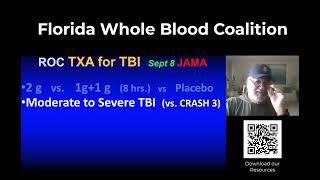
Okay, good. So this is the overall outcome. And that's the problem. People always take the bottom line, the yes or no line, without looking at the data and breaking it down. And so what happens is it turned out that if you actually. Sorry about that. If you actually got treated within an hour, look at this. Your chances of dying was point seven, you know, like 70, you know, 0.7 chance of dying over safe. It's a one to one ratio. You know, you're saying your chance of dying is only 2/3 of that of what it normally would be. And so, and so that's what pushes. But that means this is a balance of something else. Okay, and that balance of something else was, was that over three hours, if it was given late, you had worse outcomes. Now why would you have worse outcomes? And again, we're going to talk about that in just a second. Well, the worst outcomes is attributed to the fact that it's, it's a thing that causes you to clot. If you live long enough to have clotting associations, you'll have risk of problems. And this is what's interesting, is because at first many of the surgeons had been not accepting it, whereas military people were. Many our trauma surgeons weren't, because when they did the studies in the hospital in person, live long enough, they actually had more. They started seeing these complications. All right, so. And that's totally understandable. And again, where I'm going to be going to is that if you give it early, and I mean really early, it's. It's a good thing. There may be some complications, but you will have a better chance of living if you're in a position where you have to get this. It's that as time goes on and you give it later, then the risk benefit ratio flips where risk benefit is now much higher, etc. And that's going to be my main theme here. But I'll go ahead and give you some of the data. All right, so again, let's go back to this. If you give it here within an hour, and that is what made a difference. So which way do we go? All right. The really cool thing is that we started understanding this and right about that time, people like Dr. Marty Shriver, who did a study on head injury cases following one also that was called Crash three, by the way, which showed kind of similar results. It sort of, kind of, yes, is a little bit better, et cetera. But what really came down to when Marty did his study with the Rock Resuscitation Outcomes Consortium, he prospectively asked, we're going to see what happens if you had a person with a head bleed. In other words, if you later document they have a head bleed, let's see how they did in terms of their survival, et cetera. All right, that's Dr. Driver right there. So this study published again in the Jamaica, you know, overall didn't show a real significant difference between it because they lumped everybody together. And one of the things I'll tell you is that they lumped the one plus one grouping with a two grams right up front group. So everything was kind of mixed together in those two groups. You'll see why that becomes really important as we go along here. But when they did look at the specific thing of this 2 grams versus 1 place versus placebo. So they had the wisdom to look at this in terms of three arms. You lose a little statistical significance, but still 2 grams versus 1 plus 1 versus placebo. And they looked at moderate to severe TBI cases in this particular situation. What was interesting is the median Time, that means half the people got it within 40 minutes of the time of the injury. So that's pretty significant. And it goes along with the line of what I've been thinking, what the TCCC people have been thinking, that my mantra has always been the earlier the intervention, the better results. And this was getting pretty, that's pretty good to get it in half the patients with that period of time. So. And the other thing is that nearly 60% of the people later were found to have an intracranial bleed. And then of course that MEANT There was 44% without, which by the way is a nice built in safety cohort. In other words, they didn't have any bleeding in their head and yet they got this and didn't hurt them and just not the, you know, the jump ahead. It was perfectly safe to give it to them under these circumstances. They didn't have more complications or anything like that. So the overall results again were 65% plus versus 62% for the controls. But remember, the 60, the 65% thing lumps both the people with, with head injury without, I mean, sort of with it, with head bleed, without head bleed. And also it lumped in the ones that got the one plus one. You know, they put it, they just lumped them together in that primary thing. But when you examine those with ct, confirmed intracranial bleed target group, from my point of view, right, there was a 16% mortality with the 2 grams up front. Okay. And look at this. When you looked at 27% with the one plus plus one infusion versus 26%. So mortality rates were about the same for the placebo plus the 1 plus 1 gram versus the 2 grams up front. And this really started pushing me even further to being aggressive about, let's saying if it's going to be more than an hour, I may not even want to give it. Yeah. And certainly I don't want to give a infusion over, over the next eight hours. If this was my family member, this is how I feel at this point in time. There was a slight risk of more seizures, but you have seizures anyways. It's like they had 13 seizures versus eight seizures out of the 300 patients that were being examined.
But there was no other increased complications. They did fine long term. It was deemed to be safe from that point of view as well. Let's go back to this. What it really tells us is that this thing is what we need to concentrate on, the less than one hour thing. Early treatment, less than one hours is much better. And avoid going by the way, and avoid going here and particularly I'd like to avoid going anywhere out towards over an hour from my point of view. Right. So now when you look back at Crash three, okay, under that circumstance, same kind of stuff starts showing up that your chances are dying. This is like 60%, you know, there was 40% less. It was only 60% of what it normally would be. And especially if you got it done, this is treatment, you know, within the first hour here. This is minutes to treatment. So they did have a relative risk ratio that was much better if you get the earlier you gave it, the better off. You were in the rock study that I just talked about there, what was interesting, the early time listed, an hour to therapy with 2 grams improves the outcomes pretty significantly. And so that's what you see down here. Now this is a time in days, so we're talking about the hour thing is in here. But you can see this is extremely low when you get into this, you know, first quarter hour, half hour, hour period here, etc. It's all showing the same thing. This is the bolus only group, the 2 grams IV up front. And now here's your mortality rates out here with the placebo and the bolus maintenance group. All right, so when the stamp trial came out with Frank guy at and his group out there, same kind of stuff shows up. Favors, favors transact. They give one gram and then they give one on the arrival at the hospital, which usually generally there was within about an hour by the they pointed out to me and again all this stuff started favoring the, the, the trans examine group here. And the same thing, if the time from injury is less than an hour, they did better. And then if the blood pressure less than 70, obviously the people who are sicker, much better, et cetera. So better with higher dose, better with treatment within an hour and especially if you presented with hypotension. So anyways, when the article that just came out about a week ago out of, you know, you might ask, well, what do they find there? One of the interesting things about the patch trauma group, which is came out of Australia primarily.
I knew the results of this, by the way, about eight or nine months ago because they consulted with me and talked to me about it because they were getting ready to write the paper up and I said, before you tell me the results, I just want to know one thing. What was your protocol? And they said, one gram IV followed by one gram infusionator. I said, you're not going to find any difference or it may even Be worse for all I know. But and it depends, and it turns out only about 20% of their people got the drug within the first hour, by the way, in this study, let alone the fact that they did the protocol with a one plus one. There were no, there was not the two grams up front and as predicted, you know, it didn't show any difference of that kind of thing. So it was very, very interesting that it said right now I was able to predict what their outcome was going to be without them telling me, just based on that alone. So in summary for the txa, and I hope I haven't gone over too long here, Peter, is that there are better outcomes, but only if given early as a 2 gram bolus, as far as I'm concerned, it's safe if it's given early. And also it's likely good for all trauma, including internal bleeding and TBI cases. And then we can talk later about giving it for other bleeding cases, obstetrical and so on. But that's the reason why most of our protocols down here in South Florida do go this route. I know you mentioned San Antonio and there's so many others that's the same way we've been doing it, the same approach here and by the way, haven't seen any particular issues coming out of this that have been a problem that we have to note. Someone will have to clue me in if there is anything else to be known about here. So again, coming Back to it, 2 grams IV IO administration. Some people have asked me, by the way, about giving immigration and one of the things that a lot of us worry about there is, I guess it's better than nothing if you're in a tough situation where you're, for example, I don't know, pinned in, in a tactical situation, but your blood flow may not be so good, so maybe it doesn't absorb as well. You know, IM those studies are actually kind of going on. I mean they may already be published and I don't have the data, but that's one thing. The other thing is that places like San Antonio actually will give it early on. Just it's a logistical thing because as they're getting the blood up and ready to go, they want this on board as soon as possible. And we try not to mix the two. And so, and I think that's pretty much what I want to say about that for now. And then Peter, can you just add in TXA for kids? Should we not give it to kids? Should we give it to kids? What's your protocol?
Say.
You could probably guess that we do give it to kids. We treat them just the same as everybody else. Nothing magical happens when you turn 18. So, yeah, we give 15 milligrams per kilogram, and there's lots of data on that. And actually the data from the military demonstrates that TXA in children does have a positive impact and reduced mortality. So just like with whole blood, please have a whole blood policy or protocol for children. And also, if you're using txa, do not exclude the kids as well. So that's my two seconds on that.
So, Peter, you have a protocol, I think, starting around age five or something like that. How about if it's a three year old, you know, and they're bleeding, you know, and it's not good?
Yeah.
So accident on the beach, whatever, that kind of thing. Right.
The protocol allows for whole blood in all ages. It's just that. And we're. We're not a mother. May I call the medical director? Type of people? But for this particular thing under the age of five, it's just a call to the medical director. The dose is still in the app. And so, you know, before launching this protocol, I looked at five years of data from our children's level one trauma center. And in five years, we didn't have one child who needed blood in the trauma bay under the age of five. Although there are stories from other. Other places that do have that. So it's not that we exclude under age 5. It just requires a call, just so we're aware of what's going on.
And that's for TXA as well, though. That's what I was asking.
No, I. No.
Okay. I just wanted to ask that. All right. Does anybody have any questions of me? Do you want to.
Yeah, Paul, let's. Let's keep going. Only because we have a tight agenda. So if you want to, then we'll ask questions after you do the calcium.
Okay, good. I'm fine with that. I just want to make sure. If anything wasn't clear here, let me know. Okay, so, thanks. So, in conclusion, I think we're gonna get back more people than we did before. So how about giving that pre hospital with transfusions? So what I'm going to do is why would we do this in the first place? Two, should we use calcium chloride or gluconate? And what route should we use? IV IO IM. Pros and cons on doing it pre hospital vs in hospital. And then some of the general questions that we don't address so much today, but just to know There are effects on the heart phosphate levels, the microcirculation and various things that we have yet to explore. And there's even more things we're going to talk about in terms of trauma itself causing hypocalcemia. So let's go to the why. So the why is that things like EDTA or citrate, which are calcium chelators are used to stop the clotting, to store blood. If you take out, if you absorb up calcium, you actually create a more of a pro, you know, a less coagulated environment. So you can. This, these numbers might be wrong depending on what situation or what is. But let's. There's a certain amount of this, this stuff is added into it. So usually they'll give you 3 grams of citrate or 1.6 citrate plus some other calcium binder and that's. And then of course if you have to then break it down further like into RBCs, they might have to add let's say 40 mils more. So that's 80. And if you're given two packs of red cells then you might be g lot of citrate. And it can, it depends on the formulation. You know, like for example, if you're having one that lasts 30 days, you might have more if you have. So those are all things that are right there. And in fact I know Randy Schaefer, if you make like a 10 second intro, isn't that sort of the case from what you found is different? There may be depending on how long they want to store the blood for, there may be different dosing of these kinds of chelators.
Yeah, if it's CBD versus CPDA one and the first one is usually a 21 day life cycle and the second is a 35 day. I do not know enough about the difference, but I'd be curious to see if there is some. So I'm going to start looking that up.
I would just say that the main thing is be aware of this by the way and you might want to find out in your area, you know, you know what, what they're using and how they're using, etc. So just bottom line though, it doesn't matter. It's lowering the calcium and once you get to your bloodstream it lowers it even further. All right. And then also there's free floating citrate in your bloodstream. So and what happens if you're injured, you have a damaged or poorly, poorly perfused liver where it's usually metabolized. The levels of Citrates, for example, could go up and then you have toxicity from it in the sense of really taking out more calcium, etc. So you got the general idea is that you are at risk for it, but the interesting thing is that you actually can get it from the trauma itself. Now, I'm not absolutely sure why this happens. My personal belief is that it's related to the fact that when you get into an acidotic state, you're producing a lot of H positive hydrogen ions and so it competes with the calcium, may drive it down. And so as a result you may have. There may be other reasons that I haven't delved into yet. I'm just learning more and more about this. But even so, without giving the blood, you can find that you're hypocalcemic in some of the cases that we're talking about here who are at risk. So a concern. So more and more I've been thinking this is what we need to do. But what's the treatment? Should you give calcium chloride or calcium gluconate? Well, it turns out that in theory anyways, calcium chloride might be better because you get better free calcium ions out there right away. Or is that a problem? Actually, you know, could you affect other things? Because once you put calcium out there, you will affect potassium levels. You'll affect all sorts of other things as well. But probably in this case, because you're so hypoglycemic, de facto, whether you've had blood or not is probably, you know, it says that takes some of that worry out. But there also is a risk for sclerosis, meaning that if you get it into like a peripheral IV site and it extravagates, leaks out, you could cause really bad sclerosis in that area. And then, Peter, you have a case in which it was an injury to the leg, but they just try to. Did they give it into a vein in the leg or how happened. But I heard that there was cases where at some hospitals they had an amputated kid's leg when they gave this. And so as a result they switched over to calcium gluconate altogether. Is that right?
Yes, that was a pediatric patient and the child did indeed require an amputation. So they just.
Was it a leggard arm? I'm sorry, I didn't know about the amputation. I'm sorry that I didn't know that was just thinking badly leg. But it probably was arm right where they probably gave it.
It was a leg.
Oh, and they were giving, I. They gave the IV or whatever through the leg or did it.
I'm not sure if, I'm not sure if it was a central line or an IO, but it was right lower extremity.
All right. Anyways. But you know, theoretically, if you got a good ion, by the way, it's fine to give it that way. There's not a problem with this, you know. And then of course we have emphasizing femorals and humerals, maybe in adults. But here's the problem. Did you get it in? Did you get the right place? Will it cause a problem like we've seen here that we're not sure about? So there's a lot of questions out there about this. Okay. So bottom line is that when you look at the joint trauma system recommendations, anybody can look up here's their quick reference guide and I'll pull it up a little tighter. It says to prevent hypocalcemia related domestic transfusion, modern monitor, ionized calcium, administer it early, etc. But just jumping down here, it says that calcium gluconate is preferred for peripheral IV administration. In other words, that you really have to have a good central iv and if you're going to give it calcium chloride. So you may be saying that may be the way to go and it may be the preferred way to go under these circumstances. Okay. All right, so now what's the pros and cons of pre hospital? So most of us have thought, hey, let's just get it when we get to the hospital because we're only given a unit out there. But when you consider the fact that maybe you're just getting hypocalcemia from the trauma itself in these patients, maybe that gives you some pause and think maybe immediate treatment is good after all, versus the hospital arrival where you can get a central line in all those kinds of things. But one of the some people would cite and I don't know if David Miramantes or CJ could here could comment. This is that part of it is also you need an extra iv. So it's logistics and maybe it's the time issue and let's just do it later on or go in hospital and then in the hospital you'll have the ability to check for calcium phosphate levels, potassium levels and all that. And someone would say, by the way, there's no proof that that gives you a better chance of living. They give it pre hospital. I think there is enough data and we're going to send you some papers to say your chances if you let the calcium go, if you, if the persons have HYPOGLYCEMIA it's associated with death, so presumably treating it would be a good thing. But so giving it pre hospital, does it make a difference? We're not sure yet. But I'll tell you what, as I've learned more and more about this over the last few days, and I'm going to learn more and more, I'm leaning more and more towards giving it in that pre hospital setting if it doesn't delay things and using gluconate so we avoid all the other hassles that we were just talking about with the calcium chloride. So in conclusion, the answer is do give it pre hospital or don't give it pre hospital. And that's everything today, if you're giving it, like Eric Bank, I think is on the phone that you guys have been giving it for IV calcium chloride for, you know, years. So the bottom line is that you, you could give it and I wouldn't have a problem with it, you know, and if you wait till the hospital right now, I don't have a problem with it. Although I will admit, when we talk about which way do we go, I'm starting to lean more and more pre hospital as I always have.
More from Peter




Melissa Olen MSN, FPN-C, CCRN: Sudden Cardiac Arrest Training in Schools (Project ADAM) 4/25/25



Pediatric Hospital Readiness: How Teamwork & CPR Metrics Drive Better Outcomes



Chelsea Kadish, MD & Kyle Goodknight, EMT-P, RT: Pediatric CPAP in EMS (3/14/25)