Paul Pepe, MD: Respiratory Support During CPR (12/8/23)
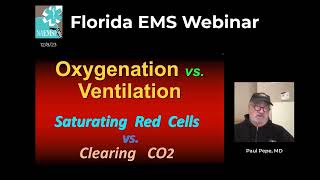
Dr. Paul Pepe explains why CPR needs bigger breaths, not more of them. Larger tidal volumes recruit collapsed lung zones and preserve venous return, while smaller breaths risk raising intrathoracic pressure and cutting blood flow. A Seattle study found patients ventilated with larger bags had better outcomes.
Questions this video answers
December 8, 2023.
Approximately 8–10 mL/kg (lab practice); larger intermittent inflations up to ~15–18 mL/kg noted historically without barotrauma in normal lungs, but 8–10 mL/kg recommended for CPR context.
Roughly one breath every 10 seconds (about 6 breaths per minute) in the scenarios discussed.
Study period 2015–2021 with about 3,200 initial patients (≈2,000 in a core analytic set mentioned).
Chapters
Alrighty. Welcome, Everybody. It is December 8th. We are in the final stretch of the year here in 2023. And I've been asking Dr. Pepe to come on and speak about this topic because everywhere we go around the country, we keep hearing people saying these things that clearly demonstrate a lack of knowledge of the physiology.
Actually, today, what I just posted on Twitter.
Was something that I said. Have you fallen into any of these traps? Used a small BVM in adult cardiac arrest, increased the ventilation rate to 20 to 30. Impedes hyperventilation equals over ventilation. GCS less than 8 equals intubate. I think many people around this country have fallen into those traps. And I wanted to ask Dr. Pepe to come on today and really give us a, you know, a nice framework which. How to think about respiratory support during cpr during severe hemorrhage so that we can start to educate our EMS professionals in the field to do the right thing. So without any further ado, Dr. Pepe, thank you for agreeing to do this. Take it away, my friend.
Okay, good. Thanks, everybody. So, I really appreciate, you know, and this is what I'm about to show you is not perfect or exact, but it's probably the best approach to things. And I've been doing this for years. And a lot of times people back. We were in the 70s in Seattle, they thought we were fudging our data, but I think what was happening, we were doing really good CPR and really paying attention to it, and we were ventilating people appropriately, as everybody would say, ventilation. You'll see in a second. I'll be talking about it in terms of respiratory support. So. And you'll see why as we get through this. Okay. All right. So with that, thank you. I thought for. Just, for first of all, you know, disclosures. Right. The only thing is I'm not a morning person. It's. I had a late night here last night. I'm in Las Vegas assisting one of the tourists here, and we got out late. And so this is like a few hours after I went to bed. So I hope I can be clear the other. I mean, there is a lot of heavy physiology, in a sense, and I'm going to try to make it unheavy, but I want to also. We may go into a part two, Peter, if I, you know, if I don't get through enough again, I'll try to keep track of the time better. Okay, so. So before I get started, I just wanted to say that most people probably know my background from the. My Seattle days there, working with the, the beginnings of the Medic1 system and doing training out the field, including respiratory stuff. And the thing what most people may not know is I started off really as an ICU doctor, so I was a critical care specialist. And then I did a. Because of my fellowships were very heavily.
I don't academic or what you want to say, research oriented. I did a lot of research in the laboratory and in the streets as well. And so as a couple examples of that would have been everything. Like I actually used, you know, mass spectrometers to measure oxygen consumption and CO2 production and in inflection points about how, you know, as you lower oxygen delivery, what happens, you know, so there was just a lot of heavy duty stuff in the laboratory. Then there were some clinical things like the concept of how I came across the thing of we call auto peep today, that cetera. And then later that kind of helped me lead to helping out with our, with the heart association and various other people about at least appreciation that, that you probably can get away if people are gasping, you can probably get away with just doing compressions only, et cetera. You know, some of the things you're all aware of under these periods. One of the things you may not be aware of is that for years I was treating people with hemorrhagic states. I don't say shock because I don't know how you define shock, but people who are in hemorrhagic states.
How just mild positive pressure ventilation with mild, even moderate hemorrhage can be really detrimental. And so we're going to talk about that a little bit today. If not, we're going to come back to this because I think it's worth, I think it's really worth repeating this a little bit. One of the reasons I put this picture up is that I'm still working in the laboratory. And one of the things we're looking at, for example, still is the effects of, for example, what tidal volume you choose, for example, on blood flow through the lungs. And we'll be getting into this in some detail. So I know there's, there's a basis for this beyond just, you know, being an EMS folks, but that's my job actually, was to take this stuff we learned in the laboratory into the streets and sort of practice that not only in Seattle, but then later here in Houston, as you can see. All right, and that brings us today's requested topic, the physiological approach to respiratory support on the streets. Okay, so I like this. Like most veterinary students, Doreen breezes through chapter Nine, which is, you know, equine medicine, taking care of horses. You know, broken leg effect is shoot, shoot, shoot. So we're going to kind of breeze through here, and I apologize, because if you don't get it all, I'll come back and talk to you or talk to individuals about this as needed. All right, so for the last, whatever, 20 years, there's been a focus on quality CPR. We've had the resuscitation academy and all that. But what's been strange to me is that there's not been a focus on quality ventilation, because these two are totally integrated, and most people don't appreciate that. And. But the. The term ventilation, people talk about it as quality ventilation. Well, but it really is quality respiratory support. And I'll show you why I define it that way in just a second. And Peter, is this going okay so far?
Are you. Peter's still there, baby. He's done?
Yeah, of course.
Yeah. Okay, go ahead. So make sure I'm not going too fast. I want to make sure I'm keeping my cadence okay for you all. So if you're going to still talk about quality ventilation or whatever you want to say, you need to ask the question, why do you need to ventilate? Okay, so in the cardiac arrest case or a trauma, you know, like a very severe hemorrhagic shock case, as I said, or hemorrhagic states, why do you need to ventilate? So the answer I typically get if I'm in an audience is to oxygenate the patient. Right. But here's what I'm getting at is that though they're intertwined, there's a difference between oxygen, what we need to do for oxygenation, and what we need to do for ventilation. And the reason why is that they are two physiological issues for me. Okay, so oxygenation is saturating red cells. That's your goal that you're trying to do from a pulmonary point of view. I'm not necessarily talking about cellular respiration, but from a pulmonary point of view, you want to separate out oxygenation, which is saturating red cells, versus, you know, ventilation, which is, for me, clearing CO2. So that's one of the things that I thought that was great what Peter brought out when he was talking about oversetta. Ventilation does not really equal hyperventilation. Hyperventilation for me is physiologically speaking, semantically speaking, but for me as a physiologist, means hyperventilation means you have a low carbon dioxide level in your bloodstream. That's what it comes down to. Or entitled, CO2. Whatever you. Whatever you want to say. Whereas hypoventilation is a whole different thing. It means that you're not clearing enough CO2. So what's a condition, for example, that you're breathing real fast, but you're not clearing CO2? Well, like a COPD, right? So you could be hypoventilating and you could be, you know, breathing fast or have, you know, or being breathed fast, and you may still have hypoventilation under those cases. So I don't interchange those words. I'm very careful when people say I want to avoid hyperventilation. So to me, when someone says that, I'm thinking, oh, they want to avoid lowering carbon dioxide. But that's not what they're saying. They're. They're talking about the effects. I hope they're talking about the effects of positive pressure ventilation on circulation. And we'll get into that in some more detail. All right, so let's give you an example of what I mean by this. Just to give you an idea. This slide comes from, like, 1975. You'll see, and you'll see a lot of other things in my talk that they won't be wearing gloves. Back in the 70s and 80s when we didn't have infectious diseases around, I said ever sarcastically. But this is a model that I kind of drew up for students, you know, back in Seattle in the 70s. And so here's your Venus return coming in, like here, past one area here. Here's one coming this way like this. And then here's an alveoli that's open. And here's an alveoli that's.
That's closed, right? Representing a lot of other alveoli in that area. Okay, so what I'm showing here is that your red cells are not oxygenated as they go by this thing. They never get oxygen, whereas they go by this open area and they get lit up. And so they. You saturate the red cells, so you've oxygenated this. This particular blood vessel pretty well, whereas nothing's happened here. So the question is, how do I correct that? How am I going to improve, let's say, the oxygenation of this? And the reason why I say that is that when you get a shunt that means something that looks like this, which could be pus blood, it could be atelectasis, it could be whatever. If you have enough cells, or, I mean, alveoli that look like this, then if. And what's enough? I mean, you get into the realm of 15% of the lung, 20%. You're talking about really significant, you know, shunting in hypoxemia as a result and therefore hypoxia at the tissues. But here, even if you got 80% of your, you know, your lung zones open like this, you can still clear CO2. So it's really easy. You can have someone like with pneumonia and has a socked in area of the lung with pneumonia, and they will have a, you know, let's say an oxygen level that's hard to correct even with 100% oxygen. And, and yet at the same time, they'll have it and they'll have a CO2 level PACO2 of, I don't know, you know, 12 or 15 or whatever it might be. So the point here is that how do you fix this? How do you clear up those lungs? If you have a lot of lung zones that look like this, what do you do? Well, obviously if you in this situation put 100% oxygen in there, it's not going to fix it. If you breathe faster, it's not going to fix it. What you need to do is what we say is re recruit those areas or re inflate them if it's atelectasis issue. Which takes us to the realm generally of what we see with cardiac arrest, of course, because we're pressing on the chest. We are, for one thing, right? Let alone the fact they're not taking breath. So there's a tendency to deflate lung zones and therefore have a problem not only in terms of oxygenation, but also getting blood through those areas of the lungs, as you'll see. So faster. Here's the bottom line here of this oldie but goodie chart. Faster rate or supplemental oxygen will be, will not help deflated lung zones. You need an adequate lung inflation for not only better oxygen, as we'll talk about, also better transpulmonary blood flow during those chest compressions. All right, Peter, is that okay so far? Any questions about that as I get to that? That was the important part.
Right, so that was a great slide. No, that was a great, great description.
So just want to make sure. I'm sorry, because I, you know, I can't see the audience and so it's a little difficult. So. All right, so here's the point then. That one for oxygenation. Now, if you have areas that have DQ mismatch, you know, partial shunt, you know, in a sense, then oxygen, 100% oxygen can work there. So my approach to oxygenation is adequate lung inflation and supplemental Oxygen. There you go. And there'll be some studies coming out pretty soon from Australia showing that you do still. You're not going to hurt anybody. And in fact, you can harm people by not giving say 100% oxygen in those initial moments, et cetera, of cardiac arrest. All right, so we have a lot to go through and this may end up being a part two, but that's an important under thing to understand. You have to have an adequate lung inflation, especially during CPR conditions. So what's a normal tata or what's an adequate tidal volume? Well, over the years we found of course, normal breathing generates negative intrathoracic pressure. Your diaphragms generate about at rest anyways at 80% of what you breathe, it pulls down almost like a syringe pulling down. It sucks air into the thorax. Okay. And then as we move along, you've got the, the lungs are pulled open in a very specific architecture. As those diaphragms contract and they flatten out, they pull the lung down. Very specific architecture. And it is primarily at the base. So there are what we call dependent lung zones down there to be opened up and closed. Now you and I usually breathe about 5 to 7 mils per kilogram. So found that classic 60 kilogram person. You know, I'm reading 300 to 350 is my title value and I'm bringing in. But what most people don't know is that you're also regularly taking size or even frank yawns from time to time to re encrute the gradually deflating dependent lung zones that we get even with normal tidal volume. Okay. And then so that's, that's the key thing. So most people, when they first started doing research on this and giving ventilation to people to and so on, let's say, or to breathe for them in the operating rooms, they found out actually that if you gave this breathing level of say 300 to 500 in that area that they were starting to desaturate. Oxygenation levels were desaturated. So they later figured out that they were having the ad size. So in the old times actually they had on the ventilators they would have size put in so they would give you a big breath of about, I don't know, about 10, 15, 20 mils per kilogram title. I'm just intermittently to keep it inflated. They later found out that you could actually get away in. The average lung is up to much as 15, 16, even up to 18 mils per kg without any barotrauma. Whatsoever. And it was a problem. So generally they backed off and just said, let's give them about 10 to 15 mils per kilogram. And that's what they typically did going forward later when people had ARDS studies. And that's a whole nother topic with diffuse lung disease in different areas, you could over stretch, especially because you're putting lots of peep on board. So that was not. You'd want to back off, but you have lung inflation due to the peep. So that's a whole other story. But that sort of got misinterpreted. But we still probably need to be giving more than this, 5 to 7 mils per kilogram for a lot of reasons, especially during CPR. So anyways, the other thing about positive pressure ventilation is that it generates intrathoracic pressure pulses, pushes the lungs open. Right. And that diminishes venous return and resulting cardiac preload. Right. And most of us have finally come to understand that this was a lot of this was based on my work in the 70s and I kind of got that. And we made sure that we were not giving too much positive pressure ventilation. I'm going to show you the strategy that we used in just a second. So because this diminishes return in resulting cardiac preload, we had to be careful about how much positive pressure you're putting in there. I'm going to tell you, I saw paramedic protocols back there. They were talking about that you were supposed to give like 18 to 25 breaths per minute because you. They said you had to combat lactic acidosis, you know, whatever, by lowering carbon dioxide and all sorts of things like that back in the day. And I think people have finally come around and appreciated this, but it was not really well appreciated even 10, 15 years ago. All right, so the other thing you need to know when you're giving a positive pressure breath, you're mal distributing the lung. So instead of going into this trying to push the diaphragms down, the law of the air that will go and will distribute have a maldistributed manner into areas of less resistance, not the diaphragm as usual. So the normal tidal volume that does not necessarily open up some of those dependent lung zones that we're talking about. Right. And it also increases intracranial pressure because you got pressure in there that backs up on the vein side. And I think with the heads up CPR stuff that we've been talking about in the past, you know how important it is to lower intracranial pressure. So you can get blood flow across the. The brain as well. So this worsens the chest compression effect and compromises cerebral blood flow as well. So every time you give a breath, it's got a little bit more harm. So you need to develop a ventilatory strategy to diminish mean intrathoracic pressure by lessing the need for positive pressure. You know, and so what I'm saying, I'm going to give you a strategy for giving a more efficient breathing approach. So let's. Let's give you an example. So Peter brought this thing about the small bag. I saw one the other day. We were doing I'm out here on the streets with the various people, and we saw, you know, I saw small bags being used. I'm going, oh, that's not going to inflate that guy's lung. So I'm just, like, scratching my head. And I think the intent was to use these things, were to avoid.
I think they were saying barotrauma. And that's another whole other subject that's poorly understood. And secondly is that it basically was done to maybe keep people from giving too many breaths or too much intrathoracic breath. The problem is that that's that compromise of not getting enough blood flow across the lung, let alone oxygenation. So let me give you an example. And again, I think I may, because of time, I may come back to this whole subject again, particularly in the area of.
You know, hemorrhagic states, because we're gonna. You're gonna see in the future, going forward as we give blood, that it's better to give blood first before you intubate, you know, or whatever, and give positive pressure, because once you start putting a tube in, then people have a new tool to harm people with too much positive pressure ventilation. Yet you need to make sure that they're getting, you know, adequate lung inflation as well to get the blood across, whatever it is. So there. It's. There's still be evolving evidence that will support everything I'm saying here today. All right, so let's talk about larger TD versus a smaller tab. That's because Peter brought that up. So I might as well. I might as well address that. All right, so a minute ventilation of five liters is what we're doing here at rest. All of us here probably breathing about this much. Maybe me a little bit more because I'm talking. But let's just say there. There's several ways to approach giving 5 liters per minute. That could be as an example. One example is 500 times 10 or we give a thousand times five. Right. Okay, so let's see how that means. Now, the key thing is when I'm clearing CO2, right. What I'm trying to do to remove the CO2, what I'm doing is basically making sure I have enough alveolar ventilation. Right. There's a difference between minute ventilation and alveolar ventilation. So consider tidal volume minus the dead space in terms of actual alveolar ventilation, which clears the CO2, you know, and does whatever else we need to do for lung inflation. So if you have 500 minus 150, you get 350 times 10 means that you have a minute ventilation of, you know, 5,000, but you only have an alveolar ventilation of 3,500. All right, let's move on then. Say, let's take that 1000 minus 150 gives you what? 850. And you multiply that times five, it's still a. A minute ventilation of five liters per minute. Right. But you're getting alveolar ventilation that's much higher. In fact, if I just backed off the four breaths, right. Less breaths I have to give, it's almost the same as given that, you know, 10 times the 100, the 10 times the 500. So bottom line is a larger breath is more efficient ventilation wise. I get away with a. Like, I get away with fewer times. I have to inflate the lungs. Then you might say, oh, yeah, but you're inflating the lungs more. Okay. So you're putting more pressure down there. Well, one of the interesting things you find is that as you kind of stretch the thorax out a little bit more with that larger breath. What kind of happens is that you eject it faster too, at least in normal lungs, you know, and we're gonna, we'll talk a little bit more about how you handle other situations, but the general patient you're facing will do much better with larger breath and it's more efficient ventilation wise. And of course, it's going to be better for your adequate lung inflation that you need to achieve. So that oxygenates better, pushes more lung zones open. Correct. Especially since you have maldistribution of air. As you give a positive pressure breath, it ventilates better. It means that it removes CO2 more efficiently. You could get away with four breaths per minute instead of five with the same minute ventilation. And the expanded chest ejects the air more forcefully. So what happens this means over, let's say, a mean intrathoracic pressure. Let's Say over a period of a minute or so, you're giving fewer breaths over a minute and it's ejected faster. So you, you kind of minimize the effect on intrathoracic pressure. So you're getting one better blood flow. Okay. Through the lungs. Fewer intracranial pressure increases during compressions and it helps you and so on. So this is better cpr, let alone the fact that it's better respiratory support. So when I say respiratory support, let's go back to that. I mean that respiratory support is that you have to make sure there's oxygenation and of that, of that bloodstream saturating the red cells and you have to make sure you're ventilating, removing CO2. Well, all right. And it turns out that you won't have to worry about removing CO2 much because you're not producing much during these kinds of states. But more preload allows more transport blood flow. So that's where you're going to. All right, so what's an adequate title volume to choose? And so because in the interest of time, because you're going to have to wrap up, this will be a two parter, I think is that the 8 to 10 mils per kg we to use when we do this in the laboratory is with the caveat that you're, you're, you're like intubated. Okay. That's, you know, or it could be an eye gel, it could be, you know, whatever you're using to trick. It was like we always did, no peep. Okay. And no diffuse lung injury. And what I mean that the ARDSNET trials show that you have diffuse heterogeneous lung disease. Some areas are open, some are closed. If you have ards, that's a situation in which if you apply a larger tie volume and now you're applying peep. Well, that's a whole different story. Now you're stretching lungs stretch on top of stretch and you are going to get barotrauma. So in those studies we showed you need to go if you have a lot of people on board, you need to be, you know, then ventilating with, you know, smaller tidal volumes. So that's a whole different thing. And that's been kind of applied. And people call it protective, you know, lung protective thing. Well, that's a whole different can of worms with what we're generally dealing with. So one of the things that we, I learned from Peter Safer early on and everybody else, they said, well, don't worry about measuring it now. We have tools to measure this by the way. But you can do pronounced chest wall rays. Now, that's not perfect. There's a lot of. As I. With the maldistribution issues I was talking about before. But the big issue I do want to get across here is that, you know, let's get the chest wall raised or. Or you can probably even calculate from that bag. That squeeze There is about 1200 cc's, by the way. And I've always had a pretty good handle on, you know, how much you're giving as you do that. But the. Here's the. I think the big issue that we're not paying enough attention to is that you've got to give a steady squeeze and a very quick release. So. So that air doesn't, you know, distribute out like past your bag valve device, you know, mask or pasture Igel or anything else. It's. And make sure your air is getting into the right lung zones. I give a steady squeeze, like over one or two seconds at a quick release. And let me tell you why that is. In some studies, like Tom, after Heidi did years ago, he found that people were not paying attention. In fact, he'd squeeze and then hold it in. So then you're maintaining the positive pressure in the chest. So there are so many aspects to how to breathe people. And I hope to come back a little bit more and talk about. So you make sure that they're really. They're giving that steady squeeze and then they're releasing quickly and do not prolong the positive pressure time over that period of time. So ventilation is clearing CO2, as we talked about before. And so we've chose the tidal volume, right? The times the respiratory rate. So now all we have to do is pick a respiratory rate. And as everybody knows with oxygen, with cardiac arrest and little oxygen delivery and consumption, that there's little CO2 production of venous return, so there's little need to ventilate to remove that CO2 in most cases. And then I want to come back later to y' all and talk later about auto peep and hypovolemia, how they contribute to this, especially in cases in the hypovolemia, very serious, you'll just kill people with positive pressure breaths, even at a fairly low rate. And when I come back, what I will do is mention to you that generally what I do is I give a good lung inflation and only give the breath maybe once every 10 seconds because you don't need to ventilate, but you need to oxygenate under those conditions and you need to make sure blood is getting through the lungs. And with that, I think, Peter, I think what I want to do is, you know, cut it off at that point and maybe come back and reiterate this a little bit. But I think this is a good primer to get them into the realm. And I'll come back and show the effects they have in just moderate hemorrhage studies that we did and all that in the traumatic edge. I think that'd be good. We call it the area. And I'll do a refresher on a lot of this stuff. But we'll come back and even talk about how this is work for us, you know, amongst children, etc. In, in studies like Paul did so nicely up in Polk county, so on. So Florida is taking the lead again here, Peter. So thank you so much. I'm going to drop it off to you because we got to get on to the other one. But I wanted, like I said, I wanted to make sure I went over the physiology a little bit and it's more complex than this, but I try to make it as user friendly as possible under these circumstances. So.
Okay, so yeah, Paul, that was, that was amazing. If possible, can I share my screen? I'm going to have you comment just in the 10 minutes we have left on this study. And I'm gonna show just, I'll show about a minute of it. And then, because this goes exactly to what you're saying. Paper just released from the folks in Seattle, association of small Adult Ventilation bags with return of Spontaneous circulation and out of hospital Adult Cardiac arrest. And again, you know, they ended up in. They started off this was from 2015 to 2021 in Seattle. They whittled it down. You know, they had 3,200 patients, including about 2,000. And some interesting things. First of all, in that look at their bystander CPR rate in Seattle. This is why I think they're always, year after year, they do so well. They have a very high. In Florida, it's about 29%.
A very, very small percentage of these patients received an ideal which I think is different than the rest of the country. I found that pretty fascinating. But let's get down to the quick.
Reason for that, is that they have a small cadre of paramedics and then most of their EMS is run by ems. And so these guys are pretty highly skilled and we trained them the right way, by the way, in some of the things we were just talking about. So. Okay, go ahead.
Right, right. So you can see here that using a large bag, they had better outcomes, including a CPC of 7 versus 5. And that's actually with a P value of significance. Here's another very interesting graphic. The odds ratio plot. And you can see that the large bag was favored with asystole dea, unwitnessed arrest. Look at the male versus female difference, which would make sense, right? And then overall, you could see that the favorite, a large bag. So everything you're talking about, you know, really, really held true. And then going over to the ventilation aspect of it, you could see that the large bag ended up having a lower.
A lower mean and Tidal CO2. So I would love for you to comment on that particular aspect in relation to what you just said in the next 30 seconds.
So. Well, I think that's pretty. They may not even appreciate why they may. Maybe they're thinking in terms of. Everybody keeps thinking in terms of respiratory. But I like, in the laboratory, we see pulmonary vascular resistance going up if we're not giving 10 mils per kilogram tidal volume. So, you know, with, you know, in the work with Keith and what we're doing there, we. We're looking at. Everything's really closely. And, and it's really cool because it's. It's totally validating what we've been doing clinically over the last, you know, two or three decades in our, in our shops anyway, so. So I mean, the only thing to say is that it just. I don't know what else to say. It goes along with what I was telling you, you know, that you first. Okay, so just think about it. Oxygenation is not how fast to breathe people. It is giving 100 oxygen. Yes. And that's okay, by the way. And it also is making sure there's an adequate lug inflation, which in our case is a good, you know, moving the chest wall up if you have to. But it's around 10 mils per kilogram, probably is adequate. And we're seeing that in the laboratory and then just giving it at a much lower rate. And you can get away with a lot because you're. And there's not a lot of need to ventilate under those circumstances, by the way.
More from Peter




Melissa Olen MSN, FPN-C, CCRN: Sudden Cardiac Arrest Training in Schools (Project ADAM) 4/25/25



Pediatric Hospital Readiness: How Teamwork & CPR Metrics Drive Better Outcomes



Chelsea Kadish, MD & Kyle Goodknight, EMT-P, RT: Pediatric CPAP in EMS (3/14/25)