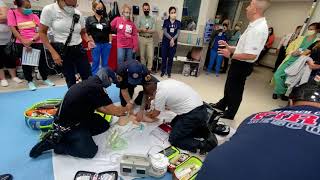
EMS team walks through resuscitating a one-year-old after a pool incident. They demonstrate pediatric CPR with two-minute compressor swaps, use an IGEL supraglottic airway for ventilation at 10 breaths per minute, and establish intraosseous access in the femur. The defibrillator charges every 1:45 to 2:00 between shocks.
Questions this video answers
1 year old
IGEL 1.5 (i-gel supraglottic airway)
One breath every 6 seconds (10 breaths per minute)
Every 2 minutes
Distal femur (not tibia on mannequin)
Chapters
Okay, good. So they're gonna go ahead and come in. We'll just say the kid was. Let's say the kid was in a pool. The kid has an unknown downtime. The kid's 1 years old. You know, there's a lot of activity on scene and nobody's doing bystander cpr, so the floor is open for you guys. Come on in when you're ready.
I dispatched to a one year old.
CPR surgery progression. Got airway equipment for the airway IGEL 1.5. The dose on the EP is 1 cc and I got monitored. So the first five 50 joules times three. Last one's 100 joules.
All right?
Yeah, we went to max 40.
Okay, we went right to max. Okay.
So here's some of the things we talked about earlier. Right. Position number one, defaults right over to the left side of the patient whenever and he's doing chest compressions. Position number two, the monitor person puts the pads on, turns the monitor on, but does nothing with it. The metronome you're hearing in the background is Dr. Antebe's app. It's going to tell you a couple things. Number one, it's going to tell you when to ventilate. We got two breaths. Then it's also going to tell you, it's telling you when to push down on the chest.
All right, stop CPR systole. Continue cpr.
See, that's a key part there, right? Asystole. What do you do with asystole? No shock. However, if it was vfib, that time to the fibrin rate would have been under 10 seconds because the monitor already had the charge ready to go. So now he knows that he's got approximately two minutes before it's time to charge that monitor again, right around 1 minute and 45 seconds. So the way that we work it in the perfect, you know, I call it the blue skies theory. Airways being done. Okay, somebody's working on chest compressions. He's already charged the monitor one time, knows underlying rhythm. Now he's going to go ahead and drill the leg. They're going to drill the tibial tube because the mannequin doesn't allow for it. How it needs to be done. But we're going to be going in the distal femur. So when the child arrives to your facility, you're going to see it in the femur. Now, the IO, I will tell you, you can draw labs out of the IO because I'm curious to see what happens when we transfer here. But you'll see. There's like IV team comes in. Got to get the iv. Got to get the iv. No, we're okay if we have this, we're good enough. We don't get an iv. Remember that warm transition we talked about? So they've already now have the eye gel in. So the eye gels are superbotic air again it's got about a 90% FPC rating as far as success on the first attempt. And they're going to be measuring capnography.
They have an I. O in place. They went ahead and got the pads on. So we'll have to charge here again pretty soon. And they're currently ventilating the child. One breath every six seconds, ten breaths per minute. Like we talked about in the standards here on top of the eye gel you'll see a strap. Stand by. The strap is so important, important for the Igel. The ideal does not have a puppet. One of the things with the Igel is the king airways or other superbotic airways have a bulb. The bulb pushes outward on the carotid artery and decreases the blood flows of brain.
However, if you do not have the strike on putting that anywhere pressure, it backs out of where it needs to be. So there'll be constant pressure applied to the eye gel. Now they've done the two minute mark. They shock or dump the monitor based upon the heart rhythm and they swap the compressor every two minutes. Right. That should never change. You will get somebody in your ED that is so passionate about chest compressions that they never stop. I will tell you that is the most inconsistent chest compression that you'll ever see over a 10 minute mark. As a matter of fact I can tell you when my provider swap out.
They'Re passing around that other passing around because you'll see what they're doing here. That's telling you the effectiveness of their compressions and their recoil. Now let's just say we'll elapse this, we'll go, we'll fast forward 15 minutes. Now we're going to start having that conversation. Hey, have we had a rhythm change? Hey, what's the entitled CO2 waveform? Hey, what's the capometry number? Hey, how much EPI have we gave ADA? Captain Rayburn, our EMS captain is probably going to start to say she's over here helping but she's probably already addressed the parents. Hey listen, we're going to get going at this time we bring the stretcher in, we put the kid on, we do all the immediate life saving interventions right there on scene. We transfer the stretcher and we start heading your way. We know. We know for a fact that chest compressions, or think about this, they're doing good chest compressions now, right? Who here has ever done chest compressions in the back of a truck doing 70 miles an hour?
It's not fun. How good do you think those chest compressions? It's not good. It's not. That's why it's so imperative for us to work here. So think about the emotional connection they have to this kid right now.