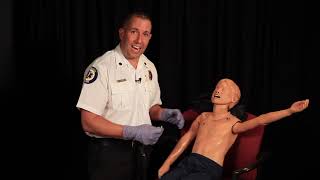
Dr. Peter Antevy explains why pediatric chest trauma now calls for shorter decompression needles: 1.25 inches instead of 3.25 inches, based on a 2019 Colorado Children's Hospital study of over 240 children. He covers the three signs of tension pneumothorax, where to insert the needle, and how to locate the right rib space using an ECG as a landmark.
Questions this video answers
14 gauge, approximately 1.25 inches (pediatric needle)
3.25 inches, 14 gauge (adult needle)
1) Respiratory distress or inability to ventilate effectively; 2) Diminished breath sounds on the affected side; 3) Age-appropriate hypotension (adult threshold listed as systolic <90 but pediatrics use age-appropriate values).
Fifth intercostal space at the mid-axillary line (primary); second/third intercostal space at the mid-clavicular line as alternatives.
A February 2019 study (Prehospital Emergency Care) from Colorado Children's Hospital measured chest wall thickness by CT in over 240 children and concluded a ~1.25 in needle is sufficient to reach the pleural space.
Chapters
Hey everyone, this is Dr. Entevi. I wanted to talk today about chest trauma. It's not a topic we talk about often in pediatric patients, but I wanted to talk about some brand new data that has caused us to change our protocol. And I wanted to show you the needles that we're going to be discussing. We'll talk about the protocol and the actual location of where these needles go. But let's talk about tension pneumothorax, whether it be adult or pediatrics. It's the same protocol, the chest trauma protocol. And as you know, we have the needle that we typically carry here is a three and a quarter inch needle. Now you can see here, that's a 14 gauge needle. And you can see here that it's a pretty long needle obviously here. And this needle, as you know, the location for this needle is the fifth intercostal space at the mid axillary line as the first choice. Second choice would be the second or third intercostal space at the midclavicular line. Obviously with adults that have a very pretty thick chest, guidelines, they recommend a 2 inch needle. So a shorter needle at the fifth intercostal space mid axillary line. There's a study that just came out that you're seeing on the screen right here. This is from February 2019, pre hospital emergency care by the folks out of Colorado Children's Hospital. And what they did, they measured by CAT scan the chest wall thickness of over 240 children. And they measured exactly how thick is that chest wall from the skin all the way down into the pleural space. And what they recognize is that the only needle size you need to get through that is something here that we have here, which is about one and a quarter inch. And so you can see here, we've now purchased the 14 gauge. It's a wider gauge needle just like this one was, right? Same 14 gauge. But now instead of having a three and a quarter inch, let's say on a one year old, on a five year old, now you just have one and a quarter inch. So it's a two full inches shorter. And you can see here that this will have less opportunity to kink and this would be better for the pediatric patient. So what I want you to know is look for this particular item, recognize that it's the same location, fifth intercostal space, mid axillary line as you would for the adult. But just recognize here that we're using a new needle rather than the adult needle that we have for the adult tension pneumothorax. So let's talk about the protocol for tension pneumo. You need three of the following, not one or the other, but all three of them. So respiratory distress or the inability to bag effectively, that's number one. The second thing is diminished breath sounds on the affected side. And the third one is age appropriate hypotension. So the protocol says a blood pressure of less than 90, but of course for pediatrics that systolic blood pressure is age appropriate. And you can find that in the app or in the book.
Okay, so just to finalize everything, as you know, we've worked really hard to have the adult and pediatric protocol be as one. I want you to think of these patients, whether child or pediatric, the same. So if you're running on a call of a three year old who was ejected from a vehicle on the turnpike and you come in and you see respiratory distress, diminished breath sounds, hypotension, I don't want you to think twice. I want you to take that needle, I want you to insert it in the appropriate location. We want to treat kids just like we treat adults. And that's why the protocol is as that. You guys are amazing, you guys do amazing work and I wanted to thank you very much. Have a great day.
So let's identify where we actually perform the pleural decompression on our pediatric population. So the first thing you need to understand is if you know how to do a 12 lead, you know how to find your landmark. And there's a little bit of controversy in the literature. So if you read the ATLS guidelines versus the PHTLS guidelines versus the ITLS guidelines, it's slight controversy between where is the actual primary insertion site for the pleural decompression. So some of the textbooks will tell you it's the second or third intercostal space in the midclavicular line. Some will say that it's the fifth intercostal space, the mid axillary line. And they say that that's a little bit of an easier spot to hit. And then they say you could also go anterior axillary, which is just inward on the body, towards the actual torso itself. So I'm going to go ahead and demonstrate how we would find the landmarks to match our protocol, which is the fellow fifth intercostal space in the mid axillary line. So everyone understands how to do a 12 lead by this point. And it's a very simple process. So remember, the first actual rib that you can feel is the second rib of the body. The first rib is underneath the clavicle or right behind the clavicle. So you'll never be able to actually palp rib number one. So when you palp the first rib that you can feel, that's rib number two. So then it goes second intercostal, you'll touch the third rib, third intercostal, fourth rib, fourth intercostal. That's going to be right where you start your 12 lead process. And you know, if you straddle the sternum, V1 and V2 go in the fourth intercostal space. Now we're going to talk about V4. V4 is going to go midclavicular line, but it's going to go down into the fifth intercostal space.
Then we know V3 goes in between V2 and V4, fifth intercostal space. And then you're going to go V5 and V6. And ultimately I'm going to put this as V6 so you understand exactly where your needle placement is going to be for the pleural decompression. When you come in, you're going to go right down that fifth intercostal line like we talked about. You're going to go right above that six rib in the fifth intercostal space, and then you're just going to gently slide it in until you actually get your rush of air. As you get the rush of air into your syringe at that particular point, you would remove your needle. As you remove your needle, you can further thread the catheter into, but there's really no need. Every bit of air that you're going to get out is going to occur right at that particular time. As a matter of fact, the military teaches accident. After they do the pleural decompression, they remove the whole setup right out of the cavity. And if they need to redo it, they redo it at that particular time. So in closing, when performing pleural decompression on a pediatric patient, number one, make sure you use the appropriate sized needle. Number two, the electrodes in the video today were just to show you where the placement is of the fifth intercostal space. And remember, we're now on the mid axillary primary position when inserting the needle for the pleural decompression. And last but not least and most importantly, make sure after you perform the procedure, even if you don't feel the rush of air, or if you do feel the rush of air, you re evaluate your patient. Watch for the vital signs, pay close attention to the blood pressure. Watch the pulse oximetry. And the most important, watch the work of breathing of your patient. If there is, there's no noted improvement. Do not hesitate to perform this procedure again. And make sure you constantly monitor your patient.