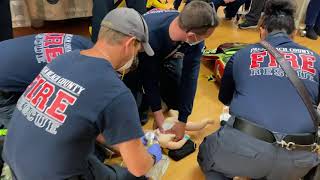
This clip is a narrated simulation from a pediatric resuscitation training video focused on EMS-to-ED hand-off and team coordination for a one-year-old in cardiac arrest. Key procedural points: two-minute compression swaps with metronome and monitor readiness for shock; ventilations delivered at one breath every six seconds; intraosseous (IO) access placed in the lower tibial/tuberosity area; epinephrine dosing prepared based on age over radio and first epinephrine was given ~3 minutes prior; end-tidal CO2 reported ~10 cm. The speakers emphasize timing of ventilations during compressions, securing airway devices (eye gel/ET tube straps), and team roles (ventilation, drugs, compressors).
Questions this video answers
One year old.
One breath every six seconds.
Down low in the tibial/tuberosity (lower tibial area).
About three minutes.
About 10 centimeters.
Chapters
So watch. They're going to come saying stuff. They know their position, if they know what their function is, and they're going to kind of lay out into, you know, the, the perfect scenario. Now, granted, some of these things are by a pool or somewhere, but they're going to try and figure out this format like the triangle, like Dr. Antebe said. All right, guys, come on in.
So that's the metronome you're running in the background. One ML shocks are at 50. Baby, baby, baby. I know it's 1.5.
All right, I got no faults.
We're gonna start CPR.
We have a one year old.
Okay, good. So you'll see he strategically placed his medications down here because he's going to be working on the IO and the distal femur area. Okay. Yvonne put the monitor over on that side to stay out of his way specifically. But you'll see at the two minute mark that they're going to swap back and forth between compressions. So you'll see him reach over to grab the monitor. You'll see her reach over and grab this bag that's very common for them. Up at the airway. You have two people working. They're in.
Probably five seconds off the chest at best. She had the monitor charged though, ready to shock. That way, if no shock, she dumps the charge. If there's shock inflictable, she would have went ahead and shocked up at the airway. He's giving breath. He's giving one breath every six seconds. When you talk about ventilations, remember when somebody's pushing down for chest compression, if you squeeze the bag the same time they push down, no air, you're meeting collision. So you really have to time the ventilations on the upstroke. I don't know if aha told you that, but you need to think like that. And I don't care if you put a tube in somebody or not. When you have someone pushing on the chest, the lungs are expelling air. Air is trying to go in. You have a trapping T. Okay, so one person's controlling the ventilation. That once every six seconds you have one preparing the IO in. Thank you. And then Yvonne went ahead and did the IO. Now you'll see the IO down low in the Tyndale tuberosity. But essentially what you're going to see is this One in the FEMA Easy I O Teleflex endorses the femur for 200 compressions. It's a much easier bone for us to hit. And the flow rate is 3 to 1.
Okay, stop. Assistly. Continue.
Now there's the swap. So she swaps over. She starts the chest compressions. He picks up where she left off, which is going to be the first dose of epinephrine. The key is he knows the dose of epinephrine he rolled into this house because he heard the age over the radio. So he's already pulled it up on the app. He has it on the app now. He's going to go ahead and administer the drugs. Ventilation. Eye gel is secure. You're going to see when the eye gel comes in, it's going to have a strap over top of it. For the eye gel to work appropriately, they have to have downward pressure on the eye gel. Remember, this is not an endotracheal tube that sits with a cuff inside the trachea. When you do chest compressions, you will dislodge that tube if you don't have inward pressure on it. So when they take the strap off and they're not 100% sure if they're going to innovate or they're prepping their stuff, you're not getting good ventilation. So if you're going to innovate, save that pulling the strap off to the very, very last second. So you're ready to go.
Any questions about this? And that's it. They'll stay in this triangle and they'll work. One person's focused on ventilations. The other person is going to be over here doing drugs until it's his turn to change compression. Now they're going to be fatigued. They're going to be tired when they get there, for the most part. Right. Especially if we don't have the loop. Lucas, age break is around 12 years old. Anything under the age of 12 is probably not going to adjust to the chest.
When's the last time you gave epi?
Epi was given about three minutes ago.
We also. We have an IO established size 1.5. I delve in place. We're getting big back compliance on it. The end tidal CO2 is at about 10 centimeters.