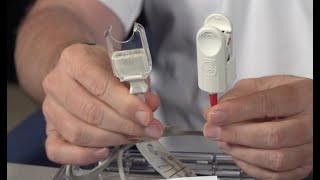
Captain Joe Nelson and a colleague walk through setup and use of rainbow SPCO sensors for detecting carbon monoxide exposure. Store the probe sealed in its pelican case with the instruction booklet inside. The device alarms when SPCO exceeds 10% or SPMET goes above 3%.
Questions this video answers
When SPCO (patient CO) goes over 10%.
When SPMET (methemoglobin) goes over 3%.
Chapters
Hello, everyone. I'm Captain Joe Nelson with Medical Services Division, and I'm here to talk to you today about some equipment we're going to be rolling out to the field. The first thing I wanted to talk to you about was the return of the rainbow sensor. We've been missing them because we have a protocol for carbon monoxide exposure, and we'd like to be able to measure carbon monoxide levels. So we wanted to bring them back out, but we want to be careful about how we do it. So it's coming to you now, sealed in a pelican case. And what we would like is for you to keep them in the pelican case when they're not in use and stored in the truck, and then just pull them out when you have a suspicion that you might be dealing with somebody who has carbon monoxide poisoning. So the probe is going to come in this pelican case, and there's only going to be two things in here. It's going to be the probe itself and then also the instruction booklet. So the instruction booklet is there for you to refer to, but it also works to help cushion the probe in the box and protect it a little bit. Leave that in the box when you're not reading it. The probe itself is going to look just like your normal SpO2 sensor. The only difference is going to be that it'll have a red tag on it, and there's a much larger tag here that actually says CO on it, spco. So that gives you an indication that this is going to be the rainbow sensor. If you notice there's a small hole here, that hole is there to help determine if somebody's finger is big enough to use the sensor. So if their finger can go through that hole, then their finger is too small to use this. And they're supposed to use a pediatric sensor, which we do not have available. So just you could use that for reference to determine if your readings are going to be reliable or not. So these sensors are expensive, and they're a really good tool for us. And if we're going to keep them, we need to just keep them protected. Want to make sure that you keep them in the box, put away in your vehicle if you need to. If you need to use it, pull it out, attach it, use it while you have the patient there with you. And when you're done, clean it and then put it back and then store it again. If we do that, we should help keep them in service and keep them from being damaged during their use in the Cleanup.
Now let's look at SPCO and met. When the patient is connected to a rainbow sensor and we have a good SpO2 reading, SPCO and SPMET are also monitored continuously in the background. When the patient's CO or MET is abnormally elevated, for example, the patient's CO goes over 10% or MET goes over 3%, an advisory occurs.
There's an alarm tone, an advisory message, and the elevated value starts flashing here Instead of the SpO2 to acknowledge the advisory, press alarms. The SpO2 replaces the CO value, but the advisory message stays on the screen until the value drops below 10%. The SPMET advisory works the same way.
So if you are monitoring with a RNBO sensor and there is no advisory, then you know that the patient's CO is less than 10% and met is less than 3%. But if you want to check those actual readings, there are two ways to do it. You can press print and get a printout of the vital signs. You see the CO and MET values up here on the strip. Or you can manually display the value in the SpO2 area. Rotate the speed dial to outline the SpO2 area and press it. Select Parameter from the menu and then select SPCO or Method. The value displays for 10 seconds, then reverts to Spo2. If you have difficulty getting a stable signal or the value shown is questionable, consider these. Is the sensor size correct for the patient? Consider using a pediatric sensor for adults with small fingers. Is the sensor aligned properly on the patient's finger? Try taking it off and putting it back on again. Make sure the tip of the finger touches the raised stop inside the sensor.
Is the sensor too tight? Is the sight well perfused? Some patients have different levels of perfusion on different fingers. Try another finger. If there are notable temperature differences, use the warmer finger. Is the patient moving excessively? If so, get the patient to hold still or move the sensor to a less motion prone location. It's especially important to keep a rainbow sensor motionless during its self calibration process. Is there interference from bright lights like sunlight or emergency lights? You should cover the sensor to block the light. Again, that's particularly important while a rainbow sensor is self calibrating. If the readings still seem questionable, get two or more readings from different fingers and average them.
And remember, it's important to be familiar with your sensor's instructions for use. The SpO2CO and Met Monitor has built in messages to help troubleshoot problems that may occur. Refer to the troubleshooting tips and the operating instructions for the messages and corrective actions. Remember, SpO2CO and met monitoring are tools to be used in addition to patient assessment.