Scott Youngquist MD: IM Epi 5 mg in OHCA (1/5/24)
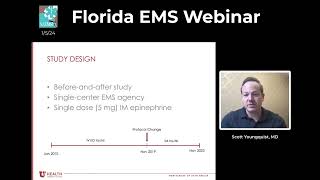
Dr. Scott Youngquist presents a Salt Lake City EMS study testing 5 mg intramuscular epinephrine for cardiac arrest. Paramedics gave IM shots in 4.4 minutes versus 7.8 minutes for IV lines. Patients receiving IM epinephrine showed better survival to discharge and neurologic outcomes, though the margins were small.
Questions this video answers
5 milligrams in the lateral thigh.
Late 2019.
IM median ~4.4 minutes; IV/IO median ~7.8 minutes.
About 372 patients in the IM cohort.
21.5 minutes.
Chapters
All right, Good morning, Everybody. It is 2024, and we are here with perhaps.
One of the most interesting topics, at least that I've been following over the last couple of years. And we're joined today by Dr. Scott Youngquist. Scott, in my opinion, is one of the brightest minds in EMS in this country. He hails from Salt Lake. You can see he's a professor at the Department of Emergency Medicine at the University of Utah. He's also the medical director at the Salt Lake City Fire Department. Scott has been doing some really interesting work. He's done incredible work on.
Out of.
Hospital cardiac arrest, and he's been on the show before. But when I saw the work he was doing with respect to epinephrine and particularly getting on EPI early, I asked him to come onto the webinar. Probably What Scott in 2021?
Probably.
It was maybe a couple years ago when he first came on.
Yeah.
And then I happen to see that you were, that you presented your abstract data at the AHA conference recently. So I called Scott back up. I said, scott, can you come back and give us more data? So I put this on Twitter and, boy, I had like 18,000 views of my tweet overnight. So there, there, there are a lot of people here who want to hear what Scott has to say, and so do I. So without any further ado, Scott Youngquist, thanks for joining us and appreciate coming back on the show.
Great to be with you all. Thanks for the introduction. I have huge respect for Dr. Antevi and all he's done to push the science forward for, for pre hospital care. And so he's one of the few people I'd be willing to come on and talk about this data. And I hope it's, you know, I'll, I won't spend a ton of time on these slides because I want some time for discussion, debate, critique, all that stuff. I welcome it.
And let me go through these slides and then we'll open up for questions. So you guys know the scope of this problem. Most patients die from cardiac arrest. And so it'd be nice if there was something to improve survival, if there was a novel drug, a novel approach, and.
The, the existing status quo hasn't worked well, you know, I don't think we'll get to 100% survival ever, because a lot of patients resuscitated from cardiac arrest are in the natural dying process. And we just try to interrupt that. You know, they've got severe comorbidities in their end stage, this or that organ failure. But I think we can do better. We probably do better with what we have. So epi, this is a non controversial statement, I think based on the largest and best run trial so far and that EPI improves survival to hospital discharge. And there is. But along with that, you get a lot of survivors with brain injury and you can see the survival when you compare it to placebo. Survival to hospital admission is much higher with epinephrine. And then you lose some patients along the way until that difference between placebo and epinephrine narrows. In the Paramedic two trial. Now, Paramedic two was a great trial.
They followed the ILCOR guidelines which prefer intravenous epinephrine over intraosseous epinephrine. So attempts were protocolized first to get intravenous access and if those failed, they resorted to androsius. So it may be a little different than a lot of US agencies where the majority of cases are intraosseous medication administration. In this case they attempted IV and were successful. In the majority of cases it was like one third that were IO and the rest were iv. But this also led to delays in the administration of epinephrine. And there is throughout the epidemiologic literature a time dependent effect of epinephrine. In other words, earlier is better. Earlier leads to a shorter low flow time, which is just a continuation of the ischemic time and earlier return of spontaneous circulation. And in this meta analysis, when you give epinephrine within 10 minutes of scene arrival, the odds ratio for survival is 1.62 compared to after 10 minutes from scene arrival. So getting that first dose on gives us our best chance of getting Roscoe early. And this is a pretty consistent observational finding. And it also improves neurologic outcome to get it on early versus late. In the paramedic 2 trial, the time from 911 called to the first dose of epinephrine was 21.5 minutes. And I think that's probably a, that's probably a decent time to epinephrine in a trial in which paramedics are, you know, incentivized to get the.
Drug agent on board in a trial and to do a good job. So there's an observation effect there. It's probably even longer in other settings where there's less of an organized approach to the resuscitation. But I don't know that for sure. But anyway, 21.5 minutes is a pretty long time from 911 call to administration.
When you look at the routes of administration available, what we do is tibial IO humoral IO or peripheral iv. And I would say humoral IO is the less common administration route. But you can look these also have, all have pros and cons. Tibial IO very successful. It's got a low displacement rate, so the Overall success is 91% and the time is short, 4.6 minutes. Humoral IO takes longer, is ultimately less successful, probably because of displacement. In studies the Overall success was 51% and peripheral IV is much less successful. The overall success rate 43% and time to initial successes in this is somewhere between any studies between IO and iv. So the big speed bump to giving the medication is the vascular access and, and this becomes more difficult with patients who are more obese. Body habitus with pediatric very small children. I know Peter has advocated for a more reliable approach to intraosseous administration of drug and pediatrics in the distal femur, which is much more successful than the tibial IO. And when you look at pediatrics, the misplacement rate of tibial IO is very high. A lot of this is not, not where it's supposed to be. And so we don't know where if the kid's getting any drug or not from those misplaced iOS anyway. So this creates a little bit of a difficulty in administering epinephrine early. And the ILCOR guidelines recommend administering it as early as feasible when initial shocks have failed or as soon as possible in a patient that has a non shockable rhythm. We've long used epinephrine through the intramuscular route for anaphylaxis. And we've put this in the hands of BLS providers and even civilians with auto injectors and in the lateral thigh has a very rapid uptake in patients with a pulse. There are some animal studies suggesting that it is also absorbed through an intramuscular route even during the low flow state of cpr. We are doing some of that work. We're analyzing our data right now, but it looks good in terms of, you know, there is, there is uptake even from the lower limb of a pig during CPR and the low flow state of cpr. And we'll report that data once we finished analyzing it. But the preliminary data looks, supports this, that im epinephrine does get absorbed, it does have effect, does have its pressure effects when administered intramuscularly, at least in the laboratory setting.
In 2019.
We established a protocol change. This was late 2019, right at the beginning of the pandemic, when we were hearing about the pandemic starting In Wuhan, China.
We implemented this feasibility study of an initial dose of 5 milligrams of intramuscular epinephrine in the lateral thigh in patients in cardiac arrest that met criteria for epinephrine. While attempts at vascular access were made for us, the majority of epinephrine is also administered through the intraosseous route. We do give paramedics the ability to attempt intravenous if they feel like they can get access. So it's kind of a dealer's choice approach. We don't say thou shalt do IO on everyone, thou shalt do iv. We say look at the patient. If you feel confident you can get an iv, go for it, and if that fails, switch to IO. If you look at the patients and there's no way you feel like you're going to get something, then just go straight to IO. Whatever gets you there first is how we've done it. And there are pros and cons of that approach, but that, that's been ours. So this isn't to replace all subsequent dosing of epinephrine because I, you know, I don't know. And when we started this, how much effect this might have on how much pressure effect, whether there was absorption, those sort of things was an open ended question. But so everything else was the same. We're going to give standard dosing epinephrine through whatever IV or IO route that is that is established once we've got vascular access. So the kind of, the objective of what we're doing here is to evaluate that approach and see if there's any signal there, see if it looks like there's an improvement. So this is really a before and after analysis. It's not a randomized trial. This is continued up until today with this project. Protocol change and we have for this study. These are kind of the exclusion criteria of what we're going to analyze. So this is adults. We don't have a lot of pediatric patients, patients, but.
We'Re going to focus on adults. And there are a few patients who get epinephrine before we arrive there at surgical centers or something like that. We had one recently that was at a surgical outpatient surgical center and was almost completely resuscitated by the time we got there by an anesthesiologist who'd give them multiple doses of epinephrine. So obviously we don't include those. If the patient already has IV access and they arrest en route to the hospital, obviously we're just going to go with the IV access. So those are the sort of exclusions and what I'll present is survival to hospital discharge and some secondary outcomes. The time from arrival to the first dose of epinephrine in these groups. Survival to hospital admission. Instead of rosc, I present survival to hospital admission because of variable rates of intra arrest transport. So there are cases where a patient remains in pea, but we transport them so that somebody can, you know, got a high end tidal CO2. It's possible that we got ROSC. We don't know, you know, those sort of patients where we want to look with an ultrasound. So we don't, we don't stay in play for every single patient. This survival to hospital admission accounts for patients who get ROSC either in the field, en route to the hospital or on ED arrival and then looking at the most important thing, which is favorable neurologic survival. So this is a very complicated flow sheet, but basically at the bottom we got 372 patients in this cohort of IAM epinephrine. There are a couple of concurrent controls that even though you protocolize a change, it doesn't always change practice. So patients got IV or IO medication during the period under intervention. We included those in the control cohort, so mostly historical controls with those additional concurrent controls. When you look at the characteristics, one of the big differences.
That we observed in our database was an increase in the rate of bystander cpr. And I'm not sure if this is real or not, but we'll account for this in our analysis. The reason I'm not sure about this is initially we relied on EMS reports to, to account for bystander CPR. At around 2016, we started getting all of the dispatch files and actually reviewing them, listening to them and giving the telecommunicator CPR dispatcher feedback on the approach. And so this may be a data collection artifact because paramedics may not observe the bystander CPR that has occurred prior to their arrival. But nevertheless, there may be a higher rate of bystander CPR in the community, but these are pretty high rates. In Salt Lake City the time was faster. IM route was 4.4 minutes, the median was 4.4 minutes and IV IO was 7.8 minutes with longer times for IV, it was a couple minutes longer for IV compared to iOS, but this is the median for that entire cohort, so it was faster. When we look at survival to hospital admission, there is the point estimate favors IM epinephrine, but it just barely misses statistical significance on an adjusted basis with a lower confidence interval of 0.99. So, even though in the paramedic 2 trial, we saw the biggest difference was between survival to hospital admission, remember that the control group was getting placebo and that in this case, everyone is getting epinephrine. It's just that some people are getting an early dose of the intramuscular epinephrine. What we did see was statistically significant improvements in survival to hospital discharge with a higher odds ratio than the favorable neurologic outcome. But both were statistically significant and the favorable neurologic outcome just barely. So. So this is suggests that the group that got IM epinephrine did better in our cohort. And this is adjusted for things like age, gender, witnessed arrest, bystander, cpr, public location, initial cardiac rhythm, EMS response time.
All of the standard Utstein variables that need to be controlled for an observational data. So this is, as far as we know, the first clinical evaluation of IM epinephrine. There is an ongoing trial in pediatrics in Canada, and I'm not sure if they have completed enrollment, but my understanding is that that is ongoing. This does. Our findings do align with prior reports that suggest that early intramuscular epinephrine does have an effect on ROSC and that it does have an effect on survival, not only in pigs and rats, but in humans as well. This also aligns with, frankly, your experience in South Florida with pediatric arrest, that by coordinating the resuscitation so that the child receives an early dose of epinephrine, you saw improvements in survival as well. So I think all this is to suggest that we need a randomized trial. This is certainly biased data. I'm not suggesting that this tells us everything we need to know about epinephrine dosing, and there may be a better way to do this. The appeal of this is that 53% of arrests in the Resuscitation Outcomes Consortium data were attended to at first by a BLS provider with a lagging ALS unit. And that certainly what we have in Salt Lake City in this study, we put this in the hands of ALS providers. Where I think there's likely to be a bigger impact is where there's a delay to the ALS provider arrival, which adds to that delay to vascular access. So with that, I think I am done. I'd be happy to take any questions or feedback or criticism.
Yeah, well, we have a few questions coming in, and I want to bring a few people in.
But what I think it's important for people to understand is the progression with which you're going forward with this Information is, number one, the feasibility trial. And so to that question, was that difficult for you to do, to convince anyone at your agency and your community to say, hey, the standard of care is this, but I, Scott Yonquist, want to do this? Was that difficult to get done?
No. What laid the groundwork for this, frankly, was epinephrine is people recognize that from movies, TV shows, as this important medication. So it's not like a drug with a fancy name that is new that we're putting out there. This is an existing drug that everybody's getting. And it's a route of administration that is something we're also giving. So it's. It was easier than a lot of other interventions might be to get people on board with this. So we discussed it with the irb, obviously with.
The fire department, with community emergency physicians, and some of the community emergency physicians were like, isn't EPI over? I mean, didn't Paramedic two trial prove that EPI doesn't work? And so I had to kind of explain, you know, this is, these are the limitations that study, and here's what we're thinking might work and stuff like that. But, you know, at this point, people are very comfortable with it. And.
So, yeah, we've been okay with that. But it is, it is one of those things where Paramedic two suggested a way forward with epinephrine, and this is one of the ways we considered moving forward with it. Like I said, not the end all be all, but something that may become practical. I mean, you could envision a scenario where trained TSA agents not only use an aed, but while an EMS crew makes their way through the gate at the airport or something like that, they could administer an intramuscular dose of epinephrine, potentially improve outcomes, but really needs a randomized trial.
Yeah, 100%. And so before I bring Dr. Wayne in, you know, you landed on a dose of 5 milligrams. Some people may mistakenly see 5 milligrams and think you're using high dose epi. Can you, can you bust that myth for us?
Yeah. So you might be aware that the dosing of epinephrine is about tenfold higher in the intramuscular route for anaphylaxis versus an intravenous administration. So you have a patient with anaphylaxis. Right. You're not giving 0.3 milligrams, you're going to give a dilution of that, Tenfold dilution of that. The dose is based on the animal literature and a linear extrapolation of the anaphylaxis data.
What the pig is seeing is.
And this is subject to the rest of our analysis, but when we do this at the laboratory, we compare a dose of intravenous medication at 21 and a half minutes, similar to paramedic 2 versus an early intramuscular dose. They are seeing within about three minutes a comparable rise in epinephrine levels, serum epinephrine levels. So this isn't like a massive epi overdose for the patient.
Perfect. Let me bring in Dr. Marvin Wayne. Marv, good morning.
Good morning. Yeah, it is morning here on the Pacific Northwest. Hey, Scott. That amazing study. Amazingly motivated. Three related questions. Question one. You've explained the first one. I wanted everybody to understand why you use the dose that you used. Two, was there any issue with your state boards about BLS giving epinephrine? So that's question two.
No. Question two. No, there wasn't. We approached the Utah State Board of EMS with this pilot project and got approval from the state EMS committee. We had previously applied for the BLS dosing of epinephrine for anaphylaxis, meaning BLS dosing from a syringe and vial. You know, we basically have sort of like Seattle, we've given them a 0.3ml syringe and a vial to use instead of auto injectors since auto injectors became so darn expensive. So they had that history. We, we got approval for ALS provision of intramuscular epinephrine in 12, 20, 19. And since then we've gotten approval to put it in the hands of BLS providers. We haven't rolled that out yet, but yeah, that's something that we got approval for at the state level.
What I think will make it easier for us if we decide to go this way is we already have mandate in Washington state that every BLS provider has to be able to give epi for anaphylaxis. And we use the vial syringe, the $3 versus the $300 version, and then kind of related. As the last question.
I wanted to clarify because when I connected on, I might have missed it. These are all clearly non shockable patients, correct? Or are they including shockable?
This includes shockable if the initial defibrillation attempts fail. And we do see when we break out the subgroups into shockable and non shockable, there is an association with survival in both groups independently. But we do cut down on the sample size. So those associations are, as I recall, no longer statistically significant because of Loss of power. We're talking 341 patients, if I recall correctly, so not a huge number to drill down into. I will say that.
It looks like the greatest effect is in patients who go on to get intravenous medications, which makes sense that there's a longer lag, obviously, between that and the IO dose. And so I think in an IO heavy environment, the effects of an early IM dose will be diminished. Although, you know, I didn't mention, I think that IO is associated with worse survival than IV in these epidemiologic studies as well, and even humoral IO. And one recent study was as bad as tibial IO for.
ROSC and survival compared to intravenous. So intravenous is certainly the gold standard. And I think if you get rapid intravenous access, then.
That'S the gold standard. That's what we should do. It's just not feasible for the. A large chunk of our cardiac arrest population because of, you know, the difficulty of getting the access, the lack of a skilled provider on scene immediately and stuff like that.
Thank you. Just a side comment. For reasons I don't understand why giving this work so well in the VF patients, about 40 years ago, we actually drew levels of the catechols, all of them presented but never published, which is unfortunate. And found the initial EPI in a VF patient was sky high. Yet we give more, and yet it works. So there's a lot of yet to learn, as I said. But thank you for bringing this to everybody. And it's a great idea. And since we already have BLS providers carrying the epi, it's something I have to give strong thought to.
Yeah. In the pig there, where we induce ventricular fibrillation. And so it's an observed arrest, and we let it sit there in VF for seven minutes. When we start CPR and draw levels, there is a surge in catecholamines that is actually higher than subsequent intravenous doses, but that disappears in most animals within a couple of minutes. So there's a window very early where you probably don't need epinephrine for the VF patient. We're just unable to intervene on a lot of patients. Those are the one shock wonders sort of thing, or the ones that.
You know, he's shocked twice and they're back. And by the time EMS arrives, because the defibrillator was on scene or something like that.
Scott, I actually wanted to kind of.
Ask about that same exact question. In my protocols for years now, we've removed EPI altogether from the shockable rhythms. Were you able to separate out that data in your study? There's a big meta analysis that was published in August of 2023 showing that EPI has no benefit in shockable rhythms. And I'm wondering what your thoughts are on that aspect.
Yeah. In our data, it there is a positive association between the early IM dose and all these outcomes I mentioned.
Irrespective of the rhythm. Yeah. Okay. Both shockable and non shockable.
And I have a cohort, though, that has IM epinephrine followed by ROSC before the ability to achieve vascular access. And that is a group that I don't know what to do with. So you could say, well, those patients didn't need epinephrine, they fell out and they just happened to get it right.
More from Peter




Melissa Olen MSN, FPN-C, CCRN: Sudden Cardiac Arrest Training in Schools (Project ADAM) 4/25/25



Pediatric Hospital Readiness: How Teamwork & CPR Metrics Drive Better Outcomes



Chelsea Kadish, MD & Kyle Goodknight, EMT-P, RT: Pediatric CPAP in EMS (3/14/25)