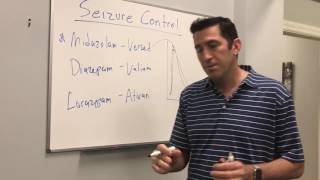
Short spoken lecture by Dr. Peter Antevy explaining seizure-control options in EMS. He compares midazolam (Versed), diazepam (Valium), and lorazepam (Ativan) on speed of onset, duration, and suitability for intranasal or intramuscular use, and recommends midazolam as the preferred EMS agent because of rapid on/fast off kinetics and multiple non-IV routes (including intranasal) useful in the field.
Chapters
Hello, everyone. This is Dr. Peter Hentevi. Welcome to another edition of the Entebbe Minute. Today I wanted to talk about seizure control. In your agency, you probably have something like either Valium, which is diazepam, or Versed, which is Midazolam. And some of you even carry Ativan, which is Lorazepam. And the question is, which one do we use and why? And so let's talk about those three medications and talk about the specifics of each of those. So let's talk about Midazolam.
We're going to talk about Diazepam.
And then we'll talk about Lorazepam.
Remember, this one is Versed.
This one is Valium.
And this one is Adamant.
So as an EMS provider, we come to the scene, people are seizing in front of us, and we want the seizure to stop right now. And. And we also wanted to. Don't want it to last that long, right? So we want it to come on fast and go off fast. And really, that's why Midazolam is really the best drug to use in that situation. So let's talk about that. Let's look at the curves.
For each of those. So if you look at midazolam, as soon as you give the drug, it spikes immediately, and then it comes off very fast. So this is Midazolam. It's really fast. It's really good. You want it to stop quickly, you want it to end quickly, and you're done. Diazepam really almost mirrors this in that it's on really quickly, and then it's off a little bit longer. So in other words, it lasts a little longer. And now let's go to Ativan. And so Ativan actually takes longer to work, and it lasts for a whole lot longer. So this may take 15 minutes until the seizure may stop, maybe 10 to 15 minutes until it's really on board. Whereas with Versed and Valium, you really get a much more rapid onset. Now, why has everyone really gone to Midazolam and ems? It's because the diazepam formulation is not really good for intranasal. So I'll put an X through that. And midazolam, on the other hand, you can go intramuscular IV intranasal for pediatrics, which is really the best, right? You don't have to start an iv. And so that's why midazolam has really become the drug of choice for us in ems. Think of this similarly for pain control, fentanyl, because fentanyl, like midazolam is really fast on and really fast off. So you really want your patient to get really good pain control fast. And unlike morphine, which is a maybe 15 to 20 minute onset. So these are the kind of drugs we like midazolam, we like fentanyl for pain control.
And that's why EMS has really moved towards that. So hopefully that was helpful. Again, Dr. Peter Hentebi for another edition of the Gentavi Minute. And hopefully we'll see you in New Orleans for the NAEMSP next week. Take care.