South Florida Stroke Coalition Quarterly Meeting (6/20/2023)
The South Florida Stroke Coalition reviewed stroke registry dashboards, announced sustained state funding, and shared regional performance data on door-to-needle times and thrombectomy use. A new task force will track inter-facility transfer times, and hospitals presented cases showing workflow challenges in stroke care.
Questions this video answers
June 20, 2023
172 hospitals
93% in Broward County
82% in Miami‑Dade County and 85% in Palm Beach County
62 hospitals
Chapters
So first of all, I want to welcome all of you to our EMS Stroke Coalition meeting.
This is I think the first in person meeting that we've had since before COVID So very excited about that and I'm delighted that many of you could, you know, drive from long distances from your work and be here in person. It means a lot to all of us, to ems, to all of our stroke coordinators and you know, countless just, you know, our healthcare providers that, you know, have done a lot of work with us to improve pre hospital stroke care. So we have a great agenda lined up and I just, you know, before we get started, want to, for those of you that are new to us, new to, you know, these meetings provide a, you know, historical context of how we got here today. So as you all know, with large vessel occlusion strokes and the evolution of mechanical thrombectomy, the proven efficacy starting in 2015 and that really becoming a standard of care and revolutionizing our field. So a group of us, Dr. Randy Katz, Dr. Peter Antevi, many others from EMS, major advocates for improving pre hospital stroke care based on their own personal experiences, family experiences, especially for Dr. Antevi. We group at least among the EMS leadership in Broward county and we said, what can we do to improve care now that there's this amazing effective treatment available? How do we get patients to the right hospital in a timely manner with EMS triage protocols, the LVO assessment sales that were just starting to come out in late 2014, 2015 and then how do we improve in hospital care? So beginning in 2015 we created the Broward EMS Rope Coalition. And I believe, you know, at least to my knowledge, that it was among the first EMS based stroke coalitions in the country. And we had a lot of support from stroke coordinators, EMS medical directors, chiefs, captains, and one of our goals beyond standardizing pre hospital stroke protocols and in hospital care, parallel workload, timely reperfusion, was sharing that data back to ems. Right. Because up until then, unlike trauma and STEMI care, it was a black box. And so EMS really didn't know the quality of care at any of these individual hospitals. And all of them, literally overnight after the trial, were becoming ambient stroke center stroke centers starting in 2017. So we had our work cut out for us. So basically we started working with the University of Miami and their amazing group at Dash 9 led by the late Dr. Ralph Sadrook. And we had a very simple request that can we create some mechanism through data collection and sharing with EMS on a regular basis so that they Had a, you know, very clear understanding of the quality of care. And what I mean by that is.
What is the stroke volume at the.
Receiving hospital, what are the mortal and needle times or the concert times, outcome state and publication rates, et cetera. And it's a heavy lift, right, with so much data that's being collected at all of our stroke centers for gamifica guidelines and other national databases. But they were very enthusiastic. They were already developing the Florida Stroke Registry and had the infrastructure, the statisticians, the analyst. So it was very exciting for us from an EMS and neuro interventional standpoint to partner with the University of Miami. And so today a lot of what you will hear is the progress that has occurred as a result of their hard work. So I just want to give a round of applause to the FSR team at UM&TO.
So beyond that, we also wanted to, before we started sharing data with ems, we wanted to make sure all the hospital processes were in place and that we didn't want to shame any hospitals, you know, give them ample opportunity to be ready. So starting in 2016, we began to create educational courses for pre hospital care as well as in hospital providers to make sure that everyone, you know, was acting as quickly as possible, parallel workflow, as I mentioned earlier, and get these patients treated quickly. We didn't want anybody behind the eight ball, you know, prior to sharing the data. And so we gave each of them all the hospitals, you know, initially Broward and then expanded to the Tri county about two years from 2017 to 2019. And then in 2019, Dr. Antebi and with his advocacy, we sent out a letter to all these C suite executives at all of the stroke centers providing tps and from mechanic treatments so that at least they knew what was coming from the stroke coalition, the, you know, at least soft mandate to share data. Right. Nobody can require any of these hospitals to share data. But if some of them were earlier doctors such as Memorial and some of the other hospitals like University of Miami Baptist, then our hope was others kind of aligned with us just being the best practices. Right? And so now we're really at this junction where we start to see the results over the last couple of years, despite Covid, as you'll see in the dashboards, we've truly maintained the quality of care with consistent fast work and needle times, as Dr. Galvano showed at our last coalition meeting a couple of months ago. And so, you know, we are very excited about the agenda tonight. We're going to have Carolina Gutierrez and Jose Romano, the You know, directors, leads of Florida Stroke Registry go first. And then we have stroke coordinators, the delegates representing all of the tri counties to really give updates about, you know, what the status is of some of the stroke centers, any challenges, issues and so forth. And they've also worked diligently to create a poll so that we can also get feedback on future coalition meetings and what type of topics for educational purposes to address. And then after that, we'll have updates from Dr. Anteby from the EMS side. We have some exciting news in terms of additional county joining us. And then we'll open it up for Inbo Journal Club. Hi. Doctors Harris Kamal and Basujani from Sini, from University of, from Mount Sinai and from Memorial. So this is a new format. We've never done this before in terms of in person plus hybrid plus Turtle club plus embo Club. But I think it's going to be very exciting. And so, you know, welcome to what we hope will be many more meetings to come in the future.
Thank you very much.
It's really great to be here. It is wonderful to see good friends and new faces and share with you some of the things that we have been doing at the Cornerstruck registry. I wanted to acknowledge Dr. Gutierrez, who's the associate director of the Cornerstone Registry. We also have Christina here and I think I saw Julie Gordon Peru and Victor Napruto online and there may be others that have joined us remotely. So great to see all of you here. What Dr. Gutierrez and I wanted to do today was to give you an update of what has been happening within Florida's crop registry. So.
Many of you know that the forestry registry began over a decade ago, initially with NIH funding to establish Forest Stroke Registry, and then eventually with all of your advocacy and the grassroots effort, it got funded by the state and actually written into law that it was mandatory that if you were a stroke center, you had to contribute data for Forest Stroke. Right. And this initiative has grown and it's. It is more than a registry. It's more than data. It is an educational collaboration. It's an advocacy initiative. It is a way to impact care by benchmarking data, sharing data.
Involving multiple stakeholders, as we have in this room, to try to improve the care of stroke patients. Now, we are delighted to let you know that.
Just a few weeks ago we got news that the legislature approved and the governor signed off on funds for this next year. As you know, we do require some funds to keep everything going. So we're delighted that we're here.
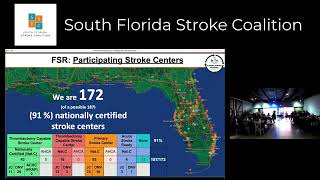
So we currently have 172 hospitals participating in the floristic registry. If you recall many years ago when the Florida Stroke act was first passed almost two decades ago.
One of the first when they do the first state of have a Florida Stroke Act. At that time there was the option to be self attested as a primary or comprehensive stroke center. But based on data from the foreign throat registry and based on the input that many of you had for us, we started looking at performance metrics. And based on that the state decided that it was time to have national certification of stroke centrics. So we currently have 91% of the hospitals in Florida in the cardiac drug registry being nationally certified. And you see the breakdown there. We have a 43.
Thrombectomy capable that's actually comprehensive stroke centers. Right. 18 thrombectomy capable centers, 92 primary stroke centers for acute surgery hospitals and then a few that I'm sure are in the process of getting nationally certified. So this is great news. We have also identified a number of hospitals that are currently not in the registry. But hopefully we'll try soon.
There we go. Now I can't read off the screen, but I perhaps read off that screen. This is the hospitals in South Florida and our certification Miaga County, Broward and Palm Beach. So Broward, congratulations. 93% of the hospitals in Broward are currently certified. 82% in Miami, Dade County, 85% in Palm Beach. Which is really great news. And.
Hopefully when we meet next time we'll see the number of hospitals are exported by growing over time. So fantastic.
As you know, the Florida structure is also collaborating with the Department of Health of the state of Florida on Coverdell efforts. The whole Coverdell stroke program is designation given to select states with an award. And the state of Florida earned this all Coverdale status now a couple of years ago. Right, like years ago. And is this really focuses on trying to improve systems of care. There are 13.
States in the US and we are one of them. So we have asked each hospital in Florida in the forest private street to join the Coverdale program. And it takes a signature from the hospital authorities and just a couple of new data points to add. Your ongoing collection of data is relatively easy. We currently have.
62 hospitals in Florida that have signed the Coverdale amendment. And you see here the ones in South Florida that have joined Coverdell. And our ask to all of you is to make sure that your husband is join. There are a number of advantages of joining coverdale and perhaps Dr. Potatoes can talk a little bit about that.
Sure. Certainly if you join. It's a prestigious thing you get on our website we will promote faculty to hospital as part of it. Those who participate will have opportunities to go to meetings potentially for three. So we'll encourage you that we in that sense this. We have surveys, we have different asks of the hospitals that we know take a little bit of time, but we also have ways to incentivize result. And again, it's a prestigious group. It's 13 for the past three years. We're expecting another, another award to come out in the next year where there will be a five year award. But it's, it, you know, changes every, every time. So hopefully we'll be in that group again in the next five years.
And again this is of a great importance to the state of Florida Department of Health. So they may be reaching out to you as well to join Coverdell. Again, a pretty simple process.
Within Coverdell there is a.
Focus not only on acute treatment of stroke, but also on the transition of stroke care after hospitalization, which is critically important to prevent the second stroke and eventually hopefully also on primary prevention. So the continuum of stroke care and the systems of stroke care.
Oops, fast there.
How can I go on the.
Let's go back.
No, go back one more.
Perfect. So I may be preempting Zachary and Debbie here, but there has been some news that Monroe may want to join. So this is very good news and you hear, hear a lot more about that. There are three hospitals in Monroe county and you will have to think through. And by the way, is there anybody from Monroe here?
A little bit of a drive anybody online from Monroe?
Okay, so we will have to think.
About the dashboards, the regional dashboards and our initial thought, but again it's for discussion as a group whether the Monroe County Hospital should join the Miami Dade county dashboards, which would make probably more sense, particularly because at least two of them are part of the Baptist group. So.
I'm going to turn it over to Dr. Gutierrez to talk a little bit about the webpage.
Thank you. So real quickly, you all may have seen this and if you haven't, hopefully you will go. You all should have accounts to go into the website. This is the part where you go onto our website, you have to log in and you have a password. Basically what this is is the different stroke positions that exist right now throughout the state. One we've been around really a while.
And so what we're trying to do for you through the Florida Stroke Registry is create a webpage for you. So you see on the right side of the screen, you see this image that we created for you. This video is being made right now. We're going to upload this video and any other materials that you want for your coalition on the website. If you don't mind going to the next slide. The most important part about this website is that we've been creating EMS hospital collaboration chart. And basically that was something that was requested by Ken Shepky as well as Peter Anteby and others from this group where what they're trying to do. Also what they're trying to do is get a little better visualization of the dashboards that you create for hospitals. We're still grinding it, obviously for ems, for the hospitals, but this is a place where EMS can go into the website with a password and access the dashboard. It's a little couple of steps and we're trying to make it a few less steps for everybody. But these are the things that you'll see when you join into the. Into the website. I don't know if I need the next one. Oh, I know what I want to say about this. What I wanted to say is I'm going to send out an email to the group because I also need names of EMS directors who should be a part of this group. We're not giving this access to just all EMS directors from the counties, but those who participate in this coalition. Because you're here and we hope that you'll see the dashboards, you'll talk about it together here in this kind of an environment, and you're part of this coalition. So we'll ask the chairs of this, this group to tell us who should be a part of the website. If you can go to the next one, it may be your turn. But when you click here, you'll eventually get to these and you'll see these dashboards in a blind way. Now I'm going to hand it over to Dr. Amano.
Great.
So with.
The dashboards and regional dashboards, and just so people don't get confused, the FSR has three reports. One to the state, an annual report in the state which is active, which everybody can access, one to each hospital which is focused on disparities. And then the regional dashboards and composites of recordings are the key stroke metrics for the participating hospitals, benchmarked with the county, surrounding counties and the state.
There are 11 measures, and I'm going to show you just a couple of them. And by the way, there's many ways you can visualize these metrics. You can do time tracking, you can do a number of things. But let's look at the graph on your left and again in the website. This is an interactive graph, but you see in colors the hospitals. The ones with higher volumes are mean medium volumes in blue or purple and then the smaller volumes in orange.
You will know who you are as a hospital.
You'Ll know which letter in this list you are and you will share this information with your EMS medical director. But you will also be able to compare yourself to the county and to the state. So, and I can see from here, but let's take Osteo K in.
Osmo K saw.
284.
Patients, gave thrombolytics to.
20% of them.
In. And then you can see that this is better than the state. The State is at 14%. By the way, this is a great number. A decade ago we were at 7%. Probably use amongst all ischemics patients. So tremendous improvement. Right. And then on your right you see the door to needle types. And again as a state we are at a little over 38 minutes. I can't read from there, but 34 minutes, 20, 22. By the way, I believe that.
This is probably the fastest door you need to find in the US as a sale. This includes large and small public, academic, private, urban, rural hospitals, everybody put together. Still very important in historic needle time. Tremendous. But you see that within this area and I believe that this may be. Is this Broward? Yeah, this is Broward. There are some differences, right? Some hospitals a bit more DPA than others. Some have a little bit faster northern client numbers. We believe that this is useful information because you can share it with your administration either to celebrate successes or perhaps to ask for more resources benchmark with the rest of the county, the region and the state.
So we hope that you find this useful.
Let's go to the next one.
Here you have on your lab a utilization of thrombectomy for acute ischemic stroke in those patients that arrive within 24 hours of symptom onset. And by the way, this has been refined over the years based on your input. If you recall, initially we had a different report for those that arrive within six hours and those that arrive within six and 24 hours. And we have collapsed that include one metric. Not everybody does thrombectomy and that's why not all the hospitals have a bar associated with it. But again, if you look at the utilization of thrombectomy or the state, it is.
15%. Again, we were at almost zero or maybe 1 2%.
A decade ago. A tremendous improvement over time. But again, with differences by hostels. So comparing hostel J and hospital M, you know, there may be some differences in what types of patients you get and so on, but there are some differences. And then to your right you have dorsal puncture claim. Again, this varies a lot on yourself patients. Some hospitals may require a lot of advanced neuroimaging, others may have streamlined that. There may be many factors that play a role here. But again, this gives you a sense of where we are and how we're doing. And by the way, per hour is doing great. They have short door to needle times. They have higher use of thromboctomy, short door to puncture times. So great news here.
Let's go to the next one. Perfect. You will hear from Dr. Gordon Peru about a new initiative. We're looking at inter hospital or inter facility transfers. Dorian Doral, Dorin Doreen Matrix, you will hear from her about this new initiative and the work group that is ongoing to try to define that metric, implement it so we can track it and report it to all of you. We think that this is important because not everybody gets to Comprehensive Stroke center right away for a thrombectomy walk ins or people that may be taken with a different diagnosis. Yes.
Inter facility transfer.
Okay.
Yeah. So. So eventually, once we define this metric and we make it operational, this will go on the dashboard as well. And this will be the important metric for primary scripts and just to track as well. Right.
Okay, let me turn it over to Dr. Mattes.
Almost finished. Just on the right side. I want to remind you, I want to talk about it earlier. These are the annual hospital disparities dashboards. We have a new book, but these are individuals for each of the hospitals. And so there's about 17 measures. They're all about quality performance. We stratify by race, ethnicity and sex. And I think there's some new recommendations or requirements by CMS and also by joint commission related to hatchery and disparities. So these reports may become much more important to all the hospitals. We'd love to hear from you all and tell us what we should improve on this.
And we can run through these really fast. This is just opportunities that you all have to reach out to us. If you want magnets, if you want to see videos, you see Dr. Anteby there with one of the videos that we did. This is community outreach stuff that we have to give all the hospitals free. And if you go to the next.
One, I'm sorry, and you can use all of these resources for your local education as well so.
That everybody has access to a lot of educational modules or activities and you can use them to educate your community, your patients in any way that it can be helpful. Please use them all for free.
Some publications that we've had, you don't have to go through them, but they're also on our website if you all want to access them. A variety of different topics. And finally I know that we're getting close on time. Our annual meeting. These are our guest speakers, Mitch Helkheim from the AHA and also from other other times that we've worked together. He was a mentee of Dr. Chadho and then Dr. Prabhakaran who is doing important stuff in door in door out inter facility transfer type work. But we invite you all. We hope you'll be with us. Dr. Beth, please answer our emails and say that you're going to attend. Yes.
So we really would love to see you all. It's just in a few weeks in Jacksonville and it's going to be a great meeting. So thank you all.
Yeah.
Dr. Epic, good question.
Here we go.
So one of the things I wanted to emphasize at your last slide, this.
Made the effort because we could do all these things quickly. But when we studied this through this coalition, we found out that what do.
You think is the longest part of.
Getting people into a comprehensive stroke center? Is it the time it takes to respond to 911? Is it bypass time? The time on scene is they got.
To get.
What is the longest period of time.
Time might fall. It's almost like it's a half an hour EMF when they get the call.
But it's sometimes four or five hours. We even looked at that it was.
Wake up stroke, daytime stroke. So I what I'm getting is we.
Have a lot of fire chiefs here.
That forgot to just execute the ppr. We've got to get people to.
Thank you.
Thanks.
It's one of the state's priorities in the five year proving plan. So it is an important.
Another question in the back.
Thank you. Doc. Just had a question regarding on EMS side of things and I do see how you're trying to integrate and get involved in by providing invites for EMS to go in and take a look at the dashboard. But it seems to be very possible heavy by way of doing metrics. How can we as an EMS community help in providing this particular registrant data as compared to like say what we're doing with American art with you know.
Yes. Thank you. So the the purpose of these metrics initially was to make sure that all stakeholders, EMS hospitals, other individuals, have access to acoustic metrics. We realize that there's many other metrics that we want to incorporate, and we've been working very closely with the state, with BMO to try to identify other metrics that can be incorporated into these dashboards so we can track the continuum of care. And we're in the process of merging.
Mstar'S data with FSR data, so that will be very exciting. But thank you for the question. Right on. We agree.
Sorry. And obviously we're getting input from our EMS partners. That's why we're inviting you to our meetings in our annual meeting, because we want to get your point of view. What's important for you to see on these regional dashboards. We have to create a separate one for you, but we're definitely trying to address that.
And the other big issue is that all of our data, all of our pre hospital data doesn't get into the hospital database, which goes through the get with the guidelines.
There's called quintiles.
Anyway, if our data can seamlessly flow into the hospital and then they can grab it, get it together with the guidelines, that's where the FSR gets all their data from, then they can make sense of it. But at this point in time, all these wonderful stroke coordinators who are here, if they wanted to get our EMS data into this, they have to go find a report, start typing in exactly the times and so forth, because there is a special tab, an EMS tab. And how many people here are filling out the EMS tab for their. In their stroke, the guideline data? 1, 2, 3, 4, 5. And so there shouldn't be humans involved. I think it should just be all seamless. But those vendors, quote unquote, aren't playing ball just yet. I've been pushing them to do that, and that's kind of the evolution what we're going to.
So you had a great point.
Yeah.
Not to take this too far along, but it seems to get. And not to be ji techie about it, but it seems that we're drawing within need to have integration invol Nemesis. You have the data and it's required by Nemesis.
I don't know what's happening. Nemesis.
It's there. It's just a matter of getting those codes then translated into your registry.
So all that is possible.
It's just that those connections have. Have not been made at this point in time.
That's part of Coverdale. That's Coverdale.
Right And so the other.
Thing I want to say is that I was just sitting here with my chiefs, and we're looking at the screen. In Coral springs, we did 185 strokes last year. They went to two hospitals. So we can now look at those letters. We know which hospital and which letter. And we could say, oh, that's the hospital we go to. They're doing a great job. Or we have to go talk to them. So the EMS perspective, you guys will go with Dr. Roach. You look at the letter, you look at how the hospital is performing, and you go visit them, and you do the CEO tour with the stroke coordinator there in the room, and you say, hey, great job. Thank you, guys. We love coming here. Or you're at 5% when the hospital next door is at 20%. And we're going to keep coming every.
Quarter to talk about that.
And that's really what those with these dashboards are there for us today. And all the medical directors now, thanks to these wonderful people at the registry, have given that to us. Any other questions?
Good. Any.
Any comments from the school coordinators or anyone?
Before we continue, the next speaker, I think it's Dr. Peru.
Right.
I want to give a big thanks to our sponsor, Medtronic. Where are you guys?
Every time we go with something crazy. When we first started this thing many.
Years ago, 2000, whatever it was, you guys were there for us.
And thank you.
We really appreciate it.
All right, let me. I want to get the tech stuff and.
Sorry. I want to take the opportunity to introduce Dr. Julie Martin Peru, who was an integral part of the Florida Strip Registry. She's also the director of Neurology and Stroke at Jackson south and Jackson West Medical Centers at.
A great colleague. And she is here with Dr. Delbruto, who is also a member of our group and a great collaborator. So I'll turn it over to her. And.
So she's going to be speaking out of the speaker, so let's hope it works. All right, Doctor.
Hi, guys. Thank you so much for having me. Even virtually, it looks very fun. Thank you, Dr. Amano, for that kind introduction. Are you guys seeing my. My screen?
Okay?
Yes.
And you're seeing the presentation view, right? Not the speaker's view, correct?
Yes.
Yes.
Perfect. So a lot of this as already started to be covered in the little talks that we've had so far. It's been really interesting how well our talks are woven together. So I'll talk quickly with you about why do we need a new measure for the dashboards that you so eloquently heard about just a few minutes ago and then give you an update on our progress and really just a quick sneak peek. Nobody else has seen it on what some of the data has started to look like. So as you heard before, we'd be adding door in, door out as a new measure to the dashboard. You'll remember that many of the measures that we currently have for the dashboard were defined in 2010, and the dashboards have been very instrumental in improving care. But since then, since 2010, there's been a tremendous evolution in endovascular therapy with, as Dr. Mehta said at the beginning of the session, is proven effective therapy for large vessel occlusive stroke, with patients doing dramatically better with mechanical thrombectomy than without. With this change in 2015, what we've seen across the nation is an increase in the need to transfer patients. You see this inflection point in 2015, when all the randomized clinical trials were published, and that's the same for Florida. So the question becomes, what's happening for these patients who get transferred and what can we do here in the state of Florida to improve things? So as you've heard, different stroke coalitions have done different things in Broward County. They do screening with stroke scales for LVO and they'll do a bypass. If someone has a high LVO prescreening score, they'll bypass the comprehensive centers and go bypass the primary stroke centers and go straight to the comprehensive stroke centers. And that's where you get the measures you see on the dashboard. As Dr. Romano intimated, though, not everybody will actually be bypassed. There are patients who have a low NIH stroke scale or a low pre hospital score and who still have a large vessel occlusive stroke or patients go directly from home to the primary stroke center rather than calling ems. And so this is an opportunity for us to really assess the other part of our process, those patients who arrive at a primary stroke center who then need to be transferred to a comprehensive stroke center and see what are our times and how are we doing here in Florida so that we can benchmark and improve as we've done with other metrics so far, so that the potential metrics that we're looking at are door in, door out. So once they arrive to the primary stroke center, how much time does it take for them to actually leave to get to the comprehensive and then potentially door into the primary to door into the comprehensive to better understand what's the total time that it is taking? So as you've heard what we've done so far is we've actually collaborated and started a task force, many of whom are currently in the room. Dr. Mehta, Dr. And Tevi, I think Selena are in the room. I can't see everybody, so if I miss someone, it's the fault of the camera. But honestly, we're very happy with everyone who's joined or team. Then we met with the vendors to try to understand what's the source of the data and, and to optimize that source of data and then look at our current data. So these are the members of the task force who've joined us so far, led by the Florida Stroke Registry team and then of course our stakeholders across the state, including EMS as well.
These are the potential sources of data for this inter facility transfer. There is actually a layer of within the guidelines that already exists with some data present. We're going through diligently and checking each of these to understand our data sources and what we can do to improve things. And then this is that quick sneak peek that I promised. And you can see just looking at this sneak peek that indeed, like the rest of the country, while we have data from 2011, it really is only 2015. You see the burgundy start to come up that you see transfers happening more consistently. You have very few before these markers. Then what you notice is we do have a problem here in Florida because most of our transfers are taking.
You.
Know, 120 minutes upwards. So the benchmark, the national benchmark is transfers less than 120 minutes. And you can see the majority of our transfers are actually happening somewhere between 120 and 420 minutes. And so really this is an opportunity for us to benchmark and drive care as we have done with other metrics so far. So that is our sneak peek. I'll just echo Dr. Romano and Dr. Gutierrez and say come join us on the task force. If you're interested, our next meeting will be July 31st and you can feel free to come join us at our annual meeting in Jacksonville, Florida. We will have a special session on inter facility transfers. So with that, I will stop there and open the floor for questions and answers.
Thank you so much. That was amazing and we heard you. We saw you beautifully.
Okay, who's going to be our next presenter? We have several presentations coming up.
So next up we have Ashley Bowling and Selena Echetta and Mary Marghese. So at the last meeting we had announced some restructuring of our coalition just to have more engagement with individual hospitals and also the stroke coordinators to get their feedback and learn from each other. As the data evolves, new literature comes out, guidelines, et cetera. So we felt that having delegates through the coalition such as Ashley, Selena and Mary would give us a way to have a better relationship, improve communication with individual hospitals, and to continue to improve our education efforts. So I'm going to pass it along to Ashley, Salina and Mary.
We're just going to start with a quick intro. My name is Ashley Boling. I am the system wide Stroke Program Manager for Baptist Mal Florida.
Good evening. My name is Selena Anetta. I'm the Stroke Program Coordinator at Jackson Memorial Hospital in Miami.
And hello everyone. My name is Mary Verghese. I'm the Stroke coordinator at Delray Medical Center.
So.
So as program managers and coordinators, we can never let an opportunity pass by to collect data and explicit participation. So I'm going to ask everybody to get their cell phones out. I know you've been hiding them under the table and texting this whole time, but now the opportunity to show them to us. So please scan that QR code and answer the poll real quick. It will take you about 15 to 32nd.
People are still scanning.
If you are still scanning, don't worry, the QR code is still there.
I've got 14 responses so far. So let's see who else is going to respond for me here.
Bill broward.
Oh, you are okay.
Yeah. And online too, right?
I'm going to settle for 26. So it looks like the majority of our attendees are from Broward. 69%, 27% from Miami Dade, and 4% for busy school Beach. We're going to have to work on that for participation, but I know we're going to get there.
And then who do we have here? We have EMS, 33%.
Growth program coordinators and managers. In second place at 26%, we have an ED provider neurologist, and 15% for neurointerventionists. I know we're going to get that up with our mo.
Are you familiar with the Florida Stroke Registry Dashboard? I was expecting to pay 100% after we just had that fantastic presentation. Good point.
If you're not familiar, you'll become familiar over the course of these meetings.
Yeah.
And what do you do with your Florida Stroke Registry export data. So 47% say they share with DMS, 34% share the possible stroke committees and council, 13% do others. So if you're one of those other people, we want to hear from you. I want to know what you're doing with that data. So we can share that with our team here. And then 6% just do nothing and delete the email. So we're hoping to change that again with station.
Perfect.
So I'm going to tell you a little story that happened recently, within the last month at my hospital regarding the Florida stroke registry registry dashboards. So I was, you know, I don't see our neuro interventionalist, but maybe once every two weeks or two weeks on, two weeks off. And I hadn't probably seen him in a month, but we were sitting down chatting, and he was like, you've seen them, the dashboards lately? I said no. So I pulled him up immediately because I had emailed him to them. Oh, okay, I see your email. We pulled them up and we're looking through some of the ones that Dr. Romano was looking at, like the percent thrombolysis as, as well as like the IVCPA cases. And we noticed. So for years now, we have been like the highest. We are a high volume center, but we were the high, highest volume of ischemic strokes. And we noticed that another letter was ahead of us. Like, they're getting more volume. Like, this freaked us out because we're like, what? Why are they getting more volume than us? So we. He immediately took it to the CEO. They had dinner like a week later, and now we have a stroke strategy meeting. So that's what came out of this whole, you know, large stroke registry dashboard sharing just, you know, with my committee. So it's cool. So hopefully we'll, we'll grow a little bit because still want to be the highest in Palm beach county next slide?
Oh, sure.
So, yeah, we're going to show you a slide on IV thrombolysis. And it's looking at Miami Dade, Broward, Palm beach, and comparing. It's all against Florida.
Yes, that one. So you can see what the door needle is for the IV thrombo thrombolysis. The Miami Dade. It's pretty fast. 29 minutes. You can see everyone is about the same. Palm beach, we can see we need some work.
Right?
You guys down south here are really fast. We're at 36 minutes. So looking at this, it's a little. I'm like, oh, my gosh, I gotta talk to my colleagues up in Palm Beach County. You can see the symptomatic hemorrhages are 100 across the board, a little bit lower than Florida overall. And then the modified Rankin, if you're not familiar with that, it's a functioning scale. So is the patient able to function? I'm sorry. Is the patient able to function? Can they dress? And then they leave in the recipes of the bathroom. So the percent of patients that have a pretty good outcome at 90 days, you're looking there and look at Miami, almost 80% of their patients are at a high functioning at 90 days. Whereas Palm beach, about half of our patients. So that's how you kind of look. Oh, we're already on the endovascular side. So this is for patient. You're gonna go for thronbeck to wheat. Same kind of deal as horticulture. Florida overall is at 79 minutes and then Broward is at 64. So faster than Miami and Palm Beach.
Symptomatic hemorrhage are about the same across the board. And modified rankings in the 40s and 50s, which really matches with the literature. I think Miami is actually and rower, you guys are up there in the 50s and 60s, so that's great. So it, it's just nice, you know, I, I'm competitive by nature and when I look at my dashboard, I want to make sure I'm right at, you know, the bat. That's how, when I. That's how I use them. I just, I want to be the best, fastest. So maybe you will too. Anyway, thank you.
So I'm going to talk a little bit about opportunities. And lo and behold, we have another little survey. So get out your phones again, it's survey time. So, you know, everybody has opportunities. It's in all of the.
Listserv questions, all of the A N questions. So that's a nursing forum where we ask what everybody else does because we know that best practices are made by people like us in this room. And why reinvent the wheel if someone is doing it right? We want to know, we want to know what everybody is doing right. So let's see what we're doing over here.
Might have to put it on repeat.
I can.
Okay, okay. We only have one response. How many responses?
Not consistent staff.
Oh, okay, okay. So we have non consistent staff. Dordin needle delays. Those are the most consistent things and everybody struggles with that in the hospital. But lately is not having consistent staff delays in imaging access. Yes, absolutely. We have some people in Miami Dade that we cannot get IV access on. We'll have to get all kinds of people to come down, get any IVs in shift order, BP issues. Oh, I love this walk ins. So yeah, a lot of delays could be considered, you know, challenging if walk ins aren't noticed right away or if people don't have very specific stroke Symptoms. If they don't fit the VFAST criteria, they don't look like a typical stroke.
I want to say thank you to all of our EMS partners to thank you for giving us that family number. That phone number is so critical. Just finding any kind of health history, if they're on anticoagulants and so forth, that is so important.
Okay.
Right. Word of puncture. Kind of the same, right? Team hours. That's an interesting one there. Puncture time, team arrival, CT collab. Oh, yeah, I'm sure.
In the room.
Sorry.
Okay. Anything else?
Thank you. Okay, so how about reducing symptomatic intracranial hemorrhage post IV thrombolysis? VP that blood pressure. I mean, that's evidence based, right? Not having that.
Issue. And sometimes underlying issues, underlying comorbidities that we didn't know about, like amyloid, anti geography, like all those kind of things that we don't know beforehand. Next slide. And then what opportunities have you identified for improving patient outcomes post intravenous?
Okay.
How do you improve outcome? So ICU protocol. I would say getting the patients up to icu. Not like keeping all these patients in ER for a long time.
So.
I need.
Need more methods. Maybe we should get EMS to give the tpa. Right?
You see that one? I have to drive semi trucks around with CT scans.
All right.
Oh, what did I miss?
One of them said, need more Vega.
So we need work.
This is my. From a stroke coordinator perspective. We want to know all of these opportunities and ways that we can help each other in the South Florida Stroke Coalition. You know, we want to be able to learn from each other, learn best practices. So please share all of your best practices with us.
Great.
Thank you.
Oh, are you going next? I think so.
He just gave me some slides. Who's going next, you or him?
Do you have any slides? What's that?
Oh, okay.
I have this.
I thought we're just going for the updates.
Okay. So you guys can decide who wants to go first. It doesn't matter to me.
Actually, you can go what slides you have. You know.
I don't know what slides you want.
Oh, that's a. Cases. Oh, cases, Right.
No.
So I'm just going to discuss the trial.
Okay.
Then you guys discuss the cases.
Yeah.
So that's what we're gonna do.
Okay, fine.
Like, you have a good case.
Yeah.
So you want to just go quickly.
Then, discuss your case?
Okay, let me just. Let me just do that.
I'll get the case and then I'll discuss it once.
And mine is on that one.
Yep, yep. I'm gonna get you.
All right.
Okay. Let me just get this off of here.
Take that back.
Okay, thank you.
So we're making an effort to at least get updates on what happened in the last say three months, six months. In most of the conferences. If there is anything that particularly focus lies on that changes practice. Right? Incredible. Changes practice with a new trial coming out especially with large business trials and.
In what it change in terms of. So we will discuss a few cases and we will discuss the Epoch conference that happening here and discuss.
That particular.
Thanks. Thanks for the opportunity to present the first annual club case.
Can you guys hear me better now? Okay, thanks. So my name is Norman Ajiboye. I'm one of the neuro interventionalists at Memorial and I have the opportunity of working with Harris, Sandy, Valerie and Maria is also here from west.
Next slide please.
So this is a 61 year old gentleman who had history of diabetes as well as hypertension. It was last known normal about maybe 10 hours prior to presentation to the hospital. His symptoms started about 9 o' clock.
In the morning and he did not.
Present until about 6 o' clock in the afternoon. It was on the weekend. He had noticed that he was having difficulty with his speech in terms of understanding his expression himself. And he also noted some lights at weakness. Then I was at 5. Now he did not get any CPA and we did a CAT scan and the CAT scan showed an aspect of nine. It's insula was out and on the CTA we saw rapid as well.
So the CTA.
You can see the cutoff in the left M1 and also you can see on our Rapid AI app there's less than 45% blood on the left side. We basically took him to the angel street dock to puncture time of about 45 minutes in this case. And on our initial run you can see that there are rough cutoff in the left end one.
I used a aspiration with a superior catheter, six branches and there is ticket three score.
To reprofusion was about 62 minutes. His exam had increased significantly. Then I actually scale was down to a 1. You only had like a mile south of him. And this was at about nine o'clock in the evening. So he went to his room.
Thank you.
And his blood pressure was running in the 130s, 140s.
And a few hours later. Now we're talking about one o' clock in the morning. On a Sunday morning. His exam was. His NIH scale became a 7. He had significant weakness on the right side it was mute. Actually, I thought it was severely aphasic at that point. And on the repeat angiogram, we're Back to square one. There's a left M1 occlusion at the same site of prior thrombectomy. So at this moment we had another aspiration from BaconToMeRNA. Pass Ticket 3 where you can notice there's a clot at the site of the M1, probably from ITAD. So at that moment I made a decision to actually provide.
Intracranial scent prior to getting these. Well, back to the angios. We actually did an MRI and we saw that he had a small electricity guy in the infarct, so and there was no evidence of hemorrhage. So we had loaded him with aspirin as well as merlenta. Intraoperatively, I gave him about 4mg IA of Integraline. And then I brought up a 5 range Sophia EX. And instead of using the Wingspan, which is the classic intravenous centrifuge we use, I opted for a coronary stent.
And.
So the next slide, so we use the Medtronic balloon Mountain Onyx Frontier. Based on the measurements, the 2 millimeter by 12 millimeter most optimal stent. And you can see the stent is a very good stent in terms of it's got a gold triangle, it's got a gold profile and it tracks easily and it's less bulky. So on the angiogram there's good placement of ascent at the precise location that was desired. And on the post sentinel angiogram you see there's good diffusion, good antigrav flow, no stasis, no evidence of blood.
He basically did well. His MRI showed his smaller MCA impact. His exam I think was practically a zero point discharge. And I actually saw him in clinic today and he's doing well. So some of the questions or some of the controversial areas is would I have actually placed a stent during that initial thrombectomy? You can argue that there was evidence of plaque and it's most likely to probably end up reoccluding. But also, you know, you can argue that there was good integrated flow, there was no perfusion defect. We just need to optimize them on dual attack withlets, and there's probably no need for sensitive. So that's why I bring up this case where we can discuss among ourselves what's the best management option in this case.
So the question I have for you.
Straight up, is your case.
Spot.
So the one that FDA Approved. That we usually consider would be the wingspan st but we know with the wingspan it's a little bulky. In addition to being bulky. Also you have to do this exchange when using a 300 wire. So I consider the onyx ones here in this case because it has a low profile and it's less bulky, it's more trackable and you don't have to get a different system to build the natural plastic and all done in one setting. So that's why I consider this for any downside down south to this extension. So I mean the concern will be, if not, not any down south downside on this particular stanchion, usually with the weak span micro perforation of the vessel of the plaque. But it seems like a precise taste in these cases. We under inflate. We certainly do not get. We actually put right under the nominal pressure. So that's what we did in this case. But also you don't want to be too aggressive in terms of undersizing because in this case with this plaque, you don't want to disruption that actually goes away.
Okay, thank you.
Thank you.
Any other questions?
Yes.
Norman, that's an excellent outcome. And from a technical standpoint, you know, I don't think the patient would expect anything better. I think from a decision making standpoint, you did all the appropriate things, you know, in terms of the initial thrombectomy, seeing if the patient fared well and then if he had, then, you know, as Sandra has shown, just best medical management.
Lifetime.
From a, you know, decision to.
Bring it back later, you know, at night when you worsen. I think one of the things that we've discussed internally as a group is when we suspect underlying ICAD. Should we wait 5 minutes, 10 minutes after our initial thrombectomy and reperfusion, and if the vessel is remaining open versus shutting down, then I think that also allows us our answer immediately while the patient's still on the table. While it may not allow us to load with daft, you know, as confidently and avoid any reperfusion, hemorrhage or instant thrombosis, I think that's always sort of the gray zone is what do you do with the vessel immediately start shutting down and what are the technical aspects during, you know, those situations? You know, especially if the patients received IV qpa. Right. So, you know, I think this patient either ranges.
Thank you.
Thanks everyone.
Sorry, I'm taking over. So I have two of my fantastic, wonderful coordinators from down at Baptist. One I have in person here today, Dawn, Trey, she's Fantastic. She's from South Miami Hospital. And then on Zoom, I have Nina Cruz from Baptist, Maine and they're going to present a transfer case that they wanted to share with you.
Good evening everyone. Working with cases going from the modification of the fads to the knee fast for some institutions it's very challenging. We have a lot of neurologists or your patients not on our board of doing the pfas. But it was a huge undertaking of educating ER physicians and the nursing of recognizing patients that come in with a posterior circulation stroke. Especially with a patient that's coming in with dizziness. In essence, their fast ED score is a year. So case is a patient with a 53 year old male and believe he was asleep. He Woke up at 2 o' clock in the morning to go to the bathroom to get something to eat. At that point he noticed he was fairly busy unsettie. He went back to bed and then he went around about, I would say about 2:14. He decided to follow EMS. He arrival to our hospital was at 3:14. His symptoms, the point of CMS wasn't activated but the spas ED score was a zero. Upon arrival to the emergency room department our EMS nurses immediately recognized that he was dizzy. He had aphasia, left facial droop, extreme knee weakness and left hip. Patient was immediately taken to ct. We initiated our CT angio protocol. The patient was presented to our bath case. We actually screenshot actually from my phone activation. This is where we actively do communication between our primary and our comprehensive center. The patient has to be incubated prior to transfer. He actually did NIH. Sorry 23. He received Tenect place within 31 minutes. Our goal for a primary is 30 minutes for primary care centers. Our IV TNK door is 20 minutes. For our door out our system goal is 60. I'm very competitive. Our fastest time is 43 minutes.
Transfer out.
The reason why we had a case is 86 minutes because the patient required incubation prior to transfer. Therefore once the patient can't stand by the time the patient scan, our private ambulance is already on track. Feeling since the patient was intubated. We had to now deploy a critical ear truck. So that was in effect about 15.
20 minutes or so.
We'd like to highlight and praise our team. We have best responders with the ED nurse and our IC nurse working together as a team because we know the head industrial clerk, all hands on deck especially need to mobilize that patient. We highlight the eating physician as well and aneurologist. We also even chime in with our CT technologies team, but also our neuroradiologists. So these are a couple of images of the patient CT angio and I want to get in contact of angio study that will be back with my counterpartina that this made the comprehensive when the patient was transferred out. And as you can see, it was an EMS case. And we do share this information with ems, but we do try to be with them on a regular basis when we have really good cases. I will reach out and send that.
With them as well.
Thank you, Dantre.
Thank you Dontre Nita. Before you take over, I just wanted to point out something that I thought was really interesting coming to Baptist that I had not seen before. We actually activate or notify our transfer center for every stroke alert. Every stroke alert that comes in, the transfer center is aware. They send a truck, they're ready and waiting. Unfortunately, in this case the patient needed additional support and a critical care truck. So there was a delay. But I think that that's a really interesting and useful practice and something that I had never seen before. So awesome job. Dantre to you and your team and Nina, I'll pass it off to you.
Absolutely.
Thank you. Before I jump into what happened, let me know if you can't hear me very well. And I apologize I can't be there in person. I'm a little under the weather last minute, but I wish I was. And this meeting, I was telling Ashley I was sending actually messages. It looks like a wonderful meeting and I can tell the engagement and the collaboration. So I'm looking forward to what's to come. So I just wanted, before I jump into the remainder of the case, I just wanted to mention that before we used to not do CTAPs in all of our sites, cases were transferred over to Baptist Maine for ctaps. And then based on that, if there was an LVO and the patient was a candidate, we take them up to thrombectomy. And as you can imagine, receiving the patient taking them up to thrombectomy. After getting advanced imaging, it was nearly impossible for us to meet our daughter. Punctures of 30 minutes, especially on off hours cases. What we started incorporating in all of our sites, even in our off campus EDs, our micro hospitals, everyone is capable of performing CTAPs. So when the patient arrives, essentially we have the team ready and we know if it's an LVO and if we're going up to thrombectomy.
So with this specific case, Dante, as Dante mentioned, we use the VIS application in order to Communicate not only within our team, but between our entities as well. So we already knew what was going on at South Miami Hospital and that there was an lvo. Of course, we wait to know if the patient consent, if the patient or patient family consents, and if the patient's a candidate. So.
Don, I'm also seven months pregnant and get a little short of breath, so bear with me. But Dantre's team, when I get in, went ahead and notified our best responders through the transfer center. We did find out we do get report, both best responder to best responder, and also the ICU nurses get report as well, our triage nurse, so that the team can go ahead and prepare for the patient post thrombectomy. And then, of course, there's physician to physician handoff. All of this occurs prior to the patient even arriving at our hospital. So a lot of parallel processes happening at the same time. So by the time the patient arrived to us, of course, intubated, the patient was an NIH of 34. The team was already activated as soon as we were made aware the patient was en route or coming our way. So the team was ready and waiting for the patient. We do have our registration right there next to our ambulance bay. The process essentially is the patient arrives, we register the patient, we perform an nih, and we go straight up to intervention. Our daughter puncture was 27 minutes for this specific case. Our daughter device was 61 minutes. The patient underwent mechanical thrombectomy times 4, did undergo an angioplasty and stenting of the basilar artery, and ultimately we achieved a Tk3 reperfusion. Again, as Dantre mentioned, we really do like to have a collaborative approach and recognize every single member of our team from our fellows, from our neuroendovascular surgeons, our stroke nurses, our neurointerventional team, our neurorads, our neurologists, and our ED team. This is truly, again, a collaborative approach. This patient was discharged home from an NIH of 34 to an NIH of 1. So, again, thank you everywhere from our EMS team all the way to the patient's team through the discharge. It's truly life changing to have a patient come in with such a high NIH and deficits to an NIH of one.
Any questions?
Hey, Nina, it's Aldo Manuresa. You can hear me or not? Yeah, so I'm gonna. For those of you who know who don't know me, I'm an emergency medicine.
Physician over at Baptist, and I've had the privilege of working with Don Train in a couple hospitals now and also Nina.
And as a promising, promising practices going forward.
I just want to say that us.
As physicians, you know, we're only as.
Good as our team around us. And I've been privileged to work with Dantre and Nanina and all our staff over there and I want to say that, that their work is truly amazing, what they're doing and surround yourself with.
Good people and good outcomes will come.
And we'll be able to take care of our community better.
So I just really want to recognize.
You guys, Donatri, Nina and our whole.
Staff there and want to say thank.
You very much for everything you guys do.
Thank you.
Dr. Mandesa.
Does anyone else have any questions for Dr. For Nina, for the rest of our team?
All right, with that we'll pass it off. But it really does take a village. So I'm glad that you guys are all here. I'm glad that I have such a remaining team so support our stroke here at Baptist and I will pass it off.
Thank you.
So I quickly discuss the trials that were released during the European school conference and leave time for the cases.
So I'm neurologist currently practicing in Mount Sana Medical center on the beach have been long time at University of Miami for that. This is a recent publication that was just published in Operator.
This basically is an up to date until the resource plan. So I think this is perfect. We can reference this paper later and then adopt the trials.
So the main crux is going to be discussing the.
Large score trial that Testna that was.
At the ESOP conference and the three of the trials that we have information on from prior conferences. The main difference between the Tesla and other trials was that Tesla included patients with aspects of two whereas the respiratory pandemic selective and angel aspect include patients mainly with aspect 3 to 5. Most of the trials included ICA and M1 inclusions with some M2 inclusions Tesla similarly include ICA and the patients were enabled up to 24 hours NIHSS operating themselves.
So again the prospective randomized control multi cent normal assessment anti circulation accusers can explore the trial the graphic design ICA1 as discussed 624 aspects to fight primary efficacy as in mostly 90 day.
Proximity of Superiority was to exceed 975.
MRI was used in one of the patients in previous trial that was best in Japan limit the fusion was used.
In the inter aspect and select and.
Then this is something that we can discuss further because it comes out the nuances how you look at the Trial results especially so There were about three patients that were involved Cosmot the media analysis were 19. These are all severely depations 1/5 received IVD.
Now the result as such looking at the 5 million coin the trial is negative with the property of security is just 0.957 rather than 975. However, there are certain nuances within this data. If you analysis just looking at the overlap imaging needs there will benefit when you.
The imaging that was actually elevated knowing the aspects of the actual accurate it did show the now some of second endpoints.
Again.
Safely it's a safe procedure. One will be.
Concerns of these large profile choice that they are more likely to be but none of the trials.
Specifically test there were about 4% patients who suffered the symptomatic anesthetic people in.
Medical.
So again just after this trial discuss the data and what information we have so far. Now we have at least pending. So this debate is not over yet. And the timelines are going to wait for those trials because they're updated. But.
Previously trial for test slides were included about thousand patients and they showed a favorable benefit from mechme across the board.
The ischemic pores work in the analysis.
Meta analysis of the first trial showed that the benefit to EVT was lost after the pore size of more than 156. And also the major benefit was within the aspect 3 requirement whether patients with aspect 0 benefit from BECTI is something that is still not a fit.
Timeless again. So this trial was looking at whether administrat administering connectedness 1, 2, 5.
Analysis do advancement indicated.
Aspect of a 77 underwent.
The main dying for administration of stroke drug and the 13 hours of symptom onset and the EVT brunture was within 20 minutes. That's excellent. So a lot of the benefit or maybe benefit that it would treat or maybe the smaller or.
Can reduce can increase the chance of recognization.
But of course.
It'S hard to do that. It's unlikely that this is going to change practice. We're going to be limited to using or connectedness.
And beyond that we.
The good thing also.
So that means there is some friend words that using these drops and a subset of patients that I identified maybe the latest studies can benefit from it. But at least the trial from within its state.
Endless trial is an interesting study and I think this is one trial that will push us towards changing management for patients where the common intersection until now most standard practice is medical management. Right? If it's a largely meat and kinnit meal because of concern for herniation. We do that. But this branch showed that using a very hard device manufactured by Nicole, you can actually perform a minimally invasive surgery to evacuate the hemisphoma. And patients especially with no bar.
Benefited from this approach. The earlier this is done, the better the out. So probably within 24 hours if preferable within 6 hours.
One thing it did not show is benefit to the package.
And.
I think one doctor consent university is actually studying these patients because there's something to like physical fusion for stroke patients analogous to that. You can use DTI to actually study the brain pathways. The white matter tracks whether they are disrupted already or not. Because if the hemidoma has already disrupted those white matter tasks, it's unlikely that these patients are going to benefit. Talking about that. But it's not Those are the patients to target especially that's what we started.
And the important of this is that the mean volume of I think about 50 cc's they brought it down to about 15 cc's the ideal end of treatment volume that they have established a standard for. There is the.
Treatment that's.
I think so I think the number of trials in fact three basically. And one line of my track is going to be that aggressive blood pressure management, aggressive blood glucose management and providing patients who have antibiotics helps if it is done on an aggressive basis. And so you're moving on with so much information that we have now. It needs to have the giving us information what would benefit the patient. Coming with interest level hemorrhage. These are the patients who are mostly neglected so far.
That we discussed.
But I think it's better than one of the cases to see some interesting.
Thank you.
For tnk I guess are we the data has come out and you know now time is also showing as more significant. Are we saying ENK is equivalent to TPA but that's it not more effectively and probably easier to give cheaper.
But something more than that. Is that right?
So that's very interesting. And I think the European organization came out with their guidelines. So they came out with the paper saying that the few instances that does have benefit. Right. Like if. If you're using a model of say a mobile smoky where I'm just getting at the mobile and.
Versus connectedness it's beneficial to use a one push.
Right.
But there's also information that they are at each other given the differences in logistics like it's easier to administer connectedness it helps that is beneficial in that regard. But as this the data is not one over the Other because still, if you consider a wake up trial or externality.
Data is more favorable.
I think these are extremely difficult just from a decision making. When we see tandem occlusions or critical ICA stenosis and, you know, intracranial occlusion.
I think the unique aspects of this case, the fact that you. That was a great pickup. You noticed that, you know, there was contrast stasis even before the thrombectomy and the fact the patient had gotten tpa, you know, and put them in a pretty bad place. So I think the management was excellent in terms of whether to do the thrombectomy again. He had a fairly large parenchymal defect given where the occlusion was. And so I would just think of it like you did, that despite the basal ganglia hemorrhage, he has a large territory at risk. If you can salvage that, it's the dominant hemisphere. And then perhaps now that he has made a decent recovery, opt for a CEA of the carotid, you know, so that instead of stenting, so you avoid doing platelets and, you know, further he risk. But I think that's a great outcome.
Thank you. See you better.
Thank you guys for your attention.
Right? Thank you so much.
That was awesome. Great cases.
By the way.
Any questions from the crowd, any comments or anyone from the zoom call.
You guys all stuck around.
We appreciate that.
All right, Another big thanks to Medtronic. Thank you guys. This is an awesome night. The CAS were very relaxing.
And thanks for all of. All of you who do do every day. We appreciate it. I know some of our EMS folks have to leave.
They're very appreciative.
And we started back in 2012 and look where we've come a long way. So appreciate everyone coming and I'll pass.
It over to Brijesh for some final words.
Thanks very much. Peter and Harris Vasu, Selena, Mary Ashley. You know, I feel like this was a great success. We'd love to have your feedback for the next meeting. You know, we want to. Yes. Yeah. The polls that you guys conducted were awesome, and we'll continue to refine those so that we get timely feedback in terms of what else is valuable from an educational standpoint. One thing, I want to encourage all the stroke centers and with the help of the stroke coordinators, as you saw with Carolina and Dr. Romano, they weren't very part of the EMS regional dashboards. And so please encourage your hospitals to share the key. So again, it's blinded to the rest of the world. It's just, you're sharing the key to the EMS leadership, the medical directors and that allows them to benchmark each hospital as an opportunity for improvement for all of us. So we look forward to all of your participation next time. Have a wonderful evening.
It not shows is benefit to the brackish.
And I think one Dr. Gordon University is actually studying these patients because there's something to like clinical for stroke patients analogous to that. You can use PTI to actually study the brain pathways the white matter tracks whether they are disrupted already or not disrupted those white matter attacks. It's unlikely that these patients are going to benefit from hemoglobin. But if not those are the patients and targets.
That'S to be started.
And the important of this is that the mean volume of I think is about 50ccs. They've brought it down to about 15cc's the ideal end of treatment volume that they have established a standard for. There's the.
Entertainment doesn't foil target.
So I think the number of trials in fact three basically one line of my track is going to be that aggressive blood pressure management, aggressive blood glucose management and providing patients who have antibiotic syndrome helps if it is done on an impressive place. And so you're moving on with so much information that we have now at least to have the giving us information what would benefit the patient coming to the patients.
So I'm going to leave a few other trials that we discussed.
But I think it's better in one of the cases we see some interesting.
Thank you.
That was great. Quick question.
For for tnp, I guess rv the data has come out and you know, now time is also showing.
Are you saying ENK is equivalent to tba but that's it not more effectively and probably easier to give cheaper but.
Something more than that is that right.
So that's very interesting And I think the European Stroke Organization came out with their guidelines. So they came out with the pace. We're saying that the few instances that EMK does have benefit, right? Like if you're using a model of say a mobile smoking where administrating administrative job.
And administrative versus connectedness it's beneficial to use a one push. Right. But there's also information that they are at one with each other. Given the differences in logistics like it's easier to administer drop than it is it helps that is beneficial in that regard. But as such the data is not one over the other because still if you consider wake up trial or extended IPA data is more favorable.
More from Peter




Melissa Olen MSN, FPN-C, CCRN: Sudden Cardiac Arrest Training in Schools (Project ADAM) 4/25/25



Pediatric Hospital Readiness: How Teamwork & CPR Metrics Drive Better Outcomes



Chelsea Kadish, MD & Kyle Goodknight, EMT-P, RT: Pediatric CPAP in EMS (3/14/25)