Space Coast Stroke Coalition Inaugural Meeting
Peter Antevy launches the Space Coast Stroke Coalition, a regional network linking EMS and hospitals to improve stroke care. The Florida Stroke Registry will track 11 reperfusion metrics across facilities, letting hospitals benchmark performance and identify delays in treatment.
Chapters
All right, so formal welcome to everybody. This is a presentation that is done in conjunction with the Florida Stroke Registry, which I'll get into in a little bit. And this is the inaugural meeting for the Space Coast Stroke Coalition. I'll explain to you what the coalition are, what they mean and why they're important, and then what how it's going to impact you whether you're on the EMS side or whether you're on the hospital side. And at 2:30 we have the Florida Stroke Registry, folks who run the registry, I've worked with them for since what, 2012.
On this. And they'll come in and really be able to talk about the registry more kind of globally from the state perspective, what we're doing nationally, the papers that we're writing, and how it's impacted stroke care across the state of Florida. So the story for me is personal. And when I give this talk across the country, I start off by talking about a gentleman who is 67 year old, no prime medical, at an ischemic stroke at 5:00am, found on, at 7:00am on the floor. Of course, they did not know the initial time of the stroke. So he was transported back then to the hospital that I work at and he was treated as.
A stroke of unknown downtime. And therefore back in the day, this was many years ago, they did nothing for him and ended up in a vegetative state for quite some time, couldn't speak, was in a wheelchair, et cetera. And unfortunately I said, my grandfather and boy did this upset me. Then I became a medical director in 2010 and I learned there's a whole nother big problem, which is that we were transporting patients to a primary stroke center that did not have a comprehensive, let's say, mothership.
And we had a lady who had, let's say, some blood on her tongue and therefore it was deemed to be a GI bleed. And therefore they did not transfer that patient to the comprehensive center. And we started finding out about these things only let me mute this person. Hold on. Okay. We only started finding out about these things when we started doing EQI. We would call up, hey, how's Mrs. Jones doing? Was she ever transported, transferred out for lvo? No. No. Why not? Well, and then we walk into the hospital to find out and what we discovered there back this is now back in 2012 time frame, we started to recognize that there was a big problem.
So obviously I was bringing about South Florida and then I bring about everywhere else. But if you're a psc, which is the green.
And you have a cse, that's far away. The question is, what do you do? Right? If you're ems, which is the blue star here, and you have a number of hospitals to transport to, where do you go? And so finally, after we did what we did here many years ago, guidelines started to come out in 2013. And initially they said transportation times to reach another facility should be limited to no more than 15 to 20 minutes.
Okay?
So remember that timeframe. So if you had a CSC within 15 to 20 minutes, the recommendation even back then was to go to the csc. That wasn't in vogue back then. But then these are the most up to date recommendations that you could see here, that if an LVO, if an LVO suspected and there's a CSC within 30 minutes, max transport time, then this is from the American Stroke association, not coming from South Florida. This is coming from the national folks, either go to a TSC.
Or to a csc.
So things have changed even at the national level now based on the capabilities you have in your neck of the woods. This has been out for many years now in the New York Times, in the Wall Street Journal, and they came out in the Wall street journal in 2018 saying, hey, depending on where you live may depend on your outcome from stroke. Because these hospitals are may or may not be doing the procedure and needed. Just like they did not do the procedure on my grandfather back then, you know, in the early days.
So everybody talks about door to groin or door to puncture times. You know.
This is Nil Mueller Kronaz. He's someone here in South Florida that we were doing research with in the very beginning. And basically it's, it's very easy to see that your, your functional dependence independence at 90 days all matters on how long it took you to get from EMS on scene to groin puncture. Really, it's from the 911 call is really the time that we should be measuring this.
If you do go to a PSC and then you get transferred to a csd, there are, there are many delays. This is one paper, we published another paper, and it turns out, by the way, that not only are there delays, door in, door out delays, but there's also delays in people calling 911. Probably the biggest delay, about 300 minutes is what we found when we published our paper.
So again, lots of data, early data to show that getting the people to the right place the first time matters the most. So we all knew that change was needed, right? Because we were taking people to some hospital, we weren't Getting any information back. We were only getting information back one patient at a time, never on the aggregate. And it was very hard to really for the hospital to understand where they were. It was very hard for the EMS system to understand what was going on out there with Strokare. So we ended up going through a very long.
It's been almost 15 years now, probably 14 years now, where we've been working on this particular problem.
Many of you know the golden hour of IV tpa, which is basically this in series.
Process. The patient gets to your ed, the doc evaluates, call the stroke team, you get the CT scanner. And this is kind of old news now, right? That 60 minutes is a golden hour for TPA. This has significantly changed now to 30 minutes. And we'll talk more about that in a minute. But this door to needle time of 60 minutes is, has moved. The goalposts have moved pretty significantly because 60 minutes is way too long.
And by the way, all of these data metrics, imagine that I could give you a spreadsheet or some dashboards that, that provided you with your hospital's metrics.
Every single quarter.
And that's exactly what we're going to be doing here once we get this coalition fired up.
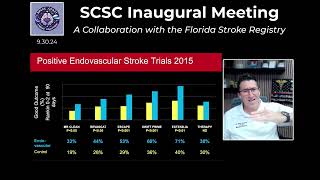
Again. I know this is a little bit of old data. This is, I think this is the last data slide for the old stuff. But this is impactful for me because we worked for two or three or four years to get people to understand that thrombectomy was important. And finally in 2015, that's finally when the endovascular trials all came out pretty much all in a row, saying that yes, thrombectomy is important in acute stroke and therefore this is the moment where things really started to change and you felt like the gravitational shift. And here we are now almost 10 years later, and.
Florida is the first state that has really gone this deep with respect to a registry that is this impactful, that collaborates with EMS and the hospital both at the same time. So what we're trying to do here with the Florida Stroke Registry is now bring in the Space coast into the registry, meaning that all of you will now be getting something that you have never gotten before with respect to these regional dashboards. Some of you may be getting them, I don't know. But now that we're going to get EMS and the hospitals together, the goal is to start today.
This coalition kind of has everybody under the tent primaries, comprehensive thrombectomy, capables, coordinators, administrators, neuro interventionalists. Of course, the EMS physicians, and we'll have quarterly meetings where everybody participates. There's going to be a presentation every single time, and that presentation will be decided based on, you know, who ends up wanting to lead the coalition and who wants to be kind of like, you know, heading up.
The agenda and so forth. And we can just, we can talk about that in, you know, after this meeting is over.
And then what's going to end up happening is that on these meetings, we'll talk about best practices, we will talk about the dashboards themselves. And then.
A little later on today, we'll have the Florida Stroke Registry folks on, on board here. We'll talk about the coalition itself, and they can answer questions that you have that come up along the way.
So I'll let the Florida Stroke Registry folks introduce themselves when they come in.
It's a pretty large group of people and I'll show you who kind of started this whole thing. But the Florida Registry is now, it gets appropriations from the state of Florida to the tune of, I think, 2 million bucks a year. And because of that, they have to basically demonstrate that they're actually providing value. So the state is actually looking at this registry, they're looking at the data coming out of it, and they're expecting publications based on what we're seeing. And our publication is about to get published.
Hopefully any day now. A pretty big publication.
The guy at the top left of the screen is considered a legendary amongst anyone who knows stroke in this country and maybe around the world. Unfortunately, he passed away last year. Dr. Ralph Sacco worked at University of Miami. He was the head of the American Stroke Association. This guy's a legend. And he basically just to kind of get you, how did we get here today? He had an NIH funded grant in 2012 called the Florida Puerto Rico Registry. They were looking at disparities between stroke, between, you know, men and women, different races, etc. And in 2017, that grant was going to expire. That's when somehow or another, we all got connected. And myself and a few other people said, hey, this is a great piece of software you have. Instead of shutting it down, can you transform it so that you could take EMS data and collaborate into the hospital so we can get a registry that actually is beneficial for the whole state? And I got to give Dr. Sacco credit. He said, let's give it a try. And that was how the Florida Stroke Registry was born. We made a number of strides, so much so that in 2021.
The federal government awarded the CDC Paul Coverdale Acute stroke program to the state of Florida, which means we get more money, more support, and now our data goes into a big national database. And that was a pretty big deal. And then that award just got renewed in 2024 for another looks like five years. In that time.
The registry now has almost every single stroke center in the state in the registry.
That was an incredible feat in and of itself, meaning that when you're going to see data in the registry, it's not just a couple of hospitals. You're going to be compared to the other hospitals in the county, other hospitals in the region, and then you're going to be compared to other counties across the entire state. So you're going to see for the first time, how do you add up as a hospital system?
And of course, EMS is involved in that. But how do we add up for community stroke care compared to everybody else in the state of Florida with specifically 11 different metrics? And I see that we have Jillian from the stroke registry joining right now. Oh, here comes Carolina. Perfect. All right. Hi, Carolina.
But we're happy to be here, and thank you for letting us join late.
This is your inaugural meeting. I'm super excited for that.
Yes, I kind of gave some background. Would it be okay if you took over and just gave everyone a little bit of background? I gave them some overall background, but if you wanted to dive into the stroke of liquid model, that'd be good.
I can do that, Jillian. And then if you want to, as soon as we get to the dashboards, I can. I can hand it over to you. Does that work for you as well, Peter?
Perfect, perfect.
Perfect for me.
Thank you. So I was. I'm happy to give you all this quick overview of the model. And thank you again, Peter. I think the. The main point of this is that the Florida Stroke Registry didn't invent stroke coalitions. We're not trying to say that, but thanks to the. The collaboration with Peter and with folks out of Broward for Palm beach, many, many years ago, and of course, Dr. Sacco, who was involved way back when, there were already coalitions that were existing, but they came to the table to the Florida Stroke Registry and said, we would like to get together in a certain kind of way and really focus on quality improvement. And the quality improvement that we want to do needs to be directed by tracking and measuring tools. And so as a Florida stroke registry, we capture data predominantly from hospitals. And so the idea was to be able to collect this data locally, particularly within Broward, Palm beach, and those specific areas that have stroke coalitions and begin to offer these report cards or dashboards to these coalitions, the seven that you see below. The reason why they all look kind of alike is because we in the Florida Stroke Registry, we have a website where we offer each of the coalitions that have been formally formed a place on our website where they can show meetings like this one, talk about the next meetings that they're going to have, talk about anything that they'd like to as a coalition and, or share with other coalitions. But the model in particular has to do with again, volunteerism and service specifically to your local community, focusing somewhat primarily on quality of care. And of course, each coalition has its own needs and own focuses that go outside of this. But if that's a specific focus, then of course you can use our FSR regional dashboards. Those are made up of 11 measures. And soon what Dr. Gordon Peru is going to talk about are the two extra measures that were soon to disseminate to you all. The door in, door out. Of course, Dr. Antevi was part of that task force and a few others from around the state, but the regional dashboards, again, she'll get into it. There are 11 measures now, soon to be 13, that have been defined by our advisory committee. They're specifically reperfusion measures and measures that are important to both PSC and Comprehensive Stroke Centers and, and very important to our EMS partners as well. Another aspect of the stroke coalition model is that we work towards data transparency. So we like to have hospitals and EMS at the table and through some of the FSR's new initiatives. We also like to include community health workers and others, other stakeholders that are important in directing some of these initiatives and interventions. But data transparency is a huge piece and thanks to Dr. Anteby pushing this, FSR is trying to make this happen. Let me move on to the next slide because I might be talking about things exactly from the next slide. So you're seeing these little images here. These are the seven stroke coalitions that we currently recognize as through fsr. Again, lots of stroke coalitions exist and we're trying to collect where else they may exist beyond these areas. But these are the ones that are abiding by and following that model and to some degree adding characteristic to that model that might be specific to their area. So nothing is set in stone. It's just that this general model works. So far, for the past I think we've been around, these coalitions have been around at least for seven years. And some of the original coalitions beyond fsr, like for Example, the West Central Florida Stroke Council has been around for almost since 2001, I think, in Broward. That coalition has been around easily more than 10 years, maybe 15 years, I think. And then, of course, phone D stroke Coalition, which is very EMS specific, has been around for multiple years as well. But so, again, the logos show you the coalitions that are existing and that are currently using the regional dashboards specific to their areas. The little yellow circles and the circle, the outlined area, are areas that are trying to become stroke coalitions. And what's specific about the one in the Tallahassee area? It's very interesting because they do not have necessarily hospitals other than their main hospital. So this may be a new model, one that involves some of the freestanding sites. Your area is obviously to the right of the yellow stuff, which would be the Central Florida Stroke Coalition. Again, also kind of led or maybe nudged by Dr. Antevi. So we're looking forward to seeing yellow in the. In the counties that you guys are interested in. You can go to the next one. Thank you. So now I'll hand it over to Dr. Gordon Peru and wherever Dr. Anteby would like to step in as well, because you are a huge part in these becoming a reality.
Yes.
Thank you so much.
And so thank you, Dr. Gutierrez. As Dr. Gutierrez just said, this has been really led by grassroots efforts. While stroke policies and standards are global, what happens on the ground is local. And so it's really important that ems, the emergency room physicians, and FSR own this process for what happens to us locally. And so this is focused on quality improvement, improving triage of patients for the delivery of stroke, and then making sure that hospitals who are doing well get credit for the work that they're doing. But in that process of transparency, feedback to ems, additionally, by talking about these through stroke coalitions, you can now start discussing best practices and applying those. If something's working really well in one hospital, maybe it would work well in your hospital as well. And you can, in a real sense, see how you're measuring up and benchmarked not just against what your system of care is doing, but what another system of care is doing, what the state, county, and really the national benchmarks are. So if you go to the next slide, this is our current dashboard, you'll see that there are 11 reperfusion measures. This on your right is a snapshot of what it looks like. I'll dive deeper into each bar to explain it to you. And you can see there are six thrombolytic measures and five endovascular measures. And then new to us will be two door in, door out measures that we'll get on this first quarter of 2024.
And these really surround timely, quick treatment for stroke. So overall thrombolytic rates, door to needle times and making sure patients have good outcomes, Modified ranking score at discharge with good questions for safety. Looking at the symptomatic intracerebral hemorrhage rate and then for evt, it's door to puncture and again outcomes and symptomatic rates. If you go to the next slide, you'll see sort of a zoomed in version of what this looks like and you'll see our performance over time. So in the first bar, that overall quality of care is actually a Florida stroke registry defined metric where we take all the quality measures and put them together. You'll see in 2010, when Dr. Sakos defined it, defined this, it was low, only about 8% of all stroke patients were getting high quality defect free care. And now in 2023, that number is up to 88%. Similarly, you'll see there's improvements in endovascular therapy, 2% in 2010 and 14% in 2023, which is among the highest in the country. You see thrombolysis treatment rates there are treating those patients who arrive kind of at the end of the thrombolysis window, arriving by three and a half, getting treatment by four and a half has also improved statistically significantly. And those patients, you don't just want to wait until they're about to be outside the treatment window. Right? You want them to come in and everybody get treatment as quickly as possible. So you see those patients that get treatment within 45 minutes of hospital arrival has gone from 6, 6% to 84%. And it's truly been just remarkable seeing what these dashboards have done for improving stroke care here in Florida. And I dare say that Florida is probably the best in the country. This is more details about the dashboard. So you will see.
At the top you'll have your individual hospitals and at the bottom in gray, you'll see the different sort of standardized region. So Florida overall IV TPA treatment rate is 12% with a median door to needle time of 33 minutes. That is incredible. Then you see the breakdown for each individual county. Some counties are faster than others. Broward is probably the fastest at 27 minutes. Door to needle.
All the way up to Emerald coast at 40 minutes. But that's still incredible. Remember, the benchmark is 60 minutes, 45 minutes. By get with the guidelines so still incredible times and the percentage treatment rates varying from 10 to 16%. So yours will be on one of these bars when you start getting your dashboard next slide.
Yeah, I just changed it. You're on EBT now.
Yeah, yeah. So evt, it looks almost the same. So evt. So instead of thrombolysis treatment rates, it's EBT treatment rates. And that's remarkable that the percentages are in the teens. In many parts of the US the EBT treatment rates are 2%, 5%, 10%. This is actually pretty dramatic that we're between 13 and 17%. The door to puncture times still have opportunities in some counties. Remember, door to groin puncture times should be within 90 minutes. So you can see overall in Florida we're well within that measure, 78 minutes. But there are some centers that have some opportunities that are just above that, that 90 minute next slide.
And so new to the regional dashboard is going to be the door in, door out times. And what we're showing you here is the overall medians for the different counties. We're going to be showing you on the dashboard door to needle times for ischemic stroke and door to needle times for hemorrhagic stroke. A lot of the coalitions told us they wanted to see that broken out because what drives your process in the hemorrhagic stroke is very different from what drives your process in the ischemic stroke. Sometimes the hemorrhagic stroke patients need an ebt, sometimes they need intubation and it can take a little bit longer. But this is your median time overall, both ischemic and hemorrhagic compliant. And you can see that the benchmark, the get with the guidelines benchmark should be 120 minutes. And we're all above 120 minutes. The overall median time in Florida is 160 minutes. And you see the fastest time is Miami Dade and Palm beach and then others still with opportunities. Some of this has to do with small numbers and how it's documented. But by putting it on a dashboard and having us have the conversation about this, we can start driving the numbers and improving. I'll tell you, in the last Miami Dade coalition call that I went to, they were talking about their door in, door out times and improving it. And you can see that driving the measures here. So start seeing that on your dashboard so that we can improve that. So how do we get these numbers? Basically, once the hospitals abstract their data and to get with the guidelines, the um, FSR core team will download that Data and clean it, make sure it's good quality, and then develop those dashboards and graphs. These graphs are then put into the regional dashboards.
Which we and you guys are able to access by the FSR Secure website. You would log in using your credentials and then go to stroke coalitions. And there you'll be able to see the dashboards as it relates to both your hospital as well as the regional dashboards. And then the EMS directors can help you guys request unblinding.
So if you go to the next slide, it talks about that transparency piece. So the EMS directors in their special access will be able to see who are the stroke medical directors for that vision, who's a stroke center, who's a stroke coordinator. And then each hospital tells you what their letter is. Each of these bars, the orange and blue and aqua, represents a different hospital. For example, I'm in Jackson south. So for that dashboard, my letter is F. So you would then be able to see as an EMS director and as a region, you know, hospital F is doing this. Hospital A, B and C are doing that. And how it compares by volume and by location.
Okay. And I think that's important, and we didn't really go over that just yet, but the colors of the, of the bar of the graph is related to the volume of patient that you're seeing. Right. So think of it as small, medium and large, low, medium, high volume. So, yeah, if you wanted to just describe that a little bit too, that'd be great.
Sure, sure. So the volumes are based on actually the number of ischemic strokes that are taken care of by that hospital per year. The larger hospitals may be comprehensive, but they're not necessarily right, depending on your location. So the first bars, the set of oranges will allow you to see if I'm a small volume hospital, how well am I doing with regards to other hospitals of my size compared to the state and the region and so on and so forth. Because it's not just the level of acuity that you can take care of, but also your volume. Does that make sense?
So if we go to. Then of course. So if you go to the next slide, this is how to contact us. There's actually. Go back one. There's actually a manual that Dr. Gutierrez and team has made that actually walks you step by step through how to get access to this stroke coalition.
Website webpage, how to get set up and how to utilize it. I'm sure she's happy to share it with us, with us all. It sort of walks us through step by step through getting access to these dashboards. And typically what happens in the coalition calls is that the dashboards are shown and we discuss how to improve the quality of care in your region.
And I'm happy to share this with everybody after the fact, after the meeting today, but that's great to know that we can disseminate this document.
Yes, yes. Okay. Dr. Gutierrez, you want to come back? We can talk about the stroke coalition.
Sure. I can run through this real fast. It's really just to again, congratulate you all for coming together and to let you know that you have a lot of power here. We're developing, and I know not everything is about power, but if you need change in your local community for things that are important for the quality of care, just being able to get together and strategize and organize is super important. And obviously, through the fsr, you have a vehicle to the state to tell the state there's a gap here. They need a little bit of help here, or they're doing amazingly here. I think this is the value that we've seen with the stroke coalitions. There's been requests through some of the clinicians and of course, the community in general for. For improvements in this whole quality of care piece with regard to certifications on hospitals. And so back in 2017 is when some of the hospitals got together and said, well, actually, yeah, it was 2017, and they actually developed policy for requiring that all hospitals that are going to see stroke patients that they become nationally certified. I have my dates wrong. It's actually 2021. And so in 2021, a group of the. A group of the advisory committee got together, went to legislation and put together some data from the fsr. And this kind of legislation became a reality thanks to these stroke coalitions and thanks to their participation in the fsr. That's the very last piece there, the systems of care piece, and actually the 2019. I also want to remind. Yeah, that's okay. We can move on to the next one. I also want to let you all know of a new initiative, which is our coalition of coalitions. We had the first meeting at our annual FSR meeting in August. The idea is to bring together all of the coalitions. You saw seven of them, now you're going to be eight. Come together at an annual meeting in person. If you want to come in by virtual. We also had a virtual option, but to basically talk about what's going on across the state in these little clumps of groups. What's a goal that you that those clumps of groups are having if they're similar to others. What we found, you know, we've been having these annual meetings for the past 12 years. Next year it's going to be 13. And what we found is that many of our stakeholders are saying, I've seen that name before. I know about these hospitals in the north or in the south, but I don't really know what they're doing. And the same is true for the coalitions. As coalitions become more of a normal thing in the Florida Stroke Registry, those coalitions are saying, I want to know more about what they're doing in the West. How are they accomplishing the things that they're doing? So that's why we put together this coalition of coalitions. Meeting the in person was very successful. We talked about the goals of the different coalitions, some of the barriers to their successes, and one of the barriers that they've encountered is just really membership engagement. It's hard, I'm certain, for you all to find the time to get together at all these meetings. But, you know, getting together can be super important and valuable for the kind of things that you need locally. So we're trying to help with that organization of the meetings. Peter knows just the administrative aspect of getting you guys together. Even though there's only a group of 17 here, could grow to 50, and even the 17, you all are super busy people. So FSR is trying to see if we can step in and help with some of that administrative aspect to get you all together again. Yep, absolutely. With the website to be able to give you information, that's a local place where you can find it, and then opportunities to collaborate across the state, maybe with another coalition nearby you, or with the entire seven coalitions across the state. There's different things that we can do in collaboration as an entire group. So this is a new thing, and we hope that this inspires you, encourages you to be part of this new coalition. We're super excited and happy to service you in any way that you need. I think that's it. Yes. Yeah, I tried to go through that fast. Peter. I know we. We end up talking a lot when we have the opportunity, so I'm sorry if we rambled on too much.
No, no, that. No, that was perfect. And because you guys came in after your other meeting, would you mind just making introductions as well? Both Carolina and Jillian, just to let everyone know who you are because you're so, so important in this whole process. I didn't want to minimize that. So Carolina And Jillian, go ahead, make some intros.
Thank you. Thank you. So I'm the one with the short brought black hair there. I don't have my camera on right now, but next to Dr. Romano, if you all know who he is, top row to the left. I'm Carolina Gutierrez. I've been part of the Florida Stroke Registry at all levels and happily and very proud to be a part of it. Now as the associate director next to Jose Romano, I work very closely with Dr. Sacco, and I think I understand the vision that started the Florida Stroke Registry, and I hope I can maintain the vision that the clinicians, the community and others have. So that's who I am. And Dr. Gordon Peru, I would say.
Dr. Gutierrez is a key driver of all things FSR. I'm sure everybody agrees with me when I say that, and I'm just thankful and grateful to work with her every day. I am Jillian Gordon Peru. I'm a stroke neurologist by training, and for the fsr, I'm the director of the Education Core. So we have multiple cores, as you saw on one of the earlier slides. And really what we're doing is transforming data into action. So if our data and our publication shows that there's an area that needs quality improvement, sometimes you guys don't have time to make.
The materials, the educational materials that is needed, we'll help make them with you for you, working alongside you so that you can then use it in your local region. So if you go to the Florida Stroke Registry website, there's a lot of videos there on stroke awareness, for example, and we're working on a few more things that I'll keep in my hat until a later date. But really the aim is to transform data into action and to impact the entire stroke system of care. So we are thrilled and excited that you guys have started this in the Space Coast Coalition area.
Well, thank you. Thank you both Dr. Gutierrez and Gordon Peru for. For joining us today. You guys have really led this registry in a direction that I only dreamed of many years ago, and I never thought we would get to where we are. You take one or two minutes to talk about the upcoming publication, which is so impressive. And I know that some of the data was discussed today, but can you tell us when that paper will be coming out and a little bit about it?
Yeah, we. We submitted it to Stroke, so fingers crossed it doesn't come right back to us, but who knows? Those things happen. And then we'll submit it again somewhere else. But in a nutshell, without having any data maybe that could be the next. At your next meeting we can have the co author, which is Victor Delbruto. We can have him come on and show you some of the data. But basically we.
More from Peter




Melissa Olen MSN, FPN-C, CCRN: Sudden Cardiac Arrest Training in Schools (Project ADAM) 4/25/25



Pediatric Hospital Readiness: How Teamwork & CPR Metrics Drive Better Outcomes



Chelsea Kadish, MD & Kyle Goodknight, EMT-P, RT: Pediatric CPAP in EMS (3/14/25)