Sriram Ragopaul, MD: Midazolam IM vs. IN in Pediatric EMS (5/10/24)
Dr. Sriram Ragopaul compares intramuscular and intranasal midazolam for seizures in children in the field. The discussion covers efficacy, safety, and practical considerations for paramedics choosing between the two routes.
Chapters
All right, welcome Everybody. It is May 10, 2024. We have another amazing guest today. We really appreciate everyone's participation. If just for those who are listening and watching now, all of these videos go onto our Florida NAEMSP YouTube channel. We have over 160 talks and they've gotten over 25,000 views. So.
A lot of people are listening. Wherever I travel around the country, people always tell me about this particular webinar series. And today is going to be another great one. So we have the very great pleasure of having Ram Ramgopal here. He actually trained a PIT at UPMC at Children a few years after me. He trained there for residency and then he did his Penn Fellowship there and now he's at Louis Children's in Chicago doing Pam and working with people that we know. Sylvia Remy, Chris Martin Gill.
I don't know who Musashi is, but I follow him on Twitter. But Rahm, if you wouldn't mind making a further introduction telling us why you got interested in ems, telling us more about yourself. But first, thank you so much for joining us. Thanks for contributing to the evidence base and take it away, my friend.
Thanks for having me. Can you guys see and hear me? Okay, you can see the slides. Perfect. Perfect. Well, first of all, yeah, thanks for having me. Thanks for the introduction. Peter My name is Sriram Ramgopal. I am at the Ann Robert H. Lurie Children's Hospital of Chicago. I'm an attending in Pediatric Emergency Medicine. As Peter hinted at, I graduated from my fellowship in Pediatric Emergency Medicine at UPMC and Children's Hospital of Pittsburgh, where I still continue to collaborate with many folks there, including Chris Martin Gill. Sylvia was one of my attendings when I was a fellow there. Remly Crow, Everyone here probably knows from eso, she's been a great asset to the EMS research community massage. She does a lot of EMS related work, including in pediatrics. And so he and I have connected in the last few years as well. So I love this research group and it's been a great joy to work with them. You asked me to talk about what draws me to EMS and pem. I started getting into this when I was a fellow in Peds Emergency Medicine, where I was looking for research opportunities and I was suggested to meet with Chris Martin Gill and he of course is a medical director for a large number of EMS agencies in Western Pennsylvania. And he does a lot of research in many domains in ems, but seems to have a soft spot for pediatrics too. And so he and I connected and it was that joy of that research connection that got me more, that pulled me more and more into ems. I think the work that EMS does is so important and so critical and I just love that, that idea that like, you know, it's. They're the first boots on the ground, the first people assessing a patient. And all the downstream effects that occur from that initial encounter are so critical and often overlooked, honestly, since a lot of research in the acute care setting starts in the hospital and so it kind of like crops out the EMS part of the encounter, which is unfortunate. So that's how I kind of got hooked into this.
So I. My work is supported by the Pediatric Pandemic Network. They're sponsoring a risk prediction model I'm doing in the pre hospital setting for children encountered by ems. And I have no conflicts of interest to disclose.
So seizures are common in children. There was a paper published in 2012 in Pediatrics by Russ and colleagues. The authors used a national survey of children's health and they estimated that the prevalence of epilepsy or seizures in children was about 1%. So like 1 in 100 kids has had at least one seizure. And the current reported epilepsy and seizure prevalence was about 6.3 children per 1,000. And epilepsy and seizures are more common in higher sorry are higher in lower income families and in older children and in males in the space of pre hospital care. We know of course that pediatric calls only account for about 1 in 20 EMS encounters in general. So they're pretty infrequent events overall. And as a result there's limited training provided to paramedics both in their formal curriculum and their on the job experience. If only 1 in 20 encounters you have is for a child, you can never get that comfortable with taking care of a child in the pediatric setting. So of that 6 to 10% of pediatric EMS calls, about 10% are for neurologic conditions of which of course seizure is the largest majority of those. We're kind of talking about 1 in 10 out of the 1 in 20 calls is for a seizure disorder. We recognize that the prompt treatment of seizures in the pre hospital setting or in the ED setting has important downstream effects. The longer we wait to treat a seizure, the harder it is to stop. If a seizure is not stopped within those first five minutes, that's how they redefine status epilepticus over the last few years, when it was originally a very generous 20 minutes. If you extend beyond five minutes, then the chances of getting the seizure to resolve as rapidly start to decline. A prolonged seizure risks of course, respiratory failure, airway compromise. And there have been some high quality studies that have shown that a seizure that continues through the ED encounter and prolonged status epilepticus increases the risk of a child needing a prolonged IV infusion to shut down their seizure and also increases the risk of inhospital mortality. There's important downstream effects that occur if a seizure is not promptly treated. And of course, as the first people at the scene, EMS can play a really critical role in ensuring a good outcome for the patient. That may not be as guaranteed if the seizure is allowed to continue by the time the patient reaches the ed.
Nevertheless, despite the importance of seizures in the pre hospital setting, there's a lot of ambiguity about the best way to care for these in the pre hospital setting. Manish Shah in 2014 published a grade study where they reviewed existing evidence for the pre hospital management of seizures. They came out with several strong and weak recommendations for the care of seizures and they recognized that nearly all the recommendations were supported by low or what they called very low quality evidence. The only real recommendations that they could strongly recommend were that blood sugar should be checked and should be treated appropriately with glucagon or intravenous dextrose. And they also recommended using a non IV route for the management of an acute seizure of a benzodiazepine. Instead of using like the buccal. I'm sorry, instead of using the IV route they recommended like a buccal, intramuscular or intranasal route when possible. The Pediatric Emergency Care Applied Research Network or pcar and published research priorities for pre hospital care and they ranked seizure in terms of their priority list as number eight. So, you know, getting recognition that this is an important area that needs more research.
We know that giving more benzodiazepines is not a good thing and it increases the risk of adverse outcomes for a patient. This was a study that Chris Martingale and I published in 2023 where they looked at. Where we looked at data from 2019 to 2021 using the NEMSIS database for all children with an impression of Seiz. There was about 360,000 patients with seizure in that data set. And among those patients that were treated by ALS, 10% received a benzodiazepine and of those a single dose was adequate in about 77% and the remainder additional doses were given this table. Here is a slice of that paper. It demonstrates that as patients got increasing doses of benzodiazepines, they needed more advanced airway interventions, basic airway interventions. They required supplementary Oxygen more frequently, they obtain IV access in the pre hospital setting more frequently, and they more frequently had a documented oxygen desaturation. Now, of course, whether these effects are from the seizure that was ongoing or from the additional doses of medications that were administered, it's hard to know and it's probably a combination of the two.
There's also a lot of variation in pre hospital protocols. One paper that we published in 2021 reviewed 35 statewide protocols where we could access.
Where they were publicly available or we were able to reach the individual state EMS directors to obtain them. We found that 12 states recommended midazolam over other AEDs. And 32 states allowed the use of any midazolam in their protocols. And 77% of the states allowed for the use of intranasal AEDs. And most of the states that we saw recommended that of blood glucose be obtained.
This is just a screenshot from that paper. You can see there's a ton of variation with respect to how individual states recommend seizures be managed for children in the pre hospital setting. I'm not going to dwell on this for too long just to kind of show you the wide variation in care with respect to nasemso, which as we know, involves many partners, including ASAP and emsp. American Academy of Emergency Medicine includes the American Academy of Pediatrics. These are the guidelines for the recommendation of seizure. It's a single guideline that applies to both adults and children. They recommend the intranasal or intramuscular route over the IV and IO route and the per rectal route as an alternative, which is, for the record, not very commonly used. In any case.
The doses that they recommend if you have iv access is 0.2 milligrams per kilogram. And if you, I'm sorry, if you don't have IV access is 0.2 milligrams per kilogram. So it's a slightly higher dose. If you have IV access, the recommended dose is 0.1 milligrams per kilo.
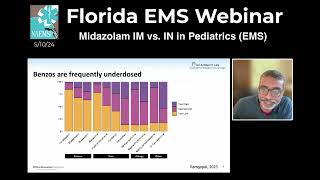
Despite this, you know, the availability of national guidelines, there tends to be a lot of variation in how it's actually administered in practice. This is a figure from a paper we published in 2023 using that ESO data set, looking at 990,000 pediatric encounters. And we found that the medications that were most frequently inappropriately dosed according to the semiso guidelines were for benzodiazepines. And of course you can see midazolam is right there. A lot of the benzodiazepines are underdosed in the Majority of cases and occasionally they are overdosed. There's another paper from Michigan that looks at the same thing. Looking at a statewide data set, they looked at 9,000 pediatric encounters. They found that the doses that were most frequently inappropriately dosed were for fentanyl and morphine and midazolam was number three. So a lot of studies are showing that.
AEDs are usually underdosed in the pre hospital setting.
So that brings us to the present study. I am a big fan of large data sets. I think they're very effective tools to retrospectively evaluate patient care. And that is particularly important in pediatrics when, as we mentioned, they don't occur that often to study in prospective ways as easily. Our objective was to evaluate the association of midasolam administration routes with the need for additional benzodiazepine dosing in pediatric seizure management by ems. And this obviously gets to addressing the variation that we just reported in pre hospital pediatric seizure care and may help to facilitate the development of guidelines. So we performed a retrospective COHORT study.
Using U.S. multi agency EMS data. From the ESO data set, we looked at the timeframe of 2018 to 2022. So it's a five year timeframe. The ESO dataset for those who are not familiar is.
A data set that is constructed by the ESO folks. It's a EHR for the prehospital system and the ESO company makes a subset of that data available for research purposes. So it includes approximately 2,000 EMS agencies.
We included all children transported to the hospital with an impression for seizure and who received correctly dosed midazolam by the intramuscular, intranasal or intravenous or IL routes. So this is different from prior studies where they were not able to assess the appropriateness for dosing for range and we were able to look at that more small slice of patients who did get the appropriate dose. We specifically excluded EMS encounters that did not arise from the scene in non transports.
Our primary exposure of interest was the route of midazolam administration. And so we looked at the intramuscular, intranasal and intravenous routes. Our outcome was the need for any additional doses of benzodiazepine. So this of course, our true outcome would have been persistence of seizure. However, when you're looking at retrospective data, I think this is one of the unfortunate compromises you have to make. So. So the requirement for an additional dose of benzodiazepine implies that there was concern for persistence of ongoing seizure, although it's not a direct way to it's not a direct way to assess if that truly is occurring or not. Many things can, of course, impact the provision of additional doses of benzodiazepines. So we constructed adjusted regression models, and those models were adjusted for level of consciousness, vital signs during the encounter, pulse oximetry, and time spent with the patient. And our approach was multivariable logistic regression. This is our inclusion diagram. You know, the ESO database is quite huge, and when you start to aggregate years, it becomes even more huge. So, you know, there's 48 million encounters that we initially started with. We excluded those with the missing age adults. We excluded BLS encounters because usually the provision of AEDs is not in their scope of practice. We excluded things that were not classified as 911 seen runs. So primarily our goal there was to exclude interfacility transports. And then, of course, we included encounters where the EMS unit did not directly provide care. From these, we identified the ALS scene runs, and from those, we identified encounters for which there was an impression of seizure.
We subsequently applied exclusion additional encounters. Of course, if you never got midazolam, we're not interested in what happened to you in this study. So those patients were removed. We excluded patients who got intraossis midazolam, and then we excluded patients for whom we could not calculate the. We could not calculate the appropriateness of the dose for weight or if the dose was inappropriate for weight. So, you know, you start with 48 million patients, you end up with just 3,000, which is kind of typical for these types of studies.
So our Overall population was 2,923 encounters, of whom the initial dose of midazolam was given by the intramuscular route in 1354 patients, that's 46.3%. The intranasal route in 637, that's 21.8%, and the intravenous route in 932, which is 31.9%. The table on the right here illustrates some of the demographics of the included sample. The median age in this sample was three years, with an interquartile range of two to seven.
So we looked at how long it took from the initiation of EMS arrival at the scene to actually give the first dose of benzodiazepine. And we can see here that the time taken for the intramuscular and intranasal routes was pretty similar. It was about seven and a half minutes for both versus the intravenous route, which was 13.1 minutes. So substantially longer for patients for that to receive their initial dose. Of benzodiazepine by the intravenous route.
2297 patients got a single dose of midazolam. That's about 78% of the sample. And 626 in the sample received more than one dose of these. Two doses were given in 79%, three doses in 16%, and four or more in 5%.
As I mentioned before, we adjusted our models for other covariables that could be associated with the provision of additional doses of benzodiazepine diazepine. So these are. These little. These little snapshots here show the results of what's called splined regression models. So we looked at each of these variables as a continuous measure because there's not a single way to categorize them that makes a lot of sense. And so these show the association of those variables with the outcome of provision of additional dose of benzodiazepine. So you can see that if EMS is spending more time with the patient, the probability of EMS having to give benzodiazepines naturally increases. That's not a surprise there. It kind of fits with what you might expect with common sense. And then there's associations with vital signs that can sometimes be non linear. For example, a low heart rate or fast heart rate can be associated with receipt of additional benzodiazepines. A very fast respiratory rate can be associated with additional doses of benzion benzodiazepines. And then if a patient's desaturating, they also have a higher chance of receiving benzos. So, you know, for the vital signs of heart rate, respiratory and oxygen saturation, we looked at it in three different ways. Initial vital signs, the maximum of that vital sign, and the minimum of that vital sign during the entire encounter. And then from each of these groups, we selected just one, based on a statistical procedure called the EIKI information criterion. So we only adjusted for one heart rate, one respiratory rate, and one pulse oxygen.
These are the unit variable results. Looking at the association between route of administration of benzodiazepine and receipt of additional benzodiazepine, you can see here that actually nothing reached statistical significance. The odds ratio for intranasal benzodiazepine was 1.23. So there's something there to suggest that patients who received intranasal midazolam had a higher chance of receiving more benzodiazepines. The odds ratio is 1.23. The 95% confidence interval is 0.99 to 1.54. And through the intravenous route, it's 0.82. With a 95% confidence interval, it's 0.67 to 1.02 in the adjusted model, the results did become significant. So you can see here that the route of administration.
Suggested that patients who got the intranasal route had a 1.39 higher odds of receiving additional benzodiazepine compared to those who got it by the intramuscular route, which is kind of the reference group that we used. And with intravenous, the odds ratio is 1.00. So these findings would suggest that patients who received intranasal midazolam as their initial AED had a higher odds of receiving more benzodiazepine during their initial encounter. Even after you adjust for their lowest level of consciousness, age, heart rate, respiratory rate, pulse oximetry and the time spent with the patient. We also performed additional analyses. I think we're running a little tight on time, so we want to have time for questions to. But.
These were not always significant to kind of keep it short, but they kind of pointed in the same direction. So if you look at patients who had a longer EMS transport, we're looking at 40 minute transports. There were 778 encounters. The odds ratios here all crossed one, so they did not strictly suggest statistical significance. The odds ratio for.
IV midazolam was 1.04 and for intranasal route was 1.56. But the confidence interval was 0.95 to 2.54 for encounters with an EMS clinician impression of status epilepticus. So, like if the EMS clinician specifically stated not just seizure but status epilepticus, the point estimates were again similar to the primary analysis, but the confidence intervals crossed 1. Again, the sample size was a lot smaller. It was only 836 patients. We also looked at alternative IV dosing. Regimens. So I will note that the dose of IV mitazolam that's given in the Stemso guidelines is twice the dose than is recommended for the intranasal or intramuscular routes. So when you, when you convert IV or when you keep all dosing the same, which is how it is in Lexicomp and other formularies. Our findings suggested that intranasal midazolam was again associated with the higher odds of receiving benzodiazepines compared to the IM route. So the odds ratio is 1.41 with a 95% confidence interval of 1.11 to 1.78. So our findings suggest, you know, within the context of this multi agency retrospective study, at the Intranasal route may require more frequent additional dosing of benzodiazepines by EMS for patients with an impression of seizure. There's a. There's been a lot of rich qualitative work that suggests that paramedics suggest that there might be benefits with giving the intranasal routes. They don't like to hold needles near a patient that, you know, is obviously a cause of concern. You're talking about a patient who has a seizure. But other paramedics in, in that work have also suggested that they have concerns about the efficacy of the ion route in prior research. So in terms of that prior work, there's been some of both perspectives that we're seeing. Our study can be interpreted in the context of another great study that was published in 2022 in Pre Hospital Emergency Care by Whitfield et al, looking at a sample of kids that were less than 14 years of age. And that study actually found very similar results from a sample of 2034 patients. They again found that patients who received intranasal midazolam had a higher odds of receiving additional dosing of that medication compared to those who received it by the IM or IV route. Potentially, if these findings can be more extensively studied, they could impact the use of the preferred route of midazolam and EMS protocols.
You know, there are some important limitations to consider. This is a retrospective study, and so there may be errors in the charting of data by ems. And so we're kind of limited to what we have available. Case ascertainment, of course, is going to be a challenge. And, you know, you're trying to identify patients who had a seizure. And so we looked at patients who had impressions of documented seizure or status epilepticus. There could be potentially other patients who we missed by using this approach. For example, if there's altered mental status or somnolence or some other finding that might guide the impression we might have missed patients based on that. Optimal weight based dosing, as we discussed, is different based on the route that's given in the guidelines. And of course, exact protocols can be different based on your agency and locality. And we weren't able to look at specific differences in EMS protocols and their impact on seizure cessation.
There's been some interesting research that shows that paramedics have difficulty sometimes to assess if seizures are ongoing or not. An excellent paper that was published in Pre Hospital Emergency Care that suggested that a large number of patients who had ongoing seizures were not recognized by ems. You're counting on the fact that EMS is recognizing an ongoing seizure. And so they're giving an additional dose of benzodiazepines based on that. But of course, it can be hard to know in real life if a patient is truly seizing or not.
That wraps up what I have here. I just wanted to give a shout out to Remlee Crow, as I mentioned, who made this data available. And she knows it very intimately and has been an excellent resource. And I'm always grateful to have the chance to work with her. And to my primary mentor slash partner in crime, Chris Martin Gill, who has gone on all these great adventures with me. So thanks to those two. And there's my email address if anybody would like to reach out to me after the fact.
Amazing.
Wow.
What a great presentation. And I'm like sitting here scribbling a lot of notes because I'm going to go back and look at your other papers. I have a few questions to start. And I'm sure we have an amazing group of people here today who are many of them leaders, respective leaders in their own organization, and I'm sure they have a lot of questions, too. I'm going to start. So, impressive numbers. 48 million overall records. What I was interested in is that I saw in the chart that the total patients in Your study was 2923, 2923. But then I saw that 8,388 were not included because they were dosed inappropriate for their weight. And my question is, did you use the 0.2 per kilo dosing regimen? And why were those other ones inappropriately dosed? What was it specifically that counted them out there? It is.
Yeah. So we used the. Yeah, that's a great question. So first of all, we have, we defined appropriate dosing for weight to be based on the SAMSO guidelines, which I showed in that screenshot earlier. So that's 0.2 mgs per kilo when you're giving it by the IM or in route, and it's 0.1 per kilo when you're giving it via the IV route. So they're not exactly equal dosing. In the ESO data set, we are able to.
Look at the patient's weight, which in some cases may be estimated or it might be ascertained by asking parents. So that in itself may be a limitation. But where there was a documented weight, we were able to calculate if the dose of midazolam was appropriate for the patient's estimated weight. And as you can see in this figure, in a lot of patients, it's underdosed.
Okay. So basically, in a large preponderance of patients, 83, 88, they were not dosed. More than likely underdosed is what you're saying.
More than likely underdosed. Yeah.
Which is probably a product of the protocol. I'm just guessing the protocol calling for 0.1 versus 0.2, which I see a lot of. In a lot of protocols, they just underdose the in and IM route. But in your study. Okay, so which means that in that study, if you were to look at those patients, more than likely, many more of them would have probably required redosing. But in your study of the 29, 23, all those patients got the correct dose and they still needed 40% of the time redosing.
That is correct, yeah.
Wow. Wow. All right, I know we're coming getting close on time, But I have two people, so. Dr. Pepe, Paul, go ahead, please make a comment.
Yeah, yeah. Hey, a couple things. First of all, fantastic stuff. This is actually supports a lot of things that I'm very interested. I have a background neuro, sort of in critical care. Neuro, critical care. So any event, one of the things I want to point out is we're used to using the term AED there for antiepileptic devices. And of course, in our realm, when you're speaking to EMS people, you know, make sure that you clarify that that's what you're talking about when you say an aed. So just a small point, because I think some people do know, but not everybody may know. One thing I'd like to point out is that we have been doing some other research in this arena, and we're also seeing that the only cases that might have even failed in status syllabticus were using in routes again, and maybe that was slower to work or whatever it might be. So this is sort of complementing a lot of things that we're seeing. So. Good. Good on you. So I. There's three references, and maybe you can get them to Peter that I'd like to have is besides the Whitfield reference, I'd love to have this paper you have. And then also the previous study you did where as you get more doses.
You know that. You know, as you get more doses, you have more complications. So that would be really fun for me to get. I just have to go right now. I'm running another meeting, so. But those were kind of good things.
I'll get you those, Paul.
Yeah, and I had those because that would go along pretty well with some of the things that we're, we're finding now under those circumstances, which is really fantastic. So thanks for the great work that you're doing here and yeah, thank you. Okay, so I'm trying to, I think that was it for now. So I'm sorry, I gotta go. Okay, take care. Bye.
Bye. Yeah, we'll see on the other side in a minute. Let's get to Dr. Wayne Lee. Wayne, go ahead.
Dr. Ramgopal, Dr. Lee here. Listen, thank you for what you do and thank you for that presentation. You know, I'm a real simple guy and so if I look at this, you know, it develops a little bit of a conundrum for me. On the one hand, my knee jerk is, gee, let's just. And I use these, these, you know, these conferences in teaching the paramedics, etc. But if I look at this, I say, well, gosh, let's just tilt toward im it looks like that works better, it works faster. The problem that you alluded to, which I don't know if we know that's real or not real, is that the paramedics don't like to do that because of fear of puncture wounds, et cetera, et cetera. So my question to you is, and so it seems like you're weighing the. On the one hand, if we give it intranasally, we have a greater chance of prolonged seizures, recurrent seizures, and having to give it again. On the other hand, in theory, the question of if we give it im, it works faster and is more efficacious. However, the it may, we may end up with, end up with injured paramedics, in theory. So it seems like to me we're weighing one against the other. How do you address that?
I, I personally, I think the, the fears of giving the IM drug to a seizing patient might be overstated. But that said, I think it's different when you're on the scene taking care of a patient who's actively convulsing. If you can do it as a two person team, one to hold the patient, the other to administer, I think the risk is, is not very high. If you're doing it by yourself, it might be, it might be different. In my personal experience, I don't do EMS runs. I work in the emergency department. When our nurses are giving intranasal, my dazzling. I swear, half of it gets like, like snotted out. And so, you know, because they're seizing, they're shaking. It's also hard to give an in drug to a patient who's seizing. And I think a Lot of it gets wasted, and that's why they're not getting the full effect of the drug in practice.
And so that's where I think the real difference lies.
So let me ask you something. And intuitively I would think that's true. You know, in my years, I've never seen that. I can recall a medic that was, you know, punctured, you know, during medication to a seizure patient. However, I don't know that we know the answer. Has anybody ever looked at that? Or should they? Is that a real concern or not is my point.
I do have some notes here that I wrote down. I don't think I said them, but it's all qualitative research.
The, the first author name is Carrie.
I don't, I, I think it's, it's perceived safety. I don't think anybody in that qualitative study specifically reported having a needle stick type of injury. But that, that's a good question. You know, I think my opinion, other people's opinion is hard to assess, how often it actually happens without real data.
So the comment I'll make, Wayne, is that there was a study and I think. Sriram, you. Have you mentioned the paper? It was Manish Shah. They did a paper.
A few years ago when he was in Houston. And out of all the patients who were actively seizing in the back of an ambulance in Houston, Texas, only 50% of them receive a dose of Mediterranean. That means that the era of omission, which kind of, Wayne, goes to your point where, hey, if you tell a paramedic, we don't want you to give intranasal anymore, only im, and there's fear of what have you, they're just going to say, you know what, I'm only two minutes away from the hospital. We've heard that line before. And they bring in the patient to us in the emergency department, still seizing and not having received the drug, because then it's not an error and they can't be pinned for that. So, you know, I have a sense based on the number of patients that you showed in your, in your graphic that only 10% of those patients even received the benzo. I have a sense that there's a lot of patients in there who probably should have received a benzo but just didn't because we do know most of these seizures and kids resolve before we get there. I get it. But do we really think the number is 90% of the time they're resolving or that we're missing a whole cohort of patients who are not getting the medication because of fear or what have you. So it's a great question, Wayne, that you asked and there probably needs to be more qualitative research on that to figure out the real answer there, you know.
Yeah. I think in the meantime I this is very useful. And you know, I think to me it seems like let's lean toward I am with and put in as much safety as possible, you know, to do that and, and maybe try to alleviate their concerns with regard to that. However, I would agree that a needle wound is, you know, problematic. Probably not threatening in this case, but problematic. Thanks, Peter.
Right. And also the other thing I would say, just because I look at a lot of, a lot of protocols, is that the dosing for pediatric seizures is not correct in many of them. Many of them have 0.1 per kilo, all routes, I, M, I, N, I, V, I, O. And as many times as I send people the evidence based guideline that you described earlier.
You know, changing an EMS protocol and getting people to do that is tough. Then you have the shortages. People carry one and one, then they carry five and one. So it is very confusing. Which is why I think that the underdosing and errors that you're seeing that you reported are very prevalent in kids.
On another note, it's not so easy in adults either. And you see the same problem in the adult side where Rampart recommends 10mg IM. And the author of Rampart, who was at NEMSP last year, stated that only 4% of EMS systems use the rampart dosing of 10mg IM. So this is a major problem. Midazolam is a major problem in both pediatrics and adults. But your presentation was wonderful. Thank you so much for joining us today. I'm going to give you the last word. Sriram. So you have a lot of really smart people on the line. What would you leave us with as we head over to Dr. Peppy's webinar?
Oh, wow, that's a heavy request. I think I personally believe that the in route has a lot of challenges, even though we would like it to work better than it truly is. I think there's fantastic research being done by Manish Shah to sort of look at this more prospectively and rigorously. So hopefully we'll get a more definitive answer in the years to come.
Perfect. That was wonderful. Way to leave it there. I'm going to post this on YouTube. Thank you so much for joining us. Hope we can stay in touch. As fellow UPSC alum, I hope to meet you in person and maybe we'll see you at the NMSP this coming year. And thanks for all the research that you do. We love seeing it and you're always invited back on this program, my friend. Appreciate it.
Thanks for having me.
Just let me know when you got it. All right. And so for everyone else, thank you so much. The CME codes are in the chat and Dr. Pepe's webinar just link on over and we'll see you guys on the other side. So sree just so you know that on the other side we Dr. Pepe who made a comment on he does another webinar now with kind of the EMS medical directors for the for the United States if you will.
Yeah.
So you're always welcome to join those but we're going to hop over to that at this point in time.
Sounds great. Thanks, Peter.
All right. We'll be in touch. All right. See you.
More from Peter




Melissa Olen MSN, FPN-C, CCRN: Sudden Cardiac Arrest Training in Schools (Project ADAM) 4/25/25



Pediatric Hospital Readiness: How Teamwork & CPR Metrics Drive Better Outcomes



Chelsea Kadish, MD & Kyle Goodknight, EMT-P, RT: Pediatric CPAP in EMS (3/14/25)