Stephanie White: Medical Marijuana use in EMS (5/16/23)
Webinar (May 16, 2023) in which Stephanie White—a 19-year fire service veteran and paramedic—reviews medical marijuana (cannabis) as a therapeutic option for firefighters, describes biologic mechanisms (endocannabinoid system, CB1/CB2), and argues for regimented departmental policies modeled on Pittsburgh’s program. Key claims: controlled access (prescription, dispensary receipts, pills/tinctures rather than smoking) can protect health and reduce reliance on opioids and other addictive medications; Pittsburgh’s 2018 bargaining agreement allowed off-duty use with strict rules and reported reductions in discipline and substance misuse, and no documented on-duty impairment incidents in five years. She cites firefighter behavioral-health statistics (e.g., 59% reporting sleep deprivation) and contrasts high opioid overdose deaths nationally (record ~106,699 in 2021–2022) with the low fatality risk from cannabis (she quotes an extreme theoretical fatal dose). Remaining concerns discussed in Q&A include federal Schedule I status, DEA registration/liability for medical directors, DOT testing standards, screening limitations (THC can remain detectable ~30 days), and potential insurer/hospital credentialing responses.
Questions this video answers
May 16, 2023
2018
59% (from IFF Behavioral Health Program, per speaker)
Approximately 106,699 lives lost (record number cited) between 2021 and 2022
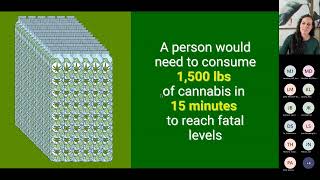
Consumption of ~1,500 pounds in 15 minutes to reach fatal levels (speaker's cited hypothetical)
Chapters
And so let's.
Is that PowerPoint showing for you guys?
Oh, press the up arrow and, and see if.
Did you see where it says Open share tray.
Share?
Yeah, like on the, on that little bar, the teams bar, there's a box with an up arrow. And when you open it it'll say click on desktop or window and then you gotta.
What's worked in the past is if you say share entire screen. So then everything works that way, apparently.
Side by side, reporter and content only.
Are you seeing where are you seeing.
That under presenter mode?
No, no, but go into the Microsoft Teams app.
Okay.
And then you'll see on that little bar there that you'll have an up arrow in the little bar. There's like a little bar that shows once you're in the team's app. Like where you could see us on video here?
Yeah. For some reason it's showing it as share. And if it doesn't, it's not a huge issue. It's more for me than anything else.
Yeah, it's always good to see stuff. It's fine if it does or not. We'll figure it out. But are you seeing the panel.
On.
The Microsoft Teams that has the time on the left and on the right hand side it has.
The little telephone in a red box. Are you seeing that at all? What I'm going to do is I'm going to show you my screen. One second.
No, I've got it. Doc. It's the telephone with the red box and it's the share content. And when I'm hitting it, it's just taking me back to here. So hold on.
Does it say, is there, is there a little box with an up arrow that says open share tray, like right in the middle of those options?
Yep. And for some reason it's just taking me back to here each time I hit share.
Okay. What you can do is real quick, you want to just send me. Oh, wait, here you go. Okay.
Finally working.
Yeah, perfect. All right, so stay right there. And if you want to, if you want, you can open up your camera. See if that works so people could see you.
Right. It should, should be back on camera.
Let's see.
Turn camera off. Let me try turning it back on.
Yeah, I think it was off. Oh, there you go. Okay. And during the thing, I'll turn my camera off. Okay, perfect. All right, so let us get started and let me, let me just give a quick introduction if that's okay. So welcome everybody. It is Tuesday, May 16th, and welcome for another exciting episode of the Florida EMS webinar. And as you know, we bring on spectacular guests with very interesting topics. And today is no different. Stephanie White joins us today. She's a 19 year veteran of the fire service, has spent the past 17 years as a professional firefighter, paramedic in a metropolitan fire department. And throughout her entire career she's been actively involved in firefighter health and safety as a personal trainer, cancer awareness educator and a trained mental health peer. Today she's talking about an article that I read in Fire and Engineering magazine and she's written other articles about medical marijuana and firefighters creating a medical marijuana use policy. And I know that many of us have dealt with this in our own agencies. People are like, oh my God, can you really believe it? And so there's none other than Stephanie to come talk about it. So, Stephanie, thank you so much for joining our program. Take it away.
Thank you so much, Doc. So for those of you guys down in Florida, you guys, I believe a lot of the departments are simply addressing this by removing THC testing from the policies. So this will be a little bit different than what I did. This initial case study and article on this was based off of Pittsburgh. And the reason Pittsburgh is so special is they actually have it very regimented. And the way they did that is they didn't just remove testing, they approved the use of medical marijuana and then they put stingent rules on it. So for example, to use medical marijuana you have to have a prescription. You have to give that prescription to the medical resource officer. You have to be able to give receipts from the dispensary that you got it at. So I really prefer the model that they used because you can be more stringent with it. But to me, that also means you can really protect this resource and write a lot better by protecting the health of the firefighters by making sure that it's a good cannabis product that they can only get at dispensaries and by keeping them safe. This project really started out of a need for pain meds for myself that I didn't want to use because I know we have an incredibly addictive lifestyle just for being trained in the mental health aspect of firefighting. It was, I wanted to find a better, a better tool in the toolkit for those of us who have injuries to use. So that's where all of this started. I'm just going to give a quick down and dirty overview. It's not going to be very long.
Just talking about what is medical marijuana. I'm not a botanist in any way, but Cannabis contains over 500 chemical compounds, including over 100 cannabinoids. I think most of us at this point should be familiar with the endocannabinoid system and Harvard's work on that. We can go in a little more into that. But the primary psychoactive substance marijuana is thc. We've all heard of that.
It can be smoked or ingested. Leaves, flowers, seeds, stems, extra extracts, recreational and therapeutic uses. Pittsburgh the way they have done it is they have also really tightly controlled how you can use it. You can only really use it through pills and tinctures and I really appreciate that because it keeps you from smoking it. Anything with butane or anything else mixed in it, just from lighting, it gets removed. So it's really a healthier way of doing it. For those of you looking at doing it for your departments, I would heavily consider doing it that way. And then the cannabinoids, the endocan cannabinoid system, your CB1 and CB2 receptors, it's something that I've never really seen much education on, but it's really fascinating. If anybody wants more in depth, I can send you some stuff. But these are these receptors that they've discovered in your bowels. So inflammation across the body, this is something that can be calmed by using any kind of cannabis issue receptors in the brain. They've discovered that one of the reasons that cannabis helps so much with PTSD is because it does work on these receptors and it can help people actually forget those memories. So it turns out that this isn't just any old plant. This is a plant that works hand in hand with some of our neurotransmitters. And here's a picture of what they work on. So brain, immune system, those are two things that are going to pop right off in my mind as things that are always going to be affected by a lack of sleep. We're always going to have that inflammation level brain, we're going to have fatigue, we're going to have stress, we're going to have all of it. So that's something that can be a different therapeutic effect. I highly doubt as physicians or as former paramedics, any of you guys have seen anybody die from cannabis use. You may have had one or two first time users come into the ER with anxiety or racing heart, anything like that. But it is, it's very rare to see. In two years on the job, I have seen two patients and they were both first time users and one of them was a kid who couldn't figure out why he couldn't stop coughing. So it's, it's rare to see any kind of serious side effects from using it. A person would need to consume 1500 pounds of cannabis in 15 minutes to reach fatal levels. I would be so impressed if anyone could actually manage that. But after watching kids eat Tide pods, I wouldn't challenge anyone. And the CDC no longer has a category for cannabis deaths as there have been none reported. And I think we can all attest to that in our careers. Why should it be an option? Mental health, I think, was the first thing other than injuries that really popped into my head with this. I think we can all attest to Covid and how that made many alcoholics out of half of us. We got off duty, we got out of the er, we went home. We were experiencing this new world of being very isolated, having experiences that we couldn't relate with with anyone else. So I think all of us across the board in the medical world probably have a heightened sense of sensitivity to trauma just after that experience, that shared experience that taught us all these are some bad side effects that can happen. We can hit addiction much faster than I think any of us ever thought. I can tell you from having to homeschool two kids during that time, it was much easier to start reaching for a drink of alcohol to unwind than I had ever done ever in my career or life. That had never been a go to. So this was something that really popped into my mind to research because it's not going to have the effects of other things that we might reach for as a crutch in the medical and fire community. PTs, sleep disorders, chronic pain and anxiety. I think one of the best quotes I heard from one of the guys who got this initiated in Pittsburgh was, listen, this isn't going to cure my problems, but it's going to help me sleep, it's going to help me get problems or pain off my mind and that sleep is then going to help me be better able to handle those things in the morning. And I think that's a fantastic way of looking at it. It's not going to cure anything for us, but it is going to be an extra aid for us.
Overall, many firefighters reported sleep deprivation 59%. And these statistics come from the IFF's Behavioral Health Program. So obviously firefighters are horrible at reporting things, so this is a smaller window of people who've gone through their care. But 59% binge drinking behavior, 58% poor mental well being. 21% current nicotine use, 20% hazardous drinking behavior is 14. Depression, 11 poor physical well being 8, caffeine overuse 5% or poor social bonding is 4%. Now imagine if we actually had accurate numbers from firefighters who hadn't sought any kind of help because we know that they struggle with that. Firefighters struggle with behavioral health issues view seeking treatment as a sign of weakness. I think we've all seen that firsthand with anyone in our life who's part of the fire department. And we're three times more likely to die by suicide than in the line of duty.
SSRIs, TCAs, ACDs, other drugs that help reduce anxiety, like benzos, can interfere with the activity of the hypothalamus. I think most of us end up on Wellbutrin when we are given something which can absolutely affect your ability to deal with heat. And I do believe I have to double check that it does actually warn not to go into any high heat environments, which is quite an issue when you're a firefighter. Emotional blunting, dependence, increased suicidal thoughts can all be side effects of it. Things that in any kind of environment where you're not sleeping for 24 hours, you're already susceptible to. Imagine not sleeping for 48 hours and then being on one of these medications. Your risk of suicidal thoughts would probably go through the roof, I would imagine. And then career firefighters reported drinking 10 days a month, or about half of their off duty days. Something that I would assume you guys are dealing with in the emergency room situation is staffing issues. We are seeing that in record numbers for our fire departments. So our off duty days are even more decreased now. So imagine that that could now be those people that reported 10 days a month. Now those 10 days a month are their only days off because of forced holdover and recall and then just overdose deaths. We're all aware the opioid crisis.
Just how that's been over the past couple years, and we're not seeing marijuana on there. The biggest thing about opioids is the manufacturers have come out and said, hey, we designed this to be addictive. And once again, to hammer that point home, why do we want to be prescribing anything addictive to people who are already at high risk for an addictive lifestyle?
Just some numbers on drug dosage deaths for narcotics over 2021 and 2022, a record 106,699 lives were lost from the opioid crisis. I think you guys have probably all seen a nurse or two with a back injury who unfortunately developed an addiction that has gone sideways. I know in our local trauma center, I unfortunately Witnessed that twice, along with a couple police officers. And the numbers speak for themselves. And once again, this isn't something we have begun to see with medical marijuana because the addiction option just really isn't there.
Apologies. So Pittsburgh Bureau of Fire, they're the ones who really pioneered all this. In 2018, they officially signed their bargaining agreement that allowed them to use it. Obviously they use it off duty and not on duty. And they reported a record number of fewer discipline issues. That was the big glaring thing that stuck out to them. Their members reported lower substance abuse, self medication, better sleep, domestic issues, and lower use of prescription drugs. But I think the disciplinary issue with other substances such as alcohol just was a dramatic number to them that caught their eye. And in the five years now that they have had access to medical marijuana, they have had absolutely no incidences it being misused or anybody being caught still having it in their system on duty to a level where it would affect their ability to function. The biggest thing that's obviously holding, I think a lot of departments back is there is no real standardized testing protocol in place across the nation. Some departments, there's one out in Washington state, they do blood tests. That's how other departments have fought against that because they feel that's invasive. Companies are trying to create breathalyzers, which I think once that comes out, that's really going to be what opens the doors. But that is not there right now. So that, that leaves a lot of departments floundering in terms of, well, how do we enforce this? And I think the biggest way we enforce this is our officers are already supposed to be watching us. They're already supposed to be saying, is Stephanie able to do her job today? Does she look impaired? Are her eyes red? Is she keeping to herself, hiding in the bunk room? Officers are supposed to be watching these side effects already for behavioral health issues or alcohol issues. I would think that they would be able to notice if somebody came in high. I would think that they would be able to catch that or shiftmates catch that. Because obviously if a department gets the ability to have the right to use medical marijuana, I would think the members and the shift mates would also want to be watching out and protecting that right as well. So that, that's a great way of addressing it. Because I could drink.
Gin or something else that doesn't have a smell and come into work and you would only catch me because of my behavior. So we're supposed to be watching our people anyway. That's a good get around argument right there. It does need to be removed as a Schedule 1 drug. For a lot of departments to really open up to use it, DOT standards really need to change and be less restrictive obviously for it to be used because it does stay in the system for up to 30 days. And it needs to be recognized really nationally as a legally prescribed drug because thanks to the 80s and the 90s, it is still going to have that stigma to it. I think we all lived through the Nancy Reagan era of where do you guys go? Of just saying no? And the DARE shirts and that was something that was really hammered home. I'm in my about to be 40s, but that was the big campaign of the 90s and that stigma has really held true. And I think a lot of people are clinging to that and therefore not having the ability to see it as a medicine. I think the biggest problem a lot of people have when they try to gain access to it is that they compare it to alcohol. And you can't, you're not going to find success doing that as much as you are going to find success presenting it as a legitimate prescription.
Yes, sir.
Just real quick, we're seeing your screen with the Microsoft Teams and we lost the slides. You may want to flip back on to the slide.
The slides are actually done. That was pretty down and dirty.
Okay, so you know what? So click on Stop Share. Perfect. Click on Stop Share so that. Hey, perfect.
Okay, so the biggest thing is for you guys as medical directors, as clinical clinicians.
I would imagine that you guys would be very concerned having people operating under your license potentially using a new substance. So something that I would really, really encourage OMDs and other medical physicians to go out and do is to really look at the addiction levels of firefighters, the alcohol abuse level of firefighters, and then also the cocktails of medications that we do get put on for behavioral issues and how those respond to high heat environments. It's always frustrating to me when I meet young guys in their 20s who due to genetics have hypertension and so they're put on some sort of diuretic and you just, you can't be on that and do this job in the summertime. And unfortunately so many treating clinicians don't think about that when they prescribe people these cocktails. I might have a busy 48 hour shift and if I'm on Wellbutrin, what happens if I miss two of those doses? Any kind of medication where we have to have a therapeutic threshold that we have to maintain is going to be very, very difficult for our lifestyle. Medical marijuana is something that we could potentially use to help us in those moments so that we can better mentally face any kind of crisis versus giving us any altering drug, anything like that.
Well, I could tell you, you make a very, very strong case and I love the whole run up to kind of putting into perspective of how this can impact specifically people who work in fire and ems. So that's incredible. Thank you for doing that. And I see. I figured there would be some people who want to jump in here, so. Dr. Angus Jamison, Pinellas. Angus, go ahead. Do you have some questions?
Hey, I'm really sorry. I missed part of this because I'm jumping between meetings and I heard you address one of them, which is in terms of understanding, you know, how you deal with somebody being impaired while on duty. But the other. The other things that I've run up against this. And again, I'm sorry if I missed it, but. So what about the fact that I'm the DEA registrant and I am handing these folks a box full of Schedule 2 and Schedule 3 substances and the feds still consider this Schedule 1? And what kind of risk is that to my DEA registration? If I knowingly hand a box of Schedule 2 and 3s to somebody using.
A Schedule 1, I would have to ask, how would that be any different? And I understand that it's Schedule one, but if I am put on any kind of other narcotic for any pain medication.
I know those aren't all going to be schedule ones, but they're going to be similar.
So.
That'S exactly my point. Actually, the Schedule one thing is a problem.
If I could jump in.
Peter and Angus, it's Cindy Schumer. Hey, Cindy. So keep in mind, guys, you don't prescribe it, okay? Marijuana is not a prescription drug because it is. It's not legal. So you order it. So the ordering physician is one who by certificate is. Is able to enter the order into the University of Florida's registry.
So it's not a matter of the medical director ordering, unless the medical director, of course, is already an ordering physician in the state of Florida. But it would most likely come from a physician who the paramedic or EMT is seeing for the conditions that are outlined in Florida law, which could result in an order for medical marijuana.
So, yeah, maybe I should clarify. I'm worried what the DEA could do to my registration if they find out that I knowingly put Schedule 2 and Schedule 3 substances in the custody of somebody who is using something Schedule 1. I don't care whether that Schedule 1 is marijuana or any other Schedule 1. And frankly, I don't care whether it's a Schedule 2 that they're abusing or Schedule 3. But for me, as the DEA registrant, for the same reason, I would be concerned about putting a box full of fentanyl in the hands of somebody with an opioid use disorder. I'm worried what the DEA's take on that would be until marijuana gets reclassified away from Schedule 1.
And I absolutely answer to that because I am not a physician and have not had to look into that. But now that you've brought that up, that is something I'm very curious to research.
It's a new one, an important nuance that you're talking about. That kind of. It's a whole other layer of someone's on a Schedule 1, and now you're actually giving them all these other medications that they're allowed to give patients.
And.
And what you're worried about is that the DEA will say, you can't do that knowingly, is what you're.
So I'm worried that the DEA are saying, we'll say you as the registrant. Why. Why would you give custody of scheduled substances to somebody you know is using something that is a Schedule 1, which we believe has no medicinal use, like leaving aside whether we believe it's. It's medicinally valuable or not, that's the current scheduling. And I'm worried what they could do to me, like, they could find me 10 to $14,000 per vial per day, theoretically, if they thought I was doing something outside the bounds.
Yeah, I think that's something we probably have to, you know, figure out from the Pittsburgh folks. Right. And I'm sure they've had conversations with the dea. Maybe they'll be on the Eagles main meeting later. That's a great question.
You know, the one thing I can chime in and say is that the state laws around medical marijuana vary. So Florida's laws are pretty specific. In fact, I've got the annual report I can share with you, Peter, that the joint committees actually give every year to the Governor, the president of the Senate, and the speaker of the House. So it has a lot of data around the Florida law. But because each state has a unique law, you know, if we're going to do something in Florida, I think it probably has. Of course, it'll have to align with. With the existing Florida law.
Yeah, Florida just has very little in the way of controlled substance stuff for us as medical directors. It's really the feds that hold our DEA registration and so that disconnect between where it lives in the federal view and where it lives in the state's view is, I think, problematic and needs to be worked on.
No, I absolutely agree with that. And since most of the governmental agencies have a. Basically there's no drugs, so the policies are pretty strict. Right. I think it would be very hard. And Angus, you bring up a very good point is how if, you know, an individual is already ordering or, and in Florida, you know, certainly smoking marijuana is legal. So if you knew that that individual was smoking and yet they were a chief or someone who was dispensing the actual narcotics to the group.
That'S a problem.
Yeah, I just, I hope that Stephanie or somebody could get the answer to that because I frankly don't want to be the one that asked the question to my local DEA field office because the less I communicate with them, unless it's me helping them with something, the better.
Wise words. Angus, you had two other questions because we have two more minutes. So you want to.
Yeah.
So.
The other issue we've run up with here is insurance coverage. The agency's insurance carriers might in some cases have a lot of concerns about somebody driving a big, huge fire engine if they know that they're using medical marijuana. And there's difficulties with, you know, it's just so less clear than alcohol or anything else in terms of having some kind of legal cut.
So insurance issues is one thing. Has there been any movement from the liability carriers that are the cities or agencies are using on this?
So since a lot of them are self insured, I don't think they've run into those issues. I don't know how it works down in Florida, but I think the fact that there are DOT standards in place for testing and for levels has also really helped that as well. And I think it's different for those of us who are in state to have had recreational cannabis as well. I think that has forced insurance providers to already be one step ahead of that and look at that and adopt the DOT regulations.
Awesome. And then the last one was we sort of credential people the same way that a hospital credentials a physician. And so the last time I went around the block on this with my lawyers, they're like, well, the hospital probably wouldn't do that, so you probably shouldn't do that. Does anybody know of any movement in Florida in terms of our hospital or healthcare systems on this? Has there been a shift in where they're at with this or would they still consider this like an impaired practitioner kind of case.
That's another great question. Does anyone have any comment on that?
Well, you know, I'll comment, Angus, and I can't answer you specifically, but I do know that when patients have been evaluated by a physician in Florida who is certified to order medical marijuana, they are issued a medical marijuana card. So if that individual is pulled over, let's say they're driving erratically or they're in an accident, if they show that medical marijuana card, there's actual law enforcement considers that card as medically necessary marijuana. So a lot of this is already. Well, it's in our laws. Right. And it's how various counties have looked at it. I think there still is an issue in Florida because we aren't recreational like Colorado or other states. Ours is only for medical, you know, medical criteria that a physician has determined that individual needs.
Yeah, guys, I'm gonna. I'm gonna pop off to the other webinar. You guys can continue the conversation. I'm gonna pop off and then Stephanie, I sent you in the next 30 minutes or so. You can log back in and then I'll get you onto the main show. But I'm running that, so I gotta run over there. But thank you so much, Stephanie, for coming on. Angus, thank you for all the great conversation and Sandra as well. And we'll see you guys on the other side.
Great. And Stephanie, would you mind sharing your slides?
No, that is not an issue whatsoever. Let me give you guys, in the chat my email.
More from Peter




Melissa Olen MSN, FPN-C, CCRN: Sudden Cardiac Arrest Training in Schools (Project ADAM) 4/25/25



Pediatric Hospital Readiness: How Teamwork & CPR Metrics Drive Better Outcomes



Chelsea Kadish, MD & Kyle Goodknight, EMT-P, RT: Pediatric CPAP in EMS (3/14/25)