Tanner Smida: Characteristics of Rearrest after OHCA (3.22.24)
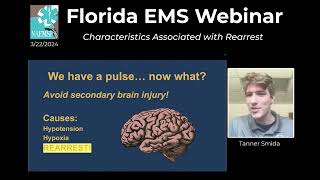
Recorded Florida EMS webinar (Mar 22, 2024) in which Tanner Smida presents a multi-author study (WVU + Univ. of Pittsburgh collaborators) analyzing determinants and outcomes of rearrest after out-of-hospital cardiac arrest using the ESO electronic patient care record dataset (2018–2021). Key points: rearrest is common (~30% of ROSC patients), clustered in the first ~10 minutes after ROSC (median ~4.4 min in prior waveform work), and strongly associated with worse survival (survival-to-discharge ~15% with rearrest vs ~40% without). The study used an operational definition of rearrest based on proxy timestamped events (CPR start, defibrillation, epinephrine administration, pulseless rhythm on ED arrival), performed multivariable logistic regression on Utstein and clinical variables (airway type, antiarrhythmics, cumulative epinephrine, impedance threshold device), and exploratory agency-level linear regressions. Findings: many Utstein factors (age, response time, downtime) correlate with higher rearrest risk; supraglottic airway, higher cumulative epinephrine, and impedance threshold device use were associated with increased rearrest; amiodarone vs lidocaine comparisons suggested lower odds of shockable rearrest with amiodarone (hypothesis-generating). Limitations: operational misclassification of rearrest, missing/unreliable timestamps, inability to access free-text notes, and pragmatic/administrative nature of ESO data. Practical implication emphasized in Q&A: the immediate post-ROSC period is tenuous and may warrant on-scene stabilization (pressors, monitoring) though interventions require prospective validation.
Questions this video answers
ESO electronic health record dataset, years 2018–2021.
Almost 300,000 cases were screened.
Over 50,000 patients were eligible for the primary analysis.
About 30% experienced one or more rearrest events.
With rearrest: ~15% survival to discharge; without rearrest: ~40% survival to discharge.
Chapters
Okay, welcome everybody.
Here we are.
It's March 22nd, another Friday. Happy spring. We have another great guest today. He's been a probably the most frequented guest we've had here on the Florida EMS webinar, and for good reason. Tanner, you know, he trained out in Pittsburgh. He's now, you know, he's kind of like the boy wonder of EMS. He's now MD, PhD program in West Virginia School of Medicine. And this guy pumps out research like Carrie Bacista pumps weights. I mean, this guy is just incredible. And so today he has another great paper. He has a list of also incredible authors, some of which we know. Remy Crow, of course. But this one is regarding why do our patients rearrest in the field? And Tanner and his team try to answer that question. So without any further ado, Tanner, make any further introductions and take it away, my friend. Thanks for joining.
Yeah, thank you very much for having me. So, you know, before we get started, I just want to say that this was a collaborative effort between our group at West Virginia University and some really talented investigators at the University of Pittsburgh, including James Menegazi and David Salcedo, who together have published more studies on Rearrest than anybody else in the world. And the team was led by an excellent medical student at the University of Pittsburgh named Sarah Suchko. So I just want to make sure that they all get the recognition they deserve. So today we're going to be talking about Rearrest. And so we know that in the pre hospital setting, once we get return of spontaneous circulation similar to tbi, our primary goal becomes avoiding secondary brain injury. In a previous webinar, we talked about some sources of secondary brain injury, including hypertension and hypoxia. We know those are associated with adverse outcomes following out of hospital cardiac arrest. But really, the ultimate source of secondary brain injury is re arrest, right? If one cardiac arrest is bad for people, two, three, four cardiac arrests are likely worse. And so therefore, it falls squarely in the hands of EMS and pre hospital providers to prevent this phenomenon, the secondary injury that comes along with it. Now, unfortunately, we really don't know a ton about rearrest. We definitely can't predict it very well. We don't have any interventions that have been definitively shown to prevent the occurrence of this phenomenon. But that said, you know, there have been some papers published. We do know a little bit about it. One of the things we know is that it's very common. And so the best data we have to date on this probably comes from a secondary analysis of Resuscitation Outcomes Consortium Data. A secondary analysis of the ROCK CCC trial showed that across the sites, the prevalence of rearrest ranged somewhere between 30 and 50%. And most other papers published that report the prevalence of re arrest, they fall somewhere in that range. So we know it's common. We also know it's associated with dismal outcomes. And so estimates have range between a 70 to 80% decrease in the odds of survival to hospital discharge. And we also see kind of a similar relationship when we're looking at neurologically intact survival, you know, more patient important outcome. Right. So already we know that rearrest is extremely common. It's strongly associated with bad outcomes. And so this is likely of public health significance when we're talking about, you know, the disease process of out of hospital cardiac arrest.
One other thing I want to point out and I think was really interesting, and this came from a study conducted by Dr. Salcedo and his team and Dr. Managazi at the University of Pittsburgh. They actually looked at cases where they had continuous waveform data. So they had ecg, they had the impedance waveforms, they could actually tell when CPR was and was not being performed. And they tried to precisely timestamp when rearrest occurred following the first return of spontaneous circulation. So the estimate they came up with was a median of 4.4 minutes following that initial Roscoe. Most of these rearrests are occurring in the first 10 minutes following ROSC. So this, this puts this phenomenon, the management of it, squarely in the hands of ems. Right? It is our responsibility to deal with and prevent and manage this phenomenon.
And so the next question comes, you know, as we are trying to kind of risk, stratify patients for rearrest, determine what patients we actually need to deploy, you know, kind of theoretical future interventions or bundles of care to prevent rearrest. An important question to ask is what are the determinants of rearrest? Right. We, we a lot of data on out of hospital cardiac arrest patients, right. The Utstein characteristics, you know, all sorts of data is available, but nobody had really asked before. There's not a lot of data out there, you know, asking, you know, all of these links in the chain of survival, which of them are associated with the occurrence of rearrest. And so that's the, the question that we attempted to answer in our study. So this was published at the end of February in the journal Resuscitation. So it's hot off the press.
And you know, I think that when I come on, we should probably just start calling it the, the update from the ESO data Set. This is another ESO study. So for those of you that don't know, this is a software company. It provides electronic health record documentation software to EMS agencies across the United States. They serve thousands of agencies in all 50 states and participating agencies on an annual basis. They have the data that they contribute to. This electronic health record software de identified and packaged into annual data sets that can be used for EMS research. So between 2018 and 2021, we assessed almost 300,000 out of hospital cardiac arrest for eligibility. We applied some exclusion criteria. So of course we excluded everybody who didn't have a documented Ross because those patients weren't eligible for rearrest. We also excluded patients that had ROSC after bystander CPR only based on the assumption that many of these patients were not truly in cardiac arrest. And this is kind of a side effect of us not being very good at palpating pulses that the literature has shown. We also excluded pediatric patients, patients with any resuscitation, limiting advanced directives, trauma patients, bit of a different kind of etiology and pathophysiology there, as well as patients that rearrested during inter facility transports. Right. So these are rearrests that occurred following resuscitation of patients that were encountered as a result of a 911 call. So even after all these exclusions, we still ended up with over 50,000 patients that were eligible for our primary analysis. About 30% of these patients experienced one or more rearrest events. Overall, between 17 and 18% of patients had survival to hospital discharge outcome data available. And, you know, although this wasn't the primary outcome of our study, you can already see, you know, our study also shows a stark disparity in outcomes between patients who did and did not experience rearrest. So if you experienced one or more rearrests, your survival to discharge was around 15%. Whereas if you didn't, you got Ross with no rearrest, your survival to discharge was about 40%. Right. So Stark disparity.
There's.
So first I want to make some, some definitions clear. So for those of you that aren't familiar with with eso, there is no, you know, drop down menu or checkbox or way to kind of objectively document that a patient experienced a rearrest event. Right. And so because of this, we had to kind of build a definition of rearrest using proxy variables that were available in the Electronic Health Record. So what we did is we took every patient's Ross time and we said, okay, so if these patients that have a documented Ross time, if they have a CPR Start a defibrillation, a milligram of epinephrine administered, or a pulseless rhythm documented at ED arrival. If any of these criteria are met, then we can reasonably assume that that patient had at least one rearrest event. Right. So that's how we derived our definition of rearrest. It's one limitation of our study. Right. This is an operational definition, but it's how we kind of had to do it with this data set.
And then so we picked some factors a priori that we thought might be associated with the occurrence of rearrest. So starting on the left hand side of the screen here, you know, these are all factors that we recognize. Right. Utstein. Factors that are reported in every publication out there that looks at out of hospital cardiac arrest, survival. Right. Age, sex, witness status, the rhythm, et cetera. We also included downtime. So, so we define this as the time from initiation of CPR by EMS to the first return of spontaneous circulation as a proxy for the ischemic burden suffered by these patients. So we assume that when it comes to modeling outcome following out of hospital cardiac arrest, this is something that's probably very strongly associated with outcome and very predictive of how well a patient's going to do on the right hand side of the screen. We also wanted to associate look at the association between some different clinical factors in rearrest. Right. You know, as clinical researchers, you don't want to just come away, you know, at least me, I don't just want to come away and say, well, you know, this is predictive. I want to be able to make some recommendation about treatment, you know, whether or not that's realistic, let's say, not for me to say, but we looked at the association between different anti arrhythmic agents in rearrest airway management strategies. We compared patients that were managed with supraglottic devices versus endotracheal tubes because it was available in this data set. We also looked at whether or not patients had an impedance threshold device applied during their resuscitation and the odds of rearrest. And then finally, we looked at cumulative epinephrine dose, so the number of milligrams of epinephrine that each patient was administered.
One thing that's conspicuously absent from this kind of set of variables that's been previously shown to be associated with rearrest are vital signs. And so we didn't include them because one, we already used the ESO data set to look at the association between these vital signs and re arrest, and we found almost linear association between hypoxia, hypotension and rearrest. So it'd be kind of double jeopardy if we publish this data twice. Another reason that we didn't include it in our model is it's possible that vital signs are a mediating variable between kind of all of these Utstein ideological characteristics of rear of rearrest and rearrest. Right. And so that's something that you really shouldn't do when you're doing these multivariable logistic regression models. You shouldn't adjust for mediators, you should be attempting to adjust for confounders. That's kind of a study design statistical point. We didn't look at vital signs. So as a secondary analysis, we also looked at the association between agency level, the proportion of patients who rearrested at an agency level and the proportion of patients that experienced survival, return of spontaneous circulation, termination of resuscitation in the field. And then we also looked at the association between agency level, prevalence of rearrest and median scene time. And we did this because we figure it's possible that there are certain agency characteristics. So for example, when we're looking at scene time and field termination rate that predict more aggressive on scene care, more of a stay and play mentality that we thought might have had some association with kind of system level rearrest. And then also one of our co investigators hypothesized that it's possible that really high performing agencies that are really, really good at resuscitation might be seeing higher rates of rearrest simply because they get more patients back. So that's why we looked at the kind of agency level, rate of return of spontaneous circulation. We did all these analyses. They were just simple linear regression analyses, kind of exploratory.
So, so for our primary analysis looking at the factors associated with rearrest, we use multi variable logistic regression. This seemed to fit our question very well. So our primary outcome of rearrest is a binary variable. You either did or you didn't. And our modeling using all of the covariables listed at the right hand side of the screen there, they met all the assumptions necessary for multivariable logistic regression.
All right, so the results are next. Before we get into those, I want to talk about some, some limitations of this study. So one of them we've already talked about. So our method of rearrest ascertainment comes with some limitations. Right? This wasn't kind of an objective. The paramedics were saying, yes, they did experience a rearrest. This was based on kind of proxy variables in the electronic health record, you know, and it's possible that, you know, for example, maybe if a patient was just really hypotensive, even though this is something we, you know, probably really shouldn't do, somebody slammed a milligram of epinephrine and we would have classified that patient as experiencing a rear rest. So there's some potential for misclassification in that direction, but also in the other direction as well. So there are some providers, and this is my personal experience, that document, for example, epinephrine administrations in the HPI or the narrative free text section of their electronic health record. And so they wouldn't have put a timestamped event for that medication administration in their kind of, you know, timestamp flowsheet. And so that could have led us to miss some re arrests. In addition, in the ESO dataset, just because of the pragmatic nature of data collection, this is like technically an administrative data set. There's a lot of missing, missing data. So that could have led to issues with the, with the generalizability of the data we used. In addition, if we were to kind of do a true epidemiologic assessment of rearrest and tried to calculate things like incidence, which requires a unit of time, we would have had to actually trust the timestamps in these electronic health records. And I think, you know, from a, from a clinician's perspective, and also, you know, looking at some prior literature, these timestamps are kind of notoriously unreliable. You know, the, the time of medication administration, CPR starts, that's being documented sometimes, you know, hours after the call actually occurred. And so for that reason, we, we chose not to calculate any kind of time based measurements of rearrest incidents. And then so finally, for our secondary agency level analyses, we didn't do any multivariable analysis. We just did simple linear regressions. That's a limitation that will be addressed by our group in future studies.
In addition. So in addition to all these limitations, our study also had a few strengths. So the major strengths of the study is the large sample size. So it's many times larger than the largest previous study examining rearrest. As well as geographic, it's more geographically diverse, right? So we included patients from over 1700 EMS agencies that are, you know, they have different treatment protocols, different levels of providers, and they're treated in every state in the United States. And so that is a strength of this study.
All right, so moving on the results, what we found was that basically every variable that we assessed was associated with the occurrence of rearrest. So Older patients were more likely to rearrest long with long. The longer your response time is, the more likely a patient is to rearrest. Of course, downtime. So that CPR time prior to first Ross, for every minute that elapses before you get rosc, you're more likely to rearrest. Females were less likely to rearrest as well as patients who are witnessed had bystander CPR performed and patients that had a shockable rhythm. There seemed to be some protective effect of all those factors. Patients that had a cardiac arrest in public were less likely to rearrest, possibly secondary to again high rates of bystander CPR, public access, AED use, early activation of the 911 system, as well as patients that had a respiratory or asphyxial etiology in comparison to patients that had a presumed cardiac etiology, those respiratory arrests which were less likely to rearrest in the pre hospital setting. And so there's a number of reasons why this might be the case. So, you know, for age, you know, as we, as we know, there's a relatively linear association with outcomes and age for out of hospital cardiac arrest. As we age, we develop more comorbidities for response time. You know, that's probably a surrogate for increased ischemic burden as is the CPR time prior to first ROSC witness status, bystander cpr. Again, these patients have more ischemic injury even prior to initiation of resuscitation by ems. For etiology, it's possible that patients that have a respiratory or asphyxio ideology, maybe that group is enriched with patients who have, you know, who had airway obstruction, patients that experience drug overdose. Right. And these patients likely have younger, healthier hearts. Right. And so are less likely to rearrest in comparison to someone with a cardiac etiology who is older and has a massive infarct and might be at increased risk of, you know, ventricular arrhythmias, for instance.
So those are our Utstein factors. Moving on to the clinical factors, we attempt to do discern an association between these clinical factors and rearrest. And we found that patients who received a supraglottic airway in comparison to patients who received an endotracheal tube were slightly more likely to rearrest. You know, I'm a big supraglottic airway guy and so, you know, I think that maybe part of this is that patients who get a supraglottic airway in the pre hospital setting are probably a little bit sicker than patients that receive endotracheal inhibition they might have less resources deployed to those arrests. They might be, you know, their airway might be managed in kind of cramped hoarderhouse situations. They might have factors that are associated with difficult airways like obesity. But we did see an association in this study. For every 1 milligram dose of adrenaline, the odds of experiencing rearrest increased by about 91%. You know, part of this is probably due to resuscitation time bias. So the longer you're actually in cardiac arrest, the more likely you are to receive more doses of adrenaline. You know, this is a European journalist. They made us change all the word, the word epinephrine in our manuscript to adrenaline. It's also possible that because of the beta adrenergic stimulation provided by epinephrine, that patients that get a lot of epinephrine are at increased risk of shockable arrhythmia. So it's kind of unclear what the components of that relationship. We also found that impedance threshold device use was associated with increased rearrest. You know, there are a number of reasons why this might be the case. So again, another one is resuscitation time bias. So patients who receive an impedance threshold device may also be more likely to have received advanced airway management in the pre hospital setting. And we know that patients who received advanced airways in the pre hospital setting do worse, likely because these patients have been in cardiac arrest for longer in order to actually have the opportunity to have their airway managed. Alternative explanations include the fact that, you know, if you get Ross within an impedance threshold device, you have to remove those devices in order to make sure that you're getting, you know, good ventilation. So it's possible that people aren't removing these devices, which leads to hypoxia and rearrest. But again, that's kind of totally conjecture.
As far as our an arrhythmic analyses. So for looking at kind of the overall population, we're looking at everybody who got ROSC after exposure to amiodarone in comparison to all the patients that got ROSC after exposure to lidocaine. There was no difference in the adjusted, the overall adjusted odds of rearrest when we compare these two antiarrhythmic agents. However, when you really think about kind of the rationale for why any arrhythmic should prevent rearrest, we think that they should prevent the recurrence of ventricular arrhythmias. We also looked, we compared these two medications with respect to the odds of experiencing a shockable rearrest, which we defined as a Rearrest that required therapy with a defibrillation. What we found in this analysis was that if you were exposed to lidocaine in comparison to exposure to amiodarone during your resuscitation, you were about 30. Your odds of experiencing a shockable rear rest were about 33% higher. Right. Which suggests that amiodarone may be a more effective antiarrhythmic agent in these patients. As an additional sensitivity analysis, we also said, okay, so let's look at patients who received post ROSC antiarrhythmic infusions and see if the relationship is maintained. And it was. So if you received a post rosc, an arrhythmic infusion of lidocaine in comparison to a post ROSC anyrhythmic infusion of amiodarone, your odds of experiencing a shockable read rest again that required treatment with defibrillation was about 90% higher. Small sample size there, but it was still statistically significant. The reasons for this are unclear. Again, it could be entirely biased confounding. But in addition, there's some, some data for, there was a recent Bayesian reanalysis of the ALPS trial that suggested that amiodarone was associated with increased odds of survival in comparison to lidocaine. And so that's kind of consistent with the prior literature.
In addition, in terms of just pharmacologic mechanism, whereas lidocaine pretty much only acts on sodium channels, amiodarone has a much more multifactorial mechanism. Right? It hits potassium channels and calcium channels, and it also has some beta blocker effects. And so it's possible that this kind of multimodal mechanism makes it a more effective anti arrhythmic in the setting of out of hospital cardiac arrest. So again, conjecture. But this is hypothesis generating.
Okay, so now we're moving into our secondary analysis, looking at the agency level proportion of rearrest versus the agency level proportion of rosc, agency level proportion of patients who were terminated on scene and agency median seen time. Now, the only statistically significant relationship we discerned was between agency level proportion of patients who experienced rearrest and the agency level proportion of patients who, who survived and were discharged to their primary residence. And so the slope there is like negative 0.393. It was statistically significant. Even qualitatively, I think we can see that there's a trend. The higher your agency's rate of rearrest, the lower your agency's rate of survival to discharge to home. And we're using that as kind of a proxy for neurologically intact Survival, as we've done in some prior studies with the ESO data set.
This is a figure that basically displays the same thing. So we basically took all agencies that had more than 50 treated patients during the study period with outcome data. We line them up from lowest proportion of patients with RE arrest to highest. Again, the range is from just under 20%, just under just over 10%, all the way up to just under 40%. So, so high variability in the rate of rearrest. And you can see that as you move from Q1 to Q4, and these were, these quartiles were created from the proportion of RE arrest, you can see that survival decreases proportionally.
In addition to our primary outcome. Again, investigating those risk factors associated with rearrest, our data also reinforced prior data. So we reinforced the fact that rearrest is common. So again, almost about 30% of the patients in this study with ROSC rearrested. And we also found that rearrest is associated with bad outcomes. So patients without rearrest, if you get ROSC, about 40% of them survived a hospital discharge in comparison to patients with ROSC who then rearrest prior to hospital arrival, only about 15% of them survived the hospital discharge.
In conclusion, so our study really showed that rearrest is strongly linked to the burden of ischemia suffered by patients. So downtime prior to rosc, unwitness arrest, lack of bystander cpr. Right. All strongly associated with the occurrence of rearrest. The recommendations that we can make on that is probably just to continue doing what we're doing, right, strengthen the chain of survival, make sure that we're increasing, increasing bystander CPR rates in our communities, making sure that we are putting public access AED programs out there, making sure that we're distributing our response vehicles in a way that minimizes response time to cardiac arrest rate. All of these things that are already out there, already parts of the chain of survival, improving them in our communities may decrease the rate of rearrest and improve survival and probably improve survival through independent mechanisms as well. So in conclusion, we know that rearrest is common, it's associated with bad outcomes. It's likely a phenomenon of significance to outcomes from out of hospital cardiac arrest. But of course, a lot more research is needed. If you're interested in reading a little bit more about this topic and seeing some different perspectives on our data. An editorial was recently published in the last couple weeks, March 11, in the Journal of Resuscitation by two, you know, kind of giants in the field of resuscitation research. And they highlight that you Know, we need more research in order to be able to predict this phenomenon. And we need to collect data that basically adequately identifies patients who are actually experiencing rearrest, ideally in a timestamp manner, so that we can move forward and start developing interventions to prevent this phenomena. And so it's a picture of the WVU part of the team that worked on this paper. And thank you very much for listening. Happy to take any questions you might have at this time.
Yeah, thanks very much. Tanner, it's Paul Pepe. So a couple things, if you don't mind, if they don't mention this is, you know, thanks for all the great work on this because it takes a lot of work. It is interesting. I want you to really reinforce the concept that it's the ischemia time, which is important, and then there's other factors that affect that. But one of the things that I think people usually don't understand is that they think that you still have the same cardiovascular status at 2 minutes that you have at 10 minutes. What happens is, especially with no oxygen going out to the arterials, you start having peripheral vascular resistance. I mean, you know, peripheral vascular relaxation, you don't have oxygen to keep arterial. So even if you had a heart that was pumping again, it basically you cannot get blood flow out. It doesn't maintain a good blood pressure generally. The interesting thing is that one of the things that Peter Safford sent you out of Pittsburgh, you'd appreciate that Peter Safford and I were identified back about 40 years ago, was that the post resuscitation period was the single most important period to keep going. And what happens, let's say if you gave epinephrine, which what happens, you might have resuscitate them then, but what happens is if you got to anticipate that that's going to wear off or it doesn't work as well with peripheral vascular relaxation. So you need. So that's why some of the plans that I don't know if you examined this or not, where people give, you know, infusions of epinephrine to maintain the pressor effect, etc. It takes about 10 or 15 minutes to get a lot of these guys back. And so that's, I think it's important. So you need to know in the older people, maybe on certain drugs that keep you give you better peripheral vascular relaxation as well, there's all those kind factors that are involved in that. So I think that helps. I'm just trying to give you a physiological theme that helps pull all the stuff Together that you've been seeing, et cetera. But what I'm getting at is your recommendation is that do what we do to get there faster, etc. But there's also an understanding that is a very tenuous state post resuscitation and that you've got to be aware that if you gain an epinephrine it's going to wear off and you better be prepared to give another one or have a press or drip or whatever it may be. And that's what we found helped keep some of those guys from re resting. But on the other hand they're going to do worse just for the lot of the reason that you went over. But thank you for a nice job. Do we have any questions out there? I can't see the. The chat. Let me see if there's anything out there.
Again.
Yeah, it's Sheldon Cheskas, Paul.
But just fantastic. Connor, I'm a big fan. I think your work is super and I love reading it. I think the editorial by Tom really focused on sort of what I would say is the time stamp is the defibrillator record is so much more accurate than a large ESO database record. So I'm using a large administrative database. Not knowing the exact time is a real, obviously an issue and I think this is what they sort of brought up in their, in their commentary. But this is. Listen, you have to start somewhere. I think this is a great start. I just wondered from a definition point of view with Ross, did you include any. The definition of Ross, was it sustained for 20 minutes or was it any ROSC?
Yeah, so this was any ROSC. So if they document. Yeah, any amount of time.
And wouldn't it have been easier to sort of look for just two documented ROSC comments in the procedures in terms of rearrest as opposed. It looked a little bit, sort of. A little bit out there in terms of how you guys sort of define rearrest. I kind of would look for just two ROSCs in the. And the documentation.
Sure. Yes. So we didn't have access to any of the free text fields in this data set. And so. And so also you have to think there are also patients who experience rearrest and then you don't get Roscoe to hospital arrival. So yeah, that would have made it tricky.
Yeah, that would have made that tricky. The. I noticed on the. In the antiarrhythmic infusion piece, survival to home, you didn't have a odds ratio for that one for the infusion. Was there a reason was a sample size issue?
Yeah. Yeah, so it would have violated the like 10 to 1 event to variable ratio and the confidence intervals would have been, you know, you could drive a semi through them. So we just decided the.
Yeah, and the only other thing I would have considered a little bit is one of the variables is the length of Ross. And again, because you didn't have time, you don't, you can't really do length of Ross. So I think, you know, how long the patient had Ross for would have been an interesting sort of predictor. I would have intuitively longer Ross less likely to be rearrest. But it would have been good to see that. I just going to have one comment that to add on to Paul. So our, we have a good group up in Lethbridge, Alberta that did some really nice work on rearrest and they looked at their data and really focused more on your previous work, like the relationship of hypodent hypotension to rearrest and really saw that in their data. Once they got Ross, they were really focusing on hypotension and using push dose EPI in those patients. And it was amazing how they really decreased the rates of rearrest in that, in that EMS system. Focusing on blood pressure is a huge determinant of it and they made a huge benefit. So I think that ties into Paul's commentary about once patients get ROSC and that that period of time right after is so tenuous to maintain rosc. But this is fantastic work. Really, really impressed. Great stuff.
Thank you. Yeah. And although, although, you know, this study doesn't provide the data to support any specific treatment strategy, I definitely think it makes sense to have a period at the end, you know, following return of spontaneous circulation where you mandate, you know, 10 minutes or some interval on scene. You have to complete a certain number of tasks. Right. You need to get a couple vital signs, you need to have a presser drip, mixed up any arrhythmic confusion if there was ever a shockable rhythm during the arrest. Right. And really aggressively manage those patients and stabilize them. Again, we don't have data to say that actually benefits anybody, but I think that that's good clinical practice based on the literature that's out there.
Great stuff, Good deal.
More from Peter




Melissa Olen MSN, FPN-C, CCRN: Sudden Cardiac Arrest Training in Schools (Project ADAM) 4/25/25



Pediatric Hospital Readiness: How Teamwork & CPR Metrics Drive Better Outcomes



Chelsea Kadish, MD & Kyle Goodknight, EMT-P, RT: Pediatric CPAP in EMS (3/14/25)