Tanner Smida: i-Gel Selection & Vasopressor Choice after ROSC (5/24/24)
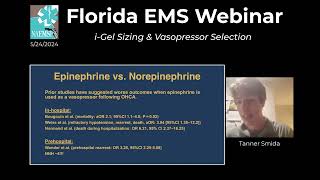
Tanner Smida presents two EMS studies: one comparing i-gel sizing methods found size 5 had lower insertion failure than size 3, and another comparing post-ROSC norepinephrine versus epinephrine in 2,000 patients found no mortality difference between the drugs, though epinephrine showed a signal favoring lower rearrest in female and non-cardiac cases.
Chapters
Welcome Everybody. Friday, yes, May 24 and 2024. And we're super excited to once again have Tanner Smita on the webinar. As I mentioned last week, Tanner is going to be assisting me in the future with the Florida EMS webinar. Sometimes when you meet people out in the world and you know that they're winners, you want to bring them into the fold. And Tanner is just that guy. He's done amazing work. And today this will be a first for the webinar. He's not just presenting one paper, he's presenting two of them. So without any further ado, Tanner, thank you so much for joining us again and take it away my friend.
Thank you very much for the kind introduction. So yeah, I'm Tanner Smita, student in the MD PhD program at West Virginia University and I'm going to BE Presenting as Dr. Antebe said, two papers today. So the first is going to be on the sizing of the Igel supraglottic airway device and then the second is going to be a comparison of post resuscitation epinephrine and norepinephrine in the pre hospital setting.
So just getting us started here. So the first paper, this is a brief report, it was published in Air Medical Journal in April. So out there in the literature there are basically two methods that have been presented to size Igel superglotic airway devices. The first one is based on ideal body weight. This is the kind of manufacturer recommended method that we're all familiar with. And there's also a publication out there evaluating a sex based method for again this is for adult patients and the sex based method says basically all females get a four, all males get a five. Right. And so for this, this sex based method there's actually prospective randomized evidence. Three French hospitals, two 18 month periods, anesthesiologists for cases. These were healthy patients coming in for elective anesthesia cases.
They in these 18 month blocks they placed eye gels according to either the weight based or the sex based system. And so what they found was that when they placed Igels according to the weight based system that we're all familiar with. I'm sorry, I'm going to turn that radio down.
Go ahead Tanner. No worries.
Sorry about that. So anyway, this prospective study showed that if you use the weight based system that we're all familiar with, about 7% of patients either had to have an eye gel switched to a different size or they had to receive endotrache you innovation. Whereas whenever they use the sex based system, only about 3% of these patients had to undergo either switch swapping the device or endotracheal innovation. Now, interestingly, because you know, this was an anesthesiology study, they had ventilators, right? They were able to measure leak pressures. They also found that patients that were treated according to a weight based system had lower leak pressures than patients treated with the kind of sex based size guide. And this is important to us in the pre hospital setting, right? We treat a lot of patients with respiratory disease. A lot of IGELs are placed during CPR in the pre hospital setting, right? And in the postdoc setting, we know we have atelectasis, we may need to deliver higher peak pressures to these patients. And so it's possible that if we use the sex based method and the airways are kind of seating better in the airway, we'll be able to deliver these higher peak pressures and get better outcomes potentially. But the question is, this study was done in the hospital with healthy fasted patients undergoing elected anesthesia. And so the question is, is this generalizable to the pre hospital setting? And so that's the question we asked using the ESO annual data sets. And so basically what we did is we looked at all patients who had an Igel attempt, placement attempt between 2018 and 2021. And we, for those cases, we took the first Igel insertion attempt. We looked at the timestamps, we took the first insertion attempt and that was kind of the unit of analysis for this study. We excluded all airways placed in pediatric patients and we excluded all the airways that didn't have age, sex, weight or placement success documented in association with that airway attempt. Overall, about 6.5% of the initial insertions were unsuccessful. Right. This is across the board. This is trauma, medical, cardiac arrest.
So the first thing we did is kind of stratify success by device. So we can see that the size 5.0 device had the the highest success. Only about 5% of them were unsuccessful. And patients who received a 3.0 had the highest or had the lowest success. About 8% of them were unsuccessful.
For our primary analysis, what we basically did is we looked at all IGELs that were placed in accordance with the weight based method. We looked at the insertion success and then we also looked at all of the igels that were placed in accordance with the sex based sizing method and we looked at their success. What we found was rates of failure were very similar between the two groups, about 6.4%. When we're using the weight based method and about 6% when we use the sex based sizing method.
We also performed a sensitivity analysis excluding patients that received that 3.0 size IGEL and the results were similar. So 6.1% failure with the weight based versus 6% with the sex based logistic regression review.
So in conclusion, again from this brief report, you know, all the limitations that come along with all retrospective observational data apply here. Right. We're relying on EMS provider documentation of insertion success. We don't really have objective measurements like end title CO2, but in the context of this brief report suggests that a sex based method of SI size selection may be equivalent to the waist weight weight based method when we're looking at the probability of unsuccessful eye gel placement on the first attempt. Right. And this might be just another method to kind of decrease cognitive burden during those first few critical minutes of a cardiac arrest, for instance, with equivalent results. And again, looking at the randomized data, maybe even higher leak pressures.
So that's our first brief report. So now moving on to the main paper that I'll be presenting today. This is a multi agency target trial emulation study comparing post resuscitation norepinephrine to epinephrine in the pre hospital setting.
This was published in Resuscitation a few months ago.
And so, you know, we know from, from prior studies that our groups presented on this webinar that hypertension is very common following out of hospital cardiac arrest. Right. As many as 40% of patients will develop hypertension following return of spontaneous circulation prior to hospital arrival. We know this is associated with dismal outcomes. And you know, vasopressors are an important tool in our toolkit to manage hypertension and restore perfusion in these patients and potentially prevent end organ damage and prevent rearrest. Right. Now some recent studies have suggested that basically post arrest using norepinephrine or using norepinephrine infusions result in much better outcomes. Right. They basically suggest that postdoc epinephrine infusions is like poison to post duress patients. A few of these studies have been done in the hospital. So we're looking at vasopressors that are used in the emergency department and the icu. And they've suggested that if you use epinephrine, you see more mortality, more refractory hypertension, more rearrest, more death. Right. And then recently, again within the last year, the first pre hospital study was published out of Seattle. And they when they compared patients who were treated with norepi versus epi at their agency, they found that epinephrine was associated with a greater than threefold increase in the odds of rearrest. Right. And again, recently we presented a paper on rearrest. We know that's associated with bad outcomes. And so using this estimate of effect size from this pre hospital study, it suggests that a number needed a harm of four. Right. So basically for every four patients that we treat with epinephrine instead of norepinephrine, we're basically causing one rearrest, which if that's true, that's really unacceptable. Right. And this is also a question of interest to, to West Virginia where our group practices, because ground ALS units in the state do not carry epinephrine. Right. Our AIR medical services carry them, our CCT medics carry them, but the ground ALS units that provide care to the majority of out of hospital cardiac arrest patients in the state, they basically only have epinephrine infusions. Right. And so before we kind of made the leap and said, okay, we're going to add this to our formulary and our protocol and make everybody purchase this medication, which, you know, epinephrine is definitely less expensive, we wanted to do our own study, use the ESO data set, try to get a large sample size, geographic generalizability and kind of repeat these analyses for ourselves.
So again, you'll notice in the title of this paper we refer to this as a target trial emulation. So basically what a target trial emulation is, it's basically a set of methods that it's a framework that's been published and it's basically, if you follow these methods, it helps you avoid common pitfalls that are common to all observational studies. Avoid common sources of bias when we're working with retrospective observational data. So again, these have been published in the paper we cited all kind of the, the source literature. But there's a few steps whenever you're taking this approach. The first one is you basically have to write down what you think the ideal randomized control trial would look like to answer this question in your inclusion and your exclusion criteria, and basically write out what you would like to see. Right. And then you try to emulate that as closely as possible with the observational data that you have. So one important wrinkle to this is when you're coming up with your inclusion and exclusion criteria, you have to make sure that that information is available at the hypothetical time of randomization. Right? So the information would have to be available when these, at the time these medications are being administered. One thing that a Lot of the previous studies did is they excluded all patients who had both epinephrine and norepinephrine administered in, in the pre hospital setting or in the ED or the icu. We didn't do that because, you know, for example, when you administer epinephrine, you don't know if the patient is going to have severe refractory hypertension. That's going to require a second line pressor. It's also conceivable that the first agent you choose might impact the probability of you requiring a second presser if one presser is less effective. Again, all of our inclusion exclusion criteria were available at the time of randomization. We included only 911 responses, patients 18 to 80 years of age. We excluded everybody who was a resident in a nursing home or assisted living facility at their time of arrest, trying to get rid of all the patients that had a poor functional status at baseline, anybody with a DNA pulse, those patients were excluded. We excluded patients who had a vasopressor or inotrope infusion prior to the first return of spontaneous circulation. We did that to exclude patients who, you know, they might have been treated by agencies who have epinephrine infusions intra arrest as part of their protocols. And then we also excluded patients who had rearrest prior to vasopressor administration.
Right.
So in this data set we saw a lot of patients who had, you know, maybe one rearrest, they were resuscitated, another rearrest were resuscitated and then they f the, you know, paramedics on scene finally hung a vasopressor infusion to stabilize the patients. Right. And of course in this case, rearrest was our primary outcome. And rearrest can't be caused by a drug that has not yet been administered. Right. So to be logically consistent, that was one of our inclusion and exclusion criteria.
Another kind of important wrinkle to this is it requires you to define time zero in your follow up interval. This is very important, especially for pre hospital studies because. So for instance, consider.
All rural agencies use one vasopressor and all urban agencies use another vasopressor. Now the urban agencies are going to be exposed to post arrest patients for much shorter periods of time. Their transport times might be four or five minutes to the nearest facility, whereas the rural agencies might be sitting with these patients for 45 minutes. When we're looking at a phenomenon like rearrest, something that's observed in the pre hospital setting, rural agencies are going to have a much higher chance of actually observing a rearrest than an urban agency that's just, you know, three or four minutes away from the emergency department. And so defining that that follow up interval is very important to ensure comparability between these two groups in terms of analysis. So, you know, of course we can't actually prospectively randomize these patients to a treatment. This is a retrospective study. And so we used multiple different statistical techniques to adjust for baseline imbalances and confounding variables. In this study, we used logistic regression, multivariable regression, and propensity score matching.
Again, this was an ESO study. So we started out with just over 400,000 out of hospital cardiac arrest patients. And after excluding all the patients that didn't meet our inclusion criteria, we ended up with a final sample of just under 2,000 patients who received either epinephrine or norepinephrine. It was a pretty even split. About 53% received epinephrine, the rest received norepinephrine.
So moving into the, the baseline characteristics now, so just based on our inclusion and exclusion criteria and how we kind of funneled patients into this study, we were fortunate that these patients looked very similar. Right? A couple differences that I do want to mention. So patients that received norepinephrine, it took a little bit longer for them to get a vasopressor following return of spontaneous circulation. So patients that received epinephrine got it in about seven minutes. Patients, patients that got norepinephrine, it took them about 11 minutes to have that first the vasopressor infusion initiated. In addition, patients who received norepinephrine received a little bit more fluid, about 200 more milliliters of fluid prior to vasopressor administration. And they also had a lower lowest systolic blood pressure. So the median lowest systolic blood pressure in the norepine group was 70 versus 78 in the epinephrine group.
When we look at our kind of categorical Utstein predictors of outcome, our groups were very well balanced. No statistically significant differences. When we're looking at sex ideology, witness status, status, location, bystander, CPR, etc.
One thing we thought is, you know, maybe all the patients who receive norepinephrine are being treated by critical care units, right hems, or physician response units right out in the field. But it seemed like an equal number of patients between the or an equal proportion of patients between the two groups were treated by critical care level providers. In terms of our outcomes, the only statistically significant difference was observed with respect to shockable rearrest so patients who received received a post ROSC epinephrine infusion were about twice as likely to experience a shockable rearrest. A rearrest is a result of a ventricular arrhythmia in comparison to norepinephrine. So about 6% versus about 4, 6.3% versus 3.7%. And that was significant. Again, this is just unadjusted differences between groups.
So for our multivariable modeling, again, we use both logistic regression and also propensity score matching. And we used two different models. So our first model included all of our Utstein characteristics as well as a couple variables that were unique to this study. So we looked at the follow up interval as well as the Ross to vasopressor interval. The follow up interval, I've already described why we included that. We included the Ross to vasopressor interval to account for differences between the two groups in speed of hypertension development as well as possible differences in provider familiarity with administering each agent as a vasopressor infusion. And then model two included everything from model one, but we added vital signs, so we added SpO2 and systolic blood pressure.
Now, before we get into results, I want to mention a few limitations. First of all, the way we determined rearrest, it was a very operational definition. So basically, for every patient that had a documented ROSC time, which was an inclusion criteria for this study, we said if you after that ROSC time received a milligram of epinephrine, had a CPR initiation or a defibrillation delivered, right? Those patients, we assume that they experienced a rearrest event, right? And of course, that opens us up to possible misclassification of some patients. You know, maybe the patients got a milligram of epinephrine slammed when they had really severe hypertension. Even though that's, you know, probably not recommended in clinical practice, there could be some misclassification as well. Just because this is kind of a retrospective study of administrative data. There was some missing data which could lead to selection bias as well as inaccuracy of times that were documented in the electronic health record and inaccurate kind of variables that were entered. That said, there are a few strengths of our study. I've mentioned some of these. So we have a large sample size, larger than any of the previously conducted studies, as well as geographic diversity. We're looking at hundreds of agencies across the entire United States.
So basically, as a long story short, basically what we found is there was no difference between epinephrine and norepinephrine for any of the outcomes we assessed. So no difference in rearrest, shockable rearrest, no difference in mortality, regardless of which variable set we used, whether we used logistic regression, whether we use propensity score matching. In our overall primary analysis, there was no difference between epinephrine and norepinephrine. Because of our large sample size, we were also able to do a number of subgroup analyses. Right? And so, you know, for example, we looked at only patients who presented with shockable rhythms, only patients who presented with non shockable rhythms, subgroups stratified by sex, witness status, pre ems, CPR etiology, et cetera. And overall, most of the subgroups were consistent with our primary analysis, right? No difference between the two phase oppressor agents. However, we actually found that in the subgroup of patients who were female, in the subgroup of patients who had a non cardiac etiology, we found that epinephrine was actually associated with decreased odds of re arrest. It's unclear what the reasons for this are. It could be just kind of a spurious finding. Another thing we thought about was maybe the patients who have this non cardiac etiology, right? The respiratory arrest patients, the patients who have opioid overdoses, maybe they have younger, healthier hearts. We're kind of looking at different physiology than the guy who has a coronary occlusion and irritable ventricular myocardium. And they may actually respond better to some of that beta adrenergic stimulation that's provided by epinephrine.
We also looked at time to rearrest, right? We, we have that very defined follow up interval and, and, and documented Ross time based on our definition. And so there was also no difference in the, in the time to rearrest between the two groups or the rate of development of rearrest.
One thing that came up during peer review was the, the possibility of confounding by indication. Right? So basically in this situation, maybe, you know, paramedics were choosing to give some patients epinephrine infusions for clinical reasons, right? Maybe it was a post an arrest because of anaphylaxis or an arrest because of asthma, right? And they were giving epinephrine for its vasodilatory effects or I'm sorry, bronchodilatory effects as well as its effect on blood pressure. Right. And so what we did is we looked at, on the agency level, what proportion of patients treated by that agency received either epinephrine or norepinephrine. And what we found was about, for about 80% of the agencies included in this study, there was 100% epinephrine given to these post arrest patients or 100% norepinephrine, which suggests that practice was being driven primarily by agency protocol, state protocol or medication availability rather than provider discretion. So this just suggests that confounding my indication might not be as big of a concern here as we might have thought.
So in conclusion, when used as a, as a pre hospital, post Ross vasopressor, it seems that the outcomes for patients who are treated with norepinephrine are about the same as the outcomes for the patients who are treated with epinephrine. Our study addressed some limitations of prior literature, including the temporality between the drug administration and rearrest. Again, some previous studies, they didn't account for the fact that some patients are going to rearrest once or multiple times before a vasopressor is administered. Now of course, you know, more research is needed, prospective study is definitely needed before we have a definitive answer to this question. But at least our study suggests that in the pre hospital setting, epinephrine might not be the poison that we, that we thought it was. Now of course, you know, we're looking at exposure times to, to these vasopressors of like 20 to 30 minutes in this study. And so it's possible that the answer is totally different when we're looking at patients who are exposed to EPI or norepi for hours or days in the icu. Right. So thank you very much for listening. I'm happy to take any questions you might have at this time.
Amazing. I have a lot of questions and I, I think a few people do as well. Would you mind going back to the first study? There was a, that the, the, the graphic where you had.
The, both the, the weight and the sex for the eye gel.
Sure.
There was one that I wanted to.
Right there. Right there. So if you go to the less than 50 kilo and you look at the patient text right below it, it looks like there was a much higher, I know that on the right the failure rate was the same, but for this particular weight category, less than 50, it looks like the male had a much more rate of unsuccessful than the female. Almost double or half, I should say, for the male. Can you explain that one or is there an explanation there?
Yeah, so I'm unsure of what the actual underlying mechanism here might be. So again, it could be just bias that's built into the data. So maybe females who weigh less than 50kg are more likely to arrest or require airway management for different reasons. Than men in a similar weight category. So, for example, if all of the men in that age category had cardiac arrest and had total airway paralysis as a result of ischemia, they might have just had easier airways to manage and had less failure as a result of that. But it does seem across the board that patients that weigh less than 50kg had the highest rate of failure, whether they got a 3, 4 or 5 IGEL. You know, and we mentioned this in the discussion of the paper. You know, it probably needs some more study. It needs people to think about it. You know, what is the underlying mechanism here? Maybe it's that we're undersizing the Igels in these patients.
So as far as the take home then is from this paper is that there was no difference between weight based versus sex based. But if you read between the lines in the under 50 kilo adult.
And I would presume child too, but in the under 50 kilo person, there may be some issues with sizing that you may have to pay more attention to.
Absolutely, absolutely.
Okay. Okay, Very good. And then on the other paper, I'm so happy that you did what you did because.
And I had the other paper up in front of me. This was done, I believe, out of the folks in Seattle. And when this paper came out, when their paper came out earlier this year, they titled it Pre Hospital administration of Norepinephrine and Epinephrine for shock after Resuscitation from Cardiac Arrest. And they came to the conclusion that patients who received EPI infusions suffered pre hospital rearrest more frequently. And you mentioned this in your paper. I'm just trying to re emphasize here that everything you read on the Internet may not be true. And there were many people who called me after that and said, why aren't we removing epinephrine from our unit? So take me into your thought process. Did this idea of this paper, the second paper that you brought up, did it come because you saw that paper and said we need a larger sample size than 451 patients? Is that how you kind of came up with it?
Yeah, absolutely. Absolutely. You know, reading the paper, I was impressed with the magnitude of the findings. Right. The effect size that was suggested there was was startling to me. Right. Again, that number needed to harm a 4.
There aren't many things that would be more harmful than that if that was a true estimate of the effect size. But also if it was true, I figured we would probably have better luck getting people to change their practice if we add geographic generalizability and the larger sample size. So I was looking to more confirm their findings. I didn't have skepticism initially because I think the mechanism is right. You have these post arrest patients, you don't want to give them all that beta adrenergic stimulation and increase their myocardial oxygen demand and cause rearrest. So, yeah, I went into it believing their findings and wanting to confirm it in a larger data set. We came away with a bit of a different conclusion.
More from Peter




Melissa Olen MSN, FPN-C, CCRN: Sudden Cardiac Arrest Training in Schools (Project ADAM) 4/25/25



Pediatric Hospital Readiness: How Teamwork & CPR Metrics Drive Better Outcomes



Chelsea Kadish, MD & Kyle Goodknight, EMT-P, RT: Pediatric CPAP in EMS (3/14/25)