Tanner Smida: Post-ROSC hypoxia & hypotension (9/19/23)
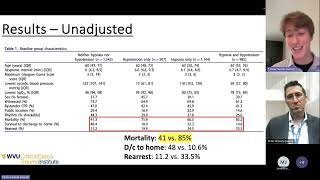
Tanner Smida analyzed 18,000 cardiac arrest patients and found those with both low oxygen and low blood pressure after resuscitation had 85% mortality versus 41% with neither. Patients with both problems had roughly 5 times higher odds of death. Optimal blood pressure in the field appeared to be 140-150 mmHg systolic.
Questions this video answers
ESO annual datasets from 2018 through 2021.
About 33 million patient care records; ≈300,000 out-of-hospital cardiac arrests in those years.
≈18,000 patients eligible for prehospital analyses (rearrest outcome); ≈4,000 patients had ED/hospital disposition data for mortality and survival-to-home analyses.
Hypotension = lowest recorded systolic BP <90 mmHg; Hypoxia = lowest recorded SpO2 <90%.
Neither abnormality: ~41% mortality; Both hypoxia and hypotension: ~85% mortality.
Chapters
And here in a minute. But let's get started because I want to make sure we give Tanner all the time he needs. Many of you remember Tanner. He came on probably, it was probably like six months ago. Now Tanner, I don't know. But yeah. And every time I, every time I see the next paper come up, your name happens to be on it. You're kind enough to always respond as a yes when I ask for this stuff. But this paper caught my eye because it resembles very much to me the EPIC for TBI data. And I don't think enough people put enough emphasis into the post ROSC.
State, if you will. And I think the numbers that you've shown in this paper are pretty drastic and dramatic and I think it'll just kind of contextualize the need for that type of education to stressed during our training. So without any further ado, if you want to provide a further introduction and then take it away, thanks for coming on.
Absolutely. Thank you very much for having me. So I'm in the MD PhD program at West Virginia University and I'm here today presenting this paper that was published, I believe in July in pre hospital emergency care comparing the association of hypertension and hypoxia and then both of these vital sign abnormalities together with outcomes following cardiac arrest resuscitation. So basically all of the patients in this study had these vital sign abnormalities in the pre hospital setting.
And just for everyone's reference, in case you're interested in the topic and want to read more, we have published several papers on this topic. So one in resuscitation looking just at blood pressure, another one looking just at hypoxia and SpO2, and then finally the one I'm going to be presenting today, kind of looking at everything together.
And so, you know, we know that the goal post resuscitation care is to prevent secondary brain injury. So the brain is particularly vulnerable post ischemia and reperfusion. And so we want to make sure the brain's happy, has good oxygenation and perfusion. And there's some precedent in the TBI literature that suggests that hypotension and hypoxia are basically neurotoxic and they can impact outcomes in a dose dependent manner. And so our group's goal was basically to see if the same held true for post dross patients. So we can hopefully kind of contribute to a body of evidence that can one day drive forward the standard of care for these patients. The same way that the EPIC studies and some of the observational studies that Came before it have done for tbi. So just to start out, I think to discuss the epidemiology of vital sign abnormalities. Our previous papers have shown that hypertension and hypoxia are very common post Roscoe. So greater than one third of all patients experience hypertension in the pre hospital setting following resuscitation and more than half experience hypoxia. And you know, I think some of this stands to reasons you have to deal with myocardial stunnings. You have sort of like a cardiogenic shock component. People that are globally ischemic are going to eventually become vasoplegic. So you have kind of a distributive shock component. With prolonged cpr, you can expect to see, you know, pulmonary contusions, you can expect to see atelectasis aspirations very common during cpr. So all these things I don't think altogether it's surprising to see how common these two phenomena are. But the question is, what's the association with outcome? Before I go into the derivation of our sample, I want to make a couple definitions clear for the categorical analyses. In this study, we classified hypertension as a lowest recorded systolic blood pressure, less than 90 millimeters of mercury. And the evidence out there is kind of starting to suggest that we should be viewing hypertension as more of a continuum rather than a dichotomous cut point. That's some of what's come out of the traumatic brain injury literature. But for our categorical analysis, we chose this cut point because first of all, there's a lot of EMS protocols out there that use this threshold as a trigger for treatment. Then there's also proceeding literature that uses this threshold. We wanted to make sure we were keeping our definitions consistent. Similarly, hypoxia, we picked the lowest SpO2, less than 90%. Our primary outcome was mortality. It's pretty clear how we, how we derive that. But I figured two of our secondary outcomes needed some defining. So first of all, rearrest, there's nothing in an EHR through ESO that's like no. There's no dropdown menu or checkbox to indicate when a patient had a rearrest. So we had to find a way to kind of build this definition ourselves. So we defined patients as having experienced a rearrest event if they had CPR started, if they a defibrillation delivered, or a milligram of epinephrine administered following the first documented ROSC time. And we also classified patients as having experienced a rearrest event if they had a documented prehospital ROSC and then a documented pulseless rhythm at ED arrival. So if they had a documented pre hospital ROSC and then PEA systole VF at hospital arrival, we classify them as experiencing a rearrest. We also chose to include survival to discharge to home as a secondary outcome, kind of as a correlate for a neurologic outcome. We don't have CPC scores or modified rank and scale scores, but so we figured that most people who go back to their primary residence after being discharged from the hospital after a cardiac arrest would have better functional outcomes than, for instance, patients who went to, you know, a long term acute care facility or a skilled nursing facility. So those are the definitions I wanted to make clear. So for this study sample, we did use the ESO annual data sets. So for those of you that don't know, ESO is a big company that provides software to EMS agencies across the United States to use for documenting patient care and for billing purposes. And participating agencies can have all of their EHRs DE identified, all the data that's included, packaged and put into these big annual data sets that people can use for prehospital care research like what we did. So we used the 2018 through 2021 annual data sets, and that comprised about 33 million patient care records. And then of those, about 300,000 were out of hospital cardiac arrests. We applied some standard exclusion criteria that you've all seen before, so age less than 18. We didn't include trauma patients, DNRs for the purposes of this study, obviously we had to include patients that didn't have RO or didn't have vital signs documented. And so once we applied all those exclusion criteria, we ended up with about 18,000 patients. And so those patients were eligible for analysis with respect to our secondary outcome of rearrest, because that used all pre hospital data, but only about 4,000 of those patients actually had ED and hospital disposition data. So only 4,000 patients were eligible with respect to our mortality and survival to discharge to home analyses.
So once we applied all these exclusion criteria, we basically broke patients into bins based on vital sign abnormalities. So we classified them whether they had hypoxia and hypertension in the pre hospital setting, Hypoxia only, hypertension only, or neither vital sign abnormality.
And so the first thing we did was basically look at the baseline characteristics of all of these groups that we generated. And so first, I just want to call your attention, comparing the patients that had neither vital sign abnormality to patients that had both hypoxia and hypotension. So you can see patients that had both vital sign abnormalities. They were older, they had longer response times, they were less likely to have a witness to rest, bystander, cpr, shock rhythm, et cetera. So I just want to make sure you understand that even before these patients had the opportunity to achieve ROSC and have vital signs acquired at baseline, they were much sicker and likely had a much greater ischemic burden. However, even with this confounding and this baseline imbalance, the differences that we found with respect to our primary outcome was very, very striking to our group. When we're looking at the patient that had neither vital sign abnormality comparison to patients who had both, we're looking at a difference, 41% versus 85% mortality. So 40% greater than 40% absolute difference in mortality between those two groups. That was very striking to us. And I think it suggests, even when considering that there's baseline imbalances and there's confounding variables, I think it's reasonable to assume part of that mortality difference may be due to the clinical care that's provided to these patients.
Then we took things a step further and we started to do some multivariable analyses to see if adjusting for these baseline confounders would attenuate the relationship between vital signs and our outcomes of interest. We adjusted using multivariable logistic regression for some basic factors, so age, sex, witness status, et cetera. And then we also added in there maximum pre hospital Glasgow Coma Scale score. This was to try to adjust for the patients who have one or two shocks and then wake up and don't need advanced airway management or breathing spontaneously and therefore don't have the opportunity to be exposed to high flow oxygen and be kind of pushed to the hyperoxic side of the SpO2 scale. So in unadjusted analyses, we found that patients that had both hypoxia and hypotension had more than eight times the odds of mortality in comparison to patients that had neither vital sign abnormality. And after adjustment for the baseline covariables that I just mentioned, that relationship was attenuated somewhat. But patients with both vital sign abnormalities still had almost five fold increased odds of mortality. We're seeing a relationship emerge here. In comparison to no hypoxia or hypotension, hypoxia is bad, hypotension is worse, and hypoxia and hypotension together are absolutely terrible. There seems to be some kind of an additive effect there of these two vital sign abnormalities and this was consistent in almost every subgroup that we evaluated. So subgroups defined by sex rhythm, bystander cpr, witness status. In the paper, we defined it by Glasgow Coma Scale score. Everywhere we look, we see the same relationship. Hypoxia is bad, hypertension is worse, and then both vital sign abnormalities occurring in a comorbid state is worst of all. We also looked at temporally separated hypertension and hypoxia, and we compared that to hypertension and hypoxia that occur simultaneously. Hypotension and hypoxia was basically documented in the same line of the ehr. And we found that patients that had temporarily separated hypertension and hypoxia. So, for instance, maybe early hypoxia that was corrected and then late hypertension, those patients did slightly better, although outcomes were pretty dismal in both groups.
And so, you know, based on what I've said so far, I think it's pretty clear that these vital sign abnormalities are associated with adverse outcomes. And that's not really a huge surprise to anyone, I think. But another question we wanted to answer is where is the optimal SpO2? What is the optimal systolic blood pressure? What we did was we continuously modeled the probability of survival across the range for both of the vital signs that we evaluated in the study. What this analysis suggests is that the optimal lowest SBO2 is around 94%, and the optimal lowest recorded prehospital systolic blood pressure is between 140 and 150, which again, if you went into your primary care doctor's office with a systolic blood pressure of 150, they might put you on antihypertensives. But it appears that patients who are hypertensive post ROSC do the best. And it suggests, again, paralleling the TBI literature, that the thresholds for hypertension that we're using may be way too low. The 90. I've seen 100, 110 in some protocols. Those may be too low in the context of out of hospital cardiac arrest or post out of hospital cardiac arrest.
And so that pretty much concludes the data from this latest pre hospital emergency care paper. But given that I do have a little bit of time left, I wanted to outline some data from some of our papers and from some other groups that basically detail.
Strategies for managing these vital sign abnormalities and then also maybe where some research needs to be conducted in the future. And so this slide has been pulled from our first hypertension paper and for one subgroup analysis, knowing that hypertension dose. So that's a Measure that incorporates both duration and depth of hypertension is associated with mortality. When hypertension occurs, we want to correct that as fast as possible. And so what we wanted to see if hypertension management strategy is associated with time to hypertension resolution. One thing that at the time was really big in like the FOMED space, you see a lot of discussion on Twitter and in podcasts is the use of push dose vasopressors. And the idea is mixing up a push dose vasopressor and administering it is faster than going straight to an infusion and mixing that up and getting it running in. And so bridging patients to an infusion using push dose vasopressors would lead to faster hypotension resolution. And so we aim to quantitatively test this claim using the ESO data set. And through this, we generated Kaplan Meier style survival curves. And I'm sure you're used to seeing these with an endpoint of mortality, but we used an endpoint of hypertension resolution. So for all of our patients that became hypertensive, time zero was the first hypertensive blood pressure measurement. And then the endpoint was the first systolic blood pressure that was greater than or equal to 90 millimeters of mercury. This first panel that I pulled from that paper is basically a proof of concept. We stratified patients in these survival analyses by the initial severity of their hypotension. The blue line, that's patients that have an initial systolic blood pressure of less than 60 millimeters of mercury. And the yellow line, that's patients that have the least severe initial hypertension of 80 to 90 millimeters of mercury. As you can see, the deeper somebody's initial hypotension is, the longer it takes to resolve that hypotension. I think that makes good clinical sense and suggests that our analyses, our code, was doing what we wrote it to do.
Following that validation, we then stratified patients by whether they received push dress vasopressors or a vasopressor infusion alone. And we found that although the point estimate of time to hypertension resolution seems to favor push dose vasopressors, this difference was not statistically significant. So it doesn't seem that the strategy of vasopressor delivery has any impact on time to hypertension resolution, at least in a subgroup analysis in our retrospective observational paper.
Now, because we also have the data available to us, we also looked at the impact of the vasopressor agent that was used and the impact of the agent on time to hypertension resolution. And so what we found was that it didn't seem to matter whether you use norepinephrine or epinephrine. Your hypertension resolved in about the same amount of time. However, dopamine was associated with a slower time to hypertension resolution. So that's displayed here. And so along the lines of the vasopressor agent that was administered, I've run across a couple papers over the last couple months and this one was actually just published online in peculiar on September 14th. So, hot off the press, examining vasopressor choice post cardiac arrest and basically what impact our choice of agent for hypertension management has on long term outcomes following cardiac arrest. This was a paper from the University of Washington and the results were quite striking. So they compared patients that were managed with norepinephrine versus epinephrine, and they found that patients who received epinephrine were twice as likely to rearrest, so 55% versus 25%. And this difference persisted after multivariable logistic regression. And so this. Although our data suggested that it doesn't matter what agent you choose with respect to time to hypertension resolution, this paper suggests that perhaps epinephrine might increase the risk of ventricular arrhythmia and rearrest. And so vasopressor choice is important when managing hypertension.
And so finally, I wanted to show you an animal study that I found and it seems pretty consistently across literature that's looking at post cardiac arrest blood pressure, it seems that patients who were initially hypertensive, so 150, 160, 170 systolic, these patients seem to do the best. And so whenever I was looking for literature kind of exploring the relationship between post cardiac arrest hypertension and outcome, I found some animal studies that were conducted by Peter Safer's group at the University of Pittsburgh in the 1980s and 1990s. And they were using a dog model, they would induce VF cardiac arrest and then resuscitate the animals. And they had a couple different arms. They were looking at a couple different experimental protocols, including hypothetical. They were looking at hemodilution. And then some of their experimental arms included artificially induced hypertension. And so they were using norepinephinephrine to artificially inflate the mean arterial pressures of these animals all the way up to like 140 millimeters of mercury. And so that's mean arterial pressure, that's not systolic blood pressure. So they were pushing these animals mean arterial pressures really high, leaving them there for a few hours. And then we're finding that these animals long term, had better neurologic outcomes. And so they suggested that the pathophysiology that they kind of fell back on was that post cardiac arrest, you get increased perfusion pressures in capillary beds in the brain. So you have endothelial cell swelling and cerebral edema that increases perfusion pressure. You also have micro thrombi, so you have little sticky clumps of immune cells and obviously platelets and red blood cells that form. And so all these things contribute to the increased perfusion pressure and ischemia of the brain. And so by artificially increasing cerebral perfusion pressure, by pushing the MAP way up, you might be able to flush out all these micro thrombi, improve perfusion of the brain, and that's what leads to the improved neurologic outcome in their animal model. So it's possible that not only is hypertension harmful post cardiac arrest, it might be that hypertension is actually neuroprotective. And so, you know, again, it's just conjecture at this point based on animal data. But I wanted to share. Share this with all of you.
Now before I conclude, wanted to point out a few limitations of this study. So, first of all, there was a lot of missing outcome data in addition to missing variables of interest. So things like whether bystander CPR was performed, whether the arrest was witnessed. And so this may let bias creep in, impact the generalizability of our analyses. But after all, this is retrospective. It's observational. We're unable to make any claims regarding causation regarding this heavily confounded question. We can't, you know, suggest any. Any effect size of, you know, good hemodynamic management and management of oxygenation on outcomes. So with that, I'll conclude, I'll say that, you know, I don't think it's a surprise to anyone that hypotension and hypoxia were associated with an increase in mortality. But this increase was pretty striking and dramatic. Aggressive management of oxygenation and perfusion may improve patient outcomes, but as always, more research is needed on many facets of this. This phenomenon. So thank you all very much for listening. I appreciate it.
Wow. All right, Tanner, that was. That was awesome. If you wouldn't mind unsharing your screen so we can. Perfect. Okay. Thank you for that. So I'll start. And I know, I see Paul is off the airplane. Okay, good. That's a good thing. And if anybody wants. If anybody else wants to make a comment, just let me know and I'll get you in. My first question is, you know, obviously you're now showing These numbers of 140, 150 for systolic blood pressure. My first question relates to the continuous infusion versus the push dose, which many of us have gone to. Push dose. You're basically showing non inferiority. Right. You weren't really looking for push dose to be better, but now that it's equivalent then we can feel comfortable because it's much easier for us to do an ems. So do you have any particular thoughts on.
Yes, one is easier than the other, but they aren't showing a difference. So that we could feel comfortable using that. Because a lot of people have asked me that question. That's the first question I have.
Sure, sure. And so another thing is this was a subgroup analysis of our previous paper. I think that it's a heavily confounded question and one that's difficult to answer with observational data because of, you know, you have confounding by indication. One thing that we go further into in that paper is patients that received push dose vasopressors were, seemed slightly less sick. So they had less severe initial hypertension than patients that they basically went straight to the vasopressor infusion. So you know, even though we used, you know, some, some adjusted analyses and logistic regression and some cost regression models and things like that, I think there's definitely some confounding by indication there that's hard to tease out in a retrospective sense. But yeah, definitely non inferiority. I'm not saying not to use push dose vasopressors. Definitely.
Right. Because we then have to tease out the negative effects in my opinion of the very high dose bolus, in my opinion, the 1 milligram, just a big spike that kind of goes away. And I do, I'm one who's against that per se. And we think, as you know, capped our total doses to 3 milligrams and we've removed it from shockwave rhythms altogether. So in your, in your discussion about EPI versus norepi, I think that's a fascinating topic as well especially and I wonder, did you tease that out in the shockable versus non shockable rhythms in that particular data set?
That actually wasn't yours. That wasn't your data. That was the Seattle folks. Yeah, correct. Sorry about that.
And so, and I just want to clarify, that was all post resuscitation norepinephrine and epinephrine. So this was just used for hemodynamic management.
Fair enough, fair enough. Awesome. Let me bring in Dr. Wayne Lee. Wayne, go ahead.
Say, Tanner, I'm an old ER doc, and I have to say I'm so impressed. I feel very secure in our future knowing that you're out there and you're doing. And PhD, MD. You know, a few more.
Few more titles in the future, I'm sure. Listen, Tara, let me ask you something. I think you're right that those, as a. Those of us that have been around for a while would have, you know, thought this was obvious, that we would. Predicted the outcome. You know, looking at this, my question to you is that you made a comment early on, looking at the data about we'll make the assumption that some of this is secondary to clinical care, something to that effect. Is that a. Am I right?
Yeah. I think that given the magnitude and given the TBI literature, it's possible that maybe management plays some role.
And I guess my point is that's a pretty major assumption. You know, and I think the. And it seems like to me that that rather than epinephrine, norepinephrine, maybe, but it seems like to me that that's a major fork in the road, that in terms of utility, you know, and practice, application, understanding, that would be very key to how we process this conclusion. Do you follow me?
Yes. Yeah, I agree.
And your plans are.
I think that untangling any effects of clinical care here would be very difficult without prospective study. So, you know, doing something like randomizing patients to blood pressure targets. I don't think it'd be ethical to randomize anybody to hypertension, but, you know, randomizing them to, you know, a certain number of blood pressure targets above our classical threshold of hypertension or do something like the EPIC studies where we kind of prospectively deploy bundles of care in the field. Something like that.
Well, I guess you're what we should do. And what I'm trying to figure out is what I need to do. Go ahead, Peter.
I'm sorry. No, I mean, Wayne, I mean, I agree with you 100%, but I also think that part of the, you know, where we are now that we have to get to mentally is what are the true values that we really need to be at. Right. Because if we're still pegged at 90, which, you know, when Epic TBI came out, I thought it'd be a big splash that they're saying be from anywhere between 125, 135 as the ideal blood pressure. And you tell people that in the field and they don't believe you. Tanner is now coming and Saying, well, the same data here showing you should be in the 140s or 135, 140post ROSC. That's a big statement right there. Right. How do we, how do we overcome. How do we get to that as a baseline first?
Well, and you said you agree 100%. It doesn't sound like it, but I'm just kidding you, Peter. But I think that the point I'm making is that this is that I agree with that. I think we, we need to know that answer also. Okay. Just like we do a variety of things, dosing and so on and so forth at the same time, you know, I would be real interested to see that large percentage of patients that was, you know, that died, that were. That had these particular problems, how many of those were actually related to lack of fundamental care, et cetera. You know, these are pretty major problems. And could they have been treated, Were they treated, et cetera, et cetera. So I think that's a retrospective look at cases, but I'm not sure. I'm. You're way over my pay grade. But anyway, just.
But Wayne, I mean, I think the problem in resuscitation research is that, you know, it's never just isolated to one thing. And so it's the quote, unquote, bundle of care. Right. So the only real way to study these things is by looking at someone's bundle, if you will. Right. And I think that the problem is, is that you look at people like the aha. The aha is going to have a hard time saying it's just this or just that. And there was a paper that just came out that Mike Sayer just, he just tweeted out yesterday that there was a study that shows that using 5 of peep makes a tremendous difference in outcome. Right. So now we're saying, oh, it's the peep that matters, and then it's the blood pressure that matters, and then it's the. It's the EPI versus norepi that matters, and then it's the intubate them. You just try glottic that matters. At the end of the day, it's going to be hard to say clinically what all mattered, but is that what you're trying to get at?
Well, no, it's not, actually. That's more specific than what I'm trying to get at. What I'm getting at is the performance level across the country of EMS in this situation. And it seems like we should understand that. And that's a global question. I'm sure. That some systems are better than others at it. And so it seems like to me that we should want to know, what is it about those systems that do this Very well. Let's say you looked at this and you parse this out to a high performing system and their numbers were lower than a low performing system. Let's say, you know, the question is, why is that? Anyway, okay, I won't beat that horse anymore.
Right. And as. Tanner, do you think that, you know, as a researcher, you know, is there a way to parse any of that out?
So if I'm not misunderstanding, I think what you're asking for could be done by, like, a retrospective characterization of how EMS agencies are caring for these patients. And that could definitely be done even through eso on an agency level. You could look at benchmarks like, how many of these patients got a fluid bolus of 250ml or more? How many of these patients got vasopressors? And see if more aggressive. A culture of more aggressive post resuscitation care is associated with better outcomes.
That's my exact point. Very good. I appreciate that.
If no one else has done that, I'll submit it to esl. We can get it done.
Right, But, Tanner, then you have very low numbers. Right? So, for example, I know at Palm beach county, we run about 60 to 70 cardiac arrests a month, but in Davie, we run only about. We work about 60 to 70 a year. Right. So it's harder to. It's harder to kind of figure that out on a smaller scale. Right.
Let'S see. Anybody else have any other comments? I know there's a lot of smart people on this. On this call. Jonathan Applebaum from South Metro, your neuro and tax revival is 12%. 12%. Holy shit. So, yeah, what do you say when you hear these things? Is your bundle of care different than our bundle of care? What are you doing different?
I wish I knew at the moment because we're still trying to mine through that data to find out what's different, what's been special here. You know, when I add my voice, that definitely is very impressive presentation. And this is really exciting to see what the next step is. You know, if it was, it was only so easy to have, like, ah, we just need this magic, you know, the holy grail, and everything would be perfect. But well done, Tanner. Thank you.
Right, so as far as, like, if we say that high performance CPR are table stakes, then what is the next step? I firmly believe that it's being hyper aggressive on the you know, on avoiding hypoxia. And I'm pushing up that blood pressure and being much more aggressive with pressors. Wayne, would you agree that your medics. My medics. Have one in the field? When you have a patient who gets Roscoe, that we're not so focused on pushing that blood pressure up. Right. Whereas all of us know that all those patients end up on multiple vasopressors, you know, on their journey through the ED into the icu. So perhaps we should be a little bit more aggressive in EMS post ROSC. And maybe 90 isn't the right number. So that's the kind of data that is exciting for me here to see. Let me bring in Dr. Tim Landry. We only have a minute left, but Dr. Landry from the panhandle of Florida. Go ahead, Kim.
Hey. Yeah. How you doing? Great. Great. Great presentation. So in the lead up to segregating the data, post cardiac arrest, is there a suggestion that pre cardiac arrest hypotension versus hypoxia made a difference on the outcome? In other words, the post resuscitation. So if a patient was hypotensive and then went into cardiac arrest versus they were hypoxic and went into cardia on the post cardiac arrest side, did that play a role in the determination of outcome?
Yes. So to avoid confounding from very that what you're describing, we excluded all EMS witness cardiac arrests. So these were all cardiac arrests that occurred before EMS providers arrived on scene.
Meaning you don't have that data. Gotcha.
Yeah. I mean, the data is available through eso, but we did not do that analysis because.
Yeah, yeah, that's a great question. All right, well, we're at the bottom of the hour. That was incredible. I would.
More from Peter




Melissa Olen MSN, FPN-C, CCRN: Sudden Cardiac Arrest Training in Schools (Project ADAM) 4/25/25



Pediatric Hospital Readiness: How Teamwork & CPR Metrics Drive Better Outcomes



Chelsea Kadish, MD & Kyle Goodknight, EMT-P, RT: Pediatric CPAP in EMS (3/14/25)