Tanner Smida: Upper vs Lower IO in OHCA (8/2/24)
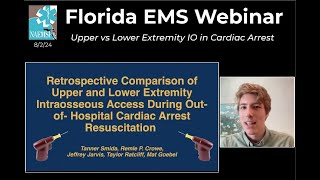
Tanner Smida reviews a study of 150,000+ cardiac arrest patients showing humeral intraosseous access had slightly better odds of return of spontaneous circulation than lower-extremity access. Survival to discharge and functional outcomes were unclear. He covers the physiology behind the difference and limitations of the data.
Questions this video answers
Over 150,000 adult non-traumatic cardiac arrest patients with successful initial IO placement.
About 75% had lower-extremity IO; ~98% of lower-extremity IOs were tibial.
ROSC: 30.6% for upper-extremity IO vs 28.7% for lower-extremity IO.
Approximately an 11% increase in the odds of ROSC for upper- versus lower-extremity IO.
Logistic regression NNT ≈ 46; propensity score matching NNT ≈ 60.
Chapters
Today we're going to be talking about intraosseous access during out of hospital cardiac arrest. This has long been part of our toolbox for emergency vascular access. The intraosseous space basically acts as a non collapsible vein that can be used to introduce drugs into the circulatory system. At least where I practice, this is most frequently used in the setting of out of hospital cardiac arrest. But it's also a useful tool in any patient where vascular access may be difficult. Patients with hypertension, patients with obesity, or vascular complications from diabetes or intravenous drug use when IV use is difficult.
There's actually some data out there that the use of intraosseous access in the context of cardiac arrest is increasing. This is a paper I was able to find looking at a number of different ambulance, English ambulance services that show that across time, intraosseous access is increasing and intravenous access as an initial strategy, increase is decreasing. And similarly for the, for the United States. And this data has not yet been peer reviewed, but I found it on a, on a pre print server. These investigators looked at the Resuscitation Outcomes Consortium data and found basically a similar trend in the United States. Again, more people are opting for intraosseous access as an initial vascular access strategy in cardiac arrest patients. Right.
And now for this presentation. Right. I'm not, I'm not going to talk at all about the difference between outcomes patients that get iOS versus IVs. That's an entirely separate presentation, is something we didn't address with our data. So we're going to be assuming that we've already passed that decision point, and we've already decided to place an IO in our cardiac arrest patients. And at that point, we come to kind of a second decision point. And so manufacturers basically recommend a number of different placement sites on the body. We're going to be excluding the sternal site for our investigation because, you know, in the context of cardiac arrest. And so basically where people place these is in the, in the humerus, the upper extremity. You can also place them in the distal and proximal tibia. And some agencies, and I'm sure some of them are represented on this webinar, have also moved to begin placing intraosseous devices in the distal femur. So for the purposes of our study, we've decided to kind of dichotomize these into upper extremity and lower extremity iOS. Right. And so many of you may be saying at this point, like, okay, Tanner, you've done all these ESO studies, right? Aren't you kind of scraping the bottom of the barrel here?
We have a supine patient. We're putting drugs into the circulatory system. What does it matter if you put it into the arm or the leg? That seems pretty spurious. Well, there's actually a decent amount of rationale for why it might make a difference whether we instill drugs into the humerus or into the lower extremity.
We're going to start with some more theoretical talk about this and then move into where we actually have experimental data. First of all, imagine that you place an intraosseous cannula into the tibia of a cardiac arrest patient and administer an aneuryth or epinephrine. In order to get that drug to the heart where we want it, right? We want it acting at the myocardium, it has to make it all the way up the vena cava, right? Which is just a big floppy tube. It gets bigger and floppier in the context of cardiac arrest. It doesn't have any valves, and it's going to be hard in a low flow state to really get that drug up the vena cava to the heart. Whereas if you place it in the humeral head in the upper extremity, the vascular territory that surrounds that, it has valves, and it's also geographically just closer to the heart. So from a theoretical standpoint, it makes sense that administering intraosseous medications into the upper extremity might lead to a faster time to peak medication concentration at the myocardium. That might make these medications more effective. To support this idea, in a number of animal models, it's been shown that tibial drug administration leads to basically slower peak concentrations and lower peak levels of plasma drug concentrations than both humoral access and peripheral IV access. So I just pulled a couple figures from these papers. So this one is looking at humoral versus tibial epinephrine administration. The red line is the pharmakinetics of the humoral epinephrine. The purple line is the pharmakinetics of the tibial epinephrine. Right. So you can see there's a clear disparity in the pharmakinetics depending on the site at which the drug was administered, as well as this figure which compared humoral access to IV access. And you see similar pharmakinetics of vasopressin in this case. So suggesting, again, humoral access is similar to intravenous access in terms of kind of pharmacokinetics, which may provide some physiologic benefit.
We also know that when you place an IO at the humeral site, you're able to generate a higher flow rate than placing an IO at the tibial site. So on the left hand side of the screen, this is a table from a paper that looked in a swine model at humoral versus tibial flow rates. And you can see that with the humerus you can get more than double the flow rate in terms of installation of intravenous fluid. On the right hand side of the screen is a similar analysis, except it was done in a human cadaver model. So potentially more relevant to the patients that we treat. And again shows that the humerus you can get higher flow rates than the tibial iOS.
And that may be important, not only intra arrest in terms of delivering boluses of medication or fluid resuscitation for somebody who's suffering from hypovolemia, but also might be important post arrest if you have a hypotensive posteroscopy patient. Right. Something we've talked about on the webinar before, it might impact your ability to start a vasopressor drip or administer a fluid bolus that's sufficient to actually have hemodynamic effects. And so this is the paper we're going to be discussing today. So this is again published in March this spring. And again we use the ESO data sets to compare the outcomes of patients who received upper versus lower extremity intraosseous access during out of hospital cardiac arrest resuscitation.
We've already talked about the data set a bit, but ESO is basically a vendor of patient care documentation software to EMS agencies all across the United States.
And so, you know, basically they provide this software to EMS agencies. And then on an annual basis, all of the data that EMS providers put into this software is de identified and included in these annual data sets that contain millions and millions of patients and they're provided for free to researchers. Right. So again, we have hundreds and hundreds of thousands of cardiac arrests to look at with this data set. It's incredibly powerful. In addition, for about one in five transported patients, this data set links all of the pre hospital data that was recorded on these patients, right? Their demographics, assessment findings, treatments that were delivered, the timings of these treatments. They link all of that with hospital disposition data. So again, for about one in five patients we can tell, do patients die in the hospital? Do they survive the discharge? And then where do they go post discharge? Right. Do they go home? Do they go to a nursing facility et cetera for this analysis, we evaluated all adult non traumatic cardiac arrest patients that had successful IO placement in the upper or lower extremity. And patients were sorted into groups. So again, whether you were the upper or lower extremity group was based on the first successful access site. We excluded patients. Again, these are kind of standard exclusion criteria. Patients with DNRs, patients that were undergoing inter facility transport at the time of their cardiac arrest, EMS witness, cardiac arrest, as well as patients who received IV access prior to IO access. And we did that to basically prevent inclusion of patients who had an IV and had, you know, IV meds given. And then on the way out the door, somebody accidentally pulled the IV and they had a, an IO placed as kind of a rescue measure.
Of course, you know, cardiac arrest is a, is a very complex and heterogeneous disease process and there are a lot of factors we know that, that the influence the outcome from cardiac arrest. And so we employed a couple different multivariable modeling strategies. For our statistical analysis. We used both a kind of type of logistic regression that allowed us to account for clustering of effect size by agency as well as propensity score matching. And I'll be presenting results from both of these analyses. For, for these analyses, we adjusted for age, sex, the witness status of the cardiac arrest, whether or not CPR was performed prior to EMS arrival, the initial rhythms, we dichotomized that as shockable versus non shock cardiac arrest etiology. So that was presumed cardiac, presumed respiratory or asphyxia, drug overdose or other that was a factor variable, as well as the location of cardiac arrest. So public, private or home, and then institutional settings, which we defined as nursing homes or rehabilitation facilities, as well as airway management strategy. So we classified patients as either receiving endotracheal innovation, a supraglottic airway, a surgical airway, or no advanced airway management documented.
So to kind of start off the results section, I wanted to talk a little bit about kind of what our sample looked like. And so we had over 150,000 patients that were eligible for analysis. About 75% of those had an IO in their lower extremity. Most of those were tibial. So almost 98% of the lower extremity iOS were placed in the tibia, while about 2, 2% were placed in the distal femur. And then we had one that was just documented as lower extremity without any further elaboration. And then the other 25% of the total iOS placed were upper extremity iOS, and all of those were documented as being placed in the humerus. So in terms of practice patterns in the United States, it's pretty clear that most providers, most protocols are opting for tibial access as kind of a first line strategy.
So these are just the baseline characteristics of our total sample and then also stratified by group, lower and upper IO. I just wanted to highlight a couple differences. So patients who had upper extremity IO access, it took a little bit longer for them to get their first dose of epinephrine. Slightly more of these patients were unwitnessed. Slightly fewer of them received bystander cpr. The biggest difference that we noticed between these two groups was that patients who received upper extremity IO access were also more likely to receive advanced airway management. It's unclear why this is. I always worry, you know, especially when we're looking at kind of differences in ALS treatments that were delivered, you always worry that this is kind of due to baseline imbalances and how kind of sick patients were, perhaps patients in the lower extremity group because of some of these baseline imbalances. Right. More of these patients were witnessed, more of them had bystander cpr. Maybe more of these patients started kind of spontaneously breathing on their own with intact airway reflexes post ROSC and didn't need advanced airway management. So that might bias things in favor of lower extremity IO access. But despite some of these baseline imbalances, we did observe a statistically significant, significantly greater probability of ROSC among patients who had upper extremity IO access. So 30.6% versus 28.7% in the lower extremity group.
So these are the results of our. Our first multivariable model. So this is our logistic regression modeling. And so what we found was upper extremity IO access, in comparison to lower extremity IO access, was associated with greater odds of ROSC survival to discharge and survival to discharge home. So about in terms of ROSC, about 11% increase in the odds of ROSC if you had upper versus lower extremity IO access.
Because of our sample size, we were also able to do a number of subgroup analyses. So we did subgroups. We looked at subgroups defined by age and sex and witness status, rhythm, bystander cpr, et cetera. And so I just wanted to highlight a few of these subgroup analyses. So some of the largest benefits were observed among patients who had witnessed cardiac arrests as well as patients who had CPR prior to the arrival of first responders. In terms of a rationale for why this Might be the case in some previous trials of pharmacology during cardiac arrest. Specifically, the ALPS trial that compared. It was a randomized trial that compared amiodarone and lidocaine to placebo. There was some suggestion that patients who were witnessed, who had witnessed cardiac arrests benefited from active agents. So, so amiodor and lidocaine in comparison to placebo, whereas patients that had unwitnessed arrests, it. There didn't seem to be a difference between groups. And this may be because patients that have been down for a long period of time, right, they have a really high burden of ischemia. It doesn't really matter what drugs you give those patients, they're not going to respond to them, right? So it could be that we're seeing that patients who are witnessed have a higher benefit to humoral IO access. Patients that have bystander CPR seem to benefit more from humoral IO access. This might be because this is just a more viable group of patients who are more responsive to ACLS medications.
We saw a similar thing when we're looking at shockable rhythms. This made sense when we were looking at it, right? For shockable rhythms, we have a drug that specific or drugs that specifically address those problems, right? Anti arrhythmics. And so this benefit from humoral IO access might just reflect the fact that, you know, the drugs that we're giving as anti arrhythmics might be working better when given via the humoral route. We also saw improvement in survival and survival to discharge to home when we excluded all patients who were in institutions at the time of their cardiac arrest. And then one final subgroup I wanted to highlight, so in terms of the actual hypothesized mechanism of, you know, why do patients benefit from humor? Intraosseous access. You know, we hypothesized that they're getting ACLS drugs. The ACLS drugs are hitting the heart faster at higher concentrations and therefore leading to a higher proportion of patients with return of spontaneous circulation or perhaps even faster return of spontaneous circulation. And so we specifically looked at a subgroup who did receive ACLS drugs. And while we did see still that humoral IO access was associated with improved odds of rosc, we did not see a benefit in terms of survival or neurologically intact, or at least survival and discharge to home, which is what we used. It's a proxy for good neurologic outcome.
Now, I mentioned, you know, not only did we do logistic regression analyses, we also performed propensity score matching analysis, which is a slightly different way to adjust for kind of Confounding within observational studies. Now, with propensity score matching, while we consistently observed that humeral head IO axis was associated with an increased probability of rosc, we did not see a relationship overall when we looked at the probability of survival to discharge or the probability of survival to discharge home. Again, survival to discharge home is our proxy for kind of good functional outcome. So again, but with this propensity score matching analysis, regardless of all the subgroups, we looked at again, age, sex, witness status, bystander CPR, airway management strategy, etc. While we didn't see any significant relationship between IO site and survival or survival to discharge to home, very consistently, we saw a relationship between upper extremity IO access and improved probability of rosc.
So, to kind of put our results in perspective, I like to use something called the number needed to treat, which is basically a measure that tells us how many patients do we need to deliver an intervention to save one life or achieve one more instance of an outcome.
Extrapolating our findings, our logistic regression analysis suggests that 46 patients would need to be treated with upper instead of lower extremity IO access to get one more ROSC. Similarly, with propensity score matching, about 60 patients would be needed to be treated with upper instead of lower extremity IO access to get ROSC for one additional person. Right. And I didn't calculate the number needed to treat for survival to discharge or any of our other outcomes because there seemed to be, from our subgroup analyses, a lot more uncertainty around those outcomes. And so, you know, just to highlight here, although, you know, we were able to find statistically significant differences in this population of, you know, 150,000 plus patients, if there is a benefit from humoral intraosseous access, it is likely very, very, very small.
So. So also, you know, there's one big limitation to our study that I want to talk about before we go on to any further discussion or before, you know, anyone out there jumps to change their protocol to humoral access.
And that's the difference between tibial and humeral intraosseous access attempts and attempt failure, right? The miss rate. So, the study displayed here on the screen was published in the Annals of emergency medicine in 2011, and it was a prospective randomized comparison of different vascular access strategies for out of hospital cardiac arrest. There were three arms in the study. The first arm patients were randomized to IV access, second arm patients were randomized to tibial IO access, and then the third arm patients were randomized to humoral IO access. And so what these Authors found was that in terms of initial success, the tibial IO arm was the clear winner. So 95% of these patients had IO insertion success on the first attempt. That was followed up by humoral IO. So 70% first attempt success, and then peripheral IO brought up the rear.
In addition, they also found that about 1 in 5 of the humoral ISOs that were placed were displaced prior to emergency department arrival. Right. So the patient's arm got moved or, you know, the IV tubing got tangled and it got pulled out of the humerus.
Leading to. At emergency department arrival, only about 50% of patients who had a humeral IO had, you know, quote, unquote, successful vascular access. And so there's always potential that, you know, when, when, if humoral iOS are less successful initially, that opting for a humoral IO as your first strategy could lead to delays in ACLS Drug Administration, which we know, and it's been. We papers have been presented on this webinar that show that delays to medication administration are independently associated with adverse outcomes following out of hospital cardiac arrest. And our study totally removed the influence of any harm that could come from unsuccessful intraosseous access attempts. Right, because an inclusion criteria for our study was having a successful initial intraosseous access attempt. Right. So any harm that could have been introduced by, you know, all the people that tried humoral,Os and missed, which led to delays to drug administration, they were totally excluded that those harms were excluded from our study. So that's just something I want to. Want you to think about in terms of kind of practical application of our findings.
In addition, you know, because this is kind of retrospective data that was collected almost for, you know, administrative purposes. You know, there's always going to be problems with missing data documentation anomalies that could lead to selection bias and impact the generalizability of our results. However, our data does have a few strengths. So we have a large sample size. So our study is actually more than 50 times as large as the largest prior study evaluating this question as well as geographic diversity. Right, we're evaluating, you know, these patients come from thousands of different EMS systems across the entire United States, Right. Representing something like one third of all the 911 calls made in the United States in a given year. And so those are some. Some strengths as well.
And so, as I just mentioned, this question has been studied before. So it was studied using the Portland Cardiac arrest registry as well as another cardia breast registry in Canada and British Columbia, I believe. And both of these studies suggested, again, similar to what we found in Term with our propensity score matching analyses in terms of survival to discharge and survival with a good neurologic outcome, they found no relationship between IO access site and outcomes.
However, I will say that I believe our study does have some overcome some limitations of these prior studies. Again, one of these is sample size. Our sample was more than 50 times larger than the largest of these prior studies, which allows us to do a couple things. So it allowed us to kind of adjust for more variables in our multivariable regression models. We were able to adjust for etiology of cardiac arrest as well as airway management strategy. Right. Things that hadn't been adjusted for before in these prior studies, as well as enabling us to perform large subgroup analyses. Whereas in terms of these previous studies tried to look at only shockable rhythms or only patients that had non cardiac arrest etiology or non cardiac etiologies, you know, their sample sizes would be in the hundreds. Right. And with the heterogeneous disease like cardiac arrest, it's hard to draw any conclusions from subgroups of those sizes.
One final study I want to discuss is the Victor trial. So this was actually published, I believe, just last week out of Taiwan, and it was a randomized comparison of humoral IO access to IV access. Right. So patients were randomized to an initial strategy of IV access versus humoral IO access. And the study, the punchline of the study is they found no difference in outcomes between the two groups with actually, if you just look at the this point estimate of the effect size, it actually favors humoral intraosseous access. So this is another piece of evidence that suggests that perhaps if we're going to be placing iOS and administering ACLS medications, we probably should be doing it in the humerus.
There are a number of other studies that will be coming out over the next few years that might shed additional light on this question. So the paramedic 3 study is another randomized comparison of IV access to IO access for out of hospital cardiac arrest patients. And there's a preplanned subgroup analysis as part of this trial that will compare the outcomes of patients who receive humoral iOS versus tibial iOS. The aptly named IV IO trial will also be be published that there was a protocol paper published in Resuscitation plus in 2023 that will randomize patients to IV versus IO access. And then patients who were randomized to IO access will be further randomized to IO access site. Right. Humoral versus tibial. And so hopefully, you know, again, this is all retrospective observational data. Right. There is undoubtedly many Sources of bias. And although we attempted to control for it. And so hopefully you know that this future data will give us a better answer to this question.
So in conclusion, in our study, upper extremity intraosseous access was associated with a consistent but small improvement in the odds of return of spontaneous circulation for cardiac arrest patients. The effect on survival and functional outcome is a little bit more uncertain. But future work may shed additional light on this findings. Thank you very much for listening.
Okay, well, listen, as I had warned you, I have to go off to another. Another meeting and I. I will take. Be here for about a minute or so. Anybody have any questions or comments to make about this at this point in time?
I don't see any hands raised quite yet, but I don't know where to be looking either. So my. Because I'm working off of my phone here. Let's see. It looks like maybe something in the Q A, but whoever it is, go ahead and you know, pipe in.
When you're looking at the chat here.
Okay.
I was just. That's me, Jeff Panazzo from Naples, Florida.
Yeah.
And hi everyone. Thank you for that presentation. Tanner. I was just wondering about any comments on distal femoral.
Yeah, so, so. And I know a lot of people are fans of the. The distal femoral IO in terms of kind of the theoretical mechanism, I would imagine that iOS placed in the femur would run into the same kinds of problems that the tibial IO in terms of it being kind of geographically more distant from the heart. You know, it's a kind of sub diaphragmatic site.
So, you know, again, I don't have any good experimental evidence to suggest that one is better than the other. I know that there may be some evidence that you basically get higher fluid infusion rates with femoral IO versus tibial IO, but in terms of the relevance of that to cardiac arrest patients, I would assume that it would be more important to have, you know, for instance, a higher concentration of epinephrine or an arrhythmics at the myocardium rather than just getting them into the patient faster. But again, no, no strong experimental evidence to back that up.
Let me interrupt again the. Because I got to go. But the couple things is I think the femoral is definitely an improvement over the tibia for all the reasons we've demonstrated. To talk about fast if you want to that route, the humerus is. Especially when you look at what we do in the laboratory to see how fast things are infused while you're pumping on the chest and increasing venous pressure out there. It's so much better going in probably of that route. Now, there are limitations to the humerus, particularly under 10. There are limitations, the humerus, in terms of. Especially if people are using machines that are pumping out the chest during that period of time and all those kinds of things to consider. But the bottom line is I pretty much agree with the data you showed there. And the other thing I wanted to make a comment about is the propensity score matching, I think, is really kind of the cat's pajamas for cardiac arrest. And your point that you brought up, that the only time we've ever been able to show differences, like, let's say the.
What was that thing called? You know, the.
The thing where they were doing the, you know, multiple shocks at the same time or different position, like Chesky study where they did that, the sequential defibrillation.
Okay. And then. Hang on, I got to turn something off here. Sorry. On this other end. Anyway.
If you look at those studies or the ALP study, like I said, those are witness arrests. And it gives you the thing where it is going to work, and that's an important thing to get that subcategory in. And then finally, one of the things I did want to say is that propensity score matching seems to be, as far as I'm concerned, the best because it really does a great job. One thing we do know about cardiac arrest, or what are all the various principles that. Or factors that, you know, go along with outcomes. And that's. So I think that's the strongest way to approach this, even better than clinical trials, as far as I'm concerned, at this point in time. Just. That's my two cents for wherever it's worth and doubt. Did anybody else pop up any questions here? Not seeing any.
Go ahead.
Yeah, this is Stanley, Northern Virginia. I miss with the zoom failure. The whole discussion on the misrates. You cited a paper that talked about the miss rate, the humoral key to summarize that in 30 seconds.
Yeah, absolutely. So it was a randomized trial, randomized patients to tibial IO, humeral IO or IV access. And they found that initially you had 95% for the tibial iOS, about 70% success for the humeral iOS, and then only about 50% success for IVs. And then further, about one in five of the of the humoral iOS were dislodged prior to ED arrival. And so only about 50% of patients arriving at the ED after being randomized to humoral IO had kind of, you know, workable vascular access.
All right. Personally, I've got off. If you guys want to continue your discussion, that's fine. And thank you, Tanner. I have to get off from the other meeting. All right, see you later.
Hey, Connor, is that that citation visible when I look at this thing in replay?
It should be, yes, and I'm happy. If you want, I can send you the link in the chat if you would like. Yeah, yeah.
Yes, send me the link in the chat. Thank you very much.
Yeah, it was published in Annals of emergency medicine in 2011. Let me find it.
All right, anybody else have any questions, comments, criticisms? All right, well, thank you all for joining. I appreciate it.
More from Peter




Melissa Olen MSN, FPN-C, CCRN: Sudden Cardiac Arrest Training in Schools (Project ADAM) 4/25/25



Pediatric Hospital Readiness: How Teamwork & CPR Metrics Drive Better Outcomes



Chelsea Kadish, MD & Kyle Goodknight, EMT-P, RT: Pediatric CPAP in EMS (3/14/25)