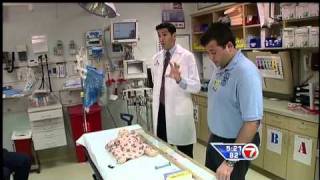
Dr. Peter Antevy created the Handtevy method to help paramedics dose emergency drugs for children without guessing their weight. Using your hand, you map fingers to ages and weights: a 5-year-old is roughly 20 kg. It cuts the math that kills kids in ambulances.
Questions this video answers
Pediatric ER Dr. Peter Antevy.
10, 15, 20, 25, 30 kilograms (respectively).
40 milliliters (example used 5 years → 20 kg, and dextrose dose doubled the weight to 40 mL).
Chapters
When it comes to an emergency involving a child, every second counts.
Too often, though, critical mistakes are made. 7. Zanadilla shows us how a local doctor came up with a new way to avoid a difficult dose.
Linda Robinson can smile now, watching her six year old son Jeremy splash around in the water. But it was a very different four years ago when his older sister found him floating face down in the backyard pool.
We don't know how long he was in the water, but she said that when my husband pulled him out, he was purple, blue, purple.
They called 911 and paramedics rushed to the scene to try to save Jeremy.
The paramedics are the lifeline at that point.
But for rescue crews, treating a child can be much harder than treating an.
Adult because they don't know how much a child weighs and they can't figure out the doses of those critical medications quickly.
Pediatric ER Dr. Peter Antevi says all too often, precious seconds slip away.
How many of you feel very anxious treating children?
That's why he's now teaching student paramedics a new way to figure out the correct amount of medication a child needs in an emergency.
How many people know what this is?
Until now, paramedics had to measure the child, estimate their weight and calculate the correct dosage of medication they should give.
Show us how you would figure out out the dose of epinephrine for this child.
So for 3kg would be 0.3mg and then 4kg is 0.4 and then 5 would be 0.5.
But under the old method, it was easy to make mistakes.
That's a tenfold overdose of epinephrine.
And if a child had been given that size dose, it could have been deadly.
We need to give people the tools that they can remember something easily, quickly, right now.
So he came up with the hand tevy method by simply counting the child's.
Age on your 1, 3, 5, 7, 9.
And then the weight.
10, 15, 20, 25, 30.
Nick figured out the right dosage right away.
He's five years old. Show me how you would do that.
1, 3, 5. So it's 10, 15, 20. With dextrose, you double the weight for your dose, so it would be 40 milliliters.
Perfect.
I think it's a great system. It's easy to learn and it's very easy to remember. Rescue 38, we're arrival.
It means the difference between life and death.
No one knows that better than Glenda and her family, whose son is now a happy, thriving 6 year old thanks to the quick work of paramedics that fateful day.
Every second counts and you can't get it back.
The hand Tevy method is already being used by doctors and nurses at Joe DiMaggio Children's Hospital. If you'd like more information, log on to our website@wsvn.com in the Plex I'm Diana Diaz, 7 News.