Trevor Wolfe RN, BSN - Workplace Violence (10/11/2022)
Trevor Wolfe, an RN, discusses workplace violence in healthcare and EMS, where hospitals report only 20-30% of incidents and EMS reports just 2%. He proposes embedding law-enforcement liaisons in health systems and creating peer advocate roles to improve reporting and support staff mental health.
Chapters
Transcription started. We are recording. All right, excellent. All right, so looks like we're starting to get our quorum here, so let's get started now. Welcome everybody. It's another Tuesday. I happen to be recording from EMS world here in Orlando. But I didn't want to miss out on Trevor's talk today, which is an important one. He's gonna have some great, I think, concepts and ideas for us to really chew on and think through whether you're in the hospital or in ems. So for those of you don't know, Trevor is a nurse by training. He's now in this, he's been in the St. Louis area, but he's been very impactful in getting state laws passed with respect to workplace violence. And my ultimate goal is for him to work with people at our state level in Florida to bring some of these concepts in the state knows about what Trevor's doing because I forwarded it to them and I think some of them are on this call today. So Trevor, thanks for coming. Without any further ado, let me pass it over to you. And by the way, before we start, for those of you who want CME, it's 15, 310 and it's in the chat. Trevor, take it away.
Hey, so thanks a lot for having me again. I really appreciate it and do want to start out by just saying everybody down in Florida is definitely in my thoughts and prayers. So much family down there and so thankful to have such amazing people responding to these horrible situations.
But you know, speaking of horrible situations, workplace violence has been something that's really been been a passion of mine. Of course not, you know, perpetrating it, but trying to prevent it as much as possible. In the health care setting I started off in the pre hospital setting I went through. I was on a fire EMS district in Peoria, Illinois while I was going through nursing school and that's really been. I've been trying to get out of the hospital as much as I can. It just keeps sucking me back in. So, but you know, now I'm in a full time EMS type of role. So this is when I started this, I was in a hospital role and it was so much easier for me to just focus on that. But I've tried to in my state laws that I've written so far include EMS in a similar statute. So I'm going to talk about two of the ideas I kind of have going forward. There's many out there and my point with this is to try and do some out of box thinking because adding is often right now just adding to failure. So anyway, you can see often this is what you feel like sometimes at the end of a shift, whether it be a full moon night or just one of those festival time frames, by the time you're done, you feel like you have combined fight record better than McGregor and any of the other great fighters out there. So.
Just some objectives real quick. Just going to discuss workplace violence and healthcare and EMS show two of these ideas that I'm working on currently called a healthcare resource officer, and another one called Healthcare EMS peer advocate. And then I'm going to beg you to take some action because we can talk and talk and talk and identify and identify, but until we all actually get out there and start knocking down doors, really nothing's going to change. So unfortunately, the incidence is just drastically underreported and it's largely because we have slowly started increasing and dealing with this more and more and more often. And really we feel like it's not our responsibility to take care of these. But remember, if you point at something, there's always three fingers pointing back at you. So remember that you can blame the prosecutors, the police, society in general, all you want, but unless you're up taking action, it's hard for them to write laws. As you've seen many kind of failed laws. You look at it, you're like, you gotta be kidding me. Well, obviously somebody who wasn't in that field, it was involved writing it. So just some quick stats, I'm gonna run through some things. 75% of all workplace violence incidents occur in the healthcare setting.
That includes EMS. Of course.
Only about 20 to 30% of hospital incidents are reported. And I actually think that number is kind of high. But it's a conglomeration of many studies that I looked at. But EMS reporting is a whopping 2% of all incidents that happen out there. And when digging into some root causes of this, I just find out that most of the time.
Departments don't have any type of system to report these. And it's definitely not encouraged or mandated for that matter. And we'll get into why that's an issue here pretty soon.
So if you take this data, just the simple little things, what is the actual prevalence? You think if only 2% of incidents are being reported in EMS and 20 to 30% in the hospitals, but 75% takes care in the workplace, in the healthcare setting, what do you think the true prevalence is there?
So we're gonna look about kind of what the effects are on the system altogether. EMS system, the whole healthcare system and workers, unfortunately. I really truly feel like this is one of maybe the top four causes of the degradation of our healthcare system in general right now.
So healthcare and the EMA system, you look at a little more statistical.
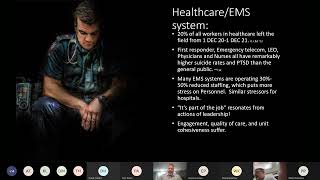
Analysis of what the problem is here is that 20% of all workers in healthcare left the field in a one year period between 2020, 2021 and that's labor. And statistics reported that. Think about first responders, emergency telecommunications specialists, law enforcement, physicians, nurses. They all have markedly higher suicide rates and incidents of PSP PTSD than the general public. I saw a study not long ago and I can't off the top of my head cite it, but I saw somewhere that.
Between EMS, emergency room or emergency department physicians and nurses, almost 94% of those people possess at least two of the five symptoms that it takes to actually be diagnosed with PTSD. And physicians are somewhere in the 30 percentile in the emergency department of actually qualifying for PTSD, whereas emergency department nurses and EMS personnel are somewhere in the 70 percentile. I think there was a time frame of practice there as well, but anyway, it was very alarming. Though many EMS systems are now operating between 30 and 50% reduced staffing. I know you are all feeling that here in the St. Louis area we are hiring our public or sorry, not our private ambulances to cover for St. Louis Fire Department that can barely put out 50% of their ambulances. Now those public or I'm sorry, private departments are not able to hire people either, but they're able to respond to 911 calls and that is.
You know, to the.
Not great for these hospitals that are waiting on patients to be taken out so these 911 calls could come in and get rooms. Right? So the whole thing is just a catastrophe right now. So some of the part of this reasons why people are not reporting as well is that it's kind of part of the job and that resonates from the actions of leadership all around.
So I apologize ahead of time, but Dr. Anteve's heard me speak on this and I call people out because we as the leaders are the ones who really have to make sure that our members understand that we are fighting for them and they are heard and they don't have to take this. And really the result of helping to fix this problem is in the end going to be better care for patients. And again, we'll kind of come up on that at the end as well. It's going to help engagement, it's going to help you in quality of care and your unit Cohesiveness, because those all suffer horribly from these violent incidents.
So the definition of workplace violence by OSHA is the workplace violence is any act or threat of physical violence, harassment, intimidation, or other threatening, disruptive behavior that occurs at the work site. This can be anything from threats or verbal abuse to the physical assaults. And of course, unfortunately, like we saw in New York recently, homicide here in St. Louis a couple months ago, we had a paramedic and a nurse stabbed in the waiting room at a place and then another pregnant nurse was kicked and beaten. Basically the people in the waiting room were the ones who saved both instances.
It's pretty sad.
Leaders.
Who here on this call, if you can use the little reaction thing, that would be neat. Who mandates reporting of violations of OSHA standards?
It would seem as though that's a federal requirement.
So.
Who here has been a champion to your people to protect them from workplace violence? I see some departments are really innovative, really forward thinking, and that is high on their priority list. Dr. Anteve put me in contact with Joe Zalkin and he's done some amazing things and we're kind of collaborating on a few things and looking to hopefully make it known that this does fall under those OSHA standards.
Who of you is willing to commit to truly reversing this trend of protecting your crews and healthcare systems? You need to really think outside the box. We need to set standards instead of say, this is available to you. Because without this kind of data that we need, we have nothing actionable to bring to lawmakers, to bring to the public to show them. Some news stations here in St. Louis have really been focusing on this and unfortunately, the data we show them, it really is kind of minuscule because it doesn't exist. And part of it is the cumbersome data reporting systems in an emergency department. As a charge nurse, I could have spent my entire shift filling out those incident reports about 10 minutes apiece, pretty much. And then.
What is even done from them? Are they actionable or are you just collecting data to collect data? So if you're any of these people above, let's chat more. And I've got a couple things to kind of show you here to see some ideas that might help out in your community. So first one is a healthcare resource officer, and it kind of mirrors the school resource officer model, leverages those resources from local and county law enforcement and creates a trained and dedicated officer for a health care system. And when I was really coming up with this, I was mostly focusing on the hospitals, but in recent months, really try to see how we can incorporate EMS services that are not hospital based. In St. Louis we only have one hospital based EMS agency and the rest deliver to multiple hospitals. So that would be something that it's a little complicated to present today. But there are definitely ways to integrate and create a system to where people can follow up depending on where they go. The other thing is.
One of the problems is just having EMS or I'm sorry, law enforcement come whenever there is an incident, you get a different officer who doesn't really know those specific laws and protections related to healthcare workers. I asked an assistant district attorney the other day in Missouri about the three laws that were passed last year and he had no idea they existed. The ones here in Missouri there were protection of healthcare workers. So sometimes you have to know some of these new statutes that come out yourself to inform the police officers or whomever to help protect you. Now if you have somebody who is focused on your system, then it's a lot easier. So the entity would share financial responsibility for the officers, but they would be an employee of the law enforcement department. They're not another security officer.
Not to be used in place of security. And they, they work together. If anything, the healthcare resource officer would just augment them and create a kind of liaison. So they'd be able to forge relationships with hospital staff, EMS crews, patients and the public. They'd get to know our frequent fliers. They get to know the patients who sometimes our issues, the families who are sometimes issues. And they're the ones who we can call when a patient. We come up with a plan that if this patient comes, they will be there with law enforcement. So in the event of a serious incident, they have arresting power, which hospital security rarely has. They're able to create an actual police report, liaise with the prosecutors, help streamline that path to justice for us when we are assaulted. Like I said, most hospital security, they don't actually have arresting power. Some places do actually employ.
Commissioned police officers, but not many. So HRLs also be able to gain a working knowledge of the healthcare facilities physical layout to help with the tactical response when needed, not if needed because as we saw this summer, we had multiple active shooter events, stabbing events across the country in these healthcare facilities, often.
Targeting physicians for, you know, whatever, not being happy with their care. I personally would just change positions, but some people tend to go, you know, all the way. So it's also adjustable. Little places may not need a full time officer there. Maybe they spend three days a week of their duty there.
Maybe a large facility has two officers 24 7. It just depends on what the needs are of that facility and what the availability is of the community to offer that as well. They could practice primary policing in a very vulnerable and volatile area, which would be a hospital.
They are not there to look up patients for warrants. They're not in place of security, and they're not to participate in patient care either.
And they're not to be a source of legal advice for staff that has those kind of questions. So there will be limits placed to make sure that it's known that they're not there as a detriment to the community.
So this is what the healthcare public and healthcare administrators think we deal with when they're issuing guidelines to take care of patients and who are volatile and hostile. But we all know this is really a lot of times what we get handed. They'll hand us these.
Little moves that we're supposed to practice, and they're great for redirecting Meemaw back to her room, but not necessarily dealing with this guy. So these are some. Some gaps that we have between the people who make the rules and those of us who actually have to follow them. So the next one is actually modeled after a law that was passed in Missouri a few years ago for police officers that created a peer advocate. And when I explain it inside hospitals, most hospitals don't want to unionize, at least the administration, of course. So I explain it that it would be sometimes kind of like your shop steward.
It's formatted in the hospital side for an RN who is trained to advocate for all staff in the facility, but could easily combine.
With EMS systems that serve in that area. It could be probably a command staff designee or a shop steward. If you are unionized. Big follow up. With all these incidents, one of my concerns was that I put in an incident report and then a couple weeks later I'd get an email back that said incident number VQR 12921 has been closed. You're like, oh, yay, thanks for that. I have no idea what's happened. You have somebody actually follow up stuff that HR used to do with you to ask you how things are going. They'd offer for ems, they'd get the critical incident stress debriefings set up, offer eap. They'd also liaise with the HRO to help for legal help and ensure your coworker's guided on how to properly report internally and externally. Recently I was approached by a. I know I'm running short on time. I apologize. I'll get through this fairly quickly. But I was approached by a nurse who was groped in the edge. He had been taken to a hospital after a incident at home. He was not intoxicated, he was just a jerk and on en route. So EMS asked the police ride. Reluctantly they did. It was a female medic in the back and he whips his thing out and starts masturbating. DOP does nothing, comes in the hospital brings him into the room. This nurse was being nice for another nurse. This nurse was new, went in and grabbed to start vital signs while the officer and paramedic were given a report outside of the room to the other nurse. And he reaches up and grabs her breasts and says, boobies, boobies, boobies. Well, she was not guided on how to document this. Told it just happens sometimes. So neither the paramedic nor that nurse ever got any justice because also the police officer didn't handle it well. And that's not always the case. Most of the time I'm very pro police, but it was not handled well. And there's a whole circle of why those things are not handled well. But if we have people like this that take these incidents seriously and can advocate for us, maybe these steps would be taken properly and we would actually see some justice and reduction in the occurrences.
So other than just those would serve an advocate to the employer to help with personality conflicts. Maybe the employer and their command staff are not doing well. Drug and alcohol issues, mental and physical wellness. In general, we are very reluctant to report anything on ourselves.
So correlate with the absence of actionable reporting. Workplace violence. The reason why we don't report ourselves often is the fear of reprisal. You can get your license jerked for admitting you're an alcoholic instead of them saying, hey, let's help you out. The stigma, like I said, job security fears and the cumulative effects are not always visible until too late. So if we start early in protecting ourselves, it's like you're back, you know, everything's great. When before you're 30 and everybody tells you, oh, you're going to be, you know, wishing you didn't bend that way. Yeah, yeah, I'm fine. And then it happens, and then you regret it for the next 20 years. Your work. So healthcare has forgotten the needs of us. HR is neither impartial, normal, nor currently available as a resource for individuals. They're downsized, downsized. And most of them are off site now, so they're not somebody you can go to for help with things. So an advocate would really be invested in Making sure that the facility or department gets back to a safe and therapeutic environment that we need to be able to offer so that we can offer the best quality of care to our patients. So this is not the end. This might be my.
My end, but this is not the end. So we need to create or work with data reporting platforms. I'm talking with ESO a little bit about.
Making their reporting a little more actionable and they are actually working on that as well. Another thing is we got to look at laws that purport to help us read into those laws and ask what is that doing?
If you look into House Resolution 1195 from a couple years ago has been trying to pass through, it went through the House, but thankfully the Senate stopped.
Had great words in there like, oh, it was talked about creating a comprehensive workplace violence plan. Well, you know what? My six year old could create a comprehensive workplace violence plan in crayon and they'd be okay with it. There was no parameter set. Also holding data for 10 years on incidents. Great, you collected the data, now what? So you got to look at and really read deep into these. Advocate for our patients by advocating for us, for our coworkers. Think outside of the box. Share these ideas that are different than things you've heard before. Let them set when they get shot down. Let them settle, let the dust settle and maybe it'll become more clear what, what the barriers are on being able to enact these types of things. And then tell your lawmakers to include us in writing these new laws. We're the ones that know how to use it. We're the ones that know what the downstream effects are going to be that tie our hands further. If you just make more regulations, that will all bounce down to us. So make sure if we make new regulations that they're things we can live with. And Then also remind Dr. Pepe this talk actually happened. And that's it. Thank you.
Thank you.
Dr. Pepe, any comment?
My memory is really great. There's two things about getting old. One, you lose your memory. And the other thing is. What's the other thing?
Whatever.
So I think I'll remember the doctor.
Okay, well, Trevor, this is the reason I wanted you to come back on because I knew that there's so many layers to this problem and there's a big advocacy portion of this problem and the solution that you've, you know, you're the trailblazer in. What do you recommend for the people who are on this call? Where do we start? Do we start on the advocacy Side, do we start collecting the data, you know, in our own locations? Do we, do we talk to the state people? Like, what's a good next step for the people on this call to do it?
I mean, that's an excellent question. And.
So far what I have learned from this is that if you do one thing at a time.
It allows you the stream to flow past. If you can kind of follow me on that, like creating jetties and things flow past. We need to create a dam. Data does exist for us to start working with. The biggest part is to make sure that everyone, every department has some type of data collection ability and somebody to start collecting. And that can be in any format. There are a lot of different systems out there. I would prefer to have one system like how ESO has it, so it can share, give us the hotspots. The insights part of it is amazing and you guys know that. I mean, I absolutely love what they have. The other thing, again to bring up the other point, the advocacy.
Find a champion, employ that champion and do what they say. Write your lawmakers. I'm a big fan of more is better. But I also, I'm not a huge fan of those form letters that somebody just puts their name on. I like because the lawmakers I've talked to, when they read personal things, it becomes personal for them. And then the other thing would be really just evaluating exactly what your department or your area needs and find a champion for that place. And you know.
It'S going to take a lot of outside the box thinking, temporary fixes for right now until we get some national things going. If I could get these healthcare resource officers and the.
The peer advocates going in a state or an area, that would be amazing. And I don't know 100% that they're going to work, but I can see from somebody who lived in those gaps for 20 years identifying, hey man, if we only had this, this would be great. Yeah. And then finding laws of other states that are working well.
Right. And Trevor, what I took away from your talk, which was great, by the way, and some new things were the insights that we got to make sure we're helping to write the laws and not them making things even worse for us. That's so important. So, Peter, to answer your question, I think I would try to do all those things if you can at once, you know, and because you could use your own data locally to strengthen your case as you go forward. But then I can't remember, Trevor, if you address the issue of training and how are their best practices somewhere. Because the other thing is we got to do something about it right now as well. How do they react? What do they do?
Right, absolutely. And Dr. Pepe, that's an. That's a perfect point. Because some of the training that's out there right now seem to be pushed at us. And they all mirror each other. They're all the same. And what I find is that when you train somebody to use specific holds, those holds come back to hurt you because they're used for the two couple, the couple flipping you off, and they want you to employ them with the crazy MMA guy that filed his teeth down. So the de escalation techniques are amazing, but the ones that I like the most are the de escalation and get yourself out of the situation ones. We need to be careful.
Inserting ourselves into these situations because you take us out, we're not there for the next 20 calls.
Right. Trevor, where does the NAMSP and NAEMT stand on these two on this issue currently today?
Well, they're kind of like a lot of the other ones. They're very supportive of it, but they're waiting for some.
Folks to get together and decide what the best way is to go forward.
I have not reached out to them specifically except for talking to them at conferences, but that's a great point. I really probably do need to reach out to them and ask if they would have any interest in creating some standards. The other thing is that we need to make sure when we issue standards that we are reevaluating to see whether or not they are effective versus just saying this is what we're going to do. We need to make sure that we're not employing something that's getting us heard.
And Peter, a place I would start then is probably Jose Cabanas because he's the incoming president in January of nmsp. So he's the president elect and he's done a lot of work in this area already. He's been doing it for over a decade. Okay, so just a thought.
You're right.
Oh, that's perfect. That's great timing then. Okay. And I'm here at EMS World. I know you're coming. And I'll be at the NAEMT meeting tonight. So maybe I'll tap on some people's shoulders and talk to them about it.
Hopefully we can reverse some of these empty ambulances right now, too, by getting it. Making it safer. It's not all about money all the time. It's only about money when you have to take a certain amount of Beating to earn that money when somebody else is earning almost what you do without that type of beating.
So great point, great point. Trevor. Anyone else have any comments for Trevor before? I just want to pop up a quick flyer just to remind people of an upcoming event on Zoom. And anybody else have any comments for Trevor? Any personal experiences, any advocacy experiences? I'm looking for a hand raise or just unmute the mic.
Somebody in chat.
Okay, so seeing none. Trevor, thank you so much as always. We always learn from you and thank you for your advocacy and we hope that. I mean, I love Paul's idea about Jose Cabanas because taking it to that level with someone who's already been working in that realm is great. So great idea. Paul.
You got Doug Kupis, right, as medical director as an example and you got people like Jeff Jarvis. There's a lot of people we can talk to this afternoon about it.
Okay, that would be wonderful. Thank you guys so much and pleasure seeing everybody and take care. Enjoy EMS World, everybody.
You got it. Can you, can you guys see my screen? Hold on.
August 22nd.
Yeah. So this is just a reminder and just for everyone to know that the Florida Whole Blood Coalition, October 27, we've moved it to a 90 minute meeting because we've had such. The response has been so dramatic of who wants to speak on this thing. So here's a quick agenda. We have Dr. Holcomb, Dr. Pepe, Dr. Roach, Chief Coyle. We'll talk about Palm beach with Madonna. We're going to talk about the hospital. We're going to have a blood bank person on. We're going to go through the logistical considerations, how much this thing costs to start up, what it costs ongoing future funding and strategic initiatives. Dr. Duchesne from Tulane and Danielle Tatum will be on speaking about the registry and how to get involved. We have the number two guy at the state of Florida, many of you know Dr. Schepke. He's going to be speaking. So we have, I think every stakeholder that we need for Whole Blood is coming on and we're going to give them, you know, 10 minutes or so per topic. But Dr. Pepe, any comments before you move over to the other webinar?
Oh, no, no. Except this is just great. I think the response speaks for itself. This is like, you know, it's just coming, right? It's, it's the, you know, the glacier just moving along. So it's, it's really kind of good. It was a slow progress, but now it's a tsunami, really. And so thanks so much for organizing this piece. By the way, Monsieur president of Florida chapter of the Namesp. I gotta go over. Thanks.
Okay. All right, awesome. So if you want to register, use the QR code here. And if you see our tagline is do it for Taylor. For those of you who don't know, Taylor is Dr. Jim Roach's niece who unfortunately was killed in a car accident in Broward county. And he spearheaded. Him and Chief Clark have spearheaded blood in South Florida. And so San Antonio has brothers in arms. We're going to be doing it for Taylor. So I just think that's just going to be really special. When you hear that story, it's just very powerful. So. All right, thanks, Trevor. Actually, Trevor, I'll give you the last word before we move over. Want to give us any last final comments?
You know what, if you want to look at a place to start, I'm happy to let you know the most recent things passed in Missouri for that they're low hanging fruit. But little bit by little bit goes a long way. Just do something.
Well said. Thank you so much. All right, we're going to go over. Let me see if somebody I see. Dr. Jamieson. Angus, are you able to restream? Because I'm at EMS world and I'm in the middle of teaching a course.
More from Peter




Melissa Olen MSN, FPN-C, CCRN: Sudden Cardiac Arrest Training in Schools (Project ADAM) 4/25/25



Pediatric Hospital Readiness: How Teamwork & CPR Metrics Drive Better Outcomes



Chelsea Kadish, MD & Kyle Goodknight, EMT-P, RT: Pediatric CPAP in EMS (3/14/25)