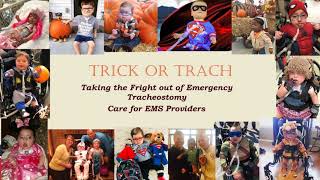
Trick or Trach: Taking the Fright Out of Tracheostomy Care for EMS Providers
Peter Antevy, Trish Casey, and Dr. Steve Laffey teach EMS providers how to handle pediatric tracheostomy emergencies. A plugged trach is immediately life-threatening. The STARS program provides individualized emergency plans and trains communities on suctioning technique, safe depths, and how to perform an emergency tube change.
Chapters
Hi, everyone. This is Dr. Peter Anteve. I'm in South Florida. With us today, as you can see on the screen, on your right hand side we have Trish Casey. She's the STARS program coordinator and a paramedic. And on her right hand side is Dr. Steve Laffey, who is the STARS program and STARS program medical director. He's a pediatric emergency medicine physician and the clinical director of the ER at Cardinal Glennon Children's Hospital. He's in St. Louis, Missouri. So how you guys doing today?
Doing well, thank you.
Awesome. I'm going to make sure that everyone can see our screen. And on your end, Trish, can you just say click, show my screen? Because I'm not sure they're seeing us yet up on the sharing platform up there.
Does it say show screen? It's showing the screen, right? Yeah, it says showing screen. Good. Okay, perfect. So I'm there. I'm there, I promise. And last but not least, he's not on your screen screen, but he's in the background is Josh Degal. And Josh is the Trauma Program manager at Cardinal Glennon Children's Hospital. The story goes is that I was very fortunate to meet Trish back at the Eagles Conference in Dallas and she gave an amazing presentation. And I was like, I remember coming up to you, Trish, and saying like, this has to go worldwide. And then I was fortunate enough to come give a talk for you all at ssm, Cardinal Glennon Children's. And I learned all about the STARS program and I begged you guys to actually do this. Truth be told, this is the most the biggest response we've ever gotten from a webinar request. Almost 400 people registered. We have several hundred people on here today. So I'm excited. I hope you guys are excited. I think everyone's in for a treat. So we're going to take away our videos and I'm going to have Trish and Steve get started. And here we go. Let's do it.
Thanks, Peter.
Got it.
So thank you all for signing up to join us today to learn a little bit about our program and our passion here at Cardinal Glennon, which is improving pre hospital emergency care for children with complex medical needs. And after a quick intro of what STARS actually is, we're going to go into the main event, which is our Trick or trach lecture. So, and we're going to explain to you why that subject in itself is such a hot topic in our area and why we're so passionate about that in particular.
And we're going to click ahead.
All right, sorry about that little pause there. So what SARS is, we're basically just. It's actually a simple concept that seems quite complex to most who look at us from the outside. But STARS is a project that actually started in the field, surprisingly enough, at a community, just EMS district. And for all intents and purposes, we intended it to stay just a community project. But we uncovered a solution to a growing need and that was recognized by Cardinal Glennon. So we now cover the majority of two states taking care of and preparing for children with complex needs. So each child in our program has an individualized emergency care plan and that is very pre hospital specific. So it's written with the capabilities of EMS in mind.
And we saw with STARS that it was extremely important to get this information in the hands of EMS providers prior to this emergency taking place. I've been a paramedic for 20 years and I knew that arriving on scene to a high acuity call with a patient who quite you might have a syndrome you'd never heard of, or have medical equipment in the home that you'd never laid eyes on that time was not the time to be handed detailed medical information. Usually it was handwritten, it was written without the scope of EMS in mind. So we changed those forms up a little bit and I will show you an example of that in just a moment. So each one of our patients is numbered. They each have their own number which coincides with the district or region they reside in. And upon 911 activation, that number is relayed to the responding ambulance who can then reference that plan either via our new electronic database or in PDF form on their, their devices that they have in the ambulance. So along with that, we do as much training as we possibly can, and again, we try to get that training done prior to any type of, you know, high acuity pre hospital event. So and with that we really try to get those kids with the medics that are going to be most likely caring for them so that they can get that real, true understanding of that child's baseline. And of course, pictures speak a thousand words, so sometimes it's easier to show what STARS is through a collage of pictures from over the years of what we do. You know, and the intention of getting these kids in front of the medics originally was to take that fear factor away from the children, if it existed. And what we found truly to be the case is that I have yet to come in contact with a child who was the least bit anxious coming to the firehouse or having EMS visit Their home. In fact, they were usually just overwhelmed with excitement to be there and to see the trucks. The fear factor seems to come from the providers getting them accustomed to that child's baseline, knowing they won't break that. It's okay to touch them and it's okay to touch their equipment. That just really, you know, you can't put any kind of value on that. It's invaluable. Do you have anything to add with that, Steve?
Nope. Doing great.
And here's an example of a STARS plan. This is actually one of our trauma patients from Cardinal Glennon that was a post traumatic arrest that went home. So, you know, she has a lot of issues going on. And you can see the, you know, the information that we store on these plans. They're all typed. We try to again keep them within scope. And then when we do have a child that goes into a community that does have any type of special order, any kind of home emergency med that may be given or a request to, for example, give a medication via G tube or access a Broviac line, we talk to that medical director and I put them in touch with Dr. Laffey here at Glennon to make sure they're comfortable with that and they sign off. That way the medics know that any plan that is there for a child they're running on has been approved by their medical director. And their medical director is, you know, is considering any of the treatments written on there to that he's agreed with them, he signed off with them, and he's considering them within their scope of practice. Some of the most important information that we find on these forms, some of the most valuable information is right here, this baseline information so that you know what's normal for that child. When we teach our special needs lectures, you know, we hit on that so hard. It's because, as you know, if you don't understand what normal is for that child, it is absolutely impossible to assess for the abnormal.
So we're going to go ahead and like I said, jump into the main event, which is our trick or trach lecture. So we teach a lot of, we have a lot of different educational programs here with our STARS program that we take out to the community and they are each important. We teach about adrenal insufficiency, we teach about hemophilia.
General assessment for patients with complex medical needs. We do a more in depth training with TRACH that goes into actual vent ventilator issues as well. And we teach about pediatric epilepsy and different types of alternative treatments for Kids with refractory epilepsy syndromes. But trach is that one that we just like to put a whole lot of emphasis on, because while all of those other patients have had. We've seen suboptimal care and, you know, things that could have gone better, we haven't seen that true loss of life. And unfortunately, that's what we've seen with our tracheostomy patients, which was actually, you know, a big push to get stars up off the ground at Cardinal Glennon. I do believe in 2014, we suffered. We had four children go home with tracheostomies who either unfortunately suffered loss of life or a devastating neurological injury just due to an obstructed tracheostomy tube, Something that was extremely fixable, very preventable. So we knew we had some work to do that we need to make sure that, you know, when we were sending these kids home, we were sending them home to a safe environment. All the kids you see on the outline of this title slide are actual stars. Patients and their parents sent me these pictures as when I requested them, and I told them we were doing a fall theme. So there's some of our stars.
So when we teach this out in the field, you know, I like to start with a scenario. It gets people thinking, and then it gives me an idea of where everybody is as far as what their understanding of trachs are and, you know, what their protocols are and what their comfort level is. So this scenario itself was actually modeled after a. I wrote this because of a call that Dr. Laffey actually told me about. This happened in our city about five years ago as a little boy. And unfortunately, this is one of our poor outcomes. So if you are able to type in, I welcome you or encourage you, rather, to type in your answers. And Josh can relate those to me and I can share it. But we'll say you're dispatched roadside to this difficulty breathing, and you have this little girl strapped in her car seat, blue and unresponsive. Where do you start? As a first responder. And for you nurses and physicians who are listening in, we can go ahead and make this a hospital scenario and say that she's just. They carry her in in her car seat to your triage in this state.
Are we getting any kind of replies?
Does she have a pulse?
Does she have a pulse? She does, but I don't think she's going to have one for very long. And we'll say it is faint and slow.
Reestab the ventilation. Check. Trick basie suction and replace as needed.
Okay. All right. So someone put in their suction and replace as needed. I like that because that's what we need to do. Absolutely. So when we, when we do this out in the field, I have my trach mannequin with me and I hold her and I kind of walk around and ask for these, these answers. Of course, we usually, sometimes I get blank stares. You know, I've heard a dry fast. Well, unfortunately, a dry fast was what happened with this child and that didn't work out so well. I do get a lot of people saying that they'll go ahead and bag her. And as soon as I say, well, that doesn't work, you know, you're not getting any type of good compliance, you're not able to ventilate this child. We go to suctioning and I say, well, what do you do past suctioning? And that's where a lot of people just get stuck because training has stopped there, their understanding has stopped there. And in fact, we've even had some physician level providers say, you know, they would not be comfortable replacing a trach tube in a pediatric patient. So we're going to go on with the lecture and we'll kind of refer back to that scenario a couple times.
Trish, I'm going to break in Peter here. I have a quick question. So this kid's strapped into the car seat. Are you recommending that they do it right as she is sitting there, or are you recommending that you quickly unstrap her and get her back to the back of your vehicle?
I recommend getting her out and putting her on the ground right there. As long as you're not in the roadway.
I love that.
Perfect. So in other words, you're not wasting any time running anywhere. You're just going to, you're going to, you're going to, you're going to take action. Right. Which you right where you are on the ground.
Absolutely. We can't waste seconds.
I love it.
So time is brain just covering the Drake and ventilator. Are you going to talk more about.
That in a minute?
Absolutely. We're going to cover a lot of different, you know, we're going to cover everything I can think of that can go wrong at the end of this because as we know in ems, you know, how often are things going to go picture perfect? Right.
So, you know, like I said, we're going to refer back to that as well. But when we had my first stars, was first transitioned from the field into the hospital, I took the time to walk around to Some of our clinics and introduce myself. And what I really wanted to know were, who are the sickest of the sick at this hospital? And who do we really need to prepare the field for? Well, I can tell you that when I hit the nicu, the picu, and our TCU floor, Respiratory therapy wasn't so fond of me. When I identified myself as a paramedic and told them what I was trying to do because they had taken care of these children that had had these devastating outcomes in the field, One of the questions that they would ask me right away, it's, you know, almost accusingly and aggressively and sometimes was, you know, aren't you a paramedic? Isn't airway what you're supposed to be good at?
And I started thinking, you know, I was comfortable with trachs. I was very comfortable with trachs. But I had the benefit of working in intensive care the first two years of my career. I also had a family member with a tracheostomy Whom I was the primary caregiver for. So this was something that I myself was very comfortable with. But I wasn't so confident that the rest of the field was in our area. So we started pulling paramedics in the St. Louis metropolitan area. And this is what we came back with. And so I said, well, here's. Here's our answer. This is why these incidents are happening. We need to close the loop of communication here, and we have a lot of work to do. So since we have educated thousands of paramedics.
So, you know, another case that. And I hate to call my stars kids cases. A child who really opened my eyes to two pediatric tracheostomy emergencies Was my buddy Nathaniel here, who is the 10th star that we ever entered in the program. While I just said that I was very comfortable with trachs, I soon found out through stars and through my transition from the field into cardinal glenn, and that my comfort level and my knowledge base Was really around adult trachs. So I was accustomed to all of my patients being trached Secondary to some terrible pulmonary insult or neurological insult. And they required. They were trached because they required vent support. And when nathaniel came up to meet us, I was a little bit surprised that this very vibrant child Was running around the room, and he just didn't appear to me to be a kid that got stuck on a bed later at night. So I asked mom why he was trached in the first place. And what she showed me, I'll show you in the following slide, was pictures of his Actual airway malformation, which at the time. And since he's had a complete laryngeal tracheal separation, so he really has no airway above that trachea. But at the time, he still didn't have an airway that would allow us to ventilate him at any time over the nose and mouth. So knowing that, plus the fact that he was in a 3.5 Neo at 2 years old, which you can translate into a size 3.5 ET tube in diameter, that really scared me, knowing that a lot of the medics I work with were not comfortable with tracheostomy care and that many of them felt that changing a trach tube would be outside of their scope of practice, because we hadn't established that with our protocols. So we talked to our medical director, we got the definite okay and support for him to change out trachs emergently, because, after all, it is an airway. And really the alternative to that is death, if that's what's needed. And we did a whole lot of training. And you can see in the picture over on the right is actually.
Our medics at the time visiting his house on a Sunday morning just to watch a routine trait change. So we made sure that every single paramedic in that agency had watched a routine trach change with Nathaniel, and then that became part of orientation and onboarding, if you worked there at the ambulance district.
So what he opened my eyes to were that while most of our pediatric trach patients are trach secondary to primary ventilator dependence, we do have a lot of patients in our communities who were only trached because of an airway malformation that inhibits their ability to breathe. Without a patent trach, we're also dealing with a lot smaller airways. So the ability to breathe around that trach once it is obstructed is a lot less than it would be with an adult patient. So, you know, time, it becomes a little bit more critical when we're dealing with these kiddos.
Just to show you an example of what Nathaniel had going on, when I met Nathaniel, he had a grade three subglottic stenosis. So this little pinhole opening is all he had for an airway. And along with that, he had a tracheal web, which is so rare, I don't even really have a picture of that to show you. I will say the last patient that we lost from Cardinal Glennon, who unfortunately passed away because of a trach plug, and a school nurse and home health nurse who were not properly Trained did have a grade four subglottic stenosis. So this was a child who really didn't stand a chance at life without a patent trach.
And that example that you gave was also a patient with a airway problem as a subglottic stenosis as well. And that original example was not a patient that was on a ventilator or had any pulmonary issues, just anatomic issues.
Yeah.
So to get down and dirty, the real basics sometimes, you know, we found that there's a little bit of misunderstanding of what a trach really even is. And some of this might sound elementary to you all, and I apologize if that's the case, but we just want to make sure that everybody has that basic understanding of what we're working with. So what we have is actually very simple. We have a tube that's been placed into a surgically created stoma, so you have a tract going right into the trachea. I've talked to some medics who were actually confused and under the impression if they pulled that trach, that replacing it would be similar to doing an emergency crike in the field. They didn't understand that they had a clear tract into the trachea. I also want you to take note, while it's less significant in the pediatric patient that you do have without an inflated cuff, a very small alternative pathway for air to pass. And sometimes that's more significant in patients than it is others, especially when you're talking about airway malformations. But keep that in mind when you're working with cuffed trach tubes in the field. Really, you know, a cuff on a trach shouldn't be inflated unless that patient is receiving positive pressure ventilation.
So here's another misconception we see quite a bit. This is a tube with an inner cannula. And this is something that I honestly don't see a whole lot in the adult population anymore, but used to be extremely common in the adult population. And again, we've seen even physician level providers who just are under the assumption that all of our trach kids have this inner cannula that you can just twist and pull out and rinse and replace. But that's not the case.
For the majority of peds. I'd like to say all peds, but I can't say that without knowing for sure. So these are the common tubes that our kids have. The Bevona, the Shiley. The names really are not. Are neither here nor there for you to remember. But we just want you to realize that what you're dealing with is just a single, in most cases, very soft and flexible tube that is keeping that airway patent along with it. If you have a new one or one to replace with, then you'll have this obturator in place which helps guide it into place. They're either going to be cuffed or uncuffed, which you'll know by the presence or absence of a pilot balloon.
And we do have a lot of kits. This is a really popular trach, this flex end here. So you may see this extension. This can shock people at times, too, coming out from the phalanges. And all this is doing is allowing that kid to have some more movement if they are on a vent or hooked up to humidity without moving the trach within the trachea. And then also for our kids who have multiple chins, allows you to put that, you know, get that past all that tissue so they can breathe a little bit easier. Over here is a picture of Nathaniel prior to his LT separation. We would not have been able to capture a picture like this because he would have been crumping within seconds of having his trach out. But you can see here the track.
That you have in the stoma.
Oh, I just got a note from Josh to explain LT separation. I think I did really briefly, but before. But if you didn't catch that, Nathaniel was unfortunately never going to be a candidate for reconstructive surgery because he had no functional vocal cords or epiglottis. So if we would were to have opened him up, then he would have been at continuous risk for very dangerous aspirations. So the only choice they had to give him a safer, larger airway was to just remove all of that tissue above the stoma. So this is a child who no longer has any connection whatsoever from his airway to his upper airway. So his trachea stops right here. It's been cut and pulled forward. And this is his true breathing stoma, which he does wear a trach in still. But the intention, when he becomes an adolescent and stops really growing, is that he can possibly just not even have a trach and walk around with a breathing stoma.
Patricia, I have a quick question for you on that one. How would you know that? In other words, if you're at the scene, what do you recommend for field providers or us in the emergency department to figure out how that anatomy is constructed? Do the parents know this?
You know, yeah. And that's a scary, you know, scary question that you pose because you won't know that, as you can see by looking at him, I'll back up a slide. You don't see anything from the outside that gives you any indication. We had a member of a pulmonary team from another pediatric hospital who actually traveled to shadow our program because the last loss of life they had in their pediatric trach community was a child who had had this exact procedure. And EMS attempted endotracheal intubation multiple times until the child passed away. Go ahead.
So I think. And this is Steve Laffey again, I think the answer to the question is really, really important. And that is, you won't know that answer as Tricia is going to bring up here.
You have to go on. The ones that are going to be the calls that are going to be a problem are going to be almost by definition, the calls that don't involve caregivers who know a lot about him or are very comfortable dealing with it, because those families already know how to handle the problems and don't call you. So you're pretty much on these calls are going to be dealing with folks who aren't comfortable, aren't having been well educated, or we do have caregivers who just really get very, you know, the stress kind of. They just kind of, you know, lose it, basically. So you won't know is the answer. What's really, really important here, though, is addressing the idea that a lot of these trach protocols, these airway protocols that we see spend a lot of time with trying to bag from above or close off the stoma or try and bag or try and intubate. And it's just really important to realize that that is not going to work all the time. You just can't rely on that at all to be the answer to your problem. And Trish will get to this further, as far as going down and doing these assessments, don't rely on it. It may not be the answer. And eventually the answer is going to be replacing the trach. And the amount of time you spend learning that has to be very, very small. You can't spend much time realizing that that's not going to work. But be aware that it is not at all uncommon that those instructions of plug off the trach and bag them from above or try and intubate them are absolutely doomed to failure. For no fault of everyone's. Except that's anatomically never going to happen.
So. Or, you know, the answer is having every single child with a.
With a START program. Exactly.
So Nathaniel's kind of a local celebrity in our area, and we call ahead when he travels to destinations for, you know, any type of period of time to let them know he's in the area. And his STARS form actually includes a diagram, a very simple diagram of what his anatomy is.
So he's got his STARS number all over his bags and everything else so they can reference what's going on with him. And actually his BLS fire department knows how to care for him in an emergency.
So real quick, I just wanted to run over some pieces and parts and accessories to trachs. It's not imperative that you know about all of these, but it'll just help in your assessment and in your care and it'll make caregivers a lot more confident in you if you have this basic understanding. So when our kids are not on a ventilator.
It'S very rare that you would see them running around with nothing on the end of their trach as far as caps go, because that's just, it's dangerous for them and it's going to create an environment for the lungs that's just too drying and unhealthy. So this is the most common one you'll see. I'm hoping you guys can see my pointer here on the screen. This is the HME which stands for Heat Moisture Exchanger. And all this does is allow the child to create a little reservoir of their own body heat and moisture to create a moist environment for them to be breathing. So they're not just breathing dry air. And then it also will filtrate out microbes. They're not just breathing them in, actually serving the same purpose as our nose does. And some of our kids will call this their nose versus the speaking valve. Here you'll commonly hear this called a speaker or a talker. And and.
This is the medical term for this is a passy muir valve or a pmv. And this one I like people to know about because it's a little bit more significant. So if you see a child using a passy muir valve, that is a good indication that you do have an open airway because that's essential for them to use it. So it serves multiple purposes. For our kids who are even our non verbal kids who have the opportunity need to be vocal or make sound, this allows them to breathe in through their trach and then as they exhale, this valve shuts and air is forced past the cords and they can make sound. So for parents, you know, and them, that's the great benefit. For the pulmonary side, this forces this child to start using that upper airway if they haven't in the past. So it's kind of like training wheels for our kids who have outgrown the need for vent support and possibly outgrown the need for their trach. We can start retraining them to breathe like a typical human past all that tissue. It's a lot more difficult than breathing through a hole. Through a stoma also forces them to create a natural peak that they're not doing at all with an open trach. So it's good to exercise their lungs and also normalizes the swallowing process so it helps prevent aspiration a little bit. Something very important to note, and I would think I wouldn't have to explain, but apparently I do because we had an incident in the field. If you have a passy muir valve in place, you cannot have a cuff inflated. That's going to create complete air trapping and asphyxiation. So very important to note. Now, the passy mulve can also be placed in line in vent tubing, which we see, I want to say, with our muscular dystrophy patients the most. So this will allow them to speak between breaths on the ventilator. This is where, you know, we want to think about the cuff, too. So these kids who do go on vents usually have a cuffed trach, and you'll know if they're cuffed or not by the presence or absence of a pilot balloon.
When that. If this child were to be in distress, that needs to come out, as well as these other caps. Any child who's in any respiratory distress whatsoever needs caps pulled off. There's also a cap that's a complete cap that we use for our kids who are weaning. And for sure, if that's in place, it needs to come off. But anything, you know, we need to open that airway completely by removing them. We don't want to do nubs treatments. Oxygen over caps. You will see little attachments for passing years and for HMEs occasionally that allow supplemental oxygen. But those are intended for very low flows, like less than 2 liters, sometimes a quarter liter, because they're drying and they need that humidity. These are the common ties. You see. Just a very soft Velcro simple tie that keeps it in place.
So as far as suctioning goes, suctioning is very important. And with our pediatrics, there's a little bit more to consider. When I worked in the hospital with adult patients, we used to intentionally, occasionally suction a little bit deep and try to induce those big coughs. That was also before we had good chest PT devices to Induce cough. So we wanted to expel those secretions. We don't want to do that with our kids. If you go down and tap the carina, it's a much more delicate area than it is in our peds. And you're going to potentially and likely induce a vagal response that you don't want. So you can see a brady issue that becomes a vicious cycle with cough brady, cough brady. And.
Some other considerations to take is, you know, twirling that suction catheter as you go in suctioning, trying to suction no longer than five seconds and giving them a rest between. You want to make sure they have that rest to oxygenate, you know, catch their breath, kind of stop coughing. Between saline in the trach to loosen thick secretions is very appropriate. Usually we say 1 to 3 CCs. Some people are hesitant to actually introduce any kind of fluid into an airway. But remember, lungs are supposed to stay wet, so sterile saline is okay if it's needed.
And I just got a question that, you know, people ask. How deep? So that's important to know. If your child is in the STARS program.
They will have a suction depth listed in centimeters, and that's why those numbers exist on your French cats that you have on the ambulance. And the child will have those with them as well. We're going to talk about the importance of bringing those with you. So you would just go to that number. So, for example, if they said, you know, suction with a size 8 French to a depth of 9 cm, you would find 9 cm on there. Grasp that between your pointer finger and thumb. Keep it there so you don't go too deep. And the intention is not to go past the trach. Now, this is an inline suction catheter that you see above. And I only wanted to mention that because they're very popular. Even for some of our kids who aren't on beds, it's just a convenient way for them to keep their suction equipment clean. These colors replace the depth so it's easier to see, but they do not match Broslow for some reason, we see colors, we think broslow that there's no relation at all. Kids with trachs, when they're in the hospital, have this usually on the wall or on their. On their bedside. So you have, you know, the size trach, the size suction catheter and the depth to Suction 2. So in the home, if they're not a STARS patient, you don't have that program in your area. That should be written Somewhere someone should know. If they. If you don't know, we always say don't let that stop you from suctioning. Just keep into consideration you're not going past the length of that trach.
The go bag. Every kid who has a tracheostomy tube goes home with a go bag.
It doesn't matter what hospital they come from, they have one. And I used to teach about what they look like because we have certain ones at our hospital. But parents inevitably go home every time and change it up into something that works better for them. Regardless of what it looks like, they have one. And the parents are trained to keep that with them at all times. And that needs to come with you. You pre hospital providers, that needs to come with you in the ambulance, that needs to be considered like that child's umbilical cord, because in that you're going to have a spare trach if you need it. You're also sometimes more importantly going to have a trach that's either a half or full size smaller in case you have that difficult recannulation. We have kids that have known difficult stomas that have three sizes smaller just to troubleshoot and get a good airway on them. You know, if you're having a lot of problems, you're gonna have extra ties, you're gonna have saline bullets. And if again, if you don't have those saline bullets, use your sterile saline flushes on the ambulance or in the ed. Those work. Those are the same thing. Their BVM from home is gonna be in there. And if you guys don't have peep valves on your ambulance, it's really likely they're gonna have a peep valve on their home bvm that's gonna help you out a whole lot. It'll already be set and parents probably don't even know what that is. You're going to have surgery lube packets for difficult recannulation too. And then there are extra caps, trach collars, etc. This is not likely to be at the bedside in the ED when you arrive. These trachs are custom for these children and they're expensive, they expire and they are not commonly stocked in pediatric trauma rooms. So this needs to come with them. It can be timely for the ED to find their size and order it.
Our rules, our basic rules for rules for EMS is that trach has got to be considered the problem until proven otherwise. Just like you would never move away from a in your assessment for airway. We don't care if they're Seizing, bleeding, ejected from a vehicle. We want you to establish that you have a good patent airway before you move on. Check for patency by using that dope mnemonic that you use in pals and for equipment, if they're on event, check equipment displacement, obstruction and then pneumo doesn't become as important with our kids because right now that's a whole other lecture, right? We're dealing with the actual airway patency portion. And then do your suctioning, do your assessment, do your bagging. If that kid's not improving or heaven forbid, they're declining, you probably need to consider an emergency trach change and unfortunately not with a whole lot of hesitation. Something I want to mention that one of our pulmonologists mentioned when he was doing a lecture for me not long ago is I used to always teach that you could check for patency by just passing that French catheter down the trach tube. But he commented that he's had several cases with very loose plugs that end up catching on the end of a French catheter and then loosening themself again on the end of the trach tube. So you can't even really count on being able to easily pass a catheter for having a patent tube.
The other thing that I always point out is having a hole to breathe through that's the size of your small French catheter is not going to be an adequate airway. So even if you get something through that that's the size of a 5 French catheter that is not going to be adequate to oxygenate and ventilate. So you absolutely cannot trust the suction catheter as the, you know, I suctioned it out, so therefore it's not a plug trach. That is absolutely something you can't rely on.
So yeah, please, please assess your patient, look for improvement and then just oh, and I think on that previous slide I too said make sure you have suction at the bedside. They have got to have working suction at the bedside at all times. I think most of our ambulances are equipped with that these days. But you know, I work for an ambulance service that has low budget and doesn't always have it. So want to make sure that you take theirs with you if you don't have a good working suction unit. And I think on that slide too, I also briefly mentioned oxygen. Never ever withhold oxygen from a trach patient. But if you do have to provide long term high flow.
Oxygen, you know, try to humidify it if you can. And if you don't have a humidity setup in the ambulance, I used to just throw saline in a neb and that way you could keep, keep your secretions loose and, you know, try to prevent thickening plugs and drying lower airways. So step by step, you have that kid with a trach, you have to go down the checklist immediately. Yes. Check patency and placement of the trach. And like we just said, that patency, that's a little tough. So you're going to rely on how they're, how you're bagging and how they're ventilating suction to control excess secretions, especially if they're bubbling out of the trach or they're sounding really coarse. And then assist ventilations as needed. Ambu bagged a trach. We've seen people come through our PALS course who are even not quite comfortable with popping off that face mask and bagging the trach. Definitely need to go there if it's needed. And then if that trach tube is thought to be partially or fully obstructed after these clearance attempts or if this patient continues to decline, that's the time when we need to be doing an emergency trach change. And like our RTs like to say here, who help me out with teaching, when in doubt, change it out. That's kind of their motto. If all else fails, you're not improving. That needs to be changed out.
So I like to comment on this quote here. You know, I actually pulled this from ems, you know, pre hospital protocols that I found. You know, when I go into districts who are starting at the STARS program, I ask for their protocols and I always check to see if they have a trach one right away. And I look at their seizure protocols. Just what I do. I've seen this written in different ways a couple times. You know, it goes through step by step on how to suction. Almost all of them talk about that inner cannula that unfortunately doesn't exist in most cases. And then they say if you get to the point where you do need to change that trach, hand that child over to the experienced caregiver and allow them to do it. Well, here's the problem with that, and Dr. Laffey commented on that a little bit ago. When we've seen these poor outcomes and we've seen problems happen in the field, that experienced caregiver was not there. And I can speak from personal experience as a, as a caregiver to a person with a trach, you don't call 911 for an audience. I'm very close to my stars families. One of my stars moms sent me a picture the other day of her roadside on the highway, just popping a trach back in. This is something they take care of themselves. You know, it's part of their everyday lives.
So while of course, if that caregiver is on scene, it comes time for the trach change, hand them over. We need to be prepared to take action if they're not there. We also are seeing a trend more often than not of our kids coming in with EMS without their home, nursing with them and without parents. So being alone in the back of an ambulance with a paramedic and these plugs can happen at any time. So we've got to be prepared to act. And this picture here is from an actual call. EMS did a trach change and they took a picture of the plug and sent it to me. So I said, great, I'll use it in a presentation so you can see just how occluded things can get. And this child did have an inflated cuff. So as you can see here, this was a complete asphyxiation issue. And this is a kid that she did great. Mom wanted to sign a refusal when she got to the house, did the trach change. Kid was back to baseline. So we'll go ahead and hit our video. What we're going to show you guys is a rather almost, you know, kind of crude example of.
A mocked trach change. And we're not wearing gloves in it. It's something that we shot just for this presentation because I realize we usually demonstrate this in class. You can go ahead and start it. Can I talk over it? Oh, I can't talk over it. Okay, so just, you know, our disclaimers here, you know, we're mocking us up with a doll. We're not wearing gloves. You'll notice that, you know, we don't clean the site at all. And you know, honestly, in an emergency situation, trach changes are clean, they're not sterile, and we seconds count. So that's not really a huge concern for us. So with that being said, I'm going to go ahead and start the video and let you guys watch this. So we're on scene with a baby who we just popped off the vent. She was throwing high pressure alarms. She's de satting on us. She doesn't look so great. We've attempted suctioning. I've assessed her trach to make sure it's in place. I've assessed patency and she's becoming a little bit more difficult for me to bag again. I'm worried that she's going to start braiding on us. And I've determined that. I think it's time for an emergency trachea change. So guys, let's get her supplies ready.
Okay.
I'm gonna go find.
Get her trach bag.
We made sure that we didn't leave it.
Okay, so it's got all of her supplies in here. I'm gonna find that trach the same size for you.
I'm gonna go ahead and have you start bagging her over the nose and mouth. To do that, I'm gonna ensure that we have this cuff deflated since we just pulled her off the vent.
Hey, Trish, there's also a size smaller in here if you did need it.
Okay, thank goodness. I'm gonna try to separate suction one more time. Oh, yeah, I'm not getting. I'm not getting really anywhere with that. Let's get her in the proper position. I'm going to position her with a towel roll underneath. Let's get her hyper extended here so we can really expose that area. Can you go ahead and get her ties undone for me?
Her ties are undone. The cuff is deflated.
Okay, great. On my count. 3, 2, 1. I got this new trach ready to go. I'm passing it. I'm gonna pull out my obturator. Can you get those ties down, down for me? And then I'm gonna. Let's go ahead and bag her again right away from bag to trach.
Okay.
And I'm gonna go ahead and re inflate this with the water that came out of the old trach.
Okay.
How is she bagging?
Much easier.
Oh, good. I'm gonna take a listen here. Oh, I've got much better aeration.
Good.
How does she look on the monitor, guys?
Yeah, she's actually picking her heart rate.
Back up and her oxygen saturation is coming up too.
Oh, her color looks much better too. Good job, everybody.
Okay, so can everybody hear me again? Just make sure we're back.
Yeah, we can hear you.
Great. So that, you know, that was an example of nothing going wrong, which, you know, that's how it's supposed to go. But you know, we need to be prepared for things that are more realistic for the pre hospital setting.
You know, when I talk about the need for trach change protocols, I'll just go on the list here what I have for complications. The first thing I usually hear from medical directors who are hesitant to have more conservative protocols is they're worried about a false track. Now I just want to point out, and I asked our specialties here, you know, how common is that, how big of a risk is that? And the answers I get is that, you know, we don't. And then they always ask, how fresh is that trach? We don't send kids home. Pediatric hospitals don't send kids home with fresh stomas that haven't been tested. You know, they've had multiple trach changes before they ever go in the home environment. And that false tract is much more likely to happen with that brand new trach. So they have healed stomas. Yes, it's a risk, it's a very rare risk and it usually would happen from a very forceful recannulation. So we're going to say never ever force a trach in. It shouldn't take a whole lot of pressure.
And again, I think the other thing to stress when you're talking, you know, just from a global kind of medical director standpoint, these kids get their trachs changed at home on a regular basis. We fully expect the family. In fact, the kid comes in with a yucky trach. I can't believe that family didn't change that trach at home. You know, we expect that of them. And it's like Trish said, it's a part of their everyday life. I think it's a little disingenuous to use that as well. What if something goes wrong? Well, yeah, I suppose possible, but it's a very rare occurrence and it can't be something that would keep us from, from basically saving the child's life. Keep in mind that when this kid's trach is plugged, it is basically, when I describe it, it's like a giant foreign body in the airway. That tracheostomy tube has gone from a life saving, life preserving airway to a big old hunk of thick hunk of plastic stuck in their trachea. Well, what do you do when you've got a big foreign body stuck in someone's airway? You take it out of their airway and that's just what has to be done. So it's worth being prepared and thinking about these complications. But in the case of a kid who's crumping whose tracheostomy is plugged, the tracheostomy has got to go. It's just really no other answers other than that.
And to reiterate what Steve said, when I do talk to these medical directors, if I do get resistance, my Answer for their concerns is always, well, the alternative is death. And that's my answer until they say, well, okay, it sounds like a good idea to me. So difficult stomas, that happens. But again, these trachs are changed weekly, bi weekly, or as needed, several times during the week. So things that you can do with a difficult stoma, which usually equates to an infant or, you know, a child with complicated anatomy like torticollis or, you know, some kind of, you know, severe kyphosis. We've got kids who are wheelchair bound to have all sorts of abnormalities and giant heads. So get them down and really expose that area. None of this sniffing position business.
I'm sorry, I don't want to skip the question, so I'm going to break in. Someone asked if an entitled adapter will fit on a trach. And absolutely, that's a universal size for bagging and every connection. So that does fit. And it's always a good idea to spot check our kids, especially our hypoventilators. That's a whole different lecture in itself. So back to complications that you may have. Positioning is key. You know, really position these kids in a hyperextended position. Use those towel rolls under the scapula if you can. If you don't have that again, time is of the essence. Get all hands on deck. This isn't a one person job. Get someone positioning this kid for you. I never, ever advocate for physically restraining kids, but these kids will fight back. It's a natural instinct. Keep in mind, if they're fighting you, they're ventilating. So that's good. So slow down, don't panic, but hold down arms, get them positioned and use lube. So this little boy actually in this picture was one of our saves from two weeks ago from one of our EMS districts. His mom was very well trained. We had just upsized his trach size and she had a difficult recannulation, didn't have enough hands and just panicked. So when EMS arrived on scene, he was already 50s, 60s, gray and not doing so hot. They had been trained and they.
Immediately from training said, mom, do you have a smaller size trach? And she said, oh, yes. Holy cow, why didn't I think of that? So they went back from his 4 to his 3.5. They were able to pass it. And this kid did not spend 24 hours in our hospital. He was observed for about four hours and went home. And he's doing great versus the flip side that we've seen of neurological devastations. That was a big plus, for us, that was a win. As far as no supplies goes. That happens. You might take off of the bag. We've had parents show up at a fast food restaurant. Real call. Mom had no supplies with her. They ended up having to pull a trach. It happens. If you can flush that trach out, if it looks good, stick that old dirty trach back in that stoma. That is that kid's best airway they can have. It's easy to secure, it's sized for them, and they're going to do great. If you have to move to an ET tube because you have to downsize or because that trach is no longer, you know, usable, that's okay. It's an airway. But we don't advocate for, you know, just sticking ET tubes and trachs unless it's your only option. We prefer that you use their supplies. We've got a couple questions about bougies. I'm a huge bougie fan for intubating adults. Just thinking about the anatomy and size of our kids, I can't. Dr. Laffey is going to comment on this, too. It's going to be big. You're going to have a real difficult time passing a trach over it just because of the curvature. And.
Plus, we're really hesitant to put anything with that type of rigidity into a stoma and a trach because of how delicate that area is. I know, sounds silly because you're putting it in the trachea essentially when you're using it the correct way, too. But if you can use something softer in that instance, such as a suction catheter to pass over, that's your best bet. And I'm going to let Dr. Lackey comment on that, too.
Yeah, I think the size is probably going to be the biggest limiting factor. As you notice, most of these pictures are smaller kids. Certainly there are bigger kids and adults. But, you know, we have a lot of these kids are little. A lot of times they outgrow their trachs. So the majority of our kids are going to be small. I think the bougies are limited in that regards, to be honest with you. I am going to go back and see how easy it is to pass a tracheostomy tube over a bougie because of the curve of that trachastomy tube. I suspect that's not going to be a very easy thing to do, to be honest with you, because the bougies, by definition, are kind of stiff. Your number one friend is a smaller ET tube or a Smaller trach tube or an ET tube. I think you're way better off trying to do something like that, something with. Again, it's going to have a little bit of. A little bit of rigidity to it, particularly with the stylet. But I would rather probably do that. And if I pass something into the trachea, I've got my airway there, even if it's significantly smaller than my original. So I would lean towards. If I was going to try and put something in, I would lean towards a smaller trach tube or maybe an ET tube with a stylet. Pull that stylet out, and then at least you've got your air weight. I think trying to pass something over the bougie. Size limitations are pretty significant there.
And.
I also like to comment that if you do have that incident where you have no supplies and you pull that trache and you end up successfully clearing it and are able to reuse it again, depending on the brand you have, that might be incredibly, surprisingly flexible. So, in other words, difficult to pass through a stoma on its own. You can use a pediatric stylet to give it some shape and rigidity, but we do caution that you can't let it pass that past the distal end of that trach because, again, that's a very. That's delicate tissue we don't want to damage. Really, you know, where the majority of us, I think, listening are medics. We're good at getting airways. What you, Your main goal needs to be is oxygenation. You are there to prevent hypoxia. So ventilate that kid by any means. Don't just fixate on that stoma, just like we don't fixate on intubating again anymore, over and over and allowing these hypoxic events to happen. Ventilate that kid by any other means while you're working on your ultimate goal, which is cannulating that stoma. But Dr. Sobush, who also helps me teach some, you know, he. He told me what he really wants is high flow to over the stoma, over the nose and mouth. If you want to take that oxygen cannula, turn it on high flow and put that right over the stoma and then attempt backing over the nose and mouth. And of course, that has to be a child with a normal airway once you've established they have a normal airway. But really, again, focus on oxygenating that child and preventing these devastating events.
There isn't anything that you do that can be worse than an occluded airway that's going to kill them. And that's what they have. When they have a plugged trachea, there just isn't anything else that's worse than that. Everything else is better. Might be a struggle, might not be great, might not be perfect, but it's going to be better than a big foreign body occluding their entire trachea and suffocating them. So just try and keep that in mind. It's liberating to think of it that way. Everything else is better than that.
Just kind of follow up and we'll answer some questions as they come in too, if you guys have some. We realize this was a limited kind of intro to trach care course. Usually I spend much more than an hour going over these issues and situations and troubleshooting. But, you know, our motto, our hashtag, something we picked up is this one kid counts. You know, and this comes from a time where I was arguing for the need for programs like stars at the state level. And I had a nurse say to me, you know, wow, you guys, you guys talk about trach this and trach that and the bad outcomes you guys have had. You know, we've only had one, and this was from, you know, the other, the other side of our state. And I had to take pause there because it made me actually really angry that she would consider any child just one. Because to those parents, that kid was not just one. We also seem to, you know, hear that there's a common misconception that our kids have poor quality of life and that their losses of life isn't as important as other kids. And that's just not the case because to their families, they are everything and they mean a lot to us as well. So we know we have a problem with the care of these kids out in the field and we think that we can fix it, you know, with what we're doing. And that's going to take identifying who those high risk kids are in the field, providing that education with that proactive approach of getting it done prior to these emergencies taking place, and unfortunately, just providing special needs education in general, difficult because our kids are anything but general. Each one is unique in their own cases. So, you know, hitting those high risk kids individually is very important and then preparing, you know, knowing when you're going to have a bad situation, just predicting, you know, we have kids who live in areas who aren't going to see ALS intervention for a half an hour. You know, we take the initiative to try to include flight plans in those cases and do what we can to Keep them as safe as possible.
So I encourage you to reach out to us with any questions. If there's anything that we didn't cover.
That you wish we would have or, you know, any questions from any of the information that we did provide, you know, please, please don't hesitate to reach out to us. That's my personal work email there. And we encourage you to also follow us on social media. We share our stories and of our kids and we share a lot of pictures and fun events there on our page, so on Instagram as well. So thank you all very much for attending and I hope that this was worth your while.
Well, I'm going to break in here. We're right at 2 o', clock, but I want to just kind of just have a couple of comments if that's okay. First of all, Trish and Steve, Josh, this was amazing. I must say that even though it's on a webinar format, I found great value in it. But what I really find, I think in my opinion now that I know about the STARS program and jealously don't have it here, it seems to me, and maybe you can comment on this, you know, all three of you or both of you can comment on this, is it seems that what the STARS program does is it, it's kind of like it unites the patient and the hospital and EMS number one. Then it tells everyone, you know, the EMS professional that we have something for you to help. You're gonna go meet these patients when they're doing simple trach changes. It changes the whole culture, in my opinion. So from, from being scared to holy cow, this is, this is great. Right? So I, you know, I wanted you to comment on that. How have you seen the culture change your region because of stars?
STEVE Laffey I'll comment. I think I can look at it. Trish is a paramedic and started this on a paramedic level. And as Peter knows and other physicians out there know, cracking this, untying this knot or cracking the code of how are we going to do a better job of taking care of these special need kids in the field has been around for years and years and years and it's always has failed, at least in my experience. And the reasons it's failed is because the answers were coming from the hospitals and trying to go to the field. And this answer comes from the field and is working its way back. And I think that's why it's been successful because it starts with a connection between the paramedic and the patient. And that's where it's. And that's where it should start. And you can't. You know, the hospital doesn't know the capabilities, doesn't know the protocols, all that kind of stuff. So you start there and you work your way back in. This program, as Trish said, it was, you know, it was supposed to stay an EMS program. And all of these needs that are in the field are also needs that occur in a lot of the hospitals, that these kids end up at these rural hospitals. So it's working its way back, and I think very appropriately. And as Peter said, it's a marriage now between what's going on in real life in the field and what life is like here in the big house and the big ivory tower where we got everything we need. And I think the reason, again, it's working is because it starts where the paramedics see the patient and working its way back. And I think that's really kind of what has set it apart.
Right? And that's why EMS is the best freaking thing in the world, because I think most of great healthcare starts in the field. Paramedics and EMTs are people who love what they do. They get along with families great. And the hospital is kind of. It's too big to kind of have that type of caring. And so there's probably no one watching this presentation today who's not saying to themselves, how do I get this program here? And I've, you know, I know I've said it to myself probably a million times. And so maybe perhaps there's. There should be another presentation that focuses strictly on stars. And if there's people who are listening here today, if that's something that you would like, please just kind of either comment or at the end of this webinar, when it ends, you're going to get a quick survey or just email Trish or Steve or me or Josh and let us know, because I really think that I could use an hour on, you know, how did you put this together? And how can. How can you all bottle this up and send it out to the world and. Because I think it's just phenomenal. You guys are amazing.
Thank you very much.
Thanks for everyone's time. I really appreciate it.
Awesome. So as soon as we hang up here, you guys will get a survey. A lot of people have asked how to get this presentation. The same link that you registered for the webinar, you can send people that link. They put their name in their email, and then this video will show. So this. This video will show in perpetuity forever. And you can send it out to as many people as you'd like. Send it out to your agencies. If people want the actual raw video, like in a YouTube link format, just let us know and there'll be a follow up email that comes to you in an hour with Trisha's email and our email here as well. So. All right. Well, with that said, Trish, Steve, Josh, again, thank you guys very much for doing this. I think it's provided great value to everyone who's been listening and I think you guys are amazing and keep up the good work. And I'm gonna go with R D, rip off and duplicate because.
So I'm gonna want that. So. All right, bye, everyone.
Appreciate it. Thank you, everyone.
I take care. Bye.
Bye.
Good deal.
That was nice.
You know, let me see if you guys can go ahead and just, I think X off of the webinar and then that'll.
I'm not having any luck here.
Josh, can you go to the top left of your control panel and just press the X there.
Of general.
Public.
Sa.
More from Peter




Melissa Olen MSN, FPN-C, CCRN: Sudden Cardiac Arrest Training in Schools (Project ADAM) 4/25/25



Pediatric Hospital Readiness: How Teamwork & CPR Metrics Drive Better Outcomes



Chelsea Kadish, MD & Kyle Goodknight, EMT-P, RT: Pediatric CPAP in EMS (3/14/25)