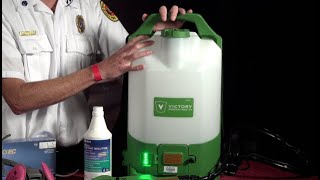
Peter Antevy walks through the Victory electrostatic backpack sprayer for station decontamination. Fill it with up to 2.5 gallons, charge the battery, and spray through the 80-micron nozzles. After use, flush with fresh water for 1-2 minutes and store in air conditioning.
Questions this video answers
2.5 gallons
80 micron tip
No; the backpack design prevents wearing an SCBA while wearing the unit.
Flush for a full 1–2 minutes
In a climate-controlled (air-conditioned) environment to protect gaskets and preserve the unit.
Chapters
Similar to the electrostatic handheld sprayer, each battalion is going to be issued one large backpack sprayer. This is also a Victory product. And it has the same process of the positive charge ions that come out of the unit. So it's still an electrostatic sprayer. It's just this allows to hold up to two and a half gallons. We want to have this for you so that if you have an outbreak within the station. Or we have a large area or large station that needs to be completed in a short period of time that you have access that will make that process move much more efficient. I do want to discuss several of the parts. And you also have a training manual that you'll be able to access within the SharePoint and other Covid pages. But I want to discuss a few things with this, just so you have an understanding. It takes the same battery, Although this unit will have its own battery as well. For the unit, which is nice that they're both universal. The window for the battery is down here. At the bottom.
It has a small screw that opens up the battery is inserted.
Into the unit. And you'll hear a small click close the gate. You'll notice that this doesn't need to be screwed down super tight. We just want it just snug with your fingers. There's a small window right here where you can get your finger behind to access it. But I don't want you to think that you have to smash that all the way down. Just snug enough, and it's protected within. Over here, when we turn the unit on, you'll see that all these lights will glow. And that's your battery indicator. This is a function that's different from the handheld. I'm going to turn the battery on now so that you can see the system be charged.
During operations. Before I start, I'm going to keep it in the off position.
The chemical chamber is a little bit different than what we had on the handheld. There's a small latch up top.
That lifts forward up and the entire container gets removed.
A small cap on top.
There's a gasket on the inside.
And there's a small screen. You need to be careful to not lose this screen. This will keep any large bulk products that accidentally would make it into the chemical chamber. And it sits just inside the tip. Again, we're going to go ahead and pour in our Bio s botanical solution into the unit. You'll have the gallon jugs at the stations. Most likely, a large area will not need a full 2 1/2 gallons I'd recommend somewhere around a gallon, if more, depending the size of your station.
Once you've filled up the product here, place your cap back on, keeping the screen inside.
It seats back inside to the unit.
You'll feel it snugly fit back into the grooves and then lock your chamber back.
Once we're ready, we want to charge the unit. You'll notice that there's two nozzles that come off the side.
And two that plug into the handheld unit here. It's worn as a backpack style, so this one you will be unable to wear an SCBA with, but the PPE requirements will still be the same. Make sure to check both your fittings, that they're snug, not loose, and you don't notice any corrosion. Unlike the other unit where you have to flip the switch on this unit is already ready to go.
We'll turn our battery on.
Note full green lights secured, no leaking. Again, we're going to use the 80 micron tip. As noted on here, this unit does have a locking mechanism on the side so that you can't engage the trigger. And again, the electrostatic charge is going to be in here. So at no time do you insert anything while the unit is charged and or running. At any time that you have to work around the tip, we want to make sure that the battery is removed and the unit is off. Unlock the button. When I pull the trigger, you can feel that the gun is still locked. Pushing this black tab in releases it.
Then I'll squeeze the trigger.
You can adjust the tips for larger settings, but unlike the small handheld, where you're going to be a little bit closer, you want to have a healthy distance away. For this spring, you'll notice that a much more larger product comes out. However, when you release the gun, oftentimes you get a little bit extra that comes out of the gun. And you want to make sure that you're not over any soft materials. As you do that, keep it facing away from you, and you'll be able to hit all the areas as needed. When I've completed the spraying procedure, I lock the button back down.
Take my unit outside, doff my ppe, and the same cleaning procedures that we use for our handheld, we want to make sure we do with the backpack. So I can take whatever product is left within this unit and pour it back into the bio esque botanical solution gallon jug. We want to save what we can keep as long as it's not contaminated with any other products. I want to thoroughly flush and rinse out this entire charged unit, I want to add about a half or quarters full of clean fresh water, same way I would with the handheld. And I'm going to flush this unit for a full one to two minutes. I want to go through every tip and make sure that I get a full amount of clean water running through this unit. Once I've completed that, I'll take my container off. I'm going to pour the rest of that fresh water out and I'll run the air out of the entire system. Once I've run the air out of the entire system, I'll do a quick wipe down to dry off all areas. I can let this unit dry before I keep in storage. These units must be kept in a climate controlled AC environment. We don't want to leave any product within the unit because even though it's a safe chemical, it still has properties that could eat away at the gaskets. And we want to keep these units healthy for sustainability.
Once completed with your unit, you want to deliver it back to the battalion HQ and make sure that it stays there. This will only be used for large areas and when requested through your battalion headquarters. I want to thank everyone for navigating this difficult time with us. I'm hoping that with this we produce a sustainable decom procedure for our agency. If you have any questions, please feel free to contact me via my cell phone and or email. Thank you. Have a great.