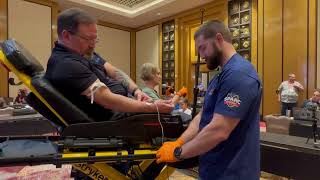
A field demonstration on collecting and transfusing fresh whole blood in remote settings. Covers donor selection, blood typing with Eldon cards, IV access, storage additives like CPD and CPDA-1, infusion setup, and visual checks. Designed for EMS, military, and rural hospitals working without standard blood bank infrastructure.
Chapters
As we roll out cold storage, cold blood to the country, it is beyond time that we start thinking about the use of fresh whole blood. So we have a strategic preparedness problem that we don't have much blood out there. So we need to start thinking next stage. I have had the opportunity to do fresh whole blood since 2005. On my first deployment where I at the hospital, we'd run low, I'm AB positive. If we tried doing a type specific first hole blood drive, clinicians would run out, dump it into the bag, take it in, and then dump it right into the patient. Okay. So in the military we have these things called the Eldon card. So if I am out and I am not sure what blood type David is, it's a little card that you can do a little finger prick on, take some samples and put it onto a card and it will tell you the ABO type. So usually we try to pre type and screen the soldiers before they go into theater or in theater. But if that doesn't happen, we do have these little things called Elden cards. They are not approved for use in the US yet. So that's a great tool that you don't need to go into a big lab and have all this complex machinery to, to run these type in screens. So what blood type are you over here? Alex is doing typical site prep, cleaning it. I think we have an alcohol swab. So he's doing largely AC is the best place to get this. It's large bore and blood can flow out much quicker. So he's palpating the site, cleaning it, finding a good spot. And because he's a Navy seal, he's going to stay cool under pressure with all these eyes on the kits do come prepackaged and I'll talk a little bit about the kits while he's he's finding his site.
The kit will come with an IV access kit. So you just drop in an IV tube. Excuse me, an iv and these kits are prepackaged. So it is the almost exact same blood bags that you would use from the blood centers. So in this case, this is a blood bag containing CPD. There's two additives that can go into blood bags, CPD and CPDA1. Clinically it doesn't matter for you all. What matters is operationally that if you do join together with a blood center, CPD is only good for 21 days. CPDA1 is a 35 day additive. So clinically not a big difference. But as you're planning your programs, it's nice to know, you can keep the bag a little bit longer.
Is that something you see in the future here in America?
Yes. And if you all were listening to folks like John Holcomb, who. Not the wood. Looking at this. In some of our smaller rural hospitals first, before we go to some of the big trauma centers. I know I've talked with.
It's going to be a little more challenging, but it is possible. The Texas Rangers.
Oh, he's got an IV we're making. Yep.
There we go.
Get the tourniquet. See if we help.
We help blood flow.
All right, so we have started the IV line. I took the donor. Bag it on to help flow. We've got it secured. And then it's important to keep the bag low. And I may have put up the gurney a scotch too high so that gravity is our friend and pulls the blood down into the bag. So. So we are going to unclamp here and see if we.
Okay.
And see if we have other pieces. The bag can stay on the ground. It's not sterile. The outside of the bag. So if you are in the dirt and you need to drop it into the dirt, that's what you do. Is set for about that 5 gram weight. So you want to keep a nice distribution of that. There are field expedient methods since guys like Alex, when they're out, you know, humping now we got some good flow here. We just had to do a little bit of adjustment.
This is going to take a few minutes for the bag to fill. Because as fascinating as it is to watch this, it's a bit like watching paint dry for about 10 minutes. Executive location. So if you're an EMS agency and you want to start blood and you don't know who provides blood in your area.
Transfuses unit 1, the physician has to sign. Now, what does. What that means is they have to sign for it. But we're just gonna do overhand.
Overhand knots closest to the bag.
Yep. And we're just gonna do it three times.
So if you're not familiar, blood cannot be transfused via your regular IV tubing. Not the same stuff as the saline. It needs to go through tubing that has a filter in there in the event that any clots have formed.
So first thing we want to do is make sure that all of our ports are closed by moving our rollers. There's going to be three on this. Two at the top of the Y, then one here below the bulb. Once you have them all shut and closed, we can go ahead and spike.
Our Normal saline bag so that you're not. Do you need. You got it?
Hang it right up here. Yep.
You got it.
Oh.
Awesome. So we got our bag spiked. Then we need to go through the steps and flush our line. So the first thing we're going to do is going to flush our Y tubing.
From here. You're going to leave this one closed and make sure it's closed. Open up the Y tubing, connect to the normal saline, then open up the Y tubing connected to the side and go ahead and crack the cap. Make sure that fluid is coming out. It is. Go ahead and shut that. Go ahead and shut your normal sailing. And from there, if we're going to be using any type of heating device that needs a cartridge. If we're going to be plugging into our patient with a 18 gauge hard needle, we're going to go ahead and connect that now so that we only have to do one more flush on this line. So everything's nice. Nice and neatly connected. We'll say that it is at this point. We've got the buddy light cartridge on. We got a hard needle. We're going to go ahead and open up the.
Normal saline now as well as distal flow and we'll turn it upside down and let it fill up.
Once all our line is nice and flushed, go ahead and close this up.
And this is closed off.
EB guidelines that need to be in your protocols. And that is when the medic needs to grab the bag, make sure that it has not expired, that it is within date, if it has a safety view or other temperature mechanism on there to make sure it hasn't gone out of range. The other mandatory element in the guidelines is that there must be a visual inspection of the bag to make sure that there is no breakage, no leakage, no clotting or discoloration.
Excellent. So once we identify that we're going to administer this to our patient, we're then going to come back up to our Y tubing again. We can make sure that we run our line, everything is set the way that we want it to be. And now all we got to do is plug in our blood administered to our patient. So with this, peel it open like a banana. Just being extremely careful that you do not touch any of where you're going to insert the Y tubing.
It doesn't pop off or twist off like other IV solutions they may be familiar with. It peels back.
At this point. And then if you're going to use a pressure infusion, this would be the time to apply this to your blood bag. And then from here, we just go ahead and open up our blood, leaving our normal saline closed, and we would let it begin flowing to our patient. Now, if we were giving.
Our patient threshold blood from another patient, we're going to run a Timer. The first five, 15 minutes. We're going to look for any adverse reactions to our patient that then pushed us into, you know, is he going to anaphylaxis? Does he need calcium gluconate now? And different kinds of things we would push with the blood.