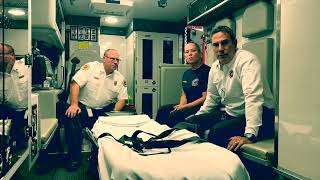
Palm Beach County Fire Rescue personnel describe a motor-vehicle crash where they extracted a patient, started an IV in the upper arm, and gave whole blood in the ambulance. From the 911 call to hospital arrival took 29 minutes. The patient's condition was critical.
Questions this video answers
July 30, 2022, at about 4:00 AM.
Rescue 24 and EMS 23 (with Engine 24 and Captain Baker also on scene).
Approximately six minutes to extricate the patient after arrival.
Intraosseous (IO) access through the left humerus.
Approximately 200 cc of saline.
Chapters
Foreign.
Tom Reyes Pio Palm Beach County Fire Rescue we're here actually in Rescue 24 with EMS Captain Castro and Lieutenant Derringer. They were lucky enough to be the.
First crew to get full blood for.
Palm Beach County Fire Rescue. A little bit of the background on this. On July 30th, at about 4 o' clock in the morning, Rescue 24 and EMS 23 were dispatched to a motor vehicle accident. Upon arrival, they found one vehicle against a pole with one victim inside. They arrived very quickly and within six minutes had extricated the patient. Three minutes after that they were on their way to St Mary's after identifying the patient as a trauma alert and while en route they gave old blood.
So I'd like to pass it on to you guys. Tell me how the problem.
Sure. So my name is Adrian Castro, EMS Capital Italian Ted Station 23. And basically we were dispatched to a car versus pole and in route. The MDT information provided to us from dispatch informed us that the patient was semi unconscious and that he was bleeding from the ear and from the arm. Understanding that we have cold blood on our unit, I proactively prematurely set up the process the back of Rescue 24 upon my arrival, trusting the assessment of the ground crew to inform me whether or not the patient needed blood. Lieutenant Derringer with Rescue 24 and Captain Baker with Engine 24 arrived on scene, first assessed the scene, assessed the patient and began extrication.
When we first arrived on scene, it was noticed the patient was in the floorboard on the driver's side. And we noticed some movement and some breathing. So basically we weren't extricating him and getting him out into the stretcher into.
The back of the truck, on him entering the. On the patient entering the back of the truck. I had already prematurely set up, like I mentioned earlier, set up the saline process. We have to administer 250cc's of saline, the line, flush the line. Then we administered the blood. When the patient arrived in the back of the rescue, we quickly assessed it.
So we went ahead and decided to go ahead and administer the bud since everything was already set up. So the rescue crew went ahead and established an I.O. through the left humerus and we flushed the line with the 200cc's of saline. We went ahead and spiked the blood and we documented the time that we started, took temperatures on the patient. We administered the unit of blood en route to St. Mary's Trauma Center. That process took probably approximately two to three minutes, I believe. And we documented the time that the last infusion of the blood went in along with the temps. We didn't see any differences in temperatures, which indicates a reaction. And upon our turnover at St. Mary's with the ER staff, everything went very smooth. Documentation was given to them. They acknowledged the receipt of us administering the blood and went back in service. Unfortunately, the patient prognosis wasn't well, but the administration of the blood went extremely well.
From the time of the initial call until the time the patient was Transferred over to St. Mary's was 29 minutes. Well, underneath the golden hour. That's exactly how we want to have this happen.