Whole Blood Resuscitation
Chief Coyle and Dr. Jim Roach present data from Palm Beach County and Broward Sheriff's Office on prehospital whole blood programs. Since July 2022, their agencies treated 45 patients with 58% overall survival, and 90% survival excluding traumatic arrest. Shock index fell 59% in non-arrest patients, and all 23 Class IV shock patients survived to 24 hours.
Questions this video answers
Since July 6, 2022.
45 patients (since July 6, 2022) as reported in this segment.
58% overall survivability.
26 out of 29 survivors (approximately 90% survivability for non-arrest patients).
The shock index roughly decreased by about 59% in the non-arrest population.
Chapters
Today I wanted to speak briefly to you about some of the changes with our whole blood program. First, I wanted to show some data to explain to you what has been going on in the county. Since July 6, 2022. We've had 45 patients enrolled that have received whole blood from one of our EMS captain or trauma HAWK personnel. The important part here is to look at the 45 and look at the overall survivability, which yields 58%. But the interesting thing about that portion of data is when you remove the patients that were found in traumatic arrest or went into traumatic arrest during our transport, we actually had 26 out of 29 survivors. For the non arrested patients, that's a 90% success rate. Very few things in medicine yield such a high percentage of survivability. One of the interesting parts about the survivability of the 26 of 29 patients that did not go into traumatic arrest is the shock index. The shock index roughly went down almost 59% in the population that did not go on arrest. So the difference in the shock index was their heart rate came down and their systolic blood pressure went up. To equalize that shock index, which ultimately tells you the probability of the patient bleeding, you may ask yourself about the 34% of the patients or where the shock index actually went up. So the theory behind given whole blood is to lower the shock index. So why did 34% of the population, why did it increase? Well, when we looked at the patient's heart rate, they were extremely bradycardic. And this hemorrhagic shock, why is that? Well, they were a pre arrest patient. So by us giving the whole blood, we drastically raised their heart rate, which in turn threw off the shock index numbers. So the take home when looking at the shock index is if a patient qualifies for whole blood, you need to get it on board as quick as possible. So when you look at those patients that did not go into traumatic arrest, and our overall program, we decided to take it to the next level. If a patient that's bleeding from a traumatic incident is in shock. Right. Inadequate perfusion to the tissue or to the vital organs, what would make a difference about a medical patient that's in hemorrhagic shock? So we look exclusively on what was happening in Broward Sheriff's Office bso. We looked specifically what the work was done out in San Antonio under the STRACH program. And we've expanded our program to medical hemorrhagic shock. Now, one of the things that we focused on in the medical hemorrhagic shock protocol is to keep the vital signs the same as the traumatic hemorrhagic shock protocol. So you'll see the vital signs are exactly the same. One of the differences is that TXA will not be administered to the medical patients. Now, does it yield some benefit to certain medical patients? Yes, but it also yields potential some harm to some medical patients, specifically the GI cases. So we looked at some trials and some studies and there was a big trial published called the Halt it. And essentially what they showed in that trial was, is that they gave half of the patients txa, they gave the other half of the patients placebo. And what they found out there was no difference in survivability for patients that received the txa. However, the group that did receive the txa, they showed that it was potential harmful by developing blood clots in the legs. The group that received the placebo did not have the same outcomes of receiving the txa. So the publication was pretty clear that that TXA and GI bleeds do not match up at this current time. Now, does that not mean we'll reevaluate certain cases for obstetrical emergencies, et cetera, in the future? We will, but just like we showed earlier in this, we want to make sure that we're analyzing our data, working with our hospital partners, and then using evidence based approach to make sure our protocol matches to exactly what we want to achieve. Now, I've enlisted the help of Dr. Roach from BSO to come in to to do a video for us on top of this video to explain what the whole blood program's been like in Broward Sheriff's Office. So I wanted to give a big Warm welcome to Dr. Roach. I wanted to thank Dr. Roach and EMS Chief Heath Clark down at BSO. I also wanted to thank all the folks out at Strac who helped us, Dr. C.J. winkler and his whole, entire team who helped us build a whole blood program here at Palm Beach County Fire Rescue. So with no further ado, I will turn it over to Dr. Roach.
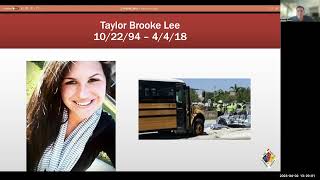
Hello, everyone. This is Jim Roach from Broward Sheriff's Office. And Chief Coyle asked me to do a presentation on whole blood to share with everyone from Palm Beach County. And it's an honor to be here to be able to do that. Thank you, Chief Coyle, for allowing that to happen. First and foremost, I want to bring a real life example which hits home for me. This is my niece, Taylor. She was an amazing young woman and she brightened up every room she was in and on this unfortunate day she was out going to lunch, making a left hand turn and was T boned by that exact school bus. And she was brought in as a trauma alert to the trauma center. And fire rescue did everything they could do. They did a great job, went to the trauma center. So everyone did their job, but unfortunately Taylor didn't make it. And this incident made me think what do we offer fire rescue to treat hemorrhagic shock in the field? And the answer is we do sailing. We maybe warm sailing. And then a concept of past permissive hypotension which is basically to let them stay hypotensive and have the discipline not to give bleeding. And then these other adjuncts to whole blood which are the life flow to rapidly infuse the cue and flow to warm reducing on scene times. I think any pre hospital agency for trauma should be thinking about 10 minute on scene times. Getting these patients off scene to the definitive care, which is a trauma surgeon has to be tantamount in all of our thinking and ultimately to decrease times to the OR, or to the IR interventional radiology where they can have bleeding control. So these are the primary things, but what does whole blood do for us? Whole blood is this perfect solution that has all of the components of the 1 to 1 to 1 plus 5,6000 other proteins that function in the human body as a perfect solution for our body. It has the coagulation factors, it has the platelets, it has red blood cells and can reverse these negative components of shock which are acidosis hypocoagable state. These things are reversed with whole blood. And we've seen some amazing things that have happened in these cases where not only has fire rescue seen dramatic change in patients physiology with the whole blood, but trauma surgeons are saying I operated and I saw clotted off vessels that were bleeding after the patient received whole blood. So it's, it's fantastic. Here's whole blood next to the component therapy. So you can see that one unit versus the three different units. And from a practical standpoint and an efficiency standpoint, giving three different bundles of something versus one easy bundle.
It has to be more practical and more efficient. So here's our data, this is back from 2021 and I think here we had about 60 patients total and now we're up to 100. And the point is of this slide is most of our cases came from MVAs and gunshot wounds. We gave a couple patients that had GI bleed, so we gave two patients at the time whole blood without trauma and the Part of the agency was mostly Air Rescue 85 and our EMS 17. And you could see on this bottom numbers here the different rescues that EMS 17 would rendezvous with. So this has changed. Now it's more of a 5050 air rescue and EMS 17. So we're expanding this whole blood to not just the air rescue, which I think is fantastic. It's exact right thing we should do. This is important because here you can see whole blood and you would think cardiac arrest. We've always thought cardiac arrest, traumatic cardiac arrest in the field. These patients almost always die. There's no, it's like 0% chance you're going to save their life. And we had a case of a gentleman that had upper and lower extremity amputations from a oxygen tank that exploded. This person was in traumatic arrest. We resuscitated the patient with whole blood and this person lived to be discharged from the hospital neurologically intact. It's an incredible story. I've never seen that and I've never heard about that. This is a huge case that really brought a lot of momentum to the whole blood program. What I want to focus really specifically on is if you look at, look to the right class four shock and that's a shock index above 1.4. We had 23 at the time and all 23 survived. If you look at class three, 90% of the patients survived. And again class 200 of the patients survived. And this data is for 24 hours survival. We're going to run numbers as we get now to the 100 and Dr. Pepe is looking at this to look at the 100 patients. And then let's start getting 30 day mortality outcomes. And so we can see 24 hour and 30 day to really get a handle on where this is with, with, with our whole blood. So this is fantastic news and, and I'm really excited to hear from you all in Palm beach county how, how everything goes. And I'm sure it's going to be extremely successful in Palm beach county as everything you all do typically is. So I look forward to that and definitely here to help in any way I can. The future. So what is the future? I really want to see trauma centers being more proactive in the blood delivery and helping with an exchange program with the, with the whole blood. Something like, you know, you give a unit, you take a unit from, from the trauma center and the trauma centers are actively giving out the blood and promoting this. I know in our trauma centers in Broward county, the, all. Both of the hospital systems that have trauma centers are using whole blood initially to resuscitate. Broward Health uses 2 units of whole blood at the beginning of their massive transfusion protocol. And Memorial has mentioned that they use four units plus another four units if the patient needs it and if the trauma surgeon wants it. So that's very encouraging. I think that as we start to use more whole blood and the oneblood and these centers that have the access to whole blood, I think as the demand increases, the supply will follow. And I think this is going to be great for not only the pre hospital, but also hospitals and patients in general throughout all of South Florida will benefit because of this access to whole blood. And what all of the the men and women in the fire service are doing really to get that blood out there and to start that treatment immediately upon arrival to the scene, I think that's fantastic. So this is wonderful. I look forward to the future. I look forward to hearing more about what's happening in Palm beach county. And thank you, Chief Coyle, for allowing me to do this and.
Be well.
More from Peter




Melissa Olen MSN, FPN-C, CCRN: Sudden Cardiac Arrest Training in Schools (Project ADAM) 4/25/25



Pediatric Hospital Readiness: How Teamwork & CPR Metrics Drive Better Outcomes



Chelsea Kadish, MD & Kyle Goodknight, EMT-P, RT: Pediatric CPAP in EMS (3/14/25)