Whole Blood with Andrew Rosenthal, MD (3/29/22)
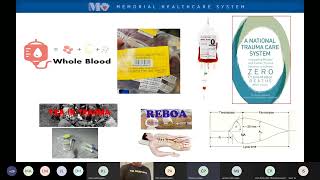
Andrew Rosenthal discusses whole blood transfusion for trauma at Memorial Health Care System, covering why it works better than crystalloid, when to use it, and how Broward County's protocol starts with four units of cold-stored O+ whole blood. Regional leaders talk about donor programs and expanding the practice to more hospitals.
Questions this video answers
15207-15207
About 4 units
Cold-stored low-titer O positive whole blood
Males over 15 years of age (not given to women)
About 50 cases last year; roughly 30 walked out of the hospital
Chapters
Yeah, should be going. Hey, Peter, I may need you to do the rebroadcast if you're available on the next meeting. I'm not sure if you.
Yeah, that's not a problem.
Otherwise I can just have to end it a few minutes early.
So you should be going.
Is.
I have one or two quick announcements if that's okay.
Peter?
Peter, it's Drew. I can't hear you.
Okay. Hey, listen. Go ahead, Angus, we'll do it.
There we go. Okay, Peter, I guess you're still working on your. We can't hear you anymore, but.
So.
Kim Landry, in response to your question about peri intubation hypotension on the biospatial data, that is a measure that's in process under the Florida Fair Measures Project. And so there's a measure getting worked up like defect free airway management. So I don't have that for you yet, but I should have that for you by the beginning of 2023, fully vetted, put through Nemsqua and all of that. So I don't have that one for you quite yet, but it is in process.
Hey, Peter.
Okay. Yeah. Okay. Yeah, I'm here. Can you guys hear me?
Peter, before we get started, just wanted to make sure you know it's today's CME is 15207-15207.
Okay, awesome. Thank you, Paul, for that. Appreciate that. Any other announcements, Angus, from your end.
Or Melissa, just thank you for the responses to the polls on Mobilize. If you are doing leave behind Narcan and you haven't sent me your protocol but are willing to please send me your protocol. I'm trying to put together a sample template protocol that anybody can use who wants to launch one of those programs. And then again, we will still have the biospatial dashboards for you for the June meeting. So when we put out the poll on who's attending the June meeting faem SMD meeting, please be sure to answer that poll. If you answer that, you're going to be attending. I will try to have a printed out copy of your dashboard for you.
Awesome. We appreciate all that work, Angus. Thank you so much. All right, now let's move into the big show. So Drew, I see you. Is Candace there with you?
Yeah, I got Candace here with me. Can you hear me?
Yeah, yeah, I want to. I wanted to see if Dr. Pepe could say a couple of words about Candace. I know she's done so much work.
Dr. Pepe? Dr. Pepe.
No, the answer is the answer Is. I cannot say a couple of words about her. I could go on all day, but she just. She's been just. I think, first of all, Drew is fantastic and done a good job over there, but a great job. And what you're going to hear today is that is a good example of it. And then Candace, of course, has just been. As far as I'm concerned, she's helped me with first there, first care and various other things. And just.
Under fire and under those last two years, particularly with COVID has just been fantastic asset not only to her hospital system, but to all of us here. So I want to thank you. I could go on forever, like I said, but it just. I'm just. This is a cool meeting, and it's so great having them with us today. So thank you. And as you.
Awesome. Thank you.
You see what my name is today.
Peter the Will to Live. I like that. That was a good one. I got that one this time.
All right, so I would love to introduce one of my favorite people. And, you know, Drew and I go way back. When I first started at Memorial.
You know, we said we used to meet each other in the dining room for the doctor's lounge quite often, and he really impacted my career, and he's just been a great mentor. Drew is the chief of trauma services at Memorial Health Care System here in Florida.
And.
And what I wanted to do is. What I wanted to do is bring him on.
The call today to discuss the impact that whole blood is having at the hospital level and how it kind of interfaces with EMS and maybe what the future would look like within having pre hospital whole blood into the hospital. So, Drew, thanks so much for coming on today and looking forward to what you have to present.
Thanks. Well, thank you, Dr. Anteby, for the invitation. I wasn't sure exactly what you guys wanted to hear, so we put together, I don't know, maybe 15 minutes of good discussion. You have to tell me if you can see our slides.
Yeah, we see it. Perfect. Yep. If you want to. Yeah, you go. It's perfect. Yep.
All right.
I guess it is timely because we just started introducing whole blood in the hospital, and I think it's been a nice thing, if you've been in the field for several decades, just to see the evolution of the use of whole blood. Transfusion. Medicine has come a long way in the last hundred years, and we've really expanded the ability to resuscitate patients, obviously not just because of transfusion, but in large part because of transfusion. So as pre hospital Care evolves and hospital care evolves. Obviously the field of transfusion has become just an intimate part of that evolution. So we're going to just talk about a little bit about our data.
In our own hospital. Trauma volume has gone up substantially in the last 10 years. And I think more remarkably, the amount of penetrating trauma has gone up quite a bit. So that gunshot wounds now sit at number four in our list of mechanism of injury, whereas just probably two or three years ago is down to number seven. And previously I think it was even lower than that. So there's been a real uptick in the amount of penetrating volume that we're seeing. And I think that that reflects national trends as well.
The distribution of gunshot wounds really is in the same age groups that we've always seen them in. Some teenagers, but mostly the young and healthy. That's just reflected in our own data. Again, nationally is exactly the same.
I put this algorithm up just to give us some guidance over what the next 10 slides really show us. If we have to summarize it, it would probably be this one slide. This is the Western Trauma algorithm for the management of resuscitation in the field. And the recommendations are pretty clear. If the patient has a decent blood pressure and they're not hemorrhaging, then you don't do anything. We just put a saline lock and a kvo, get some IV access and get them where they need to go. And if the patient is not doing well and you have blood products available, the official algorithm now out of Western Trauma is that you go ahead and give blood products under certain circumstances. And those circumstances are usually regionally defined. We have our own definitions here in the county, of course, but they're pretty nationally accepted to be shock and, you know, concern for major hemorrhage. I like the algorithm mostly because it gives us some other simple ideas to consider. Like consider txa, if you have concern for head injury and keep your blood pressure a little bit higher. If you have concern for head injury and if you need to give pre hospital fluids and you don't have blood and you need to give crystalloid, then giving crystalloid just to target a blood pressure of 80 is probably okay if you have a short hospital time, but if you don't have a short hospital time, then maybe aim for 100. And they give these recommendations recognizing that every situation is individualized, but it gives you an overall starting point for how to use the resources that you have at your fingertips. I hope that makes sense. And so that probably summarizes the entire presentation. But I'll give you a little background on how we got here. The response to trauma has not really changed. We don't really want to start resuscitating the patient until we have hemorrhage control. So it's a constant reminder to our residents and to ourselves, really, that you need to put tourniquets on, you need to stop major hemorrhage, and only then does resuscitation really start. Of course, we've known this for 100 years. This is over 100 years old now. But they knew that back then. If the pressure is raised before the surgeon is ready to check any bleeding that may take place, the blood sorely needed may be lost. Meaning you don't want to contort yourself to increase the blood pressure on a patient and pop clot that is newly forming. We know all this, which is why the 2018 recommendations from ATLS have also evolved, so that now, if you have blood, the standard ATLS recommendation is to give it as part of a massive transfusion protocol, if you can. When they talk about blood, they're either talking about component separation in this case, or the extension of that, which is whole blood, which is where we're headed. So just to be clear, there's so much literature now on massive transfusion that I could never pick any particular article and say it represents everything. But if you just peruse the literature, you'll see lots of articles about the use of plasma and platelets and whole blood. And we have to differentiate some of the issues with how these studies are done. But on the whole, you can see that some are single institution studies, some are multi institutional, some are military, some are civilian. And it gives you a general picture of what kind of things people are studying and in general, what we're finding. With collaboration between the military and civilian, we've been able to discover a lot of different things that pay a lot of dividends, I would say, in the pre hospital setting, and whole blood is part of it. The other issues that we talk about in the pre hospital setting really are things like controlling coagulopathy and additional use of things like hyper fibrinolytic or anti fibrinolytic agents. And again, this is really just a collaboration of what we've learned with our military colleagues. As civilian trauma has evolved, the urban cities especially, so too has military trauma evolved in Iraq and Afghanistan and elsewhere. And those two fields really evolved together to give us all of this data.
Where are we?
So just as some basic examples, this is a single institution study, but it was really nicely Done. They took a, a small number of patients initially I think it was 60 different patients, 58 patients, and able to determine that there was significant improvement in shock index and reduction in early mortality. They showed again that patients who have pre hospital cardiac arrest don't improve no matter what you do. But that really wasn't the point of the study. They did show that prehospital whole blood, at least at their institution, was significantly improved from the previous standards. And then this is a nice study that Dr. Sperry and Duane and a few other well known trauma surgeons looked at and they found that patients who received pre hospital blood did better than patients who received crystalloid. But even more importantly, the patients who received blood and plasma did the best. So this was really a collaboration of a bunch of different data from, mostly from the Pamper trial. But ultimately it was these sort of conclusions. Patients receiving pre hospital blood and plasma had the greatest mortality benefit. Crystalloid only had the worst survival. Again demonstrating what we're finding out over the last few decades. Patients in hemorrhagic shock should receive pre hospital blood products whenever available, preferably blood and plasma. And that pre hospital whole blood is probably the ideal solution because of course that has platelets and a bunch of other factors that component separation really loses in the process.
The BSO criteria just put up here for the sake of.
Completion. Here we have our own criteria in Broward which is pretty consistent with the criteria everywhere. Blood pressure being particularly low or moderately low blood pressure with other signs of shock, a witness cardiac arrest less than five minutes prior to provider arrival and continuous CPR throughout that downtime may be one softer indication. But the indications that we have for the use of whole blood are usually.
Obvious. Hemorrhage and unstable hemodynamics. If I had to put it simply, once they get to the hospital, we start to replace their blood not just with whole blood, but with component separation. Because whole blood is limited. We'll start off with about 4 units of whole blood and after that we'll convert to our, to our mtp. And our mtp, as you can see, is really just an attempt to try to reproduce what whole blood provides. It doesn't do it exactly. And you know, once you separate these components and re infuse them into people, obviously there are lots of consequences for that in terms of cytokines and interleukins and so on. But ultimately what we're trying to do is reproduce whole blood and whole blood may allow us logistically to achieve the same thing that we're doing with the current mtp, which is fully component separated after the first four units of whole blood.
There's just. This is the form that we use. We try to send this form with the patient so that the anesthesiologist or whoever's in charge of that patient can kind of check off what they're getting, try to keep track with a one to one to one ratio. And if you look at our MTPs, there's just a host of different mechanisms. Most of them are actually car crashes and then a slew of.
Other ones, as you can see, including that plane crash from I think it was Pembroke Pines.
Within the last year or two.
And going back to the algorithm, you can see that the algorithm really makes sense for whether you're in the pre hospital setting or in the hospital setting. If I don't need to give blood, even though we have it available, really don't want to be going down this track where we're giving the blood. So what we do in the pre hospital setting, what we do in the hospital isn't that different if you look at all of these different indications. Here's a patient who came to us. This is a while ago, but I mentioned it because she never got blood in the field, but I would have understood if they gave her blood. If you look at the progression of her injury, it was a lot of soft tissue and she did lose a lot of blood in the field. But by the time that she got to us, it was already hemostatic. So this is a shark bite, by the way. And as it evolved over time, her wounds healed really well and ultimately she did great. And this was because she refused skin grafting. She wound up with this big scar. But if I saw a patient like this in the field, I'd probably give him blood regardless of the criteria because I recognize it as a mechanism that is so impactful that nobody could criticize you for at least hanging the blood. Maybe you're not pumping it in, but it's probably, you know, like a handgun. It's better to have it and not need it than to need it and not have it. And in this case, I would not criticize anyone for giving blood. Two real life scenarios. This 19 year old came in with a bunch of stab wounds to the back. Hemodynamics were okay. Patient actually had decent vital signs, whole blood was initiated. And I think mostly it was the basis for this was that hospital drive time was over 20 minutes. And I think that's a reasonable indication, even though ultimately this patient didn't need a whole lot of Transfusion outcome was good. I wouldn't criticize someone for doing it. I think that if you run into trouble with penetrating injury to the chest, hemorrhage is usually the problem if oxygenation isn't the problem. So I wouldn't criticize people for getting the whole blood ready to go, considering these trajectories. You're talking about injuries to the cardiac box, you know, from the back just as much as from the front, and a bunch of other potential major hemorrhage.
Last case was this boating accident. This guy, again, you know, probably you could have gone with or without blood based on his vitals, but he'll meet criteria based on his heart rate and based on the mechanism. And ultimately the drive time was again, 32 minutes from call dispatch to hospital. And you know that this patient sustained some blood loss prior to pre hospital or prior to EMS arrival. So again, you're talking about some of these scenarios where drive time may be the main decision in transfusing somebody.
That was really it. You know, I think that we could take a whole bunch of different scenarios and we could look at them and I would let me. I guess I'll stop sharing at this point and open it up for questions. We could talk about some individual cases where I think it would be useful to look back and say they really clearly did not need blood or they really clearly did need blood, but we didn't have it. And if we were to do that, then I think it would be nice for our own local review and I think we could probably start compiling our data. This is relatively new, us to be giving whole blood in the field, and it's certainly new to be giving it in the inpatient setting. We could talk about why it's taken us so long, but that's a whole nother philosophical talk. We're just doing it here. I don't know how many other centers are doing it, but not that many. And so ultimately we'll have to collect our data, you know, try to come up with at least what works for us and what doesn't work for us on a regional basis and, and try to conform with what they're doing nationally, I think for consistency, but also so that we can apply the data nationally to our own center. So that's a lot of words about whole blood. There are a lot of nuances to giving whole blood. I think we have to take it with a grain of salt. When we're talking about whole blood that's been cold and stored in a hospital refrigerator versus whole blood that's warm and walking around an hour before you give it in the military far forward position. And these sort of differences are why you have to look at the literature with some acumen. Just because otherwise you'll misinterpret what's worked in certain settings. And I guess that's, you know, that's the bottom line.
So, Drew, great presentation. And you know, we're really excited, number one, because in Broward, I believe Memorial is the first hospital now to have whole blood. And someone can correct me on that. I'm hoping that the other hospitals come on board. But in order to get there, we need data. Like you mentioned, Dr. Pepe and I are now working with the Tulane folks. Dr. Duchesne out of Tulane, Candace is now connected into that. And.
I've spoken to Chief Clark and Dr. Roach from BSO. You know, currently the footprint for whole blood in Broward county exists in BSO in the helicopter, I believe, in one of their battalions. And in order for anyone in Broward county to get blood, you either have to call air or hope that you're near one of those battalions. I would like to see this kind of have a more far reaching effect throughout the county. But, but in order to do that, we need the hospitals to jump in. So can you describe at the hospital level what you're doing? Like, for example, are you going to have a special whole blood kind of fridge in the trauma bay ultimately, like I heard other people have. And is it possible you can just talk about that for a minute or two?
Sure.
I mean, I think a lot of this you probably already know, but the logistics of whole blood are underappreciated until you're trying to do something like this. And first the problem was that we couldn't get whole blood because our local supplier just didn't provide it. And then when they did provide it, it's O positive whole blood. So, you know, we do not, we do not transfuse whole blood to any women. We only transfuse blood, whole blood to males over 15 years of age from. For that reason alone. How much of that is going to change in the future? I don't know. I think we'll find that our particular guideline is going to evolve and we may change how we're doing it. But currently we use cold stored low titer O positive whole blood, which is for the most part.
A reasonable resource to try to do on a massive scale. We're never going to be able to have, at least not in the near future, you know, walking blood banks. But we have the ability to give whole blood on a bigger scale than we've done. And I think you're right. It has to come from the hospital asking for it. And if the hospital's not asking for it, then they're probably, you know, not even using an MTP is the whole blood is coming. And I think we'll find that at least it's non inferior. And I think we're going to find that is beneficial.
Hey, Drew, one thing I think would be really helpful, especially for non believers or just to justify what we're doing. I think obviously, you know, written about this for years, it's what I've always wanted to do. But what it would be helpful is that when you know how you do your trauma quality assurance and you say this was a preventable death or a non preventable death or whatever, I think that would be helpful if you could use the criteria that we have and maybe do a comparison comparison and then be able to say when you do your review and you know, add some objectivity in that you've looked at it instead of saying just, you know, someone had a blood pressure of 50 and then they got to the hospital live with a blood pressure 100 just to be able to. I don't know how to do it yet. I don't know the right mechanism, but I want you to be thinking about that so we can, you know, make it even, you know, bring it into more of a formal mechanism for saying that this really works.
Yeah, I mean the, the right way to do it is to make it multi institutional. We're, we're doing it on our own, but we're never going to be able to achieve what we want on our own. We really need to collaborate with all of the other regional centers and have something that at least we can agree on.
For the, you know, for the purposes of making sure that we're not harming these patients. I think that's the, that's the biggest issue.
You have non believers, but it's not a matter of believing it or not believing it. It's just a matter of knowing when to use the resource that's available to us. There are definitely times where non believers will want to use whole blood and I think having it available, even a non believer will use it because they'll know that under certain circumstances it's the right thing to do. So I like that the, the blood suppliers have come this far as providing it for us. I think we're going to see big changes over the next five or ten years. You know, I don't know what they're going to be. Dr. Pepe would know better than I. I think where we're headed five or ten years from now. What do you think, Paul?
Yeah, I think. I mean, they're. That's what I'm saying. I'm trying to get some data that helps them feel more justified in what they're doing. But here's the other thing. What I. What's been lovely was the Brothers in Arms program, which I hope now will be brothers and sisters in arms program that they had in. In San Antonio. My point is you have to. If you have plenty of source, the blood banks will like that. And especially if you can identify a cadre of people who now you could say will be ongoing volunteers who have low titer O positive blood that be fantastic. So I think we. We all have our chores here, including all the people on the phone, not just the trauma centers, is to go out and make sure that we create a program. Program out there that in which we have lots of volunteers who will be able to be a source for this blood. An ongoing source. Okay.
Absolutely. Okay.
So I have.
I see that Chief Clark has joined us. He's. I know he's on the road and he's busy today, but he was able to jump on.
So.
Chief Clark, can I. Can I pick on you to talk quickly? We have a few more minutes left about your experience and any other comments you'd like to make.
Yeah. Good morning everybody. So first I'd like to capitalize on what Dr. Pepe brought up. Just prior to the advent of COVID there was a discussion that we had all started about creating a regional blood drive and modeled after the Brothers in Arms program with the hopes of leveraging all the police and fire administrations and unions down here, along with our hospital partners. We figured out that's a very large pool and. And with our media contacts and whatnot, we should be able to drive a lot of interest. And then Covid happened. So I'm hoping as the death settles here over the next two or three months is something we can re. Engage on and pursue. I think our blood bank partner would probably be open to it. So it's definitely something worth looking at. And if any. If none of you have ever heard me talk about this, this is still something we're very excited about. Dr. Roach and I have seen a lot of successes with this so far. There have been a lot of learning opportunities for under and over triage, changing up protocols in order to use them. I wouldn't Say more liberally but more prophylactically. And we've just seen a lot of benefit. I think approximately 50 cases last year. I'd go as far to say 30 of those cases walked out of the hospital, and the majority of those probably would not have without the blood product interventions.
So my hope is eventually driving the cost of this down so it can be on every street corner in the county.
Wow, Chief, that's incredible. And you guys should be commended. You guys have. You started it, you initiated it, you're going through with it, and we're all learning from you. I'm looking forward to the collaboration that you're having now with Memorial, and then I'm hoping that the Broward folks and I'm not sure if anyone from the Broward systems on board. I know Kendall Regional has whole blood now. Is there anyone else on the call from anywhere else around the state? Because we have everyone from around the state here that can comment. Are you having any successes in your local region with respect to hospitals? Anyone comment on that?
I know it's kind of a new thing.
All right.
Well, Doc, did I hear correctly that the two trauma facilities in Palm beach are strongly considering switching over to a whole blood?
Right.
So in Palm beach, we just got approved, it just went through legal, and now we're in discussions with both Del Rey and St. Mary's again. There's some growing pains that are happening there, but I think it's going to be a positive outcome. It just.
One of the reasons I wanted to highlight what Drew and Candice were doing is because based on what this collaboration looks like and what the data shows, so if you have 50 cases and you guys can put together a PowerPoint of those outcomes and like Paul and Drew were talking about, to show that the blood really did have an impact in the outcome, I think it would speed up the process and those other hospitals will be able to jump on board. I think they're still a little ambivalent based on some of the data that's out there. Candice, did you want to make any comments?
Just hopefully we can work to collaborate. In Miami Dade, both Ryder and Kendall are using whole blood. We're using whole blood. So if we can get it all the way to Palm beach, we can have a Tri county cadre of use, both in the field as well as the trauma centers and that collaboration and intake.
Awesome.
All right, well, we. Go ahead, Candace. Sorry.
No, I said just let us know how else we can support it. We'll definitely be participating in that multi center.
Collection.
Okay. Excellent. All right, well, we're at the bottom of the hour. That presentation was fantastic. Drew, thanks for joining us. I'm going to give you the last word. Any final thoughts?
All right, well, thanks for inviting me. I think the only last thought I have is that remind your the crews when you have the opportunity that they don't have to pound the blood in before they get to the hospital, that sometimes I think there's an inclination to give the blood before they get there so that it's done and it's given. But maybe the better part of valor is to start the transfusion, but you don't have to finish it and use the blood pressure and the vital signs and the clinical exam to kind of tell you how fast to give the blood.
Because I know how fast you can give it, and I'm saying that we don't always need to give it that fast.
Yeah. And I think, Drew, I just wanted to reemphasize that in that the, you know, for example, if you have someone who's, you know, more of them, you know, they're. You have. They're in circulatory arrest. Maybe that's a time when you'd load it in. But otherwise, if you raise the pressure too high too quickly, you may blow up those soft clots that might be trying to form into fibrous clots or whatever. But I think that's a great comment you just made. Thank you.
Well, thanks for inviting us.
Thank you both. Drew, Candice, thanks for. For. For coming on here. And this will be recorded and will be sent out to a number of other people. So we appreciate all you're doing, and we're gonna. If other people want to stick around, I'm going to restream the. The Eagle. So just give me one moment and we'll get that done. Thanks, everyone.
More from Peter




Melissa Olen MSN, FPN-C, CCRN: Sudden Cardiac Arrest Training in Schools (Project ADAM) 4/25/25



Pediatric Hospital Readiness: How Teamwork & CPR Metrics Drive Better Outcomes



Chelsea Kadish, MD & Kyle Goodknight, EMT-P, RT: Pediatric CPAP in EMS (3/14/25)