CodeRabbit CEO Harjot Gill: going viral in Japan and AI code guardrails | Evil Martians podcast
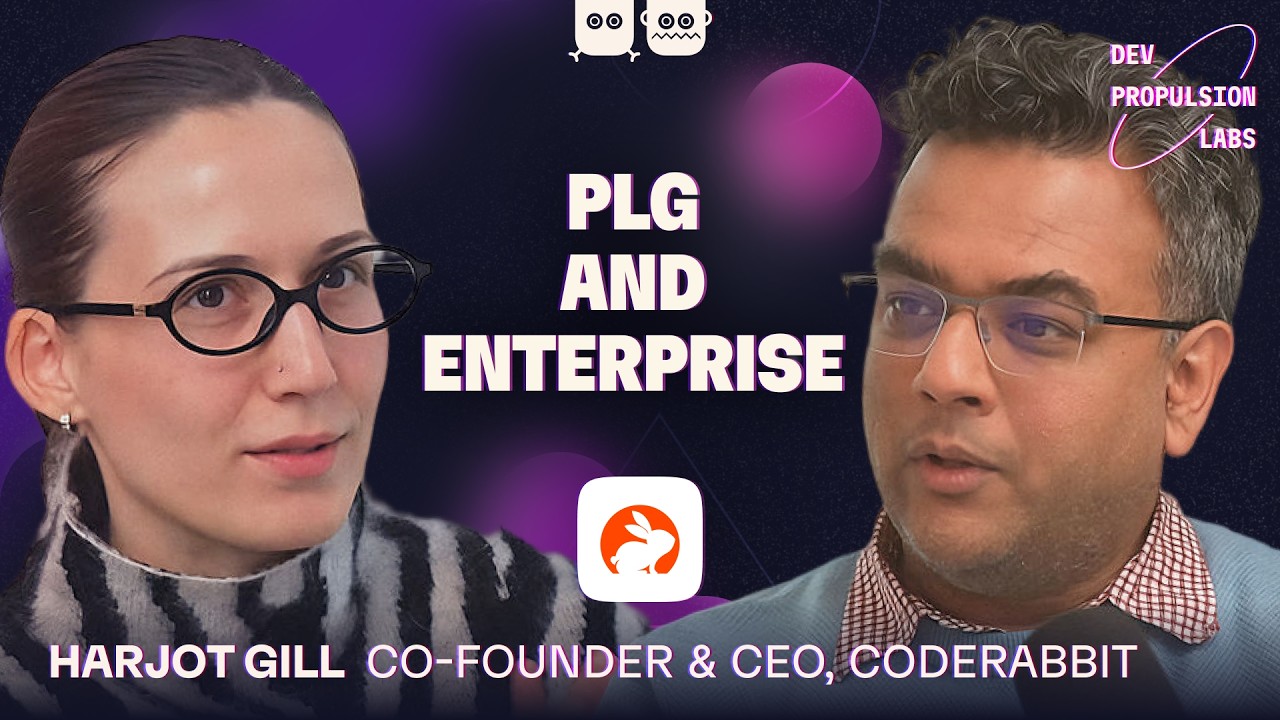
Harjot Gill, CEO of CodeRabbit, discusses how AI shifted the bottleneck from writing code to reviewing it. The company went from bootstrapped to $1M ARR to a $60M Series B in under a year, with viral adoption in Japan driving growth. CodeRabbit offers enterprise guardrails like security and PII detection, free access for open-source maintainers, and plans to expand into testing and security scanning.
Chapters
Hi everyone. This is Dev Propulsion Labs, a podcast about the business of developer tools. And my name is Victoria Melnikova. I'm the head of new business at Evil Martians. And today I'm in a new setting. I'm at CodeRabbit and we will be interviewing Harjot Gill, CEO and co-founder of CodeRabbit. Hi, Harjot.
Hi, Victoria.
How are you today?
Pretty good. Thanks for coming.
Thank you for having me. And we're in this gorgeous studio. I'm not sure if it translates, but it's kind of jaw-dropping. The views are crazy here. And I want to talk about CodeRabbit. And before we dive deeper into it, I want to kind of give an overview of the landscape where CodeRabbit sits. And CodeRabbit is an AI code review tool, right? And with It kind of prefaced the whole AI wave. So right now, everything is very different from what it was 2 years ago. Harjot, maybe you can tell us, where's CodeRabbit today? Who are you serving? What's— well, basically, what's your short pitch these days?
Yeah, thanks. So we started around 2 and a half years back. And one of the biggest use cases for generative AI has been coding. Around 2 and a half years back, we saw GitHub Copilot emerge with a really convincing autocomplete that was a step up from Tabnine and earlier autocompletes, AI-based autocompletes in the past. And then we saw rise of Cursor, the tab completion models, and then fully agentic software development lately, with Claude, Codex, those kind of solutions leading the way.
Yeah.
So CodeRabbit, focused on a slightly different pain point. We saw that as the volume of code is going to increase with generative AI, the software development is getting more and more— at least part of software development is getting automated, not the whole thing. The bottlenecks are going to shift towards understanding the code changes that the AI is now making for you. The code reviews will become a bottleneck, and that's what CodeRabbit does the best. So we are the leading product in that category that provides code reviews. whether it's human-written code and now increasingly it's all AI-generated code. And we provide feedback around enforcing best practices, finding security issues, PII leakage, and so on, and also allowing organizations to enforce their own guidelines and policies.
So something that I talk to founders a lot about is that engineers are quite conservative buyers, and sometimes it's really hard to get their buy-in on certain progressive technologies. It sounds ridiculous, but that's what we find. And at times it can be hard for engineers to adhere to new practices and really break down the concepts on which their development flows are built. Especially it's hard for them to let go of control. And code review is something that allows you to have control over things, right? So when you are pitching to developers as a company, What is the best optimal way to pitch products like AI code review to a developer and what has been really working for CodeRabbit in winning them over?
Historically, yes, developers have been a very hard audience to sell into. Like, this is my third startup. I don't know whether you know my story. Like, my first 2 startups were focusing a lot more on operators and SREs because typically the budgets tended to be a lot more on the production side. versus the development side. And people have been trying to monetize SDKs, that never works. I mean, a lot of stuff is open source driven in that community, right?
Yes.
And which has changed a lot with AI. We are seeing there's a massive appetite to pay for these AI products. Like even code editors were very hard to monetize in the past, like Sublime and all, you know, like there were many attempts to monetize editors, but now you're seeing everyone's paying for either Cursor, Cloud Code, even terminal tools, right? So that has changed a lot because there's a big step function improvement in productivity for this dev tooling. Dev tooling is right now a really great time to be in this space.
Yes.
On the other hand, CodeRabbit focuses slightly less on individual developers, I would say. Its focus is a lot more at the team level. So we are like a central quality gate that you as an organization want to implement the guardrails as your developers are adopting generative AI. At least in our category, even pre-gen AI, people were paying for the tools. If you look at all the CI/CD tools or security scanners like Snake or SonarQube or Semgrep, there were some budgets there already. But what we are seeing with the code generation space, that I have not seen that in the past. Now people are monetizing even VS Code forks.
Yes.
I mean, it's been around forever, but now suddenly people are willing to pay for even code editors and so on.
Okay, so with the tools like Cursor and Cloak Code, et cetera, why does it still make sense for people to pay for a standalone AI code review tool? What's the moat?
So CodeRabbit provides guardrails, which is similar to, I mean, my analogy would be like coming from the operations space, it's like Datadog. You have to pay for monitoring, right? And what we are seeing in the space increasingly is that the code generation front, the developers are increasingly picking up the tool that they want to use. Some people are more comfortable with IDE form factor of Cursor, while others are okay with now Terminal. Now there's a Codex app that a lot of people within our company are liking. Some people just want open source, so they are going to use OpenCode. So what we are increasingly seeing is that on the code generation side, there's going to be a lot of fragmentation. So if I'm an organization, I don't want to If I have a 1,000-person engineering org, I don't want to go down and top-down make a decision that everyone uses Vint Cerf or Ker Cerf. So increasingly you want to give people choice both on the models and the hardness. And when that happens, then the quality gate has to be centralized. So tools like CodeRabbit are going to be a standalone category in that world, just like Datadog was. Amazon had CloudWatch or GCP had whatever, Stackdriver. But in the end, Datadog became a standalone product category. And even though your Kubernetes, for instance, makes sure your services don't crash, but doesn't mean you take Datadog away. The guardrails will always remain. It's the same thing we are seeing here. Even though code generation quality is increasingly becoming good enough, as long as you can control the intent, the outcome on the coding front is becoming really good. But the thing is that that does not mean your guardrails go away. The organizations still need to bring everyone through a consistent quality gate. enforce all their policies that they care about through that choke point.
Let's talk about business a little bit. What you described just now is kind of like inventing a new category in developer tooling, right? And that's something that is a known phenomenon in go-to-market for developers. So when we think about CodeRabbit, you guys have this initiative where CodeRabbit is free for open source creators, right? And I understand why developers would love that and would be willing to try it and adopt it in their workflows. But at the same time, that imposes a question of how do you convert your open source users into paying users? So from the business perspective, do you have a stance on that? How do you kind of sit on both chairs?
No, that's a great question. I mean, I personally have been a big fan of the open source community and the maintainers especially who do a lot of thankless work. to keep these projects running. So we started, like even in my previous startup, sponsoring some of the projects that we used internally. So it's a way of giving back. For example, CodeRabbit is built on a lot of different static analysis tools like GitLeaks and all. And we go sponsor even the smaller projects. They may not be like thousands of stars, but just because we rely on them. For example, we were very early sponsors of AST-Grep. So we incorporated AST-Grep 2.5 years back. And this was still less than 2,000 stars at that point. So we always make it a point to go back and sponsor those projects. The other thing of giving back to the community is to give the product for free to this open source, but it also helps us in a big way. 2 things. One is the other developers which are working in their enterprises or bigger companies that discover us through these libraries and frameworks that use us to maintain code quality. For example, a lot of people discover us through all these I know tRPC project, I mean, and OpenShift, they all use us. Linux Foundation projects use us. NVIDIA uses us in a big way in open source. So there's a lot of discovery happening. So instead of paying for Google Ads, in a way, we are giving these maintainers a really great tool, which saves them a lot of time as they're doing this volunteer work. At the same time, it's an advertisement for our product. The second thing it does, and that is one of the reasons why CodeRabbit is a very high-quality product compared to a lot of the other people who are trying to do this in the space, is the feedback loop. The thing with the AI and the AI harnesses is you need the data to improve. So with the open source, because the data is public, so we are able to go and train, fine-tune, and even adjust our harness because you have to match the models with the harness that you're running on top. So open source becomes a really critical playground for us. When we are launching new models, we first release it to open source with constant feedback coming in, allowing us to then roll it out for the paid users. We don't necessarily monetize our open source users into paid. In some cases we do, like Red Hat is a customer, for example, NVIDIA is a customer, but we don't in a general see that as a path. It's more like awareness for us, more like marketing.
With your previous startup, you saw the GitHub Copilot, right? You saw the potential in that, in code generation basically. You kind of saw it before it became the mainstream. What allowed you to stay on top of the wave? Because I remember like earlier in 2025, it really felt like it's a wave that's crashing a lot of startups because new players are emerging. The marketing is extremely aggressive. You have to do a lot of fieldwork here in SF to make sure that you stay on top. What were the key pillars that Codrivit relied on? to not only survive, but come out on top?
It's a lot of this has to do with the foresight and where the market is gonna head and which battles we are gonna pick up and not pick up. So when we started, the big questions even the VCs had, like how much is the model versus application? Like there was a lot of like pushback that these products are just wrappers. But if you've been in the industry long enough, you know the value's gonna accrue always up the stack. The lower-level layers will always be commoditized. In fact, a launch blog back in 2023 talked about why we will only focus on apps and not bother with the models. And in hindsight, that was a great call because agent harnesses is where all the value is. If you look at Claude code and all, model is one part of it, but also agent harnesses is the UX, the human-AI interface. I mean, those will matter a lot more. So that was one focus area where we said, okay, we are going to just be a pure applications applied AI company, right? And do a great job at that.
Yes.
Right. So some companies are taking more vertical approach. They're owning the harness and the model. So that's also, it's like Apple versus Microsoft strategy in the PC, if you remember that. Like where Microsoft said, I don't have to do what Dell does or Intel does. We'll just do the apps, build Microsoft Office or whatever. And then there's Apple that said, okay, I want to own the hardware as well, which is in this case models, for example. So both strategies are correct, but as a company, we try to do the other thing a lot more, like focus just on the application layer, the context engineering part of it, the UX part of it, and launching more products on top of it. The other part is the insertion point. I mean, we feel that our strength is more on the background agents and the central insertion points. So we didn't optimize our product for speed. For example, we never said that we'll go and compete with cursor and code generation startups. That is not a battle which is of any interest to us. And the products over there are also engineered in a different way. They're designed to be fast, they're more biased towards faster responses and more interactive workflows compared to our product, which is more of a background agent. Code review takes 10, 15 minutes to run where we can apply the best reasoning models and so on. So very different product strategy, insertion strategy, even the problem statements that we are focusing on as the next series of products are getting launched. are very different than the market, the larger market is doing.
So when you decided to incorporate CodeRabbit, what were the metrics that you were looking at? Or it was kind of like you knew for certain that it's gonna play off because that's where the industry is headed and you just went all in?
Right, I mean, this is where a lot of it is like your intuition. Like, I mean, I've seen failures as well. My second startup, for instance, we thought the industry would be going in a certain way with the upscale engineering, but did not. So some of these bets sometimes take off, sometimes they do not. But the main thing is you have to make a bet. You have to be in the arena. So that's what we believe in. I mean, one analogy is it's like being in Hollywood. You have to produce 10 movies. Maybe 2 or 3 will be super hit, make all the money back, then 2 or 3 are break-even, and then some are flops. That's how we see the space, especially in the AI space where a lot of these form factors and products are still to be discovered. Look at this. Very recently, this person sitting in Austria built this Claude bot, which became open source.
Yes.
Now you had all these model labs, you had a ton of startups trying to build those things, personal assistants and so on. Now this guy goes and unlocks a form factor which was very different, and then it took off. Which what this tells us is there's so many products still to be discovered. The models are really great, but even the model labs themselves don't know what's the best way to apply them or what the UX should look like with human-AI interface. and the insertion points, right? And I believe there's still so many products out there waiting to be unlocked and the value unlocked through those products.
You started CodeRabbit 2 years ago, right? 3 years ago almost.
Yeah, almost 2 and a half, 3 years ago.
Yeah, yeah. And the speed at which the VCs invested in AI products wasn't as high as right now. Right now, I would say that we see bigger checks and bigger expectations from a lot of startups, right? They have to show certain, I want to say skyrocketing growth to make their case. Do you feel like the same pressure applies to CodeRabbit or you're kind of over that hype wave and you're just cruising?
It's partially, even we have been raising significant capital, Some companies are raising more, especially the ones which want to go after models themselves, like buy GPUs and hardware to support training. And some of the VCs have the appetite for larger checks, especially in the AI space. A lot of VCs have raised a ton of money, billions of dollars to invest in AI fundamental infrastructure as well as startups on top of it. And we have seen this Cambrian explosion of startups, different form factors being tried, and some of them are going to stick and become generational companies. Right now is such an inflection point. For example, like the next Amazon or next Apple or next Microsoft is already being founded or has been founded. And that's what the VCs are looking at. It's a land grab right now. Very interesting time to be either a VC right now or to be a startup founder.
Yes.
Right. Best time. I mean, this is my third startup, as I said, like I've never seen anything like it. If someone is thinking about starting a company, now would be the best time.
Yes.
Right. then the market gets slightly challenging. Like right now, even the low-hanging ideas are becoming massive in terms of revenue growth. And then the bar is going to be higher as you want to enter this space. It's almost like how Amazon started by selling books on the internet, became massive. It's simple. You had Cursor, which was simply a VS Code fork. I mean, not a lot of tech there actually, but then became massive. Now they are able to invest in their tech, their own models and so on. But the idea was very simple, a vector database, a VS Code fork, simple UX. Command-K interface. It's not very complicated. It became massive. It's just right place at the right time and the right team.
And I mean, with ColdRabbit Series B, $60 million, it's still a sizable check, right? It's a big round. And do you feel like there is pressure to raise more, to raise faster, to raise and to have shorter runs between the funds?
Yeah, it has been very short runs. For example, at ColdRabbit, we didn't do any seed round. So we went to $1 million ARR just on bootstrapping. We did a $16 million A round back in 2024, and less than a year after that, we did a $60 million B round.
Yes.
So in a normal space, you will have a little bit of couple of years and more time to grow the team, get some repeatable numbers, like numbers that make more sense to the investors. But this space is slightly fast moving, and the time between the rounds is very compressed. So it's a very compressed timeframe we are working with. Now we are already halfway between B and C. We are actually more than double the revenue we had at B stage. Think about it, right? And it's doubling very quickly every few months. So when you're doubling that fast, you have to grow the team as well. It's not like with the AI now you need a smaller team, right? I mean, even Cursor and all those companies have grown to 350, 400 employees by now. We are almost also 150 employees now, right?
Mm-hmm.
So yes, you still have to have the people on the ground to make the customer successful with these products. So that's the reason we are raising money. So it's still a big massive pool in the market ready to buy. And the second is the opportunity to also build more products from our vantage point, not just stop here, but can we now solve the next problem in the space, find the next form factor?
Mm-hmm.
And we have seen the products are still getting discovered, like Claude Code, for example, 12 months back, There was nothing like agentic development. The code editing with AI was very simple. Cursor had a Composer product, not the model, but it was very simple, like a few files in front of you getting edited with a prompt. Then Cloud Code comes in and introduces a form factor that blows everyone away, that you can just start with the instruction and it goes back and explores the file and makes the changes for you. And now no one can go back to the tab completion on the board. Most people have moved off it. And just like that, more and more product form factors are still to be discovered.
So what are some of the growing pains? Growing the team is hard, right? Especially when you have to hire 50 people. It's like, and there are different specialties. And obviously you are an experienced founder, right? You've seen it time and time again, and probably there are some lessons that you take from one startup to another. If we talk about the growing pains of today's CodeRabbit, what's the most painful challenge for you? Is it finding specific people or is it something else?
It's always hiring, right? So because that makes a big difference, especially when you are laying the foundation of all these business areas that you wanna build. And a company like us, we are seeing the demand from small teams, like individual developers buy the product, 5-person team, to teams which are like 10,000, 20,000 developers. So it's a whole spectrum of customers and the buying behavior across them looks very different. So we are kind of like running multiple companies in one, right? Where back in the day when I was doing my first startup, you had like New Relic on one end of the market and AppDynamics on the other, tuned to like either enterprise sales or PLG. We, on the other hand, are running both strategies at the same time. So it's complex, like finding the leaders who could appreciate both PLG or enterprise and finding people who can be experts in one area or the other. Getting those leaders has been a big challenge on the engineering side as well, because the development, software development has been transformed. So people who can leverage AI, especially the people who are not like, I mean, who are just graduating and all, like they are like more accustomed to like picking up these new tools and running with it. We have seen that as well. So we are trying to build a team which is a mixture of a lot of experience on systems building, while also people who are willing to experiment and do these hackathons and try these new products all the time. So a lot of experiments running at any given time at CodeRabbit, and some of them make it out as products. Others are just proof of concepts that are very interesting proof of concepts that people are building.
So as the team grows, How would you identify an ideal CodeRabbit employee? Who is that person? What are some qualities that they have?
A lot of the things that boil down to, especially in a fast-moving space like this, is a lot of the experience they have in the past doesn't always translate to this space. Even I'm coming from a space which was very infrastructure. So curiosity and just the humbleness and the work ethic, so those kind of things matter. Can people move fast? It's okay. We are driving an F1 car. We'll crash it. from time to time. But the idea is that you have to think like a pro racing driver versus a driver who drives in a steady street. So a lot more risk-taking. So those are the good qualities. Even the organization building we are doing is unlike anything we have seen. In most companies, your marketing is expecting, I don't know, 30, 40% growth a year. We are seeing that kind of a growth every month, in a month or so, like 20 to 25% sometimes. So it can be crazy how you are The strategies that you're running and the pace you're progressing is just mind-boggling here.
You mentioned that 2025, 2026 is some of the best time to start a company. Obviously, it's very stressful because there is a lot of pressure on the market, but also a lot of opportunity, right? Like chaos is a ladder. There is a lot of opportunity here. As an advisor, if you were to talk to somebody who is just thinking about creating a startup, here in SF? It's kind of like a request for founders from YC, you know, what are some niche kind of opportunities that you see that have high promise? What would you advise to pursue?
Yeah, I mean, that's always a challenge. Like, I mean, given how fast the space is moving, some of these ideas, if they're like just 1 or 2 months out, they get subsumed by the larger players or get copied. Even the model labs, as we have seen, especially in the coding space, they have aspirations to go build products in the coding space, right?
Yes.
So as a founder, like you have to still like a bet, but see if you can be on a little bit more stable ground, not just become a product that gets disrupted with the next model release or some agent harness can subsume it. That's always a challenge. The B2B is also a very interesting space where you can figure out the complex enterprise workflows, these complex surface areas, and bring AI into those. Those moats will be there for a longer term versus compared to— something that's easy to disrupt on the consumer side, for example, right? Because ChatGPT and all are big on consumer side. They just vacuum up all the ideas very quickly. The B2B, if you really understand the legal workflows or healthcare workflows, go and build in those workflows. There's a lot of opportunity there.
Mm-hmm.
Code reviews was also an enterprise workflow compared to code generation. And we understood that really well given our experience, and we were able to bring that taste and the knowledge very quickly into that. So that would be my advice, but it's a great time, like being in SF right now. This is kind of the ground zero of a lot of innovation. And that's why we also moved here. I mean, I don't know whether you remember, we were in the East Bay actually when we started.
Yes, yes.
So for the talent access, we had to move here. Now the SF is where all the excitement is.
It's a beautiful choice. You did it well. I also wanted to ask, so let's say we started a company, it's a dev tool. I don't know what it is. Let's say application layer. And now we need to figure out first sales, go-to-market motion, big questions that all the technical founders face. And Evil Martians is an agency for developer tools, and we see a lot of demand for go-to-market advice right now because it's tough, right? Like it's not obvious, especially now with such a high saturation on the market. It's really hard for people to position their product, right? What was your experience with CodeRabbit? Was it crystal clear from day one and you kind of ran a couple of experiments and validated your idea, or what was the journey? Did you get your design partners on board? Like, what was— how was it for CodeRabbit?
Yeah, it was a very non-traditional journey. Like in the other startups, you will have design partners, you'll generate a lot of content, do webinars. Like there are a lot of these like events, like you will go to AWS or something. Those used to be the strategies 10 years back. The market doesn't look like that anymore. The way people buy, they discover these products is very different. So CodeRabbit interestingly went viral in Japan initially.
Wow.
Of all the markets. It has nothing to do with us. If you go to this website, zen.dev, Z-E-N-N, you will find CodeRabbit, like 50+ articles written by end users.
Wow.
So that also gave us the confidence to actually build a company around it, right? Because what we saw was like a lot of these people were pulling the product versus us having to push. So we didn't have any design partners, but just the pull in the market was just so strong for something like this. And we were able to iterate based on that once the feedback started coming in. Because once you have set up the feedback loop, then it's just about iterating, the speed, and just going and fixing those things that people are running into before the competition get there. And be the high-quality product, enterprise-ready product before anyone else. So we were lucky to be in the market was kind of an early mover as well in many ways. Though it wasn't like we were the only one early mover. We had 2 or 3 other companies which had just started either before us or around the same time.
Yeah.
But we were able to iterate very fast. That was one strength we had. And the way we did it is also working with all the open source community. And then we did a lot of work with the tastemakers, the influencers, especially on Twitter and X platform. So a lot of the people were already liking our product and we started collaborating with them and they started talking about it. We did some For example, YouTube videos with Fireship and all that also put us on a global map. So it's a mix of influencer marketing, even Google Ads. We did billboards ads, we're doing station takeovers. We did one in New York very recently, Penn Station. So all those strategies are coming into play. Interestingly, the things that used to work in my previous startups haven't yielded a lot of success for us. We spent hundreds of thousands of dollars on this booths and these expos. You get some enterprise customers, but the kind of volume we are seeing through other strategies is very different. Content is something now we are taking off the ground. It has worked well in my previous startups. We used to be on the first page of Hacker News a few times in my first startup, second startup. This one, we still have to see some success. So there's some areas where underinvested, we are investing heavily.
Yeah.
But there's some areas where we are running a very consumer-style GTM strategy. And then that's working really well.
That's so interesting. Do you think that the CodeRabbit popularity in Japan has to do with the name or no?
I don't think so. It's just that people over there are usually very forward-looking and I've seen some other dev tooling product, even Vercel and all talk about if the Japanese market likes a product, then it does well internationally as well. It's just the market, the way people are more forward-looking with these dev tools. And that feedback really helped us as well on our Discord, on Twitter.
I mean, I love the name. Obviously, I'm an evil Martian, so Code Rabbit is something that I'm like, I love the name. We had a running joke with Eric on Twitter with Evil Rabbit from Vercel that it's the 3 of us can make a party and like evil Code Rabbits something, you know? How did the name come about? Is it like— Is it just a cutesy name or like what's the deal there?
Yeah, we just wanted something like which people could relate to something because AI when we started was very new. Like back in 2023, a lot of our customers, believe it or not, had not even tried ChatGPT. So this was like their first experience with something like an advanced AI at that point. And for us, like the bigger battle was like how do we make this a new habit. If you look at developers, they're very picky. And also the pull requests are a very serious workflow to be part of. How do you get the trust of the developer? There was some sense of friendliness we wanted to inject, not have something which is too abstract, anthropomorphic. It had to feel relatable, right? So we went with that name. And also we were big fans of Datadog, interestingly.
Oh yeah.
Right. So we liked what they did with the name and the brand they could work on. So we Built inspired by that and the reasons that I mentioned around how do we get AI adoption in the early days. So the name helped a lot in terms of adoption, but now maybe it doesn't matter. Anyone could come up with a different name and see success. But in the early days, I feel that it did help. Even things like Poem, I know it's been a very controversial topic with CodeRabbit. Some people like it, a lot of them hate it as well. They can switch it off. But in the early days, it did help. Because people could see the point which was tailored to their changes. And from that, they got the confidence that this AI is actually understanding my changes, right? And they could trust the code reviews as well. So early days when we were creating this market, we had to go through a different set of battles than let's say someone who's entering the space now. So we had a lot of education that needed to be done.
Even though to your point, I feel like there's a lot of I see a lot of animalistic branding still. I feel like it's still a very AI thing. People rely on it a lot, and I actually like it because it makes it a little bit more relatable, as you say. Right.
And it's all the days of personal computing as well. If you look at early operating systems, they used to have a lot of fun in Unix. You had like cowsay and fortune. And also if you look at personal computing, after-dark screensavers, a lot of fun stuff used to be there bundled in. And the space matured, then things become more clean, nicer. But we are now in the early days of AI where some of this fun stuff, friendly personality does help with adoption is what we found. And we have seen that with ChatGPT, like GPT-4o being more friendly and people were protesting not to take away that bot because GPT-5 is too pragmatic, to the point.
Yes.
So personality helps in the early days of AI. I don't know for how long. Do these products have to be fun? I mean, after a while it gets too boring and annoying. Yeah, so we are trying to balance that out.
So if you were to imagine a world in 5, 10 years, what's CodeRabbit like?
Our strength has been more on the enterprise workflows, especially the centralized background agents. So if there's any company that can win a lot of these background tokens, it's probably us. Given the footprint we have with GitHub already, and now we are also launching new products. There's a product launch happening tomorrow, which is—
Yes.
Going to talk about the bigger vision of CodeRabbit because we are going after the bottlenecks. If you look at the coding, the inner loop has more or less been automated as long as you can express the right intent to these models. accurately describe what you want the model to build and especially break it down to smaller agent execution units. These models are doing a really good job. And the other bottleneck is now the validation. So the outer loops, one is the intent and the review, they have become the bottleneck. The inner loop more or less is becoming more and more automated. Not all the way there, still human in the loop. That's why a lot of companies that went and tried this ticket-to-pull request, they were not very successful.
Mm-hmm.
The success rate is still low. What works right now is these interactive sessions with AI. That's where you have Claude Code Cursor seeing a lot of success. Code reviews is another area that's working. Then upstream, like intent and spec-driven development, I think that's a big market opportunity right there. Then there's stuff downstream. Security is another big one. As the models get really good, you want to find vulnerabilities proactively. So those are some of the areas and the themes we are working with, like dev environments downstream, like testing, Because every developer is now either doing a code review or becoming a QA engineer. AI is doing all the coding. So for us, the opportunity lies in wherever is the next bottleneck in the space, go and attack it with high-quality products.
And if we speak about the company itself, what is it like? 500 people, locations all over the world, or what do you think operationally, what's the next big chapter for CodeRabbit?
So right now we are mostly hiring to just keep up with the growth. It's not like we are hiring because we have the budget and all. Right now, the inflow of customers, because most of our customers come inbound, it's all word of mouth. And we don't have enough people sometimes to take care of all the support requests coming in or sales queries coming in, and deals fall through the cracks. And then people have angry tweets about how bad our support is. So a lot of the times our hiring is to just keep up with the growth. So yes, I mean, if the demand in the market is pulling us and in order to meet the SLAs on the support side, sales side, we have to hire. makes sense, and we'll keep hiring in all those locations, even globally, wherever it makes sense. But ideally, we don't want to keep growing just for the sake of it. I mean, there has to be a reason. Even on the product side, we see the same opportunity. How do we go beyond code reviews to these other initiatives that I've talked about? And if there's an opportunity there and we find another blockbuster product, then we can just keep doubling down and grow the teams around those.
So when we talk about sync versus async culture, remote or in office, Obviously, we're in the office of CodeRabbit and me, like, I have experienced both and I think that there are advantages and disadvantages to both. And you mentioned that you wanted to be in SF for the talent sourcing, etc. Is it important for CodeRabbit success to be in person, in the office sync, or is it just a nice to have and, you know, you could do without it?
I mean, that's a great question. I mean, it depends on the teams that you're part of. Some of the teams at CodaBit are still remote, but we are more biased towards in-person. My second startup was all remote. We had people in Romania, Poland as well, in a bunch of locations. And it was a challenge, especially in the early days when you're working on the product UI and iterating very quickly. The time zone can be very, very challenging. So being under one roof, we are definitely seeing higher velocity of ideas and iterations. That said, we also have an office in Bangalore. It's not like we don't have any other office outside SF. So we are also opening up these centers wherever the talent is, because SF, despite all the action, this talent is still scarce.
Of course.
And you're competing with all these other labs for the same talent. At the same time, we also want to get the best talent wherever we can. So we are looking at other locations as well, especially if we can build those centers of excellence around those products. Right. So that's the strategy. So it's kind of like mix of both worlds as much as possible.
So in Bangalore, would you have an office too and where people go and see each other or it's more of a remote?
It's an office there as well, 25 to 30. So they also go in person, but there's still like the time zone that we have to coordinate on the product decisions, the roadmap and so on. For example, a lot of the infrastructure work is done in Bangalore, like a lot of the sandboxy stuff we have done there. We have a lot of infrastructure we have at CodeRabbit. which is being done by the team over there while the team here is core reviews and so on.
Yeah.
So it's different swim lanes we have given ownership to different locations.
Yeah, very nice.
But some teams are remote. A lot of our marketing happens to be remote. Our head of content, for example, is based out of Canada and so on.
Honestly, the time kind of flew, but we're arriving at my final question, which is always the same. It's called warm fuzzies question, and it goes like this. What makes you feel great about what you're doing today?
What I love about this job right now is the users who love the product, and that's what keeps us going. In a way, we do feel that we are making a genuine difference in the way people are delivering software and doing their jobs. A lot of people are thankful for the issues we have prevented, and that's very, very encouraging. So this is a product that is actually moving the needle, making a real-world impact. And it's a lot of responsibility. We feel that way. So we feel great. At the same time, there's a sense of responsibility you get in how to make it even better and how to even build more products that can save them time in other activities they're doing.
And finally, I mean, even though we're at your office, I want to provide you with the stage to invite people to try CodeRabbit. How can they find it? Where should they start?
Yeah, they can always go to our website, coderabbit.ai, and it's just 2 clicks to sign up. connecting to GitHub, GitLab. They could also find us on VS Code Marketplace so they can try it locally in their VS Code or the CLI environments and then bring it to their teams in GitHub. In fact, CodeHabit is free for individual users, especially if they're using VS Code in the CLI form factor.
Perfect. Thank you so much, Harjot. It was a pleasure.
Thanks, Victoria.
Thank you for catching yet another episode of Dev Propulsion Labs. We at Evil Martians transform growth-stage startups into unicorns, build developer tools, and create open-source products. If your developer tool needs help with product design, development, or SRE, visit evilmartians.com/devtools. See you in the next! See you in the next!
More from Harjot

AI coding assistants have changed the game. Code Review is still the bottleneck.