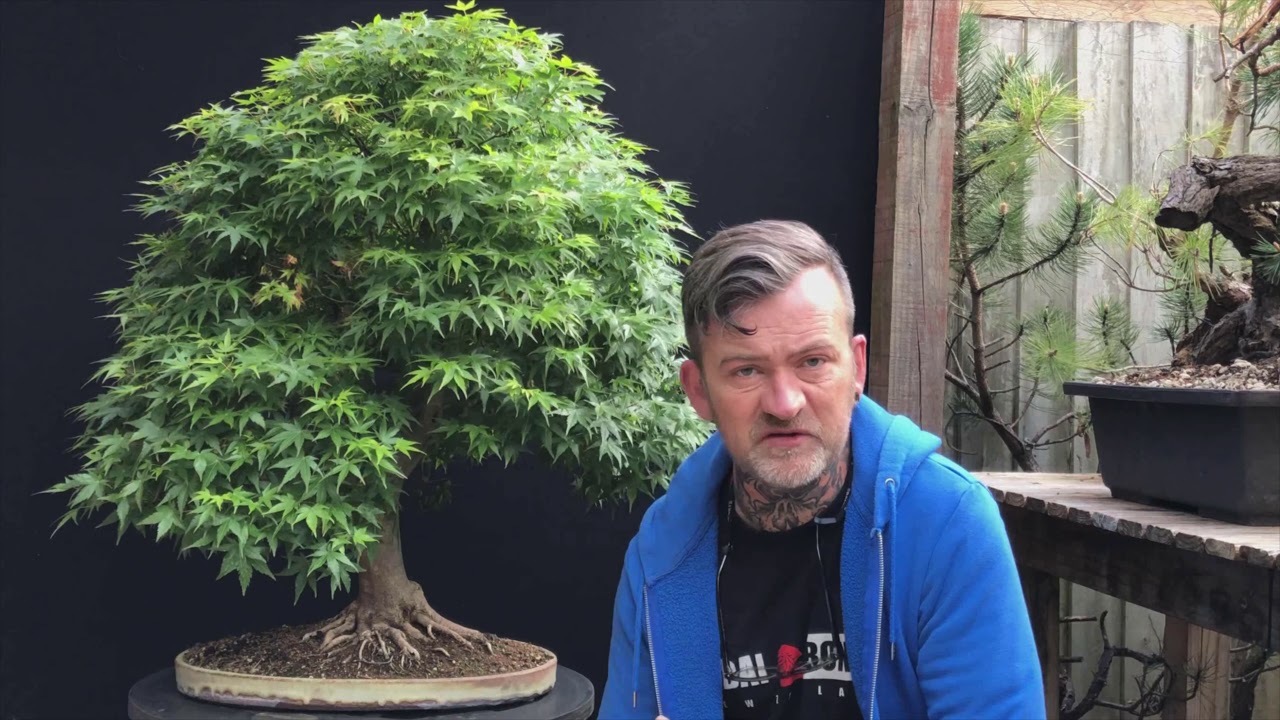
In this instructional video, the presenter showcases a 15‑year‑old Japanese (mountain) maple bonsai that has become densely ramified and leaf‑filled. The dense canopy blocks light from reaching weaker interior branches, risking their decline. To address this, the presenter performs a partial defoliation: removing one leaf from each leaf pair while leaving the petiole attached, thereby reducing shading without stripping the tree completely. He explains how to identify branches where leaves should not be removed (weak or interior‑emerging branches) and emphasizes keeping leaves on strong, vigorous branches. The technique aims to increase light penetration, stimulate new growth on interior branches, and ultimately promote greater ramification over the following weeks as the tree replaces the removed leaves with new shoots.
Chapters
This is my Japanese or mountain maple bonsai that I started from a rooted cutting around 15 years ago, and you may have seen the video earlier, shot earlier in the spring as the tree was coming into leaf. It's now May or mid-spring here in the UK, and the new leaves on the tree have turned to the summer colour. around a month ago, and the tree's been sat there invigorating itself after its spring push. As you can see, the tree is now very densely ramified and forms a fantastic image. There is one problem with many refined deciduous trees, and in particular Japanese maples. When they become this densely packed with leaves, the light is unable to penetrate the canopy, and relatively weak lower and interior branches can start to die off unless action is taken. So today I will be removing around half of the leaves in order to let light into the foliage mass with a technique known as partial defoliation. Many of you will be familiar with the defoliation technique where all the leaves in the branch structure are removed. However, this is a variation of that, and I will be removing just one of each leaf pair so the tree still has a pleasing appearance and is still fully in leaf. Maple leaves grow in pairs, and by removing one of each pair, leaving the leaf stem or petiole in place, a surprising amount of shading is reduced. 2 new leaves emerge from each node, and they're growing in pairs, so I'm simply going to cut one off Each pair, leaving the petiole in place so the leaves and— or that the petiole or the leaves are in place, so that leaves some strength still in the tree. I'm simply going to work over the entire tree cutting off one of a pair. Where a branch is visibly weak or emerges from within the branch structure, do not remove any of the leaves. Just so it can strengthen up in comparison to the other branches in the canopy. If you look closely in this area, you can see these leaves have become very, very weak just where they've been crowded out by more vigorous surrounding branches. And by partial defoliation today, I hope to strengthen these leaves and this branch in its entirety rather than it being lost. You can remove all of the leaves from those strongest branches. However, you're more likely to encourage new growth from the, the tips rather than the interior if you do that. Actually, leaving the leaves On the branch at the tips will discourage new growth. Work on the tree is now complete. And light is able to get into the interior of the tree, reaching the smaller, weaker branches. Where the tree has lost a large number of leaves, it will try to replace them over the coming weeks, and it will issue new shoots from where previously there was just a single leaf. So this partial defoliation will actually result in increased ramification as well as Ensuring that the, the weaker branches on the interior are invigorated. Hope you enjoyed this video, and, uh, we'll see you soon.