Winter Pruning And Detail Wiring An Old Yamadori Hawthorn Bonsai
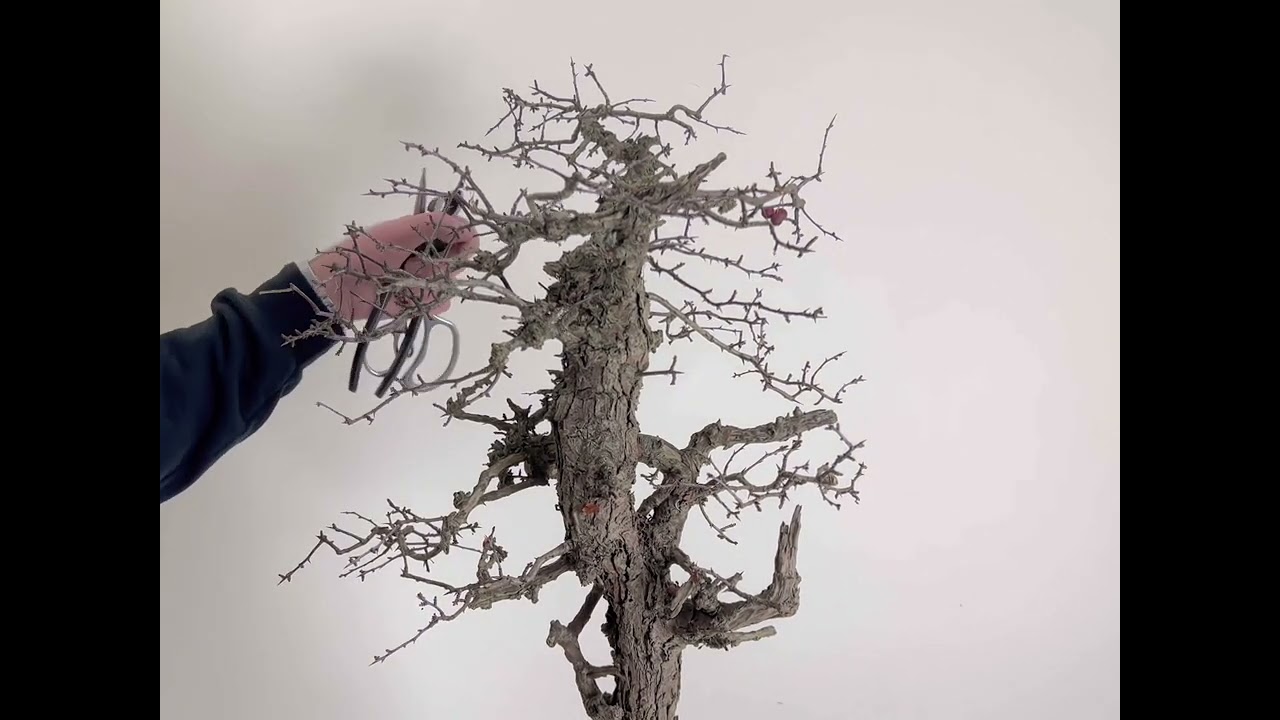
Harry Harrington prunes and wires a hawthorn bonsai collected in 2016, showing how to cut back mature shoots to encourage branching and wire fine growth with 1 mm wire. He shapes the crown into a literati style, emphasizing movement and spacing while preserving deadwood for age character.
Chapters
Hello from my new studio here in Aylesbury, and today I'm going to be taking you through the Seasonal autumnal work that I carry out on all my deciduous trees. And today we've got a hawthorn, Cretaceous monogena, collected in 2016 from the, the hill. It's a tree that had grown in the lee of a much, much larger tree, so it had grown up and away from, uh, the main tree just to get some light. And after I collected it, it was an incredibly strong and vigorous tree, recovered really, really quickly. And it's, it's given me a lot of pleasure because it's just so old and gnarly. We've got some natural deadwood from being chewed by rabbits and deer. And I slowly built up the the branch structure over the past six seven years. But as as you can see through this season, there's quite a lot of new growth. The Danu bacteria has worked extremely well in producing very even growth across the entire tree, but it's all become something of a. Um, a mess with the branch, the branch structure and the way that the branches are pointing. Some of them are pointing back in towards the center of the tree, others crossing each other, and it's all very, very congested. So as soon as the leaves drop, I start working on all my deciduous trees, pruning shoots that I don't need anymore. And wiring and redirecting those shoots I want to keep. If you look closer at the, uh, the branches, the new growth that's appeared, you can see there's a mixture of 2 different types of growth. And this is something that's very common with hawthorn and most flowering trees. So if we Have a look at this shoot here. You can see that although it's got a thorn lower down growing out sideways, there's no thorns at the tip. And this is a juvenile or vegetative shoot that will extend next year, whereas we have a combination of mature growth as well. You can find one here where there's Thorns at the tip. Where there's a thorn at the tip, that's mature growth that will try and flower and berry next year. Now, if you want your tree to develop and you want to develop your, your branch structure further on a hawthorn, it's important to cut the tips off, and that should stop the, the branch flowering next year, and hopefully you'll get some vegetative growth. It's important with hawthorn to build up the branch structure before you allow it to flower too much, because other— uh, once the, the tree is flowering, it won't grow, it won't develop the branch structure as well. Now the tree originally was planted in a pot by American potter Roy Minneri. The tree was originally planted in a pot by American potter Roy Minneri. Roy Minneri made the original pot for this tree. But it's now been moved into something that's slightly wider by Scottish potter Ian Bailey, and it's really suited this tree this year. Going closely, you can see the the very old deadwood and plated bark. It's a very wizened old tree, possibly 100, 125 years. Of age. I've left a lot of the natural deadwood of the tree in place, and you can see here, simply because it just adds the, um, the impression of age of the tree. To remove it would have sort of tamed the design, made the tree much more ordinary. I did, however, have to do some carving. If we can come in here, just to remove the, the flat wounds that I created when I chopped the trunk. And now, after a buildup of patina over the past 6 or 7 years. It looks far more natural. So it can be quite difficult to, to know where to start when you have a tree with such a complex number of branches. What I like to do is start on the lowest branches, pruning through and trying to anticipate Which shoots aren't necessarily for the final design. Now, a word in general about autumnal pruning, winter pruning, because we're now into December. Most of these branches are relatively empty of, um, strength of sap and sugars. Most of it is stored down in the trunk and in the root system. Of the tree. So we can prune away a lot of branches without removing too much of the strength of the tree. And once the tree has been prepared, ready for spring, but with this pruning and wiring, the sap will rise and it will find its budding points where it's got less budding points than it had in the autumn when it dropped its leaves. Hopefully it will start back budding as a way of producing new points where it can grow from through the season. So I like to work my way through removing shoots that are growing straight up unless there is nothing else to, to work to. But we've got plenty of side branches here. So those, those shoots growing straight upwards can go. What I'm also doing is ensuring that, that every point where there's a junction Along the branch, there's a division into 2 shoots. If I have a, a 3 or a 4, a point where there's 3 or 4 branches coming from one point, I will reduce to 2. And this goes for all species, something that should always apply to your, your branch design. Now you may notice that this tree has no lower branches at all. All the growth is in the upper half of the tree, and a lot of this is simply because it's A relatively tall trunk for its trunk diameter. So I've developed something of a literati feel to this tree, a very light, airy design with no heavy lower branches but delicate upper branches. The real emphasis on this tree is this trunk, the movement in the trunk. and its age. So with the tree given a basic wiring, I'm now going to start repointing these new shoes. Now the primary and the secondary branches have been wired and dewired in the past. It's now these tertiary branches I want to alter the direction of. They're very, very fine, and at this time of year you need to be careful not to To snap the relatively brittle wood. So I'm going to use a small gauge 1mm wire, and that should be sufficient to alter the direction without, uh, bending and damaging these new shoes. Each shoot is given movement from left to right and up and down, and this is important to take away the straightness of the new shoots. Plenty of movement. Movement. Also gives an impression of age. This way we can make the, the branches work together. They give their own space. You want each branch, or new shoot I should say, growing into its own area. We're not trying to create a cloud or cluster these shoots. You want to be pointing out into their own source of light. Now I anticipate that once the tree starts to, to grow next May here in the UK, as soon as the, the leaves have opened and then we get new extensions, the new extensions will lead the tree to bulk out and thicken up these new shoots. And by the end of May, all of these branches will have set, and the tree will need dewiring with the, the branches in their new positions. Care does need to be taken with hawthorn, same as blackthorn. The thorns on the branches and the shoots are very sharp, so I try not to grab the shoots too hard, just gently, gently. Grip them. So if you do happen to squeeze on a thorn, it's not actually cutting into the skin. Notice that I'm giving the, the newly wired shoots some movement straight away. To get rid of the straightness and giving them approximate positions. But it's once the entire tree has been, has been wired that I can really stand back and get the placement of each shoot exactly right. So with all the, the branches now wired and roughly positioned, um, I've reached the, the crown, the top of the tree, where I need to build up an apex. And one that's realistic for a deciduous tree. What deciduous trees don't have is just a small network of branches that build up a crown. The crown is built up from all the branches in the upper third of the trunk. So all of these branches are being upswept, and applying this wire every winter allows me to sweep up each of these shoots so they come together as part of a crown. And it's only possible to do this with some detailed wiring on a relatively regular basis. Very ramified trees, I may only Wire the apex every 3 or 4 years. Once that initial build has been put into place, but it's studying the, the entire tree, making sure that each branch works for you. You want to be able to see each branch. You don't want them to be clashing. You want them all to be growing forwards, backwards, to the left, Or to the right. You don't want them to be growing inside. And that all-important movement in each and every shoot. And it's important to keep working, keep working until everything is very precise. Make sure you look at the tree at the correct angle to find the exact front, and make sure your eye level is around 2/3 of the way up the Trunk. That's the correct viewing height. If you're standing above the tree or below the tree, you're, you're adjusting the branches for a viewing angle that's wrong. So if we pan out and look at the tree as a whole, that final image is there. We have slightly downsweeping branches in the direction of movement, which is towards the left, and on the right-hand side, the branches are shorter. and weaker, and they upsweep slightly where they're trying to get the light that comes over the top of the crown. I'm not too interested in where the branches come from. I don't need to have branches going, emerging from the trunk on the left, then the right, and then the back all the way up, because then that actually tames the tree. This is a very wild tree. I'm trying to use the, the growth that I have And enhance what's already there.
More from Harry

A couple of Norway Spruce bonsai from Saturday’s Bonsai4me workshop. @bonsai @tree @spruce




Yamadori Hawthorn bonsai hunting! From collection in Jan 2020 to a bonsai pot in Sept 2025. #bonsai


Here are a couple of Juniper bonsai we styled on Saturday at the Bonsai4me workshop #bonsai #juniper

Putting my Japanese Black Pine next to the waterfall at TheJGarden! #bonsai #pine #garden #japanese


A taste of yesterday’s Bonsai4me workshop here in Aylesbury, with a wide range of bonsai! #bonsai

This approx 150+ year old Hawthorn bonsai I collected 8 years ago being reworked this week #bonsai