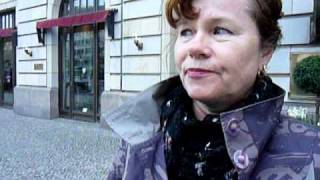
Bettina guides a Berlin walking tour covering the 1945 Potsdam Conference, where Stalin, Truman, and Churchill decided Germany's fate. Stalin dominated after Churchill lost his election mid-conference. Soviet forces took Berlin at a cost of 40,000 soldiers, and Truman decided to use the atomic bomb on Japan.
Questions this video answers
Potsdam
Joseph Stalin (Soviet Union), Harry S. Truman (United States), and Winston Churchill (United Kingdom) — with Clement Attlee replacing Churchill mid‑conference.
President Franklin D. Roosevelt had died some months before, making Truman new in office.
On the west side of the river Elbe.
"40,000 soldiers" (as stated in the transcript).
Chapters
How you doing? So I'm not sure if you realize it. We are in Berlin here, Michelle and I, and we're here for the Linami intensive in Berlin, coming this weekend. We're doing a little tour right now. So we have our own private tour guide. Her name is Bettina.
She's awesome.
And Bettina was talking about something very, very special. And it was literally this meeting about how to divide Berlin. And I wanted her to get us straight from her because it was very interesting in how the whole decision to bomb in Japan came in. So feels that she got. Just tell us a little bit about what happened this meeting in. Was it Potsdam and where that was?
Yes, this meeting was in Potsdam. The Second World War was actually came to an end in May 1945. And after all the battle stopped here in Berlin. And in Germany, the Russians, the British and the Americans met to come to a conclusion what to do with Germany. And this happened in Potsdam, 30 kilometers from Zealand. And there met Mr. Stalin from the Soviets, Mr. Truman from the American and Mr. Church of British. The great problem with this conference was that Mr. Truman was new sir. Roosevelt had just died some months before. And the next problem was that Mr. Churchill could not be with this conference for the whole period of two weeks. Because in between these two weeks of this conference they had elections and Mr. Churchill was not re elected. So he disappeared and Mr. Edley showed up. So the only one that was there the whole conference was Mr. Stralin. This gave him of course a lot of power.
That's why he ended up taking when he was kind of in charge of that conference now and had a lot more power. So he ended up taking all the historical areas of Berlin. I had asked him, why is it like we're here? Were touring mostly East Berlin versus West Berlin. She said, well, all the historical important things were taken by Stalin in that agreement.
And the second reason of course is he did the battle. The Russians, the Soviet army did the battle, not the Americans or British. There was an agreement between the Americans and the Russians that the Americans stopped on the west side of the river Elbe, a very famous river, and that the Russians should take Berlin. So the Russians took Berlin and they lost about 4,40,000 soldiers. Can you imagine this? 40,000 soldiers. We have huge cemeteries here, three huge cemeteries in Berlin. Very interesting. Typical Soviet art stops where those soldiers lied buried because they couldn't bring them back to Russia. One of the other things you guys.
To recognize was that there was in this conference was a really important conference. And it was during that Time that Harry F. Truman made a very, very important decision. All without decision had been made.
The war, as I told you, was over in Europe, but the war was not in Asia.
So what happened is that there was a world war and it was the allies against the Germans, but it was. The Japanese were on the really on the German side, the Nazi side, I should say. Mostly because they were very powerful at the time, and they wanted to take over more and more land. They wanted to take over the world also. That's just the way the Nazis wanted to do it. So in respect, they were fighting on two fronts. So saying that the war was over in Europe, but it was not over in Japan.
So during this conflict of potential, in July, August 1945, in consequence of the fact that the Japanese did not give up, did not stop this war in Asia, Mr. Truman decided in Potsdam to throw the first nuclear bomb. So the decision was made in Potsdam, which makes this place here even more serious. But of course, we can understand that he made this decision because he could estimate if they would not throw the atomic bomb on the Americans would have lost any. At least more 1 million soldiers to conquer Japan. Not possible.
So how's that? That's pretty interesting. I didn't know a lot of this stuff, but obviously, as you can see here, take a look at the whole square over here. This. This entire area, everything you see here, was completely destroyed by bombs. And one of the things that we're finding very interesting is that when Germany is rebuilt, a lot of this has been mostly rebuilt over the last 20 years. When they build things, it's not like normally in America. The thing is that in America, in Canada, very often there's something old and we kind of don't like it. Throw it down and we build something brand new. Well, it's just a real historical site. Well, but there's no bombing that occurred there. Here, all these things were in shambles, Just little columns and stuff left. And what they do here is that they try to keep as much of the old structure as was and then build in addition to it. So a lot of the buildings have places where you can see where the bombing even occurred and where the old was and the new is added to it in order to preserve the history of it. And right now we're in front of a very, very famous hotel. This hotel is called Hotel Adelon. And this was one of the most prevalent and famous hotels before the war. Right. So it's a beautiful hotel. And one of the things they have there is afternoon tea and we are going to. I was just about to take a shot of it, but let us know not to take pictures because. And there's signs up because a lot of celebrities come because it's very important.