One-on-one with Dean Graziosi and Jesse Eker [INTERVIEW]
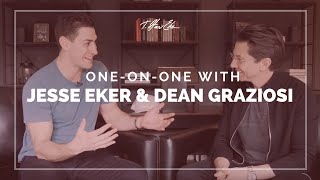
Dean Graziosi talks about overcoming dyslexia and a tough childhood to become a bestselling author and entrepreneur. He describes two internal voices—negative and aspirational—and how reframing strengthens the one that pushes you forward. For people stuck, he points to three things: hunger, focus, and measuring results.
Chapters
All right, I'm here with Dean Graziosi.
What's up, man?
Thank you so much for making it to this little home office of mine.
I love it.
I love it. I appreciate you coming out.
Good to be here, man.
So I wanted to start the interview off with something just more about you personally. Okay. So I know your story. You had a really tough childhood. You struggled with dyslexia. You didn't do very well in school. Your odds of succeeding were very low.
Yeah, for sure.
But you managed to become extremely successful. You're a multiple New York Times bestseller, and you've done over a billion dollars with a b billion dollars in sales. So getting from where you were to where you are right now is a crazy triumph. What I'm wondering is, what were those beliefs? Because we all have these limiting beliefs, non supportive beliefs that we have to overcome to really get to that level of success. What were some of those limiting beliefs that you had to overcome to get to where you are today?
Yeah, really great question. First off, I just want to say congrats for doing what you're doing, man. The world needs more knowledge, information. They need a beacon of light. They need capabilities. And the more we do this, the more we share it allows people to course. Correct. Right. We have the ability. So I really love what you're doing. Thank you. And it's my pleasure to be here with you. So here's the thing. When it comes to beliefs, beliefs are one of those things we've all heard a million times. We all think, I can't be that. You know, it's got to be, I need the tool. Like, yes, you need the tool and you need somebody to show you. But at least I know in my 20s, if someone would said to me, hey, if you change your beliefs, you change your life. Like, yeah, whatever. That's what rich people say, right? That's what people in California say. That's what my dad would have said.
Yeah.
You know, upstate, he was skeptical of everything. Right. But it's absolutely the foundation of every successful person in the world because here's what I believe in and I want to simplify beliefs. And if you've heard, you think you've heard it before, then I'm going to say, stick with us and listen right now I know there's a million other things you can be listened to, a million other things you could be watching. But I want to share the things that got me here and before I. It's really cool to say. Multiple New York Times best selling Author. I've started 13 companies. Over a billion dollars of my brands and my companies. But that also doesn't say or share the part where I was scared when I got a high school and had dyslexia, didn't go to college, and my dad's business failed and I had nothing, and I had sleepless nights living on credit cards and I worked out of a little garage. But I also know what it's like to start my own company. I know what it's like to do a hundred grand a year and be like, oh, my God, but then lose it. But then I know it's like to do 100 grand a month and 100 grand a quarter. A hundred grand a day, 100 grand by lunchtime. Right. So I know all the variables. So no matter where you are, don't think I don't understand. I never forget what it's like to be broke. I never forget what it's like to look at other people and even have envy. Like, how the hell are they getting ahead? I work as hard. I'm as smart. Like, I remember all those feelings. So know that today, my whole goal here is to deliver at least one thing so valuable that you use it in your life right away. So when it comes to beliefs, here's what I know. We all have two voices in our heads, right? And that's the easiest way for me to simplify it. But what I want to share with everybody is I still have that voice. I literally still have the voice. I had dyslexia. I was in special ed. I still have the voice, the same one when I was 17. It just got matured. The voice of saying, hey, you know, it takes money to make money or you don't come. Nobody in my family's ever been successful. My mom and dad worked their butts off, and they didn't make anything. You know, you don't have a great education. I don't have a vast vocabulary. I could never read in front of somebody because I just. I can't. My. My eyes go faster than my brain can comprehend. Or vice versa. Yeah. So all of those stories were there, and that voice was there. But I also had this other voice that said, I think everybody's wrong. Like, I think I can do this. Like, at a young age, it was being naive. Like, I don't care. I don't have money. I'm gonna figure out how to do real estate with no money. I don't care that I don't know how to write. I'm gonna try writing a book. So I Had these two voices, and one was like, shut up. To the. To the negative voice. And the other was like, yeah, you're crazy. You're a dreamer. Like, I'm not crazy. But I had these two. And the point I want to tell you is if you can empower the voice that tells you you can just a little bit more than the other voice, you win. Like, you don't have to have personal development completely dialed in. You don't have to be able to sit down and get in alignment with your chakras in three seconds and find peace and abundance. It's like that shit never came to me. Excuse my language, but it didn't. I just found a way for that voice to be a little stronger. And how that voice got stronger is I would take the stories, the beliefs of the negative voice, flip them upside down.
Okay. Like a reframe.
Just a reframe. Yeah. Nothing different than people have taught that your dad teaches, you teach. Every great teacher presents. But for me, that was my simple way. When I'd hear that voice, I would find a way to reframe it and change it. And to this day, I want to tell you, when I wrote my first book, I had the voice say, hey, you had dyslexia. You never only read a few books in your life. You're crazy. Don't try to write a book. The other voice overpowered it. I wrote a new. My new story around writing a book was, hey, maybe someone needs a book from a guy like me. Maybe. Maybe I'm just going to tell a story. I'm good at telling stories. I'm good at inspiration. Who cares? That I literally broke every rule possible writing my first book. My first editor that I hired, she called me a day later. I don't know if you shared this before. She called me a day later and she said, I'm sorry, Dean, I can't. It's not a book. She said, this is a 300 page conversation. I can't edit it. It needs a complete rewrite. I suggest you hire a real writer. I swear to God, it's what she said.
Wow.
And I remember those beliefs came back. See, you were right. You're not that smart. But this other one, this belief, said, no. Maybe the world just needs a guy that came from nothing, who doesn't have a vast vocabulary, use really simple words, just shares what's in his heart to try to inspire. I'm not kidding you, man. I almost deleted that book after she said that my finger was. It's not one of those Dramatic stories. I just remember going, you know, I'm just going to delete it. And I didn't. I launched that book and this was before New York Times bestseller campaigns. It became a New York Times bestseller in two weeks. It just freakin hit and people went nuts over it. That didn't stay there forever. But your first book that you were gonna delete. The only thing different on why that book got published was the belief I had about it. If I let the voice that said, you're not smart enough, you don't read enough books, you broke every rule possible, delete. If I listened to that one, I wouldn't have six books under my belt right now. I wouldn't be in your multiple New York Times best selling author. But every step of the way, man, and I don't mean to go so long on this question, but it's so important. It is that every step of the way. To this day I still have beliefs saying, man, can you really run a hundred million dollar company? Do you really want to go to the next level? You know, Tony Robbins and I want to fix, give an alternative to the broken education system and make self education the new norm. It's like, I'll still have a voice go, God, it might be too big to tackle. Or maybe, you know, you're remarried, you're having a baby, maybe you should slow down. Like all these things come in. But I still, I take that and go. Because that voice says I can't, I must. And I just find a way. Whether I get social proof, I talk to people who inspire me, I listen to a book, I watch a podcast, and over time, not immediate, I'll rewrite that story. And that negative belief now becomes the fuel that drives me to keep going forward. And I think we can all do that. And you just do it on any level. On any level.
That's so huge and it's right. We always talk about that. It never really goes away. You're all humans, it's just how you can deal with it and structure it, which is so big. So I want to talk about one of the things that possibly will relate a lot to our students and that's the fact that they're trying, they're working really hard, like they really want to make something of themselves. They see success and they're like, I want to go after it, I want to follow the mentors. Success leaves clues like how do I get there? And so what kind of advice do you have for people who just have not made it to the level of success? That they want to get to yet, but they're just working their butt trying to get there, and they're just not seeing the results that they.
You know, there's so many answers that come through my head, and I want to be concise and give some clear things. The first thing that comes to my head is I think there's three things that are really important. I teach my whole team this. I teach my children this, and I teach everybody around me. My core team of 60, 70 people know this. If you said. If Dean said, what's the thing to break through? Like, if we're stuck on a marketing campaign? If we're stuck, man, we can't get this ad to convert. We can't fill this event up. They know. I'll go to three things. Are you hungry? Are you focused and are measuring your results? Because if you're not hungry, someone else is hungrier than you.
Okay, right.
And hunger. Where does hunger come from? Like, hunger comes from using whatever it is inside of us that drives us. When I was broke and wanted more, you know what drove me? I watched my mom, my parents, split when I was 17.










