Ari Whitten ┃The Biggest Myths About Aging (and the Science That Debunks Them)
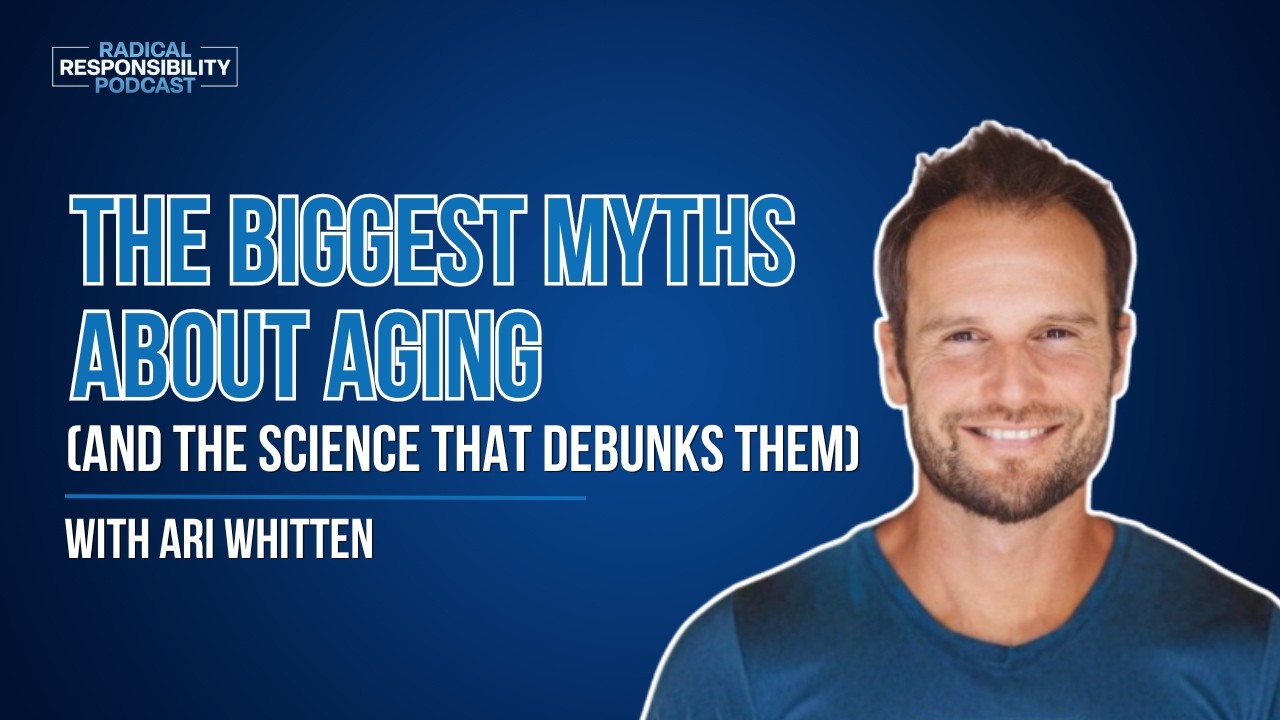
In this interview, host Fleet Maull (HeartMind Institute) talks with Ari Whitten, founder of The Energy Blueprint, about common myths surrounding aging and how many of the declines we attribute to getting older are actually driven by lifestyle, beliefs, and environmental factors. Whitten explains that stress is often mischaracterized as uniformly harmful; our perception of stress can amplify its physiological impact. He delves deep into mitochondrial biology, describing how mitochondria act as a central hub for metabolism, immune function, redox balance, and the cell‑danger response, and how disuse, nutritional deficiencies, toxins, and chronic stress lead to mitochondrial atrophy and a 75 % loss of capacity by age 70. The conversation then covers how nutrition influences mitochondria via the gut‑mitochondria axis, the importance of micronutrient cofactors, and the reality that modern soil depletion reduces nutrient density, making targeted supplementation valuable. Whitten outlines the mechanisms of red and near‑infrared (NIR) light therapy (photobiomodulation), highlighting cytochrome c oxidase as a photo‑acceptor, the stimulation of mitochondrial ATP production, tissue‑specific growth‑factor cascades, and stem‑cell activation, and addresses safety considerations. He also explains circadian biology: the central suprachiasmatic nucleus clock driven by blue light, peripheral clocks driven by feeding, and practical steps (morning bright light, evening blue‑light avoidance, consistent sleep windows) to strengthen rhythms. Finally, he discusses hormesis – the “use it or lose it” principle – illustrating how regular physical, cognitive, and thermal challenges preserve muscle, bone, brown fat, brain reserve, and mitochondria, thereby slowing functional aging. The interview ends with resources for further learning.
Chapters
have been culturally conditioned to believe that stress is extraordinarily harmful to their health. And we all accept this as true. We all accept this as a given. It is repeated again and again and again in media and by health experts of all kinds, to the point where we've had it for so many decades, we all accept it as a sort of un— unbreakable, unchallengeable truth, right?
What if feeling exhausted isn't an inevitable part of getting older, but the result of beliefs and habits you can actually change? Today I sit down with Ari Whitten, founder of The Energy Blueprint, to explore the science of mitochondria, stress, circadian rhythms, and why many of our assumptions about aging may be doing more harm than aging itself.
And I'm really thrilled to be here today with Ari Whitten. Welcome, Ari.
Thanks so much for having me. Pleasure to be here.
So Ari Whitten, MS, is the bestselling author of The Ultimate Guide to Red Light Therapy and Eat for Energy: How to Beat Fatigue and Supercharge Your Mitochondria for All-Day Energy. As the founder of the Energy Blueprint, Ari is a renowned natural health expert who takes an evidence-based approach to optimizing human energy With a Bachelor of Science in Kinesiology, certifications from the National Academy of Sports Medicine as a Corrective Exercise Specialist and Performance Enhancement Specialist, and a Master of Science degree in Human Nutrition and Functional Medicine, Ari brings a wealth of knowledge to his field. For the past 25 years, Ari has been a tireless researcher dedicated to staying at the forefront of scientific advancements in health and energy enhancement. His His deep expertise encompasses mitochondrial health, circadian rhythms and sleep, nutrition, gut health, light therapies, fitness, and hormetic stress, making him a leading figure in these areas. Over the last 8 years, Ari has developed the Energy Blueprint, the most comprehensive program in the world focused on overcoming fatigue and boosting energy levels. This flagship program has transformed the lives of over 10,000 individuals while his free courses and masterclasses I reached over 2 million people, often delivering life-changing results. So this summit is, is all about beliefs and, and how many of us have what are called limiting core beliefs of various kinds that we just inherited, got conditioned into us from our childhood and so forth, or from the culture and get continually reinforced often by the culture. And we know from modern neuroscience with the phenomenon of neuroplasticity and neurogenesis and so forth. We can change our beliefs and in the process rewire our brains. And, and so today we have each day of the summit is focused on different areas of our life. Today is focused on longevity and healthy aging. And so many people associate aging with just decline. Like, you know, I mean, I, I've been guilty myself. Even though I'm very involved in body-mind work for a long time and really into healthy aging these days, especially since I'm 74. But in the past, I've caught myself saying things like, "Youth is wasted on the young. Old age sucks." You know, these kind of things. So there's a lot of myths about old age. And for me, something shifted when I started hearing people talking about things like, well, 60s the new 40s, 70s the new 50s. That was encouraging. And I embrace those ideas readily. But I wonder if you could talk about some of the beliefs that get in our way of healthy aging and that could be really debunked because they're not necessarily true.
Yeah, there's a number of them that come to mind. I'll give you a sort of— maybe I'll mention two very briefly and you can decide where we go from there. One of them is that we have an idea around how our bodies decline with aging and how our brains decline with aging. And we attribute a lot of this to this thing called aging, right? And that, you know, it's old age. And once we get to XYZ age, you know, this is normal to happen. And what I found in digging into a lot of this literature and working with many people over many years and pairing the two, sort of seeing the, the intersection of where my experience working with people is meeting up with the scientific literature, is that I would say at least half, if not much more, of what we attribute to the aging process is is actually the process of essentially atrophy of the capacity of various systems of our body, um, that we are losing, um, capacity and performance in different systems of our body as a result of disuse, as a result of adequate challenge and stimulus, uh, to those systems of the body. Uh, they decline as we age and we attribute that to aging, but it's actually the product of our behavior, our environment, our way of life. So that's one. And, and the, the belief there is again, just how much we are culturally conditioned to, to believe and to expect that aging is doing all of these things to our body when in fact it's not. The other thing that I think is a really big one, and maybe depending on what kinds of messages you teach to your audience might be controversial, and that has to do with attitudes towards stress. So most people, almost everyone, particularly those who have grown up in North America over the last several decades, have been culturally conditioned to believe that stress is extraordinarily harmful to their health. And we all accept this as true. We all accept this as a given. It is repeated again and again and again in media and by health experts of all kinds to the point where we've had it for so many decades, we all accept it as a sort of unbreakable, unchallengeable truth, right? And— There's a couple interesting aspects to that. Number one, the research shows that most typical kinds of psychological stress that most people experience in their life aren't remotely as harmful as most people believe them to be when it comes to how harmful they are to their health, objectively speaking. And the other aspect is understanding that your beliefs about stress about the harmfulness of stress and what that does to your physiology actually interface with how stress affects you. And there's a large body of research essentially showing that to the degree that we believe that experiencing stress is bad for our health, we actually amplify the adverse effects. We essentially create a sort of nocebo effect that makes the stress actually much worse for us than if we were to have encountered the same objective circumstance, but we didn't believe that stress was as harmful to our health. So those are probably the two big areas that jump out to me.
Well, at HeartMind Institute, we certainly agree with what you're saying about stress, and we've often in many programs shown Kelly McGonigal's great TED Talk And she has a great book kind of turning the tables around our attitudes to stress and points that research that actually demonstrated that it's our beliefs about stress that impact us rather than the stress itself. And that, you know, stress is exercise, you know, if we don't put stress on the muscles and bones, they atrophy, right? So we need physical, emotional, psychological, mental, spiritual stressors in our life to grow. Absolutely. But unmanaged stress can be quite harmful, obviously, which I'm sure you could, would agree. So, and, and where this can have impact is the systemic inflammation that is really at the root of most of the chronic illnesses that have our healthcare system in breakdown and so forth. And so this really gets down to cellular health. And, and I know your work focuses a lot on the intersection between energy production and and healthy aging. And so you're talking about mitochondrial health. So I wonder if you could give us a little bit of a, a tour. I don't know how far down the rabbit hole we'll go there into cellular biology, but something about mitochondrial health and its impact or its importance to healthy aging.
Yeah, I mean, um, we could go very deep there. So let me give a, a brief sort of intro to mitochondria. Um, we all learned about mitochondria in, in grade school or junior high school and in high school biology courses. And you go even deeper when you go into more advanced college-level biology, physiology courses, and then biochemistry courses in— at the graduate level or at the undergraduate graduate levels. And you learn about mitochondria. And the first thing that we learn is really that this is the powerhouse of the cell. This is one of many organelles In the cell, we have, you know, the nucleus over here, we have lysosomes, we have the Golgi apparatus and the endoplasmic reticulum, and we have the mitochondria. And the mitochondria, the thing we have to remember for the multiple choice exam, that's the powerhouse of the cell. That's the thing that produces ATP. And for the most part, you know, it's still kind of framed as, as that basic thing, even at more sophisticated levels of biology and biochemistry and physiology courses, they're framed largely as mindless energy generators that sort of just take in carbs and fats and pump out energy in the form of ATP. And of course, that is a very important part of what they do. They are supplying virtually all of the energy to virtually all of the trillions of cells in our body, from our muscles to our heart to our intestines to our skin to our eyes to our brain. And so on. But, uh, in recent years, and really the last 20, and especially the last 10 years, it's been found that mitochondria do much more than that, and they are not just mindless energy generators, but that they actually play a central role in regulating our metabolism. Um, a researcher here in San Diego where I am now at the University of California San Diego School of Medicine, runs a lab for mitochondrial medicine there. His name is Dr. Robert Naviaux, and in his words, the mitochondria are the central hub of the wheel of metabolism. And this word metabolism is something that many of us often associate with weight loss and, you know, how fast our, you know, sort of metabolism is running. But the word metabolism actually refers refers to the totality of all of the biochemical reactions that are occurring in your body. So what he's saying is mitochondria are at the, are the central hub of everything that's happening in your body. And that's really what this body of literature has shown over the last couple decades, is mitochondria are involved in immune health, and mitochondria are involved in regulating redox balance, the balance of, of oxidants to antioxidants in the cell. Mitochondria are involved in our resilience and our ability to respond to stressors of all types. Mitochondria are central in the process of aging itself, and mitochondria are also instrumental in regulating how our bodies are responding to the environment. They are essentially like the canaries in the coal mine that are the most sensitive environmental detection system, the most upstream thing in our body that's sort of picking up signals about what's going on in, in the body, what's going on as far as how that that human being is engaged in the world around them. And in response to those signals, and it can pick up a huge variety of signals, it is determining essentially whether your body is in energy mode or in defense mode, what Dr. Naviaux calls peacetime metabolism or wartime metabolism. And at the center of this picture is something called the cell danger response. And basically what this is, You can imagine being in your kitchen preparing dinner, you're chopping vegetables and things like that. Somebody breaks in, a criminal breaks in, holds a knife or a gun up to you and says, you know, "Give me all your valuables." If you've got to deal with that threat, you can't just keep chopping vegetables and cooking dinner and going about your business as normal. You have to deal with that threat. And what mitochondria do is they're sort of the first thing that are detecting those threats. And what they do in response to it is they turn down the dial on energy production and they shift resources towards defending against the threat. That's the cell danger response. So, um, this obviously hugely relates to our energy levels in the sense that to the degree we are having our cells, our mitochondria are tasked with having to organize resources to defend against threats, they are turning down the dial on energy production, which means you as an organism will have subjectively much lower energy levels. You are likely to experience fatigue or low energy as a result of that. And this is the central thing that goes on in terms of regulating our energy levels. We need to understand it mostly as a story of to what degree we are having to defend against threats in, in lieu of operating in peacetime metabolism. So that's sort of the big, the big picture of, uh, what mitochondria are doing in our bodies.
So for various reasons, my understanding is that mitochondria throughout the body and all the cells in the body— and my understanding is there's a higher concentration of mitochondria in the cells in the brain, the eyes, the heart, and women's ovaries. But they're in every cell in the body. And that due to various negative impacts, poor nutrition, perhaps poor hydration, not enough sleep, not enough exercise, as well as being in unmanaged constant stress, that being in that war response all the time or that not in the peace zone, that mitochondria can atrophy, they can become weaker, they can die off. And on the other hand, mitochondria can be repaired and we can increase— we can have new mitochondria. Is that accurate?
It's mostly accurate. The one minor detail is that they're not in every cell of the body. We do have some types of cells without mitochondria. Red blood cells are a good example of that. But most of the rest of what you said is highly accurate. And, um, it is, it is the case. So there's, there's sort of 3 ways that we can think about as far as how mitochondria can, um, not be healthy. One is they can become dysfunctional as a result of, um, let's say nutritional deficiencies, right? If you're missing certain cofactors for your mitochondria to pump out energy efficiently, let's say certain types of fatty acids, B vitamins, CoQ10, alpha-lipoic acid, PQQ, things like this. If you are— let's see, if you have acetyl-L-carnitine is the other one I was thinking of. So, if you have deficiencies in certain things like that, your mitochondria are not going to pump out energy as efficiently. Now, another layer of this story is the extent to which they can accumulate damage. And this could be for a couple reasons. It could be insults to that system are causing them to accumulate damage. So let's say heavy metals, nutritional toxins, you mentioned, you know, inflammatory cytokines, oxidative stress, things of that nature can start to damage the mitochondrial membranes and, and physically damage the structure of them. At the same time, we have mitochondrial cleanup processes. So people listening to this have probably heard of the idea of autophagy. It's a sort of cellular cleanup and recycling of damaged cell parts. Well, mitochondria do this as well, and this is a process called mitophagy. And this is something— this, uh, cellular cleanup process happens particularly when we are in a fasted state and during the sleep period overnight. And if you are not sleeping very well, if your circadian rhythm is not healthy and you're not spending enough time in the fasted state, in a state of deep sleep with a strong circadian rhythm, you're going to impair that process of cleaning up the damage. So through a combination of imbalances there, we've got too much, insults to the system that are causing damage, we've got not enough mitophagy happening to clean up the damage, we can accumulate damaged mitochondria over time. And the other process, which is sort of going back to what I was speaking about at the beginning of this conversation, is that as a result of disuse, as a result of inadequate challenges to our mitochondria, they can atrophy and they can shrink and shrivel up and literally die off. Uh, and the way to think about this is much the same as if you've ever broken a bone and you've got a cast on your arm or your leg, 8 weeks later, you go to the doctor, they saw off the cast, you look down at your leg and it's half the size of the other one because your muscles atrophied from disuse. That same process happens at the mitochondrial level. It's just we're not as aware of it because visually we can't see it. It's happening at the microscopic level inside of ourselves. But it's been shown that the average 70-year-old has lost about 75% of their mitochondrial capacity. And that is a combination of two things. One is the actual energy production capacity of the mitochondria that are there shrinks by about 50%, and the number of mitochondria that are even present is also cut in half. So we've lost half of mitochondria, and then the ones that are still present are what, much weaker than they were in our youth. Um, also going back to what I said at the beginning of this conversation, We know that that process is not just a normal product of aging because we can find 70-year-olds who are lifelong exercisers and they have the same mitochondrial capacity as young adults do. They do not lose 75% of their mitochondrial capacity. So that tells us this is not a product of aging per se, it is a product of modern lifestyles.
Wow, fascinating. And, uh, quite an alarm bell there went off for me being 19— being, uh, 74. Um, I'm gonna ask you later about, uh, testing. Hopefully I'm some— somewhere in the middle because I have been a lifelong exerciser and doing a lot of things today to hopefully support mitochondrial health. But let's talk about how we can enhance mitochondrial health. Uh, we're going to talk about, uh, some of the things that you very much talk about and promote and teach— light therapy and the focus on circadian rhythms. And you kind of already referenced hormesis with, uh, the, the of providing the necessary stress. But let's talk about nutrition to begin with. So what are some of the basic principles of nutrition? What are some of the antinutrients in the common diet that could damage mitochondria? What are some of the basic principles of nutrition that can support mitochondrial health? And then, you know, in our diet, and then what is the role of supplementation with all that? So it's— I know that's a broad subject, but maybe you can zero in on some of the key principles for—
I mean, we could probably spend 5 hours on those questions. Right, exactly. Um, so I'll try to keep it very succinct because I know you have a number of other topics you, you were hoping to talk about. So, um, there's a number of different ways in which nutrition will interface with mitochondria specifically. So, one of the ways is that what we eat impacts our gut health, and there is a microbiome mitochondria axis, gut mitochondria axis. So, we've got that function happening, and there's a number of specific mechanisms through which that happens, things like short-chain fatty acids that are produced by certain bacteria in the gut. As well as things called urolithins produced by certain bacteria in the gut in digesting certain nutrients. And there's a few other mechanisms as well. Those are sort of— here's another one that I can add to this list briefly, which is to the extent that you have gut permeability, you're now going to have LPS, lipopolysaccharides, or endotoxins leaking through the gut-blood barrier. And when that happens, that becomes a source of toxicity for the mitochondria. So, there's ways we could optimize the gut-mitochondria axis. We also have the fact of simply consuming toxins themselves is going to impact on mitochondria. We, we also have certain nutrients that our mitochondria require in adequate amounts to function. All these cofactors that I mentioned a few minutes ago. We also have how our diet influences our body composition and overall metabolic health. So once we're influencing that picture, now we're influencing the whole biochemical milieu that our mitochondria are essentially being bathed in all the time. Our blood sugar levels, our triglyceride levels, the amount of fatty acids we have in our bloodstream, and simply, you know, the extent to which our diet is contributing to poor body composition and excess body fat hugely influences that picture because just having high blood sugar itself chronically is toxic to mitochondria, right? We have that body composition mitochondria axis. And one other one I'll mention is maybe circadian rhythm. So in addition to light influencing the circadian rhythm, our nutrition also heavily influences our circadian rhythm. And we actually have two— we can think of it as sort of two categories of clocks in our body. We have the central circadian clock in the brain in a part of the brain called the suprachiasmatic nucleus. And that is primarily responsive to light inputs. And then we have peripheral clocks. This is a more recent scientific discovery, uh, but we have peripheral clocks in essentially all of our different tissues. We have it in our liver, in our skin, um, in our intestines, in our muscles. We have all these peripheral clocks and we have circadian clock genes that are responsive to— and, and that are tied to the central circadian clock in the brain. And these peripheral clocks that are scattered throughout our whole body and in all these different tissues are hugely responsive to nutrition inputs, not so much to light inputs. So we need to optimize both layers, and we want to link those two things: the central clock, the light inputs, and the meal inputs. So feeding and fasting windows become very important as well. So that's, that's probably the brief overview. If you, if you want to go deeper into any of those, we can, but that's sort of how I would broadly describe some of the links.
Yeah, and I really encourage people to check out your work and your website and so forth because we can go so deeply into these areas and And from my own exploration, there are a lot of things about common beliefs we have about what are healthy things to eat. Even if you're, you know, a really health-oriented, diet-oriented person, it's more complex than that. Some of those things actually produce antinutrients that can be harmful to the mitochondria. And, but you know, how to balance all these things out. But suffice it to say, our nutrition is highly impactful for mitochondrial health.
And I, I will say, you know, to maybe add one layer to the story of, of nutrition, I will say that I think a lot, there is a lot of, a lot of, there's an issue of a lot of diet gurus who are financially incentivized to overcomplicate nutrition and the story of nutrition.— and we are, as a culture, obsessed with finding the next big diet craze. And there's a lot of people again who are financially incentivized to capitalize on that culture where if you are the one who successfully puts out the next diet that everybody becomes obsessed about, you know, you can make many millions of dollars doing that. But the—— the side effect of a culture and a sort of operating system that's oriented in this way is that number 1, we tend to greatly overcomplicate good nutrition. And number 2, we have an endless variety of diet gurus who end up pathologizing different food groups and making people think that certain foods are very bad for them. And at this point, you know, we're in an era now that every conceivable food group, everything other than water has been demonized by somebody. You know, I never thought I would see the day where even just vegetables would be demonized. And now we have, you know, certain diet camps that are convinced that, they're— the, the green vegetables are full of plant toxins that are going to kill them. And, um, and, and the gap between that and the actual body of scientific literature on consumption of those foods and health benefits and disease rates, it couldn't be more stark of a contrast. Um, so we can become obsessed. You know, we, we have people putting forth the idea, you know, every— everything you've been taught about diet is wrong And really, it's lectins that are killing you and, you know, making people think that eating too much lentils and beans and broccoli are the things that are killing them. No, it's not lentils and beans and broccoli that have made us obese and diabetic and diseased. We know what it is. It's hyperpalatable, rewarding processed food. And that is The introduction of a modern Western diet, a modernized processed food-based diet or a Standard American Diet. We can look all over the world and we can track it. When countries become modernized and westernized and they introduced more processed foods, they become obese and diabetic and their metabolic health gets destroyed just like the rest of us. It's not because certain whole foods, you know, are killing them. The reality of good nutrition is if all you did, if you knew nothing other than just my only rule is I'm going to eat unprocessed whole foods and you did nothing else beyond that, you would be 75% of the way to an optimal diet. That's the majority of eating a healthy diet. And, um, and a lot of people have obscured that again by demonizing different food groups and making people think it's about the right macronutrient ratio or low carb or low fat, or if it's vegan or it's carnivore or it's keto or whatever it is, um, or it's lectins that are killing you and, and anti-nutrients and things like that. And, um, those kinds of things might be relevant to particular individuals, but it's probably less than 5%, maybe less than, in many cases, less than 1% of the overall picture of good nutrition.
What if transformation isn't just about thinking differently, but feeling differently? Science shows us that true change happens when we align not just our minds, but also the neural networks in our hearts and guts. This heart-mind connection is the key to deeper healing, resilience, and expanded awareness. That's why I created the HeartMind All Access Membership and Community, a space designed to help you rewire your nervous system, cultivate heart intelligence, and live with greater clarity and purpose. With over 1,000 hours of transformational teachings specifically curated to meet your needs, You'll learn from world-renowned meditation teachers, neuroscientists, and experts in neuroplasticity, all sharing powerful tools to help you shift your mindset and heartset, regulate your emotions, and unlock your full potential. You'll also gain unlimited access to every summit and course we've ever produced, a treasure trove of wisdom worth over $10,000 and growing, plus live gatherings and an inspiring global community to support your journey. If you're ready to step into a more heart-centered, connected, and conscious life, I invite you to join us. Click the link to learn more and start your journey today.
That's incredibly helpful because it is really easy to get confused by all this information, the plethora of information out there, as well as to really have this just be another source of fear and stress. And having pure stress around your food is not helpful. I'm sure that's not helpful for mitochondrial health either.
And that's, that's, that's part of the danger of the, the side effect of all this demonization of food groups is it, it leads to a lot of psychological burden on people and eating disorders. And, you know, it's, it, it's worth saying that many thousands of people, uh, in the U.S. die every year from eating disorders. So We need to be cautious with the demonization of foods, particularly when we're demonizing foods that are, that the scientific literature have shown very clearly to be associated with good health.
So before we move on to talk about light therapy and talk more about circadian rhythms and hormesis and so forth, I wonder if you could just say something about supplementation. Now, you often hear that if you eat a really healthy diet, you don't really need it. Supplementation and some of it is gonna run right to you anyway. But then a lot of people point that there is some re— reasonable level of targeted supplementation that could be helpful, especially if you wanna target, target mitochondrial health or really optimize your cellular biology. So I'm just curious about your thoughts on the whole phenomenon of supplementation when it comes to mitochondrial health and overall anti-aging or healthy aging.
Um, it's a very broad question, so I'll, I'll just say maybe I'll address this sort of first point of people saying, you know, if you eat a good diet, then you don't need supplements. Um, I am fully in favor of optimizing your diet to be as nutritious as possible. Uh, having said that, there are certain things that you can supplement with that you can't get in your diet, you know, or that no matter how nutritious your, your diet is, you wouldn't get those things. So you're not going to get spirulina or chlorella in your diet naturally. And, you know, those are foods that and supplements that have tremendous benefits. There's, there's a sizable body of research showing that, for example, spirulina has some pretty amazing benefits for a number of different things like metabolic health, improved physical performance, and many, many other things. Now, let's say black cumin seeds, you know, have certain benefits for, you know, Hashimoto's hypothyroidism. If, you know, just eating a nutritious diet doesn't mean you're getting black cumin seeds or black cumin seed oil. Right? So like, and these are just two examples of probably 500 examples that we could give of specific compounds that one might supplement with that wouldn't be found in the human diet. If you've got gut permeability, is it smart to take some glutamine supplements and to take some colostrum? Yeah, obviously. If you are exercising and you want to optimize your performance or enhance your muscle recovery or support muscle building, is it smart to supplement with whey protein? Is there good evidence to support that as a strategy that is helpful in those processes? Absolutely. Can— is it possible to consume adequate protein without the supplement of whey protein? Yeah, but it's easier with whey. So, you know, is it easier with creatine? Yeah, you know, and there's a large body of evidence that supports that. So I don't see a strong argument in favor. I mean, basically it's just an ideological argument. It's not one that's based on science where we can say, hey, in this study, the people who chose to not use whey protein and not use creatine and not use spirulina outperformed the ones who did use them. Now, we don't, we don't have any research like that. So I don't see any compelling argument based on science, you know, other than just sort of a philosophical or ideological argument to not use supplements that have proven benefits. I'm a fan of supplements. I sell supplements that have proven benefits. I don't see a compelling reason why you wouldn't use stuff that has good benefits.
Is it, is it also true or is the research demonstrating, sometimes you hear that even eating healthy, whole organic foods that are available sometimes may not be as full of nutrient as they once were because of topsoil depletion, overall soil depletion of modern farming methods and so forth.
Yes, it is true. And it's also true, you know, so you can look at the, this has been quantified and, you know, goes down to quantification for specific micronutrients and minerals and vitamins and how much they have declined. So let's say in a head of cabbage or lettuce from the 1950s versus one now, it's declined by 30 or 40% in terms of the content of magnesium or potassium or, you know, vitamin C content in XYZ fruit, things like that. So that research does exist and it's true. It's also true that conventional agriculture has lower levels than organic agriculture. So, you know, on the whole, there might be a specific example where a conventional apricot and an organic apricot had basically the same, but as a gen— in general, what you will find is that organic produce tends to have higher levels of micronutrients. And as a result of that, what that means is that we have to eat more volume of those foods to get the same level of micronutrients that we would have got, that our, you know, parents or grandparents would have got 50 or 70 years ago. And that is also potentially a compelling reason to supplement with micronutrients.
Well, let's shift a little bit here and talk about— I know you promote the use of the science and the use of red light therapy, maybe other kinds of light therapy, I'm not sure, but I know you're associated with red light therapy. So could you talk about what are the benefits of that in terms of our mitochondrial health and healthy aging?
We generally have been taught to think about light as sort of, you know, light and darkness. We, we don't generally think about light, at least we, we are not brought up to think about light as interacting with our physiology. Maybe in recent years, people have started to become aware of, for example, circadian rhythm and how light, whether it's blue light and, you know, bright outdoor light from the sun, getting that into the eye, how that interacts with the circadian clock and how that influences health. There's growing awareness obviously around vitamin D and ultraviolet light from the sun. And what this means is that light is bioactive, right? It's not just that light affects plants and causes photosynthesis. Photons of light also interact with human physiology. And red and near-infrared light are another really important layer of this story, just as important as the vitamin D story or the circadian rhythm story. And part of the sun spectrum, about 20% on average of the sun spectrum, is in what's called the red and near-infrared range. And this is the range of— from the visible red light, which is in the 600 600s in terms of nanometers. So if somebody wants to look up on Google, do a Google image search of the electromagnetic spectrum, you'll see this. You'll see this spectrum all the way from gamma rays and X-rays to radio waves, and then part of this spectrum is the visible light spectrum, and then we get out of the visible light spectrum and go into the infrared range, which are invisible to the human eye, but we can feel as heat. Photobiomodulation, which is also called red and near-infrared light therapy. Photo is light, bio is biology, and modulation is what it sounds like. We are using light to change biology. And red and near-infrared light are particularly effective at doing this. So red and near-infrared light are unique in that they penetrate deeply into the body. So for example, blue light or green light or ultraviolet light, even infrared, far infrared, like in a sauna. It's actually a widespread misconception that that infrared penetrates very deeply into the body. It doesn't actually, but red and near-infrared light uniquely penetrate very deeply into the body. And that turns out not to be such a coincidence. Okay. We're wired essentially to allow that particular part of the light spectrum to penetrate through our skin and go down into the greater depths of tissue into our body. It can penetrate up to a few inches deep into our body. And that— those light photons in the red and near-infrared range are bioactive. They interact with our physiology, and they interact with our physiology through a few different mechanisms. One of them is very centered around the mitochondria. They interact with essentially what's called a photoacceptor. It's like a receptor for photons. And cytochrome c oxidase is the name of this receptor on the mitochondria. So, photons of light literally are caught by mitochondria in your cells, in your skin, in your fat tissue, in your muscle tissue, in your bones, in your tendons, even in your brain and in internal organs in many cases if the light can penetrate to them, they will be— they will hit this photoacceptor on mitochondria. And as a result of this, it will trigger a process that enhances mitochondrial energy production. So, this is kind of mind-blowing. We're used to, again, thinking of light photons interacting with plants in a similar way that sort of does this whole photosynthesis process that's really important for plants. We're not used to thinking of light photons doing that to our physiology inside of our cells. And it's, of course, it's not photosynthesis, it's a process that stimulates energy production by our mitochondria. And that's actually just one of the key mechanisms. One of the other key mechanisms that's really important in this process is triggering something, basically a cascade of growth factors. So we have certain growth factors in our tissues, and there's tissue-specific growth factors. So in our muscles, we have IGF-1, insulin-like growth factor 1. In our brain, we have nerve growth factor, NGF, and BDNF, brain-derived neurotrophic factor. And we have many, many other growth factors, TGF-beta, VEGF, V-E-G-F, in our blood vessels. And we have lots of other tissue-specific growth factors. In our skin, we have growth factors involved in stimulating collagen production from fibroblasts. And we have this whole web of— depending on what tissue you're looking at in the body, there are certain growth factors that help those cells grow and repair and regenerate damage. One of the other key mechanisms besides stimulating mitochondrial energy production is basically red and near-infrared light act to stimulate this cascade of growth factors in a tissue-specific way. You shine it on the brain, it will, it will lead to the increase in NGF and BDNF. You shine it on your muscles, it will increase IGF-1 and so on and so forth. You shine it on your skin, you get an anti-aging effect from stimulating collagen production. You shine it on your thyroid gland and you can help regenerate those cells. So it creates a regeneration effect in those tissues. Along with that, paired with that mechanism is that it's also been shown to stimulate stem cells, the release and proliferation of stem cells, which are also involved in, you know, local repair. So you can shine light on a particular area that stimulates local stem cells in that area to become more active. Those stem cells will also be released into circulation, where as a result of that, they can find cells and tissues in the body that are in need of repair and regeneration and help to do that. So that is probably the more important mechanism rather than the stimulation of mitochondrial energy production, which is an effect and it's helpful, but it's shorter-lived. Whereas the second, the change in growth factors and stem cells is a much longer lasting response. It can last not just minutes, but days. And some studies show even longer, so up to weeks. So what we're really doing with this is stimulating cellular repair and regeneration. And this, and, and the important part of that is that basically all of our cells are engaging repair and regeneration processes pretty much on a daily basis. And we accumulate damage and we need to engage in repair and regeneration. We accumulate damage, we need to engage in repair and regeneration. And if, if that process is not being well balanced, meaning if we're accumulating more damage than we're regenerating and repairing, then we start to accumulate tissues that are, and cells that are damaged and become dysfunctional. So the more that we can amplify and enhance that repair and regeneration side of this balance, the more we can help our cells and our tissues maintain a youthful state for much longer. And this is why this therapy, a lot of people are, have been, skeptical of it for many years because there's so much research. There's over 7,000 studies now showing so many different benefits on different systems of the body. You can use it for healing diabetic ulcers. You can heal it for— use it for healing athletic injuries and for arthritis. You can use it for healing bones. You can use it for enhancing immune function. You can use it for Hashimoto's hypothyroidism. It's been used in fighting Alzheimer's and depression. It's been used for enhancing muscle performance and muscle recovery. And, you know, you accumulate this vast body of evidence, and I'm not even scratching the surface of the list I'm giving you there, but every system of the body, you know, showing some type of benefit in response to red and near-infrared light therapy. People say, "Well, this is snake oil." You know, "How could something have beneficial effects on so many different systems?" because we're all used to thinking of drugs, pharmaceuticals, that are targeting a specific disease and a specific mechanism of a specific disease. So the idea of a therapy that can be so beneficial for so many different problems kind of arouses some skepticism. But when we understand the mechanism of what's going on, that really what it's doing is is pretty much all the cells in our body, almost all the cells have mitochondria and are involved in repair or have a need for repair and regeneration processes. And by stimulating those growth factors and by stimulating stem cells, we are allowing the tissues to repair and regenerate better and we're keeping them in a youthful state. So, those just by doing that in a universal way, we can help almost anything in the body.
Wow. Really fascinating. So, is red and near-infrared light photons, is this part of the normal solar spectrum? If we lived an outdoor life, we would get sufficient or is this something that you really need the concentrated therapy of red light, infrared, near-infrared types of saunas or treatments that can do it in a concentrated way?
For it to have impact? Yeah, it's a great question. So the reason it's— this is not a coincidence that we evolved this way. It is directly the product of, of, you know, our ancestors for many hundreds of thousands of years and probably the ancestral species before that for millions of years evolving on this planet under the sun. We evolved to not just have these photons of light from this giant ball of fire in the sky just sort of be innocuous and, and not affect us, but we evolved mechanisms through which it can affect our physiology. The light affects vitamin D. We depend on it for that. The light affects our circadian rhythm. We depend on it for that. The light activates our mitochondria to function in a certain way and stimulates growth and repair processes in our cells, right? None of this is a coincidence. So, it's not just that, "Hey, we discovered this technology that does this weird thing in our human physiology." No, this is directly the product of the fact that our species has evolved for hundreds hundreds of thousands of years in connection with the sun. 20% of the sun's energy is in this range of red and near-infrared light. And of course, it absolutely has many of these effects that I've just described. Now, for specific purposes, for targeted purposes to, let's say, use it on a particular wound, on a sprained ankle, on a cut or a diabetic ulcer or a broken bone or a you know, for applying it to muscles to enhance performance or to enhance recovery or something like that, or you have a ligament tear in your joint or you have arthritis or something like that. We can use devices in a targeted way where we apply a more powerful amount of light directly to those areas to get more light, a larger dose of light in this range penetrating to the deeper tissues to deliver an effective dose exactly where it's needed.
Are there risks with red light therapy? Does one need to approach this with any caution?
Um, to the extent you're engaged in using lasers, as, as a, uh, in contrast to LEDs, there's much more risk. It's much easier to use lasers, especially high-power lasers, and cause harm. Cause excessive thermal heating of the tissues and, and injury via that way. I definitely wouldn't recommend anybody play with lasers at home. You know, if you're going to do lasers, you should get it done by a trained clinician who is certified to use that laser. Um, with LED devices, there's much less risk, but like most things, you can overdo it. You can overdo the sun, you can overdo exercise. You can overeat and make yourself sick. And so, it's similar to that. Lasers, much easier to overdo and cause harm. LED devices are much more analogous to something like doing a workout or getting sick from overeating, meaning the safe range is very large. It's hard to overdo it and create any kind of noticeable harm. The only times that that tends to happen are people who are in a very fragile state, people who are very chronically ill, oftentimes bedridden people with, you know, severe chronic fatigue whose systems are very fragile, people who tend to react negatively to many different types of foods and many different types of supplements, people who tend to react to doing physical activity. If you have lots and lots of negative responses to lots of things like that, it's possible. I've certainly seen it to have negative reactions to red and near-infrared light therapy, and it becomes much easier to overdo it. But for otherwise healthy people, I've seen people do 10 times the doses that I would advise and not experience any noticeable side effects. Doesn't mean I advise them to do that, but it means that the range is very safe. Mm-hmm.
So you, you've mentioned circadian rhythms quite a bit already. So I don't wanna spend too much time there cuz I still wanna talk about this phenomenon of hormesis and, and, and resilience. So, but circadian rhythms and their relationship with aging. So you mentioned we have two circadian clocks, so we have this one principal circadian clock that's impacted by light and then we have all these other peripheral circadian clocks that are impacted by nutrition. But let's take stay focused on light for a moment and the importance of exposure to natural light in the morning, to having regular sleep and, and waking routines and how that impacts overall health and aging.
So we have a central clock in our brains, uh, in a part of the brain called the suprachiasmatic nucleus. It is uniquely responsive to light photons in the blue wavelengths, uh, and to some extent the green wavelengths, but especially the blue. If this sounds like a strange concept, blue wavelengths of light, just walk outside and look at a sunny blue sky and now you understand what blue light is. Those are the blue wavelengths of light, blue visible light. That particular part of the spectrum is what our circadian clock has evolved to be uniquely responsive to. And if you think about it, it makes a lot of sense because if you go out at night, you don't see a blue sky, right? You go out in the day, you see a blue sky, night, not so much. After the sun goes down, we have an absence of blue light. And so that became the signal to our brains to tell us when it's daytime and when it's nighttime. So, those blue light photons are essentially a signal that is interpreted by your brain as it's daytime, it's the time to be awake, active, alert, and energetic. And then the absence of— and that triggers a whole cascade of other neurochemicals in the brain and hormones that are linked with that, that help activate that. So we have a cortisol response that is linked with that. It is linked directly to the circadian rhythm. In the morning after we wake up, we have a big spike of cortisol, and this is on what's called the diurnal curve. So goes up very strongly in the mornings, and then it goes down throughout the day, and then it stays very low— it's supposed to stay very low— in the evening and at night, and then spikes again the next morning. So that hormone is directly tied into to the circadian rhythm, and many other hormones are too, including some people that, that people are not really aware of. So thyroid hormone is, testosterone is, melatonin is very strongly, and melatonin and cortisol are supposed to essentially go on opposite paths. When cortisol is low, we want melatonin high and vice versa. So, all of those hormones and many different neurotransmitters in the brain, and there's a long list of other specific cellular biochemical mechanisms that are also triggered by this signal that originally starts with light hitting receptors in the eyes and feeding back into the circadian clock. We have this whole cascade of changes in our biochemistry. Neurochemistry and hormones that facilitate the activation of, hey, it's daytime, time to be awake, active, alert, and energetic. Okay? When the sun goes down, we have the opposite cascade. It's the time to relax. It's the time to unwind, and it's time to prepare for the night, prepare for sleep, and it's time to repair and regenerate the damage from the day. So we have the whole cascade of those processes and the associated hormonal and biochemical shifts that facilitate all of those changes. So the circadian rhythm controls a lot about human physiology. It's really, really important. And if I've done my job well in sort of painting the picture of those cascades, If you have a non-optimal circadian rhythm, if you are— if your circadian rhythm is not getting the signals that it needs to function in the right way, in a robust way where it's saying, okay, daytime, nighttime. If it's getting mixed signals or it's not getting strong enough signals, all of those cascades of biochemical processes that I just described will also be disrupted as a result. And this is a bit of a digression, but a common mistake in thinking that many people make is they go do a blood test and they get a hormone level, you know, or they see their biochemistry and they think, oh, this thing's off and that thing's off and this hormone's off. My cortisol is this, my melatonin is this, my testosterone is this, my thyroid hormone is this, and they try to do very targeted interventions for those— that biochemistry. But we need to understand that what's upstream of a lot of the biochemistry and a lot of the hormones is environment and lifestyle. And this is again a very common mistake in thinking— people think the biochemistry is what's control them, controlling them. The biochemistry is the level of causation. The biochemistry is downstream from environment and way of life. So we need to understand that optimizing our circadian rhythm is incredibly important for all of those two— those cascades. And then by influencing our sleep, this other dimension of, you know, how we spend a third of our lives, we know, you know, from recent books from Matthew Walker and from Michael Bruce and from many other sleep experts that sleep is incredibly important to our overall health. If you have a poor circadian rhythm, your sleep quality is going to suffer. If your sleep quality suffers, everything about your health suffers. So a couple things that we must do to optimize our circadian rhythm. One is, of course, bright light early in the morning, ideally the first half an hour of the day, first hour maximum, but ideally the first half an hour of the day, we want to be going outdoors, getting outdoor light in our eyes. If that's not possible, then you use a SAD, a seasonal affective disorder, bright light lamp, or sometimes called a happy lamp. And you want it to be 10,000 lux and you want it to be white light. But I prefer natural light whenever possible. It is possible to do it even on an overcast day, but you need more time outdoors. If it's real sunny and bright, you might only need 2 or 3 minutes. If it's an overcast day, you might need more like 10 or 15 minutes in that environment to get this— a robust signal into your circadian rhythm. It's daytime, okay? Time, time to get active. Now, Conversely, when it's evening, we need to block out the blue light and, and give a strong signal to our circadian clock that it's nighttime and the time to relax and prepare for sleep. And both of these things are a big problem in the modern world because most people do not spend time outdoors. They're spending their time indoors and in their house and then driving to work and then being in an office. And then at night, you're spending your time indoors in room lighting, watching TV or looking at screens, your computer or cell phone screens, and then going to bed. Now, if you— what we need for robust circadian rhythm is not only strong blue light in the morning and the absence of blue light an hour or two before bed. But we also need a big differential in the light intensity that we're getting during the daytime and the nighttime. And the big problem in the modern world is that when we spend all of our day indoors, in indoor lighting, looking at screens, and then in the evening, we are still in indoor lighting looking at screens, we have very little differential in terms of the light intensity that we've been exposed to. And the, the, the less that differential is, the weaker the signals into your circadian rhythm are and the less robust of a circadian rhythm that you will have. And as a result of that, all of those cascades that I described of daytime and nighttime and the biochemical and hormonal processes that correspond to those are all weakened and made less robust in response to that.
Wow. Well, I know we're beyond your available time, and I'm going to have to get you on my podcast a number of times so we can explore some of these topics in even more depth than you've shared with us today. You've been incredibly generous with your, your time and your expertise. Just because I mentioned the, the phenomenon of hormesis to our audience, you, you start off our interview talking about how the myths around stress. And so we can intentionally stress systems with exercise, with fasting, with thermogenesis, with cold exposure, things like this. And that can create a positive effect.
Is that fair to say? Absolutely. This is very much at the center of my work. And I'll mention very briefly, you know, I alluded to it with regards to mitochondria when I was talking about, um, when I was talking about how 70-year-olds who are lifelong exercisers maintain the same level of mitochondrial capacity, uh, as young adults do. And that is a direct process of a direct product of hormetic stress. Um, basically what this principle boils down to is use it or lose it. And there are many, many layers of this to, you know, one, one interesting little story I'll mention here is, um, there's something in our bodies called brown fat, brown adipose tissue. And brown adipose tissue is, um, in certain parts of the body. It's on kind of our back around the ribs in particular. And it functions as an internal heater. And for many years, for many decades, actually, it was thought by scientists that this brown fat only existed in babies, in human babies, and it didn't exist in adults, that it was an— as a normal developmental product, you know, this, this internal heating mechanism that sort of burns up energy to produce heat to keep you warm when it's cold exists in babies, and then as they grow into adults, it just naturally goes away on its own.. And then they started measuring humans who don't live in indoor climate-controlled environments their whole life, where we're precisely controlling the temperatures in a, in a comfortable range, but humans who spend some time outdoors. And we discovered, oh, actually adult humans have it too. And what, what that is, is a story of atrophy. Um, that when we don't stimulate those tissues, the tissue literally shrinks and shrivels up and dies off. And that happens to our muscles, it happens to our mitochondria, it happens to brown fat, it happens to our bones. The main cause of low bone density and osteoporosis is lack of weight-bearing activity. It happens at the level of our heart It happens at the level of our brain, and this has to do with something called cognitive reserve capacity. If you challenge your brain to do cognitively demanding things, it grows physically more robust structure and enhances its function. If you don't do cognitively demanding things, and most people after their 20s, they stop going to school unless they're involved in a particularly cognitively demanding job. Most people's level of cognitive demands in their life drops off dramatically after their 20s. Most Americans don't read a single book a year. And, you know, to the degree we're involved in sort of just mindlessly scrolling on social media and watching, you know, silly reality TV shows instead of actually using our brains to do do hard stuff that's challenging, uh, our cognitive reserve capacity shrinks. Well, turns out that cognitive reserve capacity is a major factor in whether you get dementia and Alzheimer's disease. Um, the shrinking, the atrophy of your muscle tissue is a major factor in whether you get sarcopenia and physical frailty as you get older. The shrinking and atrophy of your mitochondria is a major factor in many things, but let's just say energy and how much energy and fatigue or fatigue you have as you get older and so on and so forth. This, this principle is at play in many areas of life, of our lives, and this is actually a major factor in aging and disease processes more broadly. This is a subject of, of the book that I've been writing for the last year. That will come out in 2025. What's it called? I can't divulge that yet, but it'll be a good one.
All right, well, we'll be looking. Well, this has been incredibly illuminating. Thank you so much, Ari. You've been incredibly generous with your time and expertise. Where can people find out more about your work?
You can go to my websites, theenergyblueprint.com and humanoptimization.com. Wonderful.
Well, thank you so very much, and I look forward to further conversations so we can explore some of these things in even greater depth. Thank you. Likewise.
Thanks so much for having me on, Fleet.
Okay. Be well.
Thank you for joining me on the Radical Responsibility Podcast. Remember, real change happens when we commit to our growth, face our challenges with compassion, and stay open to transformation. If you found this episode helpful, I encourage you to subscribe and help us spread the message of healing and personal empowerment. Until next time, stay grounded, stay present, and stay true to yourself. Take care.
More from Fleet



What Oregon Learned When Legal Psilocybin Access Had to Work in the Real World - Angie Allbee


Eric Zimmer┃How a Little Becomes a Lot: The Small Choices That Transform Your Life

What if anxiety isn’t something to eliminate, but something we can learn to work with differently?


What if aging, energy, and performance are more programmable than we’ve been taught to believe?

Dave Asprey┃From Survival to Human Upgrade: How Personalized Biohacking Can Transform Longevity

What if spiritual awakening isn’t about escaping your humanity, but becoming more present within it?
