Brad Costanzo | AI Doesn’t Scale Businesses, Clarity Does
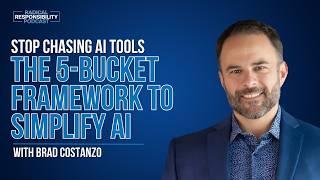
Brad Costanzo walks through his Five-Bucket framework for applying AI to business: Think, Create, Communicate, Analyze, Automate. He uses the ICE matrix to prioritize projects and the 1080/10 principle, where humans define the first and last 10% of AI output. The real lever isn't AI itself, he says, but clarity about what your business actually needs.
Chapters
Welcome to the Radical responsibility podcast. I'm Dr. Fleet Mahl, and I'm excited to guide you on a journey of authentic transformation. In each episode, I'll bring you insights from leading experts to explore trauma recovery, mindfulness practices, positive psychology, and innovative breakthroughs in health, wellness, and life optimization. This is a space for real conversations that inspire meaningful change, helping you find alignment with the person you were always meant to be. Let's get started.
Are you feeling overwhelmed by AI and.
Wondering where it actually fits in your business?
In this episode, I sit down with Brad Costanzo to explore a smarter way forward. Starting with your real bottlenecks, not shiny tools, we break down how to use AI to think, create, communicate, analyze, and automate with clarity and intention. This is about using technology to amplify.
Your human genius and and drive meaningful growth.
My name is Dr. Fleet Maul, your co host for this session and the founder of Heart Mind Summits. And I'm thrilled to be here today with Brad Costanza. Welcome.
Thanks, Fleet.
Great.
Great to be here.
You know, I hate to ask you to encapsulate your whole story, how you got to where you are in just a minute or two, but we got covered today. But if you could just touch on kind of how you got how you became an entrepreneur, how you got into specializing in AI innovation, and maybe if there were some real stumbling blocks along the way.
Oh, many stumbling blocks. Yeah. So to encapsulate, I've probably been an entrepreneur my entire life. I'm kind of that unemployable rebel who just likes to figure things out. And I'm not really great with authority. So like a lot of entrepreneurs, instead of just getting a job, since I was a child, I've always taken either entrepreneurial careers like I was a financial advisor who, you know, 100% commission for a long time, which sales is a very entrepreneurial skill set. And then throughout that, my career, up until about my early to mid-30s, I was in that professional space space. And then I started. I got out of that space in 2007 or 8, which was, you know, the kind of the big financial crash. And I got into the world of digital marketing, and I started two businesses at the exact same time, which, as one of your first entrepreneurial endeavors, is always a brilliant idea because what could go wrong? Luckily, both went really well. One was a software business, one was a digital publishing business, selling educational information products and grew. Both of those had a couple of exits. They were not, you know, you're rich enough to retire exits, but they were exits and then over the past really 10 years, what I was focusing on was either a series of other startups that, you know, some were successful, some weren't in the E Comm space, in the software space, but where I really found just a lot of success was in doing boutique consulting for growth and marketing strategies, just really applying all of my, you know, expertise and experience. I started using AI tools before they were cool, before OpenAI came out with ChatGPT. And I'm the type who always likes to, you know, get leverage and, you know, if I can find ways to work less and get better, you know, results, I deploy them. And when OpenAI came out and I started to really see what was possible with AI, I just started applying them to both my business and that of my clients and just kind of screwing around and trying to figure it out. One thing led to another as I started to get results with these things because I was actually trying to apply the AI to increase conversion, get more traffic, be more creative. People started to ask me if I could come speak, if I could help them. And I kind of stumbled into saying, look, I'm going to be offering this as maybe my primary service offering. So now in the AI space, I focus on helping new and established businesses. And it's really anywhere from, you know, businesses doing half million or so up to, you know, a recent client of mine had a thousand employees that had me really come in and help enable their, their department heads to wrap their arms around this and design AI systems that help them apply the leverage. Now, as I mentioned, I am not a computer programmer, I'm not a developer, although I have been playing with some of the AI tools that let you code and build web apps lately to a lot of success. But I really like focusing on the outcome first, where artificial intelligence is just a tool. And that's one of the reasons I named my company Accelerated Intelligence. I look, that is the outcome. AI is just a way to help get us there a little bit quicker. So hopefully that was encapsulated a couple decades of experience.
Yeah, no, and it's really wonderful that you know your journey because what you're now sharing with people and what you're.
Consulting around is born of your experience.
As an entrepreneur and then how to integrate entrepreneur into accelerating your own success and performance in business and so forth. So, you know, as AI is really rapidly changing all industries, changing our world, changing our lives really in so many ways, you know, it can feel very daunting, really difficult for a lot of entrepreneurs. It's probably just hard to keep up with. I mean, already it could have been marketing feels like, you know, you know, like so complex, so many different platforms, so many this, so many that. And just even the world of digital marketing made marketing much more expansive and so many tools and possibilities and so forth. And now with AI it seems endless, so people can easily get overwhelmed. So what would you say would be, and I know it'd probably hard to focus in on one thing, but if there was a sweet spot of a really underutilized AI capacity that, I mean, I think we probably have all kinds of folks out there in the audience right now from maybe some business leaders in the corporate world or people involved in venture capital startups, some Silicon Valley kind of thing. But I think the heart of our audience are going to be bootstrapping entrepreneurs who maybe have a six figure business. They're wanting to grow to seven or they're seven and maybe they're hitting that 3 to 4 million threshold and really struggling with scaling now. But you know, they're mostly bootstraping entrepreneurs. And you know, where might they start in bringing AI into their business in a way that could get the kind of immediate results that would then give them a greater capacity to do more with AI and then more with AI. So how to get started?
I love this question and it's what is really what my passion is to help people embrace it and start to use it without that overwhelm. Because it can be like I have a love hate relationship with this technology. I love it because it satisfies my entrepreneurial add. I hate it because I put my head down, I work on something for a week, I pick my head up and what I just did is obsolete because there's another tool that you push a button and then every day there's six new tools. I call it tool for you. Get all excited about all these tools. What do I do? What's the best tool? How do I do this? And one of the more overwhelming things is that people start to see what's possible. I can do this and this and this. And it makes the shiny object syndrome that a lot of us chase explode. And my very first piece of advice is this. Ignore all the cool things you can do. Solve your problems first, solve your bottlenecks and your challenges. And I've got a couple frameworks which I'll explain here how I do that. But I let them know that you may only use AI for one thing, two things. But if those two things are small hinges, they can swing a really big door. And yes, it can create graphics and cartoons and videos and songs and all of these number things. But the very first thing I them know is that you need to audit where your bottlenecks are. We call this theory of constraints. So if your bottleneck is too many customer support tickets or not able to set up enough appointments, or it's creating marketing copy and sales copy, then write those things down. You know, who do you wish you could hire for number one to take something off your plate? Or who do you currently have, you know, doing this work, who's maybe not doing that good of a job, or they're way too expensive. And identify those things first and then look for the solutions to those. Now, that's not the end of my advice, because that still leaves me with, well, how do I know what solutions? So in working with a lot of these companies, it took me about a year to realize this. But there's only five things that AI actually helps you do. And I call this the five bucket framework for simplifying AI. So it helps you think, create, communicate, analyze, or automate. And I want to briefly go through those, because the clients that I've worked with, who I've told this, they tell me that it really reduces the noise and the pressure to go, okay, this actually makes sense. So thinking the thinking bucket, this is brainstorming, ideation, coming up with strategies, maybe doing research, using it as a mentor to learn new things. I love, for instance, I love the talking feature of say, ChatGPT, the voice feature, where on your mobile app you can just turn it on, you can talk to it, you can put earphones in. I go for what I call walk and talks, where I will just talk to it and explain either what I'm dealing with or what I'm trying to learn. And I just brainstorm with it. And there's no limit to the things you can learn by having a brilliant brainstorming partner. But it might also be just coming up with new strategies, or maybe it's a pivot, or you need to reinvent your business or your brand or your offers. That's the thinking bucket. It's where everybody starts, like, what can I do here? The next bucket is creation. And this is where everybody else, you know, lives in. I'd say 90% of the world using AI is just in these two buckets. Now, creation is pretty simple. It creates text, audio, video, and images, like art or combinations of them, right? So I can create a complete podcast. I can create an AI avatar, video. I can create a podcast with an AI avatar, video and I can create all the sales copy and landing pages and all the things marketing, sales, content, et cetera that you want, even full blown, let's say courses if you want. And these days you can even create software. So most people stick to those and they ignore the other three buckets, which I think do the majority of the lifting. So the third bucket is communicating. So who do you communicate with? Well, most of us communicate with our leads, trying to turn them into customers. We need to do, you know, talk to our customers and give them support. We need to talk to employees and stakeholders and shareholders. So some of the communication tools under AI fall under, you know, chatbots. Whether it's on your website or via text message or an audio voice agent that becomes a 24, 7, always on highly intelligent virtual assistant who can both make inbound and outbound calls. You know, we make employee handbooks and SOP procedures for companies via chat. Hey, how do I do X, Y and Z? And it tells them the next bucket is analyzing. I think this is one of the unsung heroes because analysis can be typically very boring. But if you're a business owner, you need to make data driven decisions. If you're not really good at understanding data, well, tools like AI like chat, GPT or other business intelligence tools are. So you can do two types of analysis. One is quantitative, that is uploading spreadsheets, maybe it's past customer trends and seasonal trends, etc. And it can give you a lot of charts and graphs and data and it can tell you the stories. But on the qualitative side, I'll oftentimes upload, let's say sales copy and I'll say analyze this. Look for areas that are confusing, unbelievable or boring or. One of my favorite things to do is to take companies who have salespeople and every person who has multiple salespeople always knows you have one or you know, you have a few star salespeople and then you got, it's like the bell curve and then you got the laggards. Well, I love analyzing transcripts of the rockstar salespeople and having let's say chat GPT break down. What are they doing? How are they doing it, how are they overcoming objections? What style are they using? And it can come up with some really amazing, I would call it, you know, like forensic analysis of what the top salespeople are doing. And we'll do the exact same thing with the lower performing salespeople and then we'll create an analysis of both and we'll look for gaps and Then we'll create customized training programs for the lower end salespeople based upon the analysis it did. And when you start to really analyze both quantitative and qualitative, you start to get better intelligence on your business, or I should say accelerated intelligence. Now the last bucket, you know, we've done thinking, creating, communicating, analyzing is automating. Or in the world of AI, we like to call this agentic, like an agent. This is the hot buzzword. It's where a lot of the newest innovations are happening. Where a lot of entrepreneurs may be familiar with tools such as Zapier and Make.com and N8N which are tools that allow you to connect different software programs together that says if somebody does this, then trigger this software and do that. Well, now you can really create smart automations behind the scenes. And there's a lot of tools out there that will kind of have a mind of its own. For example, kind of a smart automation. Here is when a lead comes in, assuming they give you, you know, name, email and maybe they answer a handful of questions on the opt in form, the AI behind the scenes can analyze that. It can create a lead score and an analysis of why it gave him a lead score. And it can send it to your CRM and then send out various notifications or emails or text message to them, highly customized based upon what they said. And that's just like the automation side is really infinite. Now the way you use these five buckets, because it's one thing to know that they exist, but how do you use them? So if you remember I said solve your bottlenecks first, know what they are and then identify which bucket do they fall in. Maybe it's the creation bucket. And then go look for tools or workflows or strategies to create from there. This helps kind of like filter out or you think like in marketing parlance, like a funnel. So you're just dumping all the things that can do in and you're just slowly filtering them out into what are the needle movers. And now the final thing that I do to help prioritize projects is a simple consulting tool called the ICE matrix. And ICE stands for impact, confidence and ease. And I simply, I may come up with 10 different potential AI projects or workflows. I just write them down on a spreadsheet and then each one that I've come up with, qualitatively, I put a score on them. So on a scale of 1 to 10, what impact would this idea have if I implemented it? And then what's my confidence level? 1 to 10 and then 1 to 10, how easy would it be? So if it's like I push a button and I it's done, that's a 10. If I have to develop a mobile app for something, right, that might be a one. And then I just multiply those together, sort them by the biggest number, and now you've got your prioritized list of projects to say, okay, I'm going to do these this quarter and these next quarter. So I had to come up with this framework because I'm that ADD entrepreneurial squirrel who comes up with a million ideas and left my own devices. I'm going to try to do them all and not do any of them well. But what I like to do is say, okay, if I'm only going to do three of them, which three should I do and why? And a combination of find your constraints, identify the buckets, and then score them based on impact. Confidence and ease is what helps, you know, separate the signal, as they say, from the noise. And it's been really effective for me and a lot of the clients I work with.
I love that five bucket framework. That is so extremely helpful.
Thank you. I was really happy when I asked ChatGPT what that is and it actually knew what that was. So based upon, you know, what I've put into it.
So, you know, and ChatGPT has seemingly improved a lot since it came out. I mean, when it first came out, you know, sometimes it made stuff up. There was some pretty clear biases around certain things. It seems like it's gotten a lot better and pretty objective. And of course there's others. You know, Musk's Grok has come out, the Grok 3, and there's Claude and there's various ones out there.
Everybody asks, what are your favorites? They always leapfrog each other. I just try them all. I'll take the same prompt, put them into three or four different ones, and.
That'S a great way to test to make sure you're getting accurate data and the best data. So. And the tools are not that expensive in relation to the potential payoff. They're incredibly inexpensive. So it blows me away.
I remember when I started playing with the free version of Chat GPT when it came out, and knowing that they're going to charge for this and realize like, none of us knew what they were going to charge, but all of us were so blown away by how powerful this technology was of like these SOBs. If they come out with a $500 a month price tag, I'm going to have to pay it.
Amazing. So my next question is kind of related to the first one, like, where do we start in a sense of overwhelm. But I think some entrepreneurs, and I'm sure some in our audience are experiencing a lot of resistance around it for a number of reasons. Just that it's the complexity of it that it seems foreign. All the fears we hear about AI and what it's going to do to our world and to our lives being replaced by AI, the lack of the human touch and so forth. And I think the only way we'll get over those fears is by we start working with it. Right? Maybe you think about dating, you know, almost you could start dating a little bit with AI. Not that you want to use AI to replace having a human.
And I'm sure people are doing it.
I know people, we know people are doing that. But I'm not suggesting people go there. It's a little bit related to that. Like, you know, the entrepreneurial journey is often a very lonely journey, you know, unless, you know. And of course, we highly recommend people come to summits like this and get involved in masterminds. So you have fellow entrepreneurs you can rub shoulders with and communicate with. But often, you know, launching and growing a business is such a tough job, and we're such maverick people, we entrepreneurs, that often it can be a lonely place to be. And you need mentors, you need comrades, you need people to communicate with. You need. And so you know, that first one think, you know, as you were talking about using the voice AI version of ChatGPT to brainstorm with, right? You're out taking a walk and you're brainstorming with this tool. And of course, there are other tools you can do that with as well, but developing your own kind of. It's a cross between a virtual assistant and an executive assistant and maybe a brainstorming partner and a mentor and all these things. And, you know, you could just start there and start having conversations with AI about, I'm confused about this. How do I get clarity? How do I overcome the resistance? Here's my business, where should I start? And, you know, you'll be guided along a journey. Of course, you'll have to use your own intelligence and question things and challenge things. But, you know, you can kind of use AI to help you figure out how to use AI, right, and how to integrate it into your business and then start walking down these steps. And you could, you know, if you're concerned, especially when you get into the creation phase, that's where a lot of the shiny objects are. So, you know, you could be real clear with your AI conversation. You know, I don't want to get caught in that syndrome. This is my business. I need to use the best tools I used to figure out how to use it in a prioritized way. I need a learning curve, and you can really use AI to help you figure all that out. And then I think, you know, a lot of most entrepreneurs and business people, I mean, there may be a few very successful entrepreneurs that don't focus much on the spreadsheets and the dollars they got somebody that does it. But most of us are kind of obsessed around that stuff, I think. And when you see that you can feed a spreadsheet into AI and get a really thoughtful analysis, it's a real wake up. You think about how long you would have spent or how much you would have paid your CFO or an account or an analysis to do that work, and you just go, wow, right? So anyway, I think there's a journey here and we can get AI to help us. I'm just curious about your thoughts about that in terms of overcoming the resistance and then having a pathway into it.
Yeah, okay, great. You gave me some awesome things to unpack here, and I'm very passionate about this. So if you're not a little scared of AI, you ain't paying attention because it. I'm probably 60, 70% scared witless and the other 30, 40% super duper excited. I think when I first got into it and I saw what it was able to do really quickly, and as a growth and marketing consultant, I was obsoleting myself in minutes. Something that would take like a month to do, I'm able to do in, you know, minutes. And I realized, well, the only way to get ahead of this wave is to grab a surfboard and jump on, right? And to figure it out. You know, they often say that if you and a friend are in the woods, outrun in a bear, you just got to outrun your friend. You don't have to outrun the bear. So I do believe that those of us who adopt AI are going to be the ones who excel. Those who ignore it are going to have a much harder future. That being said, a lot of people think that, you know, is AI going to take my job? But they're thinking of their job as a thing, right? The job isn't a thing. A job is a bundle of tasks, right? Even being an entrepreneur, it's a bundle of tasks. You have like, let's say a salesperson Right. What do they have to do? They have to research leads, they have to contact that lead with a message, they have to get that lead to respond, they have to follow up, they have to be to put together sales proposals, they have to put together reports, et cetera. Like, there's a bundle of tasks. Now, the proper way to think about this is, well, which of these tasks can I let the robots do so that I can do the things that humans excel at, which is human connection, empathy, creating experiences, being more creative. You know, AI is incredibly creative, but it's kind of limited unless you really put your own spin on it. And so it's also one of those things that it's okay to be afraid of it, but it's here, you know, it's not going anywhere. It's not a fad. We all know that. So embrace it. Learn how to get really good at it. Learn how to solve bigger problems or more fun problems for you. Because most of us who have a job or even run a business, there's a lot of tasks we do. I call them the necessary evils. We didn't get into business to do this, but we have to. Well, we may not have to anymore. Now, you also brought up a really important point about let AI teach you. So one of my other little frameworks that has been, it's so simple, very effective, and a lot of people miss it. I call it the Mac Method. M A C. It stands for mentor, assistant, critic. So if you don't know how to do something, or let's say you don't know how to prompt it for what you want, you've kind of got it in your head, but you can't really formulate the right way to tell the AI you don't have to code it. You just step back and you say, AI chatgpt. Here's who I am, and here's basically what I'm trying to do, but I don't even know how to tell you what I want. Please give me a prompt or a framework or a method or whatever. Like, teach me how to use you. And it'll say, well, here's what you know. Here's the prompt that you could create to have me do it. Like, it will give its. It will give you the instructions to give it. Or let's say, for instance, I want to write a highly engaging viral viral blog post, and I don't know how to do that. The first thing I do is I go to AI and say, this is what I want to do. Teach me what that looks like, give me a framework. Tell me how you would do it. And it would say, well, the key is to have a good hook and do all this, this, this, this. And then I said, great, now can you create a framework for that? And it does. And I said, great, can you now create a prompt that will do that? And it will. That's your mentor aspect. And then your assistant, which is, yeah, do the work. So teach me what to do. Now just go ahead and do it for me. And then the last piece gets overlooked by more people than. I'm really surprised at how many people don't do this, which is the critic. Ask it to review what it just did and critique it and improve it over and over again. You can continue to reiterate. And you know, the mindset I put myself in is that of a Hollywood director, right? So I may say, you know, here's what I want to do. Here's the scene, action. And then the actor does the scene and I say, cut. That's not what I want. I go up to the actor and I say, listen, let me give you some more background context on your character. This is the emotion. I need you to be funnier or more serious or more visceral or whatnot, or more detailed or more concise. And I say, action. And it still doesn't get it right. I go, okay, cut. I may do this a hundred times. The good news is this actor never goes on strike, right? Unless you're using Claude. And it times out after like 25. But it's a way to help remove that apprehension of, well, I don't know how to talk to it. And, you know, it also reminds me back in the 80s when my parents were both professionals and you know, they came home in the late 80s, their businesses were adopting computers for the first time and they had to go to computer classes and they had to learn about how to use these DOS based computers. And I think I learned a lot of new cuss words when my dad got home those days after work. Damn computers, blah, blah, blah, Hated every minute of it. It was a totally foreign language to him, unlike AI, because AI is in our language. We can just speak English, we don't have to speak well and we can give typos and it'll work with us. So those are some of the ways that I, you know, have overcome some of my own apprehension about it, you know, and helped other people just really wrap your mindset that it's not as complex as you think. There is an existential imperative to learn it and the goal is not to just be able to do more, but it's to be able to do better things while the AI does all of the things that you never wanted to do anyway. And so I think the last, I guess, framework, I love to work in frameworks. I call it the 1080, 10 principle, which is I'm still responsible for the first 10% and the last 10%, right. AI or an employee can do the middle, but I have to define what I want and then refine what I get. And a lot of folks out there, we see it all the time. Anytime you spot you're like, that's AI, you can tell that they didn't refine it, they just said what they want, they let it do it and they pushed it out to the world. And we are getting better and better at recognizing AI generated stuff. And if you don't put a little bit of that human ingenuity into it, I think it's going to hurt you. So there's a lot of nuance to it, but when you do it right, as you know, as anybody who's played with it, it's insanely powerful.
What if transformation isn't just about thinking differently, but feeling differently? Science shows us that true change happens when we align not just our minds, but also the neural networks in our hearts and guts. This heart mind connection is the key to deeper healing, resilience and expanded awareness. That's why I created the Heart Mind All Access, membership and community. A space designed to help you rewire your nervous system, cultivate heart intelligence, and live with greater clarity and purpose. With over 1000 hours of transformational teachings specifically curated to meet your needs. You'll learn from world renowned meditation teachers, neuroscientists and experts in neuroplasticity, all sharing powerful tools to help you shift your mindset and heartset, regulate your emotions and unlock your full potential. You'll also gain unlimited access to every summit and course we've ever produced. A treasure trove of Wisdom worth over $10,000 and growing. Plus live gatherings and an inspiring global community to support your journey. If you're ready to step into a more heart centered, connected and conscious life, I invite you to join us. Click the link to learn more and start your journey today.
I want to talk more about the human and AI connection here in a moment in terms of our business, but just to follow up on what you're just talking about. So you know, using AI to critique what AI has already created. Right? And so you can actually create different bots and with different knowledge bases. And you could have a brainstorming session among three or four different. With different knowledge. I mean, it's endless what you can do. Right. And I'm curious about this because you probably are more knowledgeable about it than I, but one of the things I worked with is creating some bots that have, you know, a pretty good knowledge base of some business mentors and experts who I really respect in terms of relation to what I'm doing. Right, yeah. Some for marketing, I have, some for strategy. Right. And then conversing with that. You're virtually conversing with that knowledge base. And it's pretty fascinating. Now maybe Claude and. Or Chat GBT and others evolve so much that you don't even need to do that, that they're automatic, actually.
True. Yeah, to a degree. I mean, there still could be some other, like, nuanced knowledge, but. Yes. Anyway, didn't mean to interrupt.
Yeah, so. But I mean, it's kind of endless what you can do in terms of really getting the creative mind going, you know, Is that the principle of masterminding? And again, we don't, We're. I don't think you can replace human masterminds, but if you go back to Napoleon Hill's work and so forth and others that have pointed to that some of the famous quotations, the power of two minds versus one and the power of the collective mind, AI really lets you do kind of masterminding in a sense.
Yeah. I mean, it is an amazing mastermind for, you know, getting information and knowledge, talking about, you know, having these brilliant mentors and, you know, making a bot for each one of those. I started doing that. Then I created a custom GPT just to test it out, which was like my billionaire, millionaire business advisor. So the instructions were fairly basic in that it said, you will ask me, you know, what I want to accomplish or what is my. What is either my goal or my challenge. And then based upon what I say, you will determine which either billionaire or famous business expert, you know, in that general field or that's relevant to this would be appropriate. And then you will channel advice from them in order to give me advice for this. And I didn't even give it specifics, but if I'm asking about E Commerce, for instance, maybe it channels Jeff Bezos or maybe it pulls the wisdom there. I mean, the truth is it's ingested most of the world's knowledge in that space. But when it comes to masterminding in the human side, you know, people join masterminds like I You know, I'm in several, I own one. And it's not just for knowledge. Like people go there typically for four reasons in a mastermind is to get information and knowledge. It's to overcome the challenges of those necessary evils, like, hey, I've got payroll issues or my merchant account is holding on to my money, or I've got somebody suing me or whatever, who do you like? What do I do? And they need other experienced humans to say, that happened to me, here's what I did about it, here's a resource, et cetera. So it's kind of like dealing with the necessary evils of business. And then the other piece is the relationships that you bent, the network you get. And then that last part is the empathetic bonding. Like you said, it's lonely. I want to be with other people who are also on this lonely, risky but highly rewarding journey because my friends and family outside of this space don't get me. And now the knowledge aspect of masterminds is a lot less important than the empathy, the experience and the these hard won lessons that you can only get from people who've been there because AI hasn't been there. AI is never, it's chat. GPT has never invested a bunch of money in a business and lost everything and then have their wife or their husband look at him, you know, in shame going, you lost, you know, you mortgaged our house for this, et cetera. But other entrepreneurs have, and I believe that the experience economy is set to explode because people are going to miss and want that human experience. And if AI can take away a lot of the other stuff that we have to do so that we can focus on, on creating better experiences than do it. And that actually makes me think of one last thing in this thread, which is I like to say automate everything but that human connection. So yes, we can. We create bots all the time that will text message back and forth and be there. But if you can use the time you save to reach out to your customers, to reach out to business partners and mentors, et cetera, cultivate those with the time you have, don't just do more, do better.
And I want to circle back to this empathic connection realm in a minute. But first I'd like to talk more about the role of the entrepreneur. When you think about it, what is our ultimate role as entrepreneurs? We're visionaries, we're idea people, we live in the realm of possibility, we have tremendous courage, we're risk takers. And so the rest of it is all stuff we have to do to bring our ideas into fruition, to manifest our ideas. And some of it we like, some of it we get fascinated with and some we don't like, we have to do it. But basically our real role is we create a sense of possibility and we're able to figure out how to execute and manifest those possibilities. So, you know, it may very well get to that. AI tools are almost going to be able to take a business idea, create the business around the business. I mean, I don't think that's very far away. No, I don't either. That's really pretty scary. And of course AI can generate business ideas as well. But there's something, there's still going to be something about. Well, I mean, somebody's got to take risk. I mean, who knows? We get into the world of blockchains and everything and that AI takes over the world and they're risking their own capital, but we're not there yet. But still there's a role and I want to bring it back into the business owner strategy, how we integrate AI with our need to create effective business strategy. Right. And so as a lot of us as founders, we start off, we're busy now, we get immersed in tactics, right? We get lost in tactics and we're immersed in that. And then we manage to replace ourselves, to get back to a strategic level and maybe we finally get ourselves, you know, even out of CEO onto the board. We have a lot of things in the summit about all those stages of exiting and maybe we get back in a pure visionary role. But at least it's a big thing to get out of tactics and back to strategy. Now certainly you can use AI to help you with strategy, but there's something about, I wonder if you could talk about the human aspect and the connection with using AI when we're really thinking about short midterm strategy. I'm not even going to talk, Lynn. Things are changing so fast. I think long term strategy, I've said.
For a while, like most businesses cannot plan past three years realistically because who knows?
Yeah, exactly. But at any rate, you know, the strategic approach to succeed in whatever our particular niche and industry and service or product is of how we use AI there and how we marry sort of our genius with how AI can amplify our genius as entrepreneurs strategically.
Yeah, wonderful question. And it's, it's one that I think it's got, the nuance here is it kind of depends upon your existing experience. So if you are brand new to the world of entrepreneurship. Like when I, if I go back 20 years or more, when I, you know, probably first started my, let's say, my first digital publishing business, which was 2008, and I didn't know strategy, right? I didn't. I just knew create something that people ideally want and try to sell it to them. And I had to learn all these new tactics. So I didn't have a lot of, yes, human experience and intelligence on what strategy was outside of I got a product, I've identified a market, now I got to figure out how to put them in. So you got to kind of learn those tactics, etc. But then once you start to get a little bit more experience, you know, strategy is not hard to learn. In fact, once more, if you don't know strategy, start to ask. I use ChatGPT in general for AI. Ask it. I need to be better at strategy. What are, you know, what are some of the core components of this? And it can give you some good frameworks.
Right?
And a strategy is overall, like you said, what's an entrepreneur's role? It's to allocate capital, human capital, financial capital and other resources in order to solve problems. That people have either problems or desires and, you know, their desires is still a problem. I mean, if I want a new Apple computer and I don't have one, well, the problem is I don't have one, right? So, you know, you're always solving problems. So strategically my goal is how do I, how do I look at what everybody else is doing in the market to solve this problem for people and how can I do it faster, better, cheaper, either overall or in different areas. Some people may be familiar with the book Blue Ocean Strategy and they talk about this Blue Ocean Canvas, which it's kind of hard to explain. I'll give an overview. But you'll take an industry I always remember, like the Southwest Airlines version, which is take a look at the airline industry and look at all that, like the top players in it. And then what are the key things that people value? What the consumers value in that, like price, comfort, you know, speed of connections, number of flights, you know, does it have economy or does it have, you know, first class? How are the meals? Like, there's all these various components of value and you kind of want to look at, well, what are these other companies doing? Where, how do they score? And you can kind of graph this out. If you Google like Blue Ocean Canvas, I think that's where you'll find it. And then you just look for. You look for the Gaps and AI may or may not be able to find this. In fact, I've tried it and it does a pretty good job. But I'm just looking with the consumer in mind or my client. What are the gaps in the marketplace that I might be able to fill in a unique way that other people aren't doing? And how can I do them without them seeing me coming? So strategy at a high level is just that. How do I solve? Solve bigger, better problems, you know, faster, quicker, or less expensive. And talk to people, find out what they've done, what they're doing, and then use AI as your strategic brainstorming partner. And then put it into, you know, give it all the context, talk to it, ask, what am I missing? What am I overlooking? It's great at connecting dots that you don't see. And then, you know, one strategic framework that I learned years ago, and this is probably the single most useful thought or thinking tool that I ever learned. And. And it's called Disney's Strategy of Genius. It was. Robert Diltz, an author, analyzed what Walt Disney did when he was building up his empire. And he realized, you know, back then that Walt separated the dream storming phase into three categories. Dreaming, planning, and critiquing. Right. So rumor has it that he had three different offices inside of his building. So whenever he was, let's say, he was planning out Walt Disney World, they would go into the dreamer's office, and the only thing they were allowed to do is think about what vision they would like to create, whether it's impossible or not. The only rules in the dreamer's office are do not plan and do not critique. Just see it unfolding as if it's on a movie.
Right?
And then when you've got a vision to everybody walking into the next office where you can storyboard, what has to happen to say, okay, if I want to create this, what has to happen to be in place? Well, first I have to do this, and then this. I have to get a. I have to get a business, I get a website, I gotta get this, I have to get an offer. I have to do all these things in order. Now, in this planning office, the only two rules, don't add new things to the vision and don't critique it. You know, don't be the party pooper there. Just think what has to happen. So now you got a vision and a basic plan. Then you change up the scenery and you go to the critic's office. Now, the critic is not the fun one to be, but, you know, fleet if you've ever had an idea and you've taken it to a spouse, a friend, a colleague, a business partner, an employee, like, hey, I got this idea. A lot of times, human nature is when they hear that, if they don't fully understand it, they tell you all the reasons it won't work. This is what it won't work. I'm in the dreamers mode right here. I'm in the. I'm in this visionary state, and people are pooping in my party. So the goal of the critic is to do is to think. Not to shoot it down, but to think of all the obstacles and challenges that might get in the way, both internally to your resources and externally to market forces, to go, well, this could go wrong, and this could go wrong, and this could go wrong. Now, once more, in this critic's office, the only rules don't add new things to the dream and don't solve it. You can't solve one problem in a different mindset. So once you have a vision, a plan, and some of the critiques, you can go back and you can examine, how do I overcome these obstacles or these challenges? Once in a while, you can't. Once in a while, you're like, you know what? That wasn't actually a good idea, but I'm glad I went through this process in order to shoot it down so that I didn't run off. And the author, Keith Cunningham, has a great saying like, there's nothing worse than running enthusiastically in the wrong direction. And I know I've done that before when I failed to do this strategy, but also failing to do this strategy, you might abort an idea before it's, you know, before it's fully nurtured. And for me, this is the single biggest strategic thing I do with or without AI. I do happen to use AI with it because I'll be coming up with the vision, And I'll use ChatGPT to say, how else, what else could be better? Et cetera. And I just go back and forth. But the last piece about this thinking tool, I love explaining this to everybody I work with. I tell my clients, I tell my partners, my colleagues, et cetera, my wife. These three offices exist, and I tell them the rules. That way, when I approach them, like fleet, you and I are business partners, and I go, fleet, step into the dreamer's office with me. I got an idea. Now, what I've just done is giving you the permission to turn off your criticism in your planner for a minute and just dream with me. Because then if you know this, you might say, hey, can we step into the critics office real quick? I found some things that might go wrong and I will absolutely say, yes, let's do it. So this has nothing to do with AI, but it's more powerful than anything.
AI is really important. I spent the early part of my consulting career facilitating a lot of creative planning and brainstorming and so forth. And the key there was not to mix creativity and dreaming with analysis and criticism. 100% creativity and you have to really work. This was to creating a safe space. We're really trying to create that dream office where people felt completely safe. They weren't worried about the boss, they weren't worried about each other, they were just on fire with creativity. Then you take that and then you start working with it.
You get it. Because they're spending all of their creative abilities being risk averse and thinking of what can go wrong. But if you let them turn that off and then channel it into like I've had some of them most critical party poopers come up with some of the most brilliant ideas with me when I do this with them. So I'm glad, I'm glad that you've got some experience in segmenting those mental states.
Yeah. So this has all been incredibly illuminating. You mentioned before that you've been through a couple successful exits. Not quite successful enough to retire yet, but nonetheless launched the business, took it to a certain point, exited. That's very successful and something to be proud of. So a lot of entrepreneurs and founders of, of businesses aren't thinking about exit to begin with. I mean, some are, they may have that idea especially, you know, in the whole kind of Silicon Valley world. But a lot of people just start, this is what they love to do, they want to do, they're taking what they already love, turning it into a business. This is what they want to do. They have no idea of, they're not thinking about retiring or exiting. But we're all going to exit someday one way or the other. Right. So it's very helpful to have the exit mindset from day one to build a business because what you're really talking about there is business valuation. Right? And so the more exitable your business becomes, the higher the valuation of the business, the multiple of it are the multiple of its seller, discretionary income. And so I would assume that in today's world, and more so every month, every year, for a business to have a decent evaluation, it better be fully integrated with AI tools, otherwise some discount points that are going to get bigger and Bigger and bigger and bigger in terms of the valuation. So I wonder if you could talk about that. The importance is we're, you know, in our audience, our bootstrapping entrepreneurs out there, as you're building your business at whatever level you're growing or you're scaling, if you're not integrating AI into it, you could be really hurting yourself down the road if and when you decide you would like to exit one form or another or bring on additional capital or whatever you're doing. But you may be really getting looking at a major valuation discount if you're not fully utilizing AI, you know, you're spot on.
And here's the thing. I actually think every single business owner and entrepreneur is looking for an exit. The definition, though, of an exit doesn't necessarily mean selling the business they want to exit the things they don't like doing in that business. Now, you can exit a business by hiring somebody to run it while you go sit margaritas. You know, in Cabo, you could exit the things you don't like about a business by hiring all these people and getting AI ified in there so that once more you can just focus on the things you want to do. So I like to look at at exit as there's a lot of different ways to exit a business, right? One of them is to sell it. Another one is to shut it down. Another one is just for yourself up. Another mentor of mine when I was starting another E commerce business that ended up failing, and I told him, I'm building this business so I can sell it. And he goes, let me give you some advice. Don't build a business with the intention of selling it. Build a business that you would want to buy. And it just so happens that those two, those two things are the exact same thing. Because I want to buy a business that doesn't require me to spend all of my time in it. I want to buy something that's highly systematized or automated and I can come in and just push buttons and make money. And like you said, if you're not integrating AI into your business, if you are trying to sell the business and establish your valuation, you know you are going to be. If you're sitting at the closing table, especially if you're dealing with like private equity or somebody like that, what you do now is going to determine whether you're the prize or the prey. So if you're the prize, meaning you've got this thing automated, it's excellent, it's Systematized, you've got SOPs, you got quality people running it. You know, these guys are going to come in and see you as we got to buy this thing because it's going to be easy for us. But if you don't have that, they're going to see you as the prey. They may still want to buy it, but they're thinking, you know, I've purchased some businesses too, and if I see that they're not doing a bunch of things that they could be doing that I would do you. I'm looking at it and you know, I'm salivating because I'm going to get in, I can AIFI this, I can hire this, I can fire this person, I can do that. And I'm going to reap all the rewards of innovating inside that business. I'm going to give you half of what you might have gotten if that. And I'm, you know, once more, you're the prize of the prey. And if you want to be the prize, you have to maybe take a couple steps back to take three steps forward and integrate this. You know, I was talking just last night in a mastermind to my good friend John Assaraf, who some people may know who he is, but very successful entrepreneur. And so he was even saying non negotiable. If you don't know AI, you're not getting hired. If you refuse to learn AI, you're out. And if you are, you know, we're doing internal training all the time because it is a non negotiable thing here in this business.
Yeah, absolutely. Now you just mentioned SOPs earlier, you mentioned playbooks, you know, and a lot of people have resistance around this, but this is one of the real keys to systematizing any business and increasing its value. Right? Making it plug and play, all the operations, everything, so you can move people in and out of positions and something takes over. Can you? So I mean, it's really the core of systematizing any business. And you know, generally the old way is while you're doing stuff, you know, you have to write down what you're doing, you have to document that. And you know, we've got some tools to make that a little easier, but people say, oh, it's just getting in the way. I want to do it. Slow me down if I, you know. And so now I believe it's getting easier and easier to use AI tools to create your playbooks as you're working. So I wonder if you could talk about that because to me that's one of the real stumbling blocks is for the Owner, the founder to do that himself, but then also to get the team members to do that, to systematize the business. So could you talk about how it's gotten easier?
Yeah, and this has always been an Achilles heel of mine and is exactly for what you said. Like entrepreneurs, we move fast, we are quick starts, visionaries and anything that slows us up and steals our momentum, we hate and ah, screw it or whatever, we either rush through it and we just figured out that's, you know, we're like bulls in a china shop. And so, you know, my other exits probably would have been. I know they've been a heck of a lot bigger if they weren't solely depending upon me figuring stuff out as it goes and not having these systems. It was a hard one lesson and yes, it is a lot easier. There's tools out there. Processstreet.com guide with two D's G Y D E is tool. But even Loom, which a lot of people are familiar with the LOOM video, you know, we create screen flows of doing things. Now they have the AI features in there which I don't know if you're familiar with this, but I can film a process screen recording my video, talking through what I'm doing. And they have a little button you can push that says like create an SOP out of what you did. And it goes in there, listens to the transcript and it just writes out okay, he did this step by step by step by step by step step. And it makes the systemization like a no brainer. And then you send it to somebody else. The other thing that I always recommend is as if you're a squirrely quick start entrepreneur, you know, like me, hire the people. Just make sure that the people you're hiring are very process oriented and they will. And then give them the tools to make this easy because they'll do the things that don't come naturally to you. But you know, the last piece, when I think about systemization and I was mentioning in the automation bucket, agents. So if you systematize it once or you just have those steps, there are tools like chat, GPT's operator and there's another tool that most people don't know about. It's a convergence. AI is a tool very much like this where you go in and you plug in. I want you to go to this website, log in with my credentials, go to this, search for this, create a list of this, create a spreadsheet, contact these people and you give it in plain English if you were talking to a person what you want it to do, and you can watch on the screen as it opens up a virtual browser on its side and it does all of these things for you now, most of it. This is still such infancy. I have not seen anything that is tremendously valuable across all things because it still messes up. But we're getting to that point where if you have the SOP down, you plug that into a language model, tell it what you want it to do, and it'll just go do the things for you. You know, it's funny, I was watching a YouTube video of a guy I follow, Greg Eisenberg, really, really good entrepreneur, and he was showing a video of another guy who was going through ChatGPT's operator, which, you know, it cost 200amonth at the time of this filming to get. But he was like, I'm going to show you a demo. So he goes, I've got this, like, I don't know, $500 pizza oven. I know how much it costs, and I think there's probably other people who want it. So we're going to do test on how to do arbitrage. So he used ChatGPT's operator and he said, log into my Facebook account, search the marketplace for this type of pizza oven, create a spreadsheet of everything you find, and then message every single one of the sellers from my Facebook account, offer them a 30% discount to what they're asking, and see if they'll take cash, and then come back and update the spreadsheet. And it did it. Now then, his next step would be to take these over and list them on ebay, et cetera. But he was showing how these virtual machines can actually do all of these steps without any human, you know, insight. So we are getting to the point where, where having SOPs is not only important, but now you're going to be able to give these sops to computers and they're going to be able to do a lot of this stuff for you.
Absolutely. Well, this has been illuminating, Brad, and you've added so much value here. I mean, I'm kind of on fire just with the possibilities. I'm making notes here. Ready to go out of the house.
Glad I didn't bore you.
Yeah. And I love the five buckets. That just makes the journey so clear. It provides such clarity. So how do people find out more about. About you and your work and your business? And also I think you have some possible free gifts for audience, some way they can learn more about you. And some things they can take advantage of. So tell us about that.
Yeah, I sure do. So, you know, I've got, you know, two primary websites. If you just want to say, okay, who is Brad? You can go to bradgostanzo.com or my consulting company, Accelerated Intelligence AI. And I'm also putting together a series of resources, including that ICE framework that I talked about. Like, it's a simple spreadsheet that you can go through to prioritize projects, as well as my favorite list of tools that I use to kind of help separate, you know, the signal from the noise from there. And I've got just a handful of resources that I use every single day in my business. And on top of that, I've also got an AI clone that I built that is got a lot of my knowledge base in it that I use where people can chat back and forth if they want to have questions. And it's just like a tremendous resource. And you can get that by visiting visitbrad.com you know, and realistically, if you want to reach out, if you like this, you want to contact me, just email me@helloceleratedintelligence AI and myself or my assistant will answer. And happy to point you in the right direction, but it's an exciting time. We don't know what's coming next. We know it's coming fast though. Like most people, like I was getting a little bit burned out of, you know, doing the same old thing in marketing and business, et cetera, and AI kind of made me feel like a 14 year old again with a new toy. Now the key is to not treat it like a toy, but to treat it like a tool.
Yeah, absolutely. So, Brad Costanzo, Accelerated Intelligence. Thank you so much. This has been incredibly valuable and illuminating. So wish you all the best with your ongoing endeavors and it is an exciting time to be alive.
Thanks, Lee.
Be well.
Thank you for joining me on the radical responsibility podcast. Remember, real change happens when we commit to our growth, face our challenges. Challenges with compassion, and stay open to transformation. If you found this episode helpful, I encourage you to subscribe and help us spread the message of healing and personal empowerment. Stay grounded, stay present and stay true to you. Take care.
Of.
More from Fleet



What Oregon Learned When Legal Psilocybin Access Had to Work in the Real World - Angie Allbee


Eric Zimmer┃How a Little Becomes a Lot: The Small Choices That Transform Your Life

What if anxiety isn’t something to eliminate, but something we can learn to work with differently?


What if aging, energy, and performance are more programmable than we’ve been taught to believe?

Dave Asprey┃From Survival to Human Upgrade: How Personalized Biohacking Can Transform Longevity

What if spiritual awakening isn’t about escaping your humanity, but becoming more present within it?
