James Fadiman | The Subtle Power of Microdosing
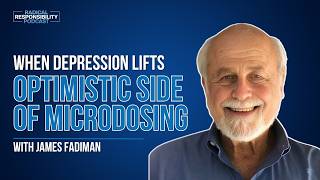
In this episode of the Radical Responsibility podcast, host Fleet Maull interviews psychedelic researcher James Fadiman. Fadiman recounts his early involvement with psychedelics at Esalen and Stanford, describing how a series of personal psychedelic experiences in the 1960s redirected his career toward psychedelic research. He explains the landmark Stanford study that attempted to use psychedelics for scientific problem‑solving, the abrupt FDA shutdown, and how that episode sparked a wave of citizen‑science microdosing reports from dozens of countries. The conversation moves to the development of the "Fadiman protocol" (one dose every three days) and compares it with other regimens such as Paul Stamets’ stack and various on/off schedules. Fadiman details the therapeutic signals emerging from thousands of self‑reports—reductions in depression, anxiety, pain, and other forms of "disequilibrium"—and notes that microdosing appears to lower negative affect while raising positive affect, unlike many SSRIs. He touches on neurophysiological findings (increased brain‑wave amplitude at lower levels than full doses) and argues that placebo effects are built‑in to psychedelic research, but microdosing’s self‑administration reduces placebo confounds. Regulatory hurdles are discussed, including the FDA’s recent rejection of MDMA approval and the limited role of double‑blind designs. Fadiman predicts a future where microdosing becomes a regulated supplement, driven by citizen demand, and announces his upcoming book, Microdosing for Health, Healing and Enhanced Performance, which compiles real‑world evidence and outlines practical guidance. Throughout, the tone is conversational, enthusiastic, and cautiously optimistic about the therapeutic potential and societal integration of microdosing.
Chapters
Welcome to the Radical responsibility podcast. I'm Dr. Fleet Mahl, and I'm excited to guide you on a journey of authentic transformation. In each episode, I'll bring you insights from leading experts to explore trauma recovery, mindfulness practices, positive psychology, and innovative breakthroughs in health, wellness and life optimization. This is a space for real conversations that inspire meaningful change, helping you find alignment with the person you were always meant to be. Let's get started.
My name is Fleet Maul, your host for this session, and I'm thrilled to be here today with Jim Fadiman. Welcome, Dr. Fadiman.
It's a great pleasure to be here. Great pleasure to be here with you.
I'd like. I'd like to delve into your history a little bit because you are clearly one of the pioneers in this movement. And I don't mean to make any assertions about your age, but we're both got gray hair, we're both baby boomers. So you had an initial workshop you did at Esalen called Expanding Vision. And I'm curious how that work your own transformative experiences around psychedelics, your interactions and connections with pioneers like Ram Dass, then known as Richard Alpert, and Timothy Leary, Aldous Huxley and Willis Harmon and others, how that impacted the direction of your life, your research, your whole career in science and so forth. So maybe you could give us a little bit of that history as it informs where you are now.
Sure. Well, Expanding Vision, and I'm delighted, God knows where you could find the history for that was the first seminar at Esalen that anyone came to. It was actually their third listed seminar, but we were the first one that anyone came to. And it was with Willis Harmon, who was a professor at Stanford, and me, who was a first year graduate student. We discovered that a lot of people were interested and that no one had any experience. And it was a very exciting weekend where a lot of people discovered that being with each other at a seminar in a beautiful place like Esalen had its own energy. So my career, I really had no career prior to psychedelics. I was a student at Harvard, better known for being in minor roles in theater than doing anything academic. But then I went and lived in Paris, and in Paris, where I wrote a novel. Richard Alpert, who is my favorite professor, showed up on his way to Copenhagen for the first seminar, first kind of public presentation of their psychedelic use at Harvard. So it was Huxley, Alpert and Leary presenting in Copenhagen to a very interested and quite negative crowd of international psychologists. So on the way, Dick said To me, the greatest thing in the world has happened to me. We're sitting at a cafe on Boulevard St. Michel, and I said, oh, that's great. Meaning I sat back expecting a story. And he takes out of his breast pocket this little bag of box of pills. And I'm so straight, I don't drink coffee. And I look at this, and he looks at me and he takes out a pill and I take it. And an hour or so later, somehow the lighting at night in the Boulevard St. Michel has changed. It's much brighter, everything's more colorful. And I couldn't hear bits of conversation that we would normally hear, you know, passing by. And then I realized I've been in Paris about a year. My French is not very good. I've never been able to hear those conversations clearly. That was my first awakening. The kind of colors and noise just felt kind of cool. So I said to Alpert, this is too much for me. And he looks at me and says, too much for me too. I said, you didn't take anything. He said, it's my first night in Paris. So we withdrew to my sixth floor, walk up, and by three or four hours later, a lot of basic ideas that I felt were necessary to protect my identity were loose. They weren't gone, but they were loose. And he went on to Copenhagen. A week. So later I followed him to Copenhagen. We did this again. And it was a great deal of bonding and caring and opening and nothing of what we would call now traditional psychedelics. This was a very, turns out a moderate dose. A few weeks later, my draft board and I had worked out an agreement is if I would go to graduate school, they would not send me to Vietnam. And that worked, I think, really for both groups. I was a better graduate student than I would have been a soldier. I met Willis Harmon, who was a professor at Stanford. And there was LSD research in a little clinic going on near Stanford. And after a while they said to me, well, why don't you have a session with us? And I thought, hey, another group, another bonding, another pleasant long evening. And I was given a realistic dose of LSD, probably 400 micrograms. And after about 30 or 40 minutes, the tree that you could see from the window of this little clinic started moving a lot. And when I was offered the chance to lie down and have eye shades and earphones, I thought that was a wonderful thing to do. And the idea of communicating with people seemed unrealistic. So by the end of that day, my life had taken a distinct turn. Where My basic theories of most everything had been not only loosened, but a number were thrown away. And so my sense of identity shifted. My sense of what interested me. This was the most interesting thing that had ever happened. My awareness of my ignorance of philosophy, religion, metaphysics, physics, consciousness, all kind of floated away. And from that point on and I'm still in that state to some extent. My career began in a underground defensive way because Stanford was basically behaviorism and psychoanalysis and I was kind of under the radar as much as I could be the only graduate student that wore a suit and tie. So I thought I'd fool them, that I was straighter than they were. And they were fooled. So, dissertation on psychedelics. The government says, by the way, we're closing down all research. And it's happened in the middle of our research project with creativity and senior scientists. So my career was affected is too small a word. My career was entirely turned on what I had learned in psychedelics, only to find out four years later at the end of my dissertation on psychedelic therapy, that nobody, you know, that this was now a illegal substance, all research canceled. And since I had not been at all underground, I stayed above ground and did a great many other things. So that's in a very small capsule how I fell out of being Jim Fathom and student at Harvard. Somewhat self impressed and more interested in books than in people to being kind of open to the fact that we are linked together in a way that is much more obvious in nature than in big cities. So here I am.
That seems to be one of the fundamental insights that almost universally experienced with psychedelics. To my understanding of that research you were doing at Stanford. From what I've read about it, a number of the senior scientists that participated in that study did end up experiencing psychedelic scientific breakthroughs of one kind or another. They came into the study with problems to solve. And many of them did land on.
You know, this was the study was could you use psychedelics for scientific problem solving, for hard science. And my initial feeling when Willis came up with this idea, which it was total nonsense because you obviously would trip out and get lost in your own consciousness and in beauty and in so forth. But it turns out if you basically paid very close attention to set and setting, you had a dose where people were communicating with themselves and with others if they needed to. And the problem mattered to them emotionally. That was the secret that held it together. And the way you got scientists to care about a problem emotionally is you say you can only come in with a problem you haven't been able to solve in at least three months. Now, these were people who had a lifetime of success. They weren't good at failure. They didn't know quite how to handle it was upsetting to them. So they cared. And we said, we never said anything about your personality or your soul or yourself or your trauma or your religious beliefs. We just said, this is going to be for problems.
Solve them.
So they came in to problem solve and they did. They would have a morning with the earphones and eye shades, and then we said, now you can work on your problems. And they had three or four hours to work on the problems. As a newspaper article written many years later said, 48 problems, 44 solutions. Wow. Was really quite remarkable. And it was in the middle of that story study that a letter came from the Food and Drug Administration saying, as of the receipt of this letter, your research is canceled, your experimental exemption is canceled. And I was the youngest person in our crew. I opened the letter, we sat as a little group and looked at it.
And I.
We had four people lying on the couches in the next room waiting to be awakened to work on their problems. And I said to the group, I think we got this letter tomorrow and put it in the drawer. And indeed it came tomorrow. And that ended our research. And in Silicon Valley, there are many, many stories, more and more of them coming up, of how companies were formed out of people's psychedelic problem solving activity.
Yeah, again, you know, maybe some of that's urban legend, but I think a lot of it's true that some of the progenitors of the digital age that is now so advanced, but the early personal computer age and all of that, there was some relationship between some of those inventors and psychedelic use.
At least Steve Jobs said so that Bill Gates, when asked about his own psychedelic experiences, said, I don't discuss anything like that. Now, the only people who won't discuss anything like that are people who've had experience. The other alternatives say, no, I have no experience. So, yes, the digital age was facilitated in part by a few people's breakthrough psychedelic experiences.
And I want to circle back later on in our conversation to the relationship between the potential use of microdosing and creativity and problem solving and so forth, which again, in Silicon Valley, I think there's a lot going on there with, even in the entrepreneurial space. So we'll circle back to that. So about, according to Your bio, about 10 years ago, your interest began specifically in your work around microdosing. So what, what led to your interest in microdosing? And then let's explore some of what you've learned in terms of the benefits and so forth.
Well, the way most science really works when you peel away the founder story is I was having lunch with someone named Robert Forte, F O R T E. And he told me that Albert Hoffman took very low doses of lsd and he took them. And as I found out later, Albert said, so I would take a low dose and then, or take a walk in the woods. It was good for thinking. And I, and then Robert talked about the use of low doses and my immediate reaction was zero interest. I was interested only in imagining amazing transcendence and life changing events. And the idea that this would do something like improve your golf game, which it does, just didn't hold my attention. Well, the nice thing about Psychonauts is if you say, would you like to take. They don't even know. Need to finish the sentence before the answer is, well, sure, I'll try that. So what I got back were reports that said, you know, that was really nice, I really enjoyed that. That was, that felt great. Which isn't a lot of data to go on. But it said there was an effect at that level. That's where it started. The first research had again, a lot of funny parts of it. I'm in Chicago, I'm giving a talk about psychedelics in general. It's, it's to a group of people who have rented a factory, emptied factory in Chicago. They're artists, they've built little spaces and they have an entertainment now and then. So I'm the entertainment. And at the end of my talk, which included microdosing, the person who directed the whole thing said, you know, wouldn't it be fun if we sent microdoses to a bunch of people and they could then write you back their results. And I said, oh, you're saying I should take a bunch of microdoses from somewhere, I should mail them all over the United States and the return address of these illegal drugs that I'm mailing should be mine. And he said, no, no, no, I'll do that. So a couple of weeks later, and he also sent them out with a notebook and a pen. He was an artist. So I began to get the first really reports and they were astounding. They range from someone who had three points each day, 1, 2, 3, 1 sentence, to someone who wrote a couple of thousand words a day. And what I got was this made a difference for people. They could feel it, they could experience it, it made a difference. And we also had the first clinical report. It's a very well known but rare condition. It's the depression that follows. Returning from Burning man is a very well known, if not well explored clinical condition. And this wonderful woman wrote, she said for the first time when I returned from Burning Man, I did not have this depression due to microdosing. So we knew we were onto something. So it simply grew from there. And I began to say to people, I'd like to know what's going on for you. Can you send me a report?
Very interesting. I hadn't heard about that phenomena in relation to Burning Man. It makes sense. I think there was a collective depression kind of at the end of the Hate of the Love and Light psychedelic era, when things started shifting into darkness and so forth in the very early 70s. You know, this is one thing, maybe this is kind of a side question because I want to continue talking about, you know, what you've learned from your research and then the protocol you've developed and some of the other protocols that are out there, the Paul Stamens protocol and so forth. But as I've learned about the microdosing movement, I've been really curious about how this whole movement kind of exists more or less underground in seemingly almost an above ground way. And so much reporting can be done. I think Paul Stamets has collected something similar to you, around 30,000 first person reports or something. So there's a lot of people doing it. And even though it's not psychoactive for the most part, there's still mostly most microdosing includes psilocybin. I think there may be some other forms, but it's not legal. So people are somehow. This whole movement has arisen. I don't know where people are growing their own mushrooms, but it kind of exists in this below ground, above ground space. What could be said of some similar things can be said about the whole psychedelic renaissance and where we are with that?
Well, the fact is that if you look at the thousands of reports that I've looked at, it's LSD or psilocybin, that's 95%. And there's a few exotics that people use, but that's basically it because they have the same, basically the same profile, the same effect. As far as we know, LSD in its heyday was being manufactured in amazing amounts. I just know of one chemist who said, well, I made, let's see, oh, maybe 250 million doses. That was the 60s. The thing about mushrooms is they. There are 200 species of mushrooms that contain psilocybin they grow on every continent. They also don't know they're illegal and they are.
Nobody's told, nobody's told them yet.
Nobody has told them. I think actually people have told them, but they say, I don't quite understand the term as we. Plants don't work that way and they are relatively easy for people to home grow. And so they have been replacing LSD simply because they're easier. And I know people who've said, well, I don't want to do anything illegal like buy something on from somebody I don't know, but if I grow it in my closet, then I know what it is, I know it's pure, I know it's safe and I can measure it. Exactly. So there are certain advantages to this method and in terms of its availability. About six years ago, Sophia Korb and I, my partner at the time in Science, did an outreach and we got reports from 51 countries. More recent research done by a group called Quantified Citizen, of which Paul Stamets is one of the. One of the people did a massive survey and they had it from 80 countries. There are certainly a lot of issues around legality, but there don't seem to be as many issues around availability.
So let's talk then about how your research progressed from this original, this colleague sending all these microdoses out and then you starting to get reports how the research progressed and then how you began developing what became the Fadiman protocol.
Well, I should make it clear that I operate almost entirely from what's called observational science, which is what are people actually doing and reporting. I haven't found theory terribly useful, but experiment, what's called real world evidence, seems to be much more helpful. So there I am, and I'm asking people, you're microdosing, tell me what's going on. Well, if they're microdosing every day, I'm not going to get much new information. So I say to them, could you not microdose every day? And after a very short time, the first discovery is what we would call the second day effect. In high doses it's called the afterglow. And in high doses it lasts for maybe four to six weeks. In microdosing, it at least lasts that second day. So there's a second day phenomenon. So I wasn't getting any information a second day either. So I said to people, could you not take it for two days? My feeling was the third day people would go back to base and on the fourth day I would get new information. So from one person over a month I would get 10 observations and given my. My capacity to take in information was limited, my budget was zero, my staff was zero. Something that I managed to maintain for many years in this work. And there we go, I get more data. Now what happened is as people would report over say a month, by the 9th or 10th cycle, they were reporting that things had stabilized and that therefore the three day. The fact that there were two days in between didn't seem to matter to people. They often preferred the first day, but they felt that what became called the Fadiman protocol was good enough. And so for a long time that was the only protocol out there. And of course it differed from pharmaceuticals, which have usually a every day or several times a day. And the effects began to look very different also. So the Fadiman protocol, as I should say, had nothing to do with being a smart clinician.
And so what sort of. I know microdosing people do it for therapeutic benefits to deal with, ameliorate the impact of anxiety, depression and other things. And then they're all also doing it for creativity and problem solving, overall health and well being and so forth. So what have you seen in the research and the reports you've been getting of. Let's start with some of the human challenges that are often treated therapeutically. Anxiety, depression, even ptsd, addictions and so forth. What have you been seeing in terms of how microdosing has helped people with that?
Let's go back a little basic because it then comes off of the same platform. It looks like from what we've observed that microdoses seem to affect the disequilibrium in the system. Now that disequilibrium is pain, it's anxiety, it's lack of balance, it's poor sleep. I'm using the word disequilibrium simply to say anything that seems to not be working as functionally well as it should be because it also affects obviously wellness the same way. So given that base, if we look at those conditions, while when you dig into the research, very often it turns out we know extraordinarily little about some of these conditions. But people know the difference between being depressed and not being depressed.
When you said including balance, did you mean physical balance also?
Yeah.
So I'm curious as whether you've discovered.
Whether there's between things like anxiety, depression, pain, you know, emotional instability, what have you, and things like physical balance, is there a common thread? This question of disequilibrium in our various systems of the body, emotional body, cognitive.
Experience is There any common thread to the quality of disequilibrium?
Well, what I learned when I was getting my PhD in psychology from Stanford, and then I became a counselor at some point at Stanford. What I realized is, as a psychologist, you are allowed to study everything above the I eyebrows. You weren't supposed to do anything below the eyebrows that had. There was other specialists. Now, as an organism, that's just crazy, okay? Because obviously they obviously work as a group, and the body doesn't make that distinction. So the generalization, when I say equilibrium, that's the most I can do as a generalization in psychedelic research. As you know, and as most of your people watching know very well, we make that distinction. And psychedelics have been used predominantly in high doses for mental conditions. Now, if you are depressed being, say, the most widely noted mental condition on the planet, you have physical issues, you are physically with less energy, you sleep less well, you probably have less social activities and a lot of physical problems. The idea that something can only affect the mind is something that you wouldn't say to an intelligent being. But when you're in the business, pharmaceutical, what you want is the small, the narrowest symptom possible. Eastern medicine, Indian medicine, aboriginal medicine, indigenous medicine, are all system. So what we find again in reports. Well, let's look at depression because we really have lots of reports. The common experience with an SSRI when it works, and we know, even the pharmaceutical companies say it doesn't work on 30% of people, when it works, it takes four to six weeks. And people feel less bad. Now, unfortunately, and that's what you're paying for, unfortunately, many people for whom that is working also feel less good. What they're getting is a dampening of affect. And that's why people complain about they can't get off of their SSRI because they get depressed. But when they're on it, they're not depressed. But they say the word that's most used is numb or zombie or flat. Now, what happens when you take a microdose, whatever the disequilibrium of depression is. And again, we have a lot of measurement here with a very simple instrument called a positive and negative effective states instrument, which basically says, how are you feeling? Happy, sad, eager, enthusiastic, depressed, angry, et cetera. When you microdose, the bad feelings go down, but the good feelings go up. So what people report after microdosing or while microdosing is literally, and this is a quote from many, many people. I'm back. What does that mean? It means I feel like I do or I did before. I was depressed. I feel normal, I feel happy. My libido is back. I'm both enjoying work or disliking it more depending on the job, but I'm more able to feel feelings. That's a. So it's a different. We're really talking. Something is different happening. So that microdosing for depression is not a better ssri. It's coming at it from maybe different parts of the mind, different parts of the brain, different parts of the system. That's probably the clearest data we have because so many people have depression and have microdosed and we only get people. If you think about it, if SSRIs or whatever you're taking is working for you, you're not interested in microdosing. So we're in a sense limited to what's called treatment resistant people, which are the people who the pharmaceutical people blame. Somehow treatment resistance sounds like it's your fault rather than the treatments you were offered didn't work. That's our, the pharmaceutical part of companies responsibility. So that's a huge difference and that's probably the major difference as we talk about other conditions.
What if transformation isn't just about thinking.
Differently, but feeling differently?
Science shows us that true change happens when we align not just our minds, but also the neural networks in our hearts and guts. This heart mind connection is the key to deeper healing, resilience and expanded awareness. That's why I created the Heart Mind All Access, membership and community. A space designed to help you rewire your nervous system, cultivate heart intelligence and live with greater clarity and purpose. With over 1000 hours of transformational teachings specifically curated to meet your needs. You'll learn from world renowned meditation teachers, neuroscientists and experts in neuroplasticity, all sharing powerful tools to help you shift your mindset and heartset, regulate your emotions and unlock your full potential. You'll also gain unlimited access to every summit and course we've ever produced, a treasure trove of Wisdom worth over $10,000 and growing. Plus live gatherings and an inspiring global community to support your journey. If you're ready to step into a more heart centered, connected and conscious life, I invite you to join us. Click the link to learn more and.
Start your journey today. Well, it's very interesting that, and I think this is true in the world of psychedelic assistive psychotherapy too, with moderate or higher doses, where we really need a system understanding, a systemic understanding, a holistic understanding of the human body which as you referenced the eastern indigenous aboriginal traditions have and now in the west, we have integrative medicine and so forth. Interesting. I interviewed Dr. Andrew Weil a couple of years ago for this summit, and he referenced some experiences he had many years ago where psychedelics actually relieved him of some chronic pain and he was able to physically do things he wasn't previously able to do. And he thinks there needs to be more research into the potential physical health benefits and pain amelioration, physical pain and so forth, or functional physical benefits from psychedelics and perhaps microdosing. So with your protocols, I understand that you began to, you know, invite people instead of doing it every day, to skip a day and then skip two days. So you're getting more reports. And that made sense from a research perspective in terms of the. And you kind of alluded that people still were getting the overall benefit. Has there been any kind of comparative research? And I realize this isn't double blind, you know, clinical trial trap research, but even in terms of the report you're getting of the comparison of someone's experience who does some kind of on off protocol versus somebody who would microdose every day.
Well, there's now a number of protocols out there. All of them have space between doses and something else, which is every four to six weeks, you take time off. Unfortunately, in SSRIs. I hate to keep blaming them for things, they do the best they can. That little fine print says if you skip a couple of doses, you'll have worse depression and you will have terrible words, suicidal ideation, which we all know what that is supposed to mean. In English, with different protocols that have come up. And obvious protocols are every other day. Paul Stamets has two protocols, actually. Four days on, three days off, five days on, two days off. And I said to Paul once, which is it? And he looked at me and he said, you can't be too rigid. And what he was saying is, one is, I'm not a clinician, I'm not a researcher, I'm a mycologist. But he was also saying that when you're working with human beings, your goal is not to find a standard dose. Your goal is to find the dose that works for each person at each part of their lives. So we find, for example, that people who microdose for some condition, the condition improves, they stop at some other time in their life, they have another either need or condition, and they start again. And they may or may not use the same protocol, they may or may not use the same substance. What they're after is the kind of effects that they see as beneficial. And so there is no research between protocols. There's barely research on protocols. There's a little bit of research showing that people who use the stamet stack, which is not just the psilocybin, but lion's dose and niacin, do a little better on certain tasks than people who don't. So we also have. So we have not only protocols, but we have microdose plus additional substances, all of which is citizen science. And again, we have thousands of cases of each of these. And in the laboratory, things don't work as well. The laboratory is a very constrained and artificial way of measuring, and certain things don't measure well under the same conditions that a pharmaceutical does. So one of the problems the government has is since double blind came in, by the way, not for any science, but for political, legal purposes, it has become a kind of iron maiden, which is, if you don't do a double blind, first of all, you're a bad person. And second of all, no one can believe your results. And that's a kind of religious position, which is silly. It's kind of like saying, we are considering using this hammer, but we have tested it, and we test it the way we test every drill. And it doesn't drill holes, therefore it has no use.
That's a pretty good analogy there. So, yeah, absolutely. And of course, we've seen just recently, the FDA decided not to recommend the rescheduling or approve MDMA for medical purposes. And unfortunately, they followed through with the recommendations from the advisory committee, which was criticizing the research and criticizing in part, the lack of a double blind, which is almost impossible to do with psychedelics, or maybe impossible. And what a lot of people don't know is the FDA was involved step by step in the development of the protocol that was used for all this clinical research. And so one would hope that perhaps there's going to be some conversations back and forth and eventually, maybe out of the political limelight, they'll end up proving it one way or another. It seems like they'll be moved. But it's an unfortunate setback.
The advisory committee had one curious thing, which is, who do you have on an advisory committee to decide about the effectiveness of psychedelic therapy? Well, one person on the committee actually had enough clinical or research experience. The other nine actually had none. And from their written and spoken comments, they were fairly clear. Several of them admitted they had no idea this was out of their league. And I'm quoting, so when they fell back on the double blind, they were basically falling back on the drill. Hammer problem, you know, we have known since the 60s and therefore you need to find something that does work rather than saying if a double blind doesn't work then there's no effect. So we hope that the FDA will consider science rather than the one tool that they have liked very much and has, you know, a lot of benefit for determining certain things in phycopharmacology.
So in terms of the data that you have from the citizens research approach, you and others, including Paul Stamets, is there been any data showing differences in the relationship between the dosage protocol, how many days on how many days off and so forth, and the dose itself and the other components of the stack? This idea of a stack that might include things like lion mane and niacin and so forth.
Well, we know a fair amount about dose and let me just use psilocybin since it's most popular. What we recommend, when people say, what do you recommend? So here's what people have told us, that between a tenth of a gram and half a gram is the range in which you need to find what's correct for you. And we the recommendation is always start low, meaning at the very low end. Go up very slowly if it's correct. And when you find where it's working for you without any again, special effects, but noticing that you're feeling better and your symptoms are less and your neuropathy is less, whatever it is, stop. That's your dose, that's called a sweet spot. Okay. And your then later goal is to lower the dose as you continue to work until you no longer are using it. So that's a very different model. Again, thank you, psychopharmacology. And that's what people now are doing. And again, see the research done by human beings, done by real world evidence, that's what people have come up with as what seems to be the most beneficial. Another group says, well, whenever I go too low or stay off of it for too long, my symptoms return. Then the advice is, well, then do another cycle. And there are conditions sufficiently serious where people simply are on a maintenance dose. And that as long as people feel they're benefiting and they're not harming themselves, remember psychedelics, High dose has been tested. It's among the safest things that come in a pill that you can put in your mouth. Microdoses being a tenth to a twentieth of that are even safer because with microdosing, yes, you can operate heavy machinery, yes, you can drive, yes, you can do computer coding. I'm still remembering a young man, some Years ago in a group in San Francisco discussing this. And he said, I only use microdosing when I have a coding problem. So we haven't really looked too much at the amount of use for people who we would clinically call well, because.
That'S something I want to explore in a moment still. And just to put the doses in context, and you kind of reference there with the 10th to a 20th, but if I'm not mistaken, a kind of somewhat standard psychoactive full trip dosage would be 5 grams of psilocybin.
That's a little high.
Is that considered a heroic dose?
At 5, it's the bottom of heroic dose. And the general term, the general. Let me just a suggestion of many of you out there may complain. Heroic dose is defined as too much.
Right.
Okay. The problem is that you don't bring back much that's useful. Now, that's obviously my bias, but it's a bias that from a clinical point of view, is a very important one. So keeping the doses appropriate to the way you want to work is very important. And with high doses, and we may get to it, there's a difference between a therapeutic dose where you and a therapist can work, as with mdma, and a transcendent dose where you. The therapist becomes a guide and says less and less and less.
So probably anything over a half a gram in psilocybin is going to begin to have some kind of psychoactive effect.
Yeah. As people say, I'm feeling a little bit high and they're smiling and I'm saying that means you're taking a little bit too much. People with lots of psychedelic experience often imagine it's a common mistake, that this is a full dose and a microdose is a little full dose. And it's not true. It's literally like moving from the AM band to the FM band. They're really different.
Another question I have about. So you mentioned that the protocol for people, they'll do this and they'll start low and bring it up and then ultimately lower the dose until they don't need it anymore. And perhaps they've dealt with a particular issue they have and they're doing better. So. And they won't necessarily continue microdosing later on. Maybe they have another issue and they do. Again, you said there may be some more kind of chronic, you know, conditions where the person will stay on some kind of maintenance dose. So what this points to is whether there are any kind of addictive propensities within microdosing, even to feeling good, as opposed to Feeling bad. And what your citizens research is showing, do people have trouble ratcheting it back down or do people seem to be go on and off microdosing easily?
Well, one of the things we know about high doses, because we've actually done the research, is if you use it too often, what's called tolerance sets in, which is it no longer has an effect so that it is anti addictive in the way it works with the body. Now if you ask, well, how can it be that there's very little and very pointless research on that point because it's very hard to measure something when the effects are not present. Okay, so it is felt in the microdosing community that the reason for starting low, going slow and taking time off, that's the third part of the little mantra has been independent, because I didn't come up with that. But independently, around the world, different groups have started using microdosing, even indigenous groups. And they found that that is a useful method and prevents tolerance. So it's not a now will people prefer to feel better forever? The answer is, of course. But if what they're taking needs to only help them, if they stop now and then, they will stop now and then. So the substance in a sense protects itself. It doesn't fit the addictive model. And in any case raising the dose doesn't, basically you move into another set of effects and so forth. So psychedelics have been accused of addiction and there are always people who are capable of being addicted to something. Ketamine, Definitely ketamine. We know what ketamine addiction is. We've got names for it, we've got slang for it, and that's a different issue. But ketamine operates on a totally different parts of the brain and body than psychedelics. Psychedelics are anti, addictive and microdoses. Yeah, I'm sure that people have used microdosing now that we've had enough years, a long time. But again, when I know Some people with 10 or 20 years of experience and they say, yeah, I microdose now and then, they never say, I always microdose. I'm sure there are people who do say that, but I haven't met them. And if it's safe, remember you probably had a cup of coffee this morning. 80% of people in the world did. It's safe, it's healthy. Now if you had 10 cups, that's dangerous, you'll be a little crazy and sick. But most people who drink coffee don't. They may become attached to it and its properties actually diminish over time. But it's not dangerous and it's not unhealthy. Now, if you look at Michael Pollan's last book on a few plants, he did a chapter on caffeine, which is fascinating, and he went to the. He does what he does, which is. He went to the experts and the experts said, you can't figure out caffeine, Mr. Pollan, unless you stopped drinking it. It was extremely painful for him to stop drinking. Journalists don't like to live without coffee. But when he finally went back to coffee, having finished the chapter, and he's having coffee in Berkeley at his usual place, usual coffee, he gets so high. It's so exciting, everything is so beautiful that he realizes that there are effects of coffee which are diminished by having coffee. It may be it's somewhat similar in microdosing, not quite as extreme as coffee.
It's fascinating. So to the perhaps neurochemical, neurophysiological effects, and I know there hasn't been clinical research on this or pharmaceutical research, but you mentioned that, you know, it seems to help with any way that the body is in disequilibrium, however that might manifest. One theory and some evidence around the psychedelics do support increased neuroplasticity, which could help our systems come back into homeostasis out of disequilibrium and homeostasis. Has there been any study of what's going on neurophysiologically, neurochemically, with microdosing? And do you think it's amenable to research and. Or is there any relationship to something. And I don't know where that the world of homeopathy, where that's probably considered pseudoscience by the major scientific community. But it's doses that are so small and the mechanisms of how it actually works. It's theoretical, but it has a huge following of people that believe it works. So I'm curious if there's any relationship. I think microdosing is bigger doses than homeopathy, for sure.
But actually that's the main difference. Homeopathy is really small doses, including doses that by conventional Western science, there's nothing in there at all. Right. Low Avogadro's number for those of you that like those kind of things. Homeopathy, by the way, is practiced in 40 countries and the Queen of England always has a personal homeopath. So the fact that if you actually look at the history of American medicine, the American Medical association, one of its main activities for forming was to destroy homeopathy in the United States. So homeopathy is its own world. And it's different than microdosing. The fact both use small doses, but homeopathy also has like hundreds of remedies. It's very symptom specific or symptom collection specific. And microdosing is, as you can mention, as we've mentioned, you know, classic psychedelics, of which there are very few, all seem to operate the same way. It's an enormous difference. And there are different medical systems, basically, they're different physical symptoms. One can also use homeopathy for wellness. It's not used as much, but it is, it's out there as well.
So suffice it to say, when one is microdosing with psilocybin or lsd, there would be measurable psilocybin or LSD in a bloodstream, probably, if you.
Well, what's more interesting and easier to measure is brainwaves. Now, we've all seen pictures of the brain before psilocybin with a few colored lines, and the brain after psilocybin with a lot of colored lines. So the one thing we have absolutely proved is you get more colored lines with psilocybin. Okay? Now what that means is you have more connections or disconnections, depending on which theory you're going, but you basically have certain brain waves that increase in amplitude. Recent research, Connor Murray, UCLA, simple, very clear. And Harriet DeWitt and some other people, the effects of a microdose are similar to a macro dose, a high dose, but lower in amplitude. Now, common sense would say, oh, that makes sense, you're taking less, it affects the same way. Now, the effects of lower amplitude are different than the effects of higher amplitude. But there is some old notions that, well, it must be a placebo because people think they'll get better. People who've had depression for 20 years and have used 20 different medications, including electroshock, they are not placebo responders. So it was a realistic possibility because it's a small dose and small effects. But we now know a number of physiological measures are simply similar to high doses, but decreased in amplitude. But it's not as important as the brain research because that's again, real world evidence.
Well, and also placebo has been used as a kind of marker for not a genuine effect, but actually the body mind, as you talked about, is one holistic enterprise, one interdependent enterprise. So what's called the placebo effect is an operation within that system. Right.
So, and normal medicine, particularly psychedelic research, high dose, uses every placebo trick in the book. Read the research on Placebo. What you know is you're going to be giving you something. And I'm a grad, I'm a student like you are. I'm a fourth year graduate student and this is my specialty. Another group, I'm a professor with publications in this area. The effects are improved with each rise in the attributes of the person giving it. That's the placebo effect and we want it in every possible way. If you ever looked at any advertising for anything, you're seeing the placebo effect being used, right? I mean if I go on my phone and I look at Instagram, there is a cure for something fantastic that nobody can cure. And it's been discovered by a elderly Japanese scientist who worked in a mountain that nobody knows about. And we can give it to you for 50% off. That's what the placebo effect looks like. And the substance may or may not have any value. Microdosing isn't given with any of that. You buy it from somebody or you grow it in your closet so you don't have any. You lose most of the benefits of the placebo effect with the way microdosing is done. So it makes it easier to do your measurements.
That's interesting. Yeah, very interesting. So we're getting near the end of our time. I want to make sure to ask you about your book. You have a new book coming out next year. What's it about?
Well, actually, surprise, it's about microdosing and the title is Microdosing for Health, Healing and Enhanced Performance. This is because there are so many uses non medical for getting better grades, for being able to get over social anxiety. Very massive usefulnesses that are not in the medical curriculum. Enhanced performance is a way of saying that you do what you do better. You don't do. You're not more creative in an upsense you might be, but you're more creative in an ability to focus and ability to be in flow. So the book covers basically it's filled with people's reports of real world experience, real world evidence. The research community is beginning to do microdosing research based on the thousands and thousands of people who are doing it. Google noted that the search for microdosing, the word has gone up 1,200% in the last few years and there were like 3 million searches last year for the word microdosing. It's out there and the research is now beginning to catch up and some very good research is being done.
That's great. So that leads into my final question really, is microdosing for Performance enhancement. And I have heard even just recently that, and this probably not such a positive association, but in Silicon Valley, and I'm sure other places, that it's becoming popular with entrepreneurs. And there's even a mindset that if you don't microdose, you won't keep up with your competitors. Which kind of makes a parallel to professional athletes that feel if they don't use steroids, which are illegal for professional athletes, they won't be able to compete at the highest level. So it's kind of a bizarre take on it, but it does point to that there's a current belief or experience that microdosing can enhance cognitive performance, creative performance, so forth.
Well, it does for people, for most people. But as I say, you're not going to become smarter, you're going to become smart longer, and that's beneficial. And what people I know who microdose in the Valley say, I use it now and then. I don't know anyone who, who buys into that particular kind of media hype, that it's just one more way in which you're boss gets more work out of you and pays you the same amount. Sure. But then again, do they give you air conditioning? You know, aha. People are becoming addicted to air conditioning in Silicon Valley because it seems to enhance performance. Let's. And then, then of course, let's stop being stupid. Okay. So the fact is it's, if it's healthy, you don't use it much, you have to take time off. And it seems to benefit your system. I mean, let me give you a system. Because athletics, the nice thing about athletics is everything's measured to death. Guy says, I do half marathons for pleasure and I run five, eight miles a day and I keep very accurate records. And I notice on days that I've microdosed, my daily run is better, it's faster or it's longer. And I say, that's terrific. And he said, you know, I have a half marathon coming up. It's a race. And I said, why don't you microdose during the race and we'll just see. And so I get this letter and he said, I did the half marathon 20 minutes better. In fact, it's the best time I've had in 10 years. Okay, now he's not breaking world records, but for pleasure, his body is working better. Yes, that's out there. And yes, it's much more known in extreme athletics where everyone is very aware of the possible benefits. It's also being more and more known in the martial arts, and it's very hard to test for. So perhaps the Olympics just say, I don't want to talk about it. I'm not sure.
So, last question. Where do you see the future of microdosing going? I've talked to Paul Stamets and he imagines a time when there's basic supplements, like other supplements that we buy that will have psilocybin or some other psychoactive component at a microdose level mixed with other supplements. But for that, there's going to have to be a legalization or some determination that below a certain content level it's not illegal. And there's some current efforts to decriminalize plant medicines in some states like Colorado and Oregon and other places. So I just wonder where you see this. There seems to be a lot of citizen involvement and that may drive consumer often drives change. So I wonder where you see this going.
Well, we started out by saying mushrooms don't know they're illegal. They're out there and people are using them and they're not hurting themselves. There will be people who misuse them. There's a candy bar that came out saying it was a microdose and it was full of whatever it was. A lot of people got ill. That'll happen. All the usual things will happen. It would be much easier on everyone if it were basically discovered today and it didn't resemble a high dose. Then it would be simply a supplement and it would be incredibly popular. A lot of therapists have told me that their patients who are microdosing proceed more easily and faster through therapy than the ones who don't. And they can see the difference. When a patient begins to microdose, that therapy becomes easier and better for both parties. It helps conditions that aren't helpable. You know, I have a beautiful case of cerebral palsy of a case of Ms. Now, it doesn't take away the conditions, but it gives people a higher quality of life. I see that as the optimistic view. And it will happen, probably depending on our election in 2024, whether it happens faster in the US than abroad or vice versa. But when you have something that's used all over the world already, it doesn't take a big jump for it to be legal. The countries in which it's legal, nothing's happened except they now get a lot of tourists coming for retreats using psilocybin.
Well, thank you so much for this, Dr. Patterman, illuminating and fascinating as always. Thank you so much for your work. We'll look forward to your new book coming out. It comes out early next year or.
It can be ordered now.
Aha.
Pre ordered now.
Great commercial. And then your money isn't taken and you're in a little pool. And authors like people to buy it in advance. You can read it on Amazon because basically then when it comes out, all of those at once happen at once. And the newspaper says, wow, we're discovering microg. So yeah, the book's out, will be out in February. The research continues and expands. There's a number of places now doing good research and it will perhaps this is now a scientist, not me, saying it may be that microdosing will be looked at as the correct dose for psychedelics and that high doses, which are so complicated, may be seen as a special case. That's one of the possibilities and one, of course, that I find delightful.
Well, thank you so much again and thank you for your work.
Thanks very much. Always nice to talk with you.
Be well.
Thank you for joining me on the Radical Responsibility podcast. Remember, real change happens when when we commit to our growth, face our challenges with compassion, and stay open to transformation. If you found this episode helpful, I encourage you to subscribe and help us spread the message of healing and personal empowerment. Stay grounded, stay present and stay true to you. Take care.
Of.
More from Fleet



What Oregon Learned When Legal Psilocybin Access Had to Work in the Real World - Angie Allbee


Eric Zimmer┃How a Little Becomes a Lot: The Small Choices That Transform Your Life

What if anxiety isn’t something to eliminate, but something we can learn to work with differently?


What if aging, energy, and performance are more programmable than we’ve been taught to believe?

Dave Asprey┃From Survival to Human Upgrade: How Personalized Biohacking Can Transform Longevity

What if spiritual awakening isn’t about escaping your humanity, but becoming more present within it?
