Jim Kwik | Unlock Limitless Possibilities: Transforming Beliefs & Supercharging Your Brain
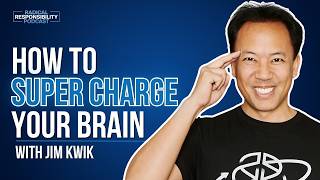
Jim Kwik talks about recovering from a childhood head injury and developing learning techniques. He argues that two-thirds of memory is trainable, not fixed, and that beliefs shape what your brain can do through neuroplasticity.
Chapters
So memory is an essential component for both personal and professional success. And the good news is, anyone can improve their memory, right? About one third of your memory is predetermined by genetics and biology. But two thirds is in our influence and in control. And I take two approaches. We teach people the software, like how to learn a language faster, how to remember a speech without using notes, how to improve your vocabulary, how to remember numbers and passwords and pin numbers and all those things. But that's the software. You also take care of the hardware, right? The brain itself, that three pound mat between your ears. And I always tell people to take your meds. It's not a pharmaceutical, it's another acronym.
Welcome to the Radical responsibility podcast. I'm Dr. Fleet Moll and I'm excited to guide you on a journey of authentic transformation. In each episode, I'll bring you insights from leading experts to explore trauma recovery, mindfulness practices, positive psychology, and innovative breakthroughs in health, wellness and life optimization. This is a space for real conversations that inspire meaning change, helping you find alignment with the person you were always meant to be. Let's get started. Have you ever been told that you're not smart enough? That your brain is fixed and learning stops after a certain age? Millions of people are trapped by these toxic beliefs, feeling like their potential is limited. But what if everything you've been told about your brain is wrong? Jim Kwik knows this struggle all too well. Once labeled the boy with the broken brain, he he faced learning challenges that seemed insurmountable. Today he's a world renowned brain coach, founder of quick learning and author of limitless. Upgrade your brain, learn anything faster and unlock your exceptional life. He has dedicated his life to helping millions unlock their brain's potential and accelerate learning. In this episode, you'll discover the science backed truth about human potential and learn how to break free from self doubt. Are you ready to unlock your limitless brain? This is the Radical Responsibility podcast where transformation begins.
So before we get started, I wonder if you could. It was somewhat referenced in your bio that you had a childhood head injury. I wonder if you could just talk a little bit about how that then led you to get into this work.
So my inspiration was my desperation. When people see me in audiences at events, I'll sometimes, if there's time, do a memory demonstration where we'll pass around a microphone to audience members and have them introduce themselves and I'll memorize fifty, sixty, a hundred people's names, or they'll challenge me by giving me a hundred digit number, a hundred random Words, and I'll recall it forwards and backwards. But I always tell people, I don't do this to impress you. I really do this to express to you what's possible. Because the truth is, every single one of you watching and listening right now, you could do that too. We just weren't taught, you know, school teaches you what to learn. Math, history, science, Spanish. But there are very few classes on actually how to learn. And the reason why I know it's possible. As you mentioned, I had an injury when I was five years old. I was in kindergarten class and I took an unfortunate fall, or maybe a fortunate fall, and I hit my head two times on that fall and I was rushed to the emergency room. And you could say that before my parents would say I was very energized, very curious, very playful. I became very shut down. I had focus issues, memory issues. I had migraines every day as a five year old. So I really struggled. Took me three years longer just to learn how to read like the other children. When I was nine years old, there was an inflection, like an event where I was being teased in class pretty harshly because I just didn't understand the lessons and I couldn't keep up. And a teacher came to my defense. She pointed to me in front of the whole class and said, leave that kid alone. That's the boy with the broken brain. And talk about wiring your brain. I wasn't born with this idea that I was broken, but adults have to be very careful of their external words because they often become a child's internal words. So every single time I did badly in school, which was weekly, every time I was in pick for sports, which was all the time I would say, oh, because I have the broken brain. And so I struggled every single day. When I was seven years old, I unfortunately lost my grandmother, who was my hero. She was. My parents immigrated to the United States. They had many jobs. We live in the back of the laundromat that my mom worked at. She was taking care of me. And she started showing early signs of dementia when I was five and. And that was very confusing as a child, you know. So she eventually passed of Alzheimer's when I was 7, and I wrote a book called Limitless. We gave all the royalties that book to Alzheimer's research for women. Women are twice as likely to experience Alzheimer's than men. Yet most of the research is done on males and treatments on males. So you could say, you know, I've taken my mess and turned it into my message. You know, when I was 18. I learned some strategies that really transformed everything. And. And I started a tutor. And one of my very first students, she was a college freshman. She read 30 books in 30 days because I taught her how to speed read, but not skimmer scan. She really understood it. And I wanted to find out, not how I taught her how. I wanted to know, like why, what was her purpose? And I found out her mother was dying of terminal cancer. And doctors only gave her mother 60 days, two months to live. And the books she was reading were books to save her mom's life, which she ended up doing. So. And when I heard that, I realized two things. That if knowledge is power, then learning really is our superpower. And it's a superpower we all have, regardless what age or stage you are in life. And the other thing I realized, because of neuroplasticity, as we're talking about in this summit, the other thing I realized was my dharma, my mission in life, is to, as the boy with the broken brain, was to build better, brighter brains. No brain left behind.
Wow, what a powerful story. So we're focused on beliefs in this summit. Of course, beliefs have their correlates and neural networks, and we can look at it psychologically changing our beliefs, that means we're changing the brain, changing neural networks. So what have you seen as how the power of belief, how belief influences how we interpret the world and then how we show up in the world and our strategies for getting our needs met and so forth, that you've seen the power play a role in someone's ability to access higher performance and creativity versus not what are some of the limiting beliefs and just the power of belief altogether. How do you see that?
I love this question. This is a topic I really wish was taught in school. I believe all behavior is belief driven, meaning if you want to create a result in your life, you need to do a new behavior. But in order to do that behavior, you need an empowering belief that says it's possible. You know, when I wrote Limitless, before I hit send to my publisher, I asked myself this question. Will everybody who reads this book get the results they're hoping for? And my honest answer was no, because the book was just full of methodology. How to read faster, how to learn languages, how to remember names and faces, how to focus. And a lot of people know what to do, but I realized they don't always do what they know. And so I added two new sections in there. One on motivation. You know, the secrets to motivating yourself when you have to do things you're procrastinating on. But the other big section of the book is mindset, and a big part of mindset are our beliefs. You know, like what you believe is possible, what you believe you're capable of, what you believe you deserve. If you have this belief that says, you know, you can learn the great methods on how to make money, but if your belief is money is the root of all evil, I have to hurt people to make money, you're still going to be stuck in that box, right? And so for me, belief is foundational. It's a powerful driver for all human potential. The way we think about our own abilities, whether we believe we can improve or not, whether we think our brains are fixed, like our shoe size, or if it can grow, it has a profound impact on how we perform. You know, when we're talking about neuroplasticity, you know, the brain's ability to adapt with novelty. When you adopt a growth mindset, a belief that you can develop the abilities through effort. At these same events, people will invariably pull me aside in the lobby and say, I'm so glad you're here. They'll do it secretly. They'll whisper, and they'll say something like, I have a horrible memory. I'm just getting too old. And I always say the same thing. I say, stop. If you fight for your limitations, you get to keep them. If you fight for your limits, see, they're yours. If people truly understood Fleet how powerful their mind is, they wouldn't say or think something they didn't want to be true. And that's not to say you have one negative thought and it ruins your life any more than eating one donut will ruin your life. But if you ate that donut 30 times a day, every single day, I think everybody listening would agree there would be a consequence. Same thing. It's. It's hard to create a positive life with, you know, a lot of negative beliefs. But when you adopt that growth mindset that you can develop through effort, your brain is more likely to engage in the learning process, making it easier to create new neural connections and invariably will help your performance. And so me, my belief was, I'm broken, right? And so, you know, I filtered everything through that. And so it's one of those things where I believe when it comes to something like our brain, there's no such thing as a good or bad brain. There's a trained brain, and there's an untrained brain. And so beliefs are really foundational, which is why this summit is so very important because your brain doesn't come with an owner's manual. Right. And it's not user friendly. So that's why we write books about this. We have podcasts and courses to support people in this process that you could be the pilot of your brain. You don't have to be the passenger.
So, Jim, you work with a lot of students, you work with a lot of leaders. I wonder if you could give an example or two of how a real fundamental shift in belief or mindset has helped someone really unlock a whole new level of performance, cognitive abilities and performance in their career life.
So limiting beliefs are, you know, powerful mental roadblocks that could significantly.
More from Fleet



What Oregon Learned When Legal Psilocybin Access Had to Work in the Real World - Angie Allbee


Eric Zimmer┃How a Little Becomes a Lot: The Small Choices That Transform Your Life

What if anxiety isn’t something to eliminate, but something we can learn to work with differently?


What if aging, energy, and performance are more programmable than we’ve been taught to believe?

Dave Asprey┃From Survival to Human Upgrade: How Personalized Biohacking Can Transform Longevity

What if spiritual awakening isn’t about escaping your humanity, but becoming more present within it?
