Richard Taubinger | Selling Less and Serving More
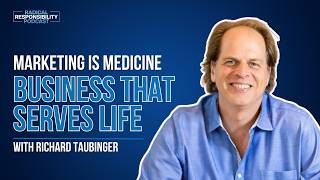
Marketing strategist Richard Taubinger argues for "conscious marketing" built on three principles: act for the highest good, practice no-harm marketing, and tell the whole truth. He contrasts this with fear-based sales tactics, positioning entrepreneurs as trusted guides rather than pushers, and cites the "Wisdom of Trauma" film campaign reaching ten million viewers.
Chapters
Welcome to the Radical responsibility podcast. I'm Dr. Fleet Mahl, and I'm excited to guide you on a journey of authentic transformation. In each episode, I'll bring you insights from leading experts to explore trauma recovery, mindfulness practices, positive psychology, and innovative breakthroughs in health, wellness, and life optimization. This is a space for real conversations that inspire meaningful change, helping you find alignment with the person you were always meant to be. Let's get started. Marketing doesn't have to feel icky or complicated. In this episode, I sit down with Richard Taubinger to talk about conscious marketing. How to grow your business while staying true to your values, actually helping people, and even turning marketing into a kind of creative, soulful practice. If you've ever struggled with how to reach your audience without feeling salesy, tune in. My name is Fleet Maul, your co host for this session, and I'm thrilled to be here today with Richard Tobinger. Welcome, Richard.
Thanks, Fleet. Glad to be here.
So, Richard, your work emphasizes, obviously, conscious marketing. And so I wonder, to begin with, if you could define what you mean by that, that approach, and how entrepreneurs can integrate these principles into their businesses to really develop more authentic connections with their customer base and to succeed altogether.
Yeah, that's a great question, Fleet. Well, I think that, you know, one of the underlying premises is that we want to do what's in the best interest of the customer. And so on a. Maybe a traditional marketing or sales call, the idea is to close the customer at all costs. You know, a different approach might be to help the customer make the best decision. And if it's not a good decision, then to tell them that, and tell them that it's not the right time, or they're not ready, or maybe the cost is too much, or they would be better somewhere else or working with somebody else. So I have a kind of a larger teaching that we can't get into. But there are definitely some principles behind conscious marketing. And I guess in the business world, a lot of people follow Elon Musk and a lot of these tech entrepreneurs. And there's a concept called first principles, which. A first principle is a principle from thousands of years ago, and it should exist no matter what. And so we have some. We have, like, three first principles in terms of conscious marketing. And one is basically, we want to do whatever in the highest good. And so we're always kind of checking whether the ad or the thing we're selling or the product we're representing actually helps people and doesn't hurt people. You know, the second one is kind of Karma free marketing and do no harm. So there's always a readiness of the client. And so we don't want to sell or push something on somebody when they're not ready. And then the third first principle is really just tell the truth. And so and that means kind of like don't hide certain things. So truth by or omitting certain things is just as bad as not sharing everything. And I think what we've seen in recent years is the companies that make things a lot more transparent and that's, it takes a lot of courage to do that. And people that are more vulnerable and less perfect on the outside, they actually tend to do a lot better. And then we trust them more because we can, we can see who they are. And that includes if, if you mess up or if you make a mistake, you admitted it and you, and you make your, your company or you make a customer good to make things better rather than worse.
So for the bootstrapping entrepreneur or even a marketing professional who trying to expand their customer base, trying to get their marketing to work, it might sound like what you're talking about is reducing my potential customer base and limiting my marketing strategies.
I think if you're an entrepreneurial company, you actually have the advantage because bigger companies are seen as colder and there's many more things that can be hidden among the many layers. So if you're starting an entrepreneurial company, you know, telling the truth, doing what's in the highest good of the customers, doing no harm, and actually leading with values right from the start is a benefit to you.
Yeah, obviously I completely agree with you. I'm totally on board. And at the same time I just, I think there could be a mindset of I just want to do what works, I need to get customers. But in, I think what you would probably assert that in the long run, in the long term you're going to get more sustainable growth taking this conscious marketing approach than just trying to do whatever works in kind of an immediate short term fear based approach.
Yeah, I, I could see where somebody would have that perspective, but I might have a different opinion. And everybody can have their own opinion, but I kind of think if you start off bad, you're going to end bad. And most businesses are built on long term customer value. And so if you're not focusing on that right out of the gate with your first customer and providing value, then what you're going to have to do is keep finding new customers and then keep under delivering. And so that's not a good sustainability strategy ever for A big company or a small company. So I might actually argue the opposite, that you might as well just start to, to do what you say and deliver on your promises right from the gate. And so few companies are willing to use creativity and really go the extra mile to over deliver that. You'll stand out, you know.
Exactly. So also, and we're talking primarily about marketing here, but in terms of sales, this approach and kind of where you started with, we're not trying to sell products that customers don't need or they're not ready for and so forth. And so similar in sales to kind of consultative selling needs based selling really about a relationship where we're, we're meeting real customer needs and providing something that's actually value adding for them.
Correct?
Yeah, yeah, absolutely. So I think in general, you know, entrepreneurs are risk takers and obviously, you know, taking a big risk to starting a business and then there is all kinds of pressures to survive and thrive. I think sometimes there can be a felt struggle between meaningful values based work and then just succeeding, just driving profit and driving growth. And I think your approach addresses that. I wonder if you could say a little bit about that.
Sure, yeah. Well, first I would say that a lot of the entrepreneurs I know are, I think there is a meme that entrepreneurs are risk takers. And I also think that a lot of entrepreneurs are very strategic and they make very calculated bets and they see things before other people see them. And I would, I would say that especially in the last 10 years what we've seen is entire industries being destroyed. And I would say often it's more risky to be in a company and have not have your fate in your own hands. So I view entrepreneurship as actually much less risky than working for somebody where, where you can't control your destiny. And then on the purpose thing, I think, I don't know, I think I, I thought this when I was younger. You know, I was a financial trader and did a lot of things. I loved it when I was doing it. I was on the floor of the exchanges and then was one of the first screen traders, helped design actually some of the initial systems and things. And I think back then I thought, oh, I will make my money and then I'll do something that mean that's meaningful. But there's a certain point where either you don't make the money or you just burn out or you make the money and then you can, you can integrate that in, but the money is never really assured. So how we counsel especially people in our mastermind, those that you know, our higher end clients, either they're already doing what their purpose is or it might be just outside the periphery. And so what we try to do is pull it into the center. So the purpose is at the center around everything they do rather than it's the thing that they get to at the end, you know, and if you, what you want to do is design your business so that everything you do in your business contributes to the purpose. And then you'll get up at 5am and you'll work extra hours and you'll make hard calls and you'll do the things that you need to do because you're kind of driven internally because it's part of what you're passionate about in the world. If you're. I know a lot of people who don't do well in certain industries and they have another passion on the side that they would rather do, but they're kind of locked in with however they're locked in, whether it's a mortgage or, you know. Yeah, I couldn't agree more that I
think having our destiny in our own hands, even though it may be a bit risky and we're carrying a lot of weight on our shoulders, is where I'd much rather be than being at the mercy of corporate budgets and so forth. And I think most entrepreneurs are very much purpose driven and driven by a passion to innovate and bring something new and something that's really meaningful to them. I think there can be a risk that once dealing with the challenges of growing a business and scaling a business, one can sometimes lose sight of that. And I wonder if we could talk a little bit about it. Depends on the kind of business. Sometimes the brand may be very product identified, but very often entrepreneurs need to put themselves out there. They are the brand. And there may be a lot of fear around putting oneself out there and fear of rejection and, you know, fear of being driven by what other people think of us and so forth. So I mean, that is one of the things that I think often sets entrepreneurs apart is their willingness to put themselves out there.
Yeah, that's true.
So what would you say to somebody who's sort of struggling with that part of their business and maybe trying to kind of maybe avoid that by trying to, you know, grow the business while being in the shadows somewhat.
Right? Yeah, that's a great question. Well, what we try to do is especially with marketing or sales, like a lot of people are resistant to sales especially, but we try to create a new paradigm around it. And so you can kind of Be driven by pain, pleasure, but also just shifting the beliefs you have about something, the meaning you make about something. And so we're, I mean I think, I think marketing and sales in general, like we're hit with so many messages every day, we kind of develop marketing antibodies and then the thought of doing it for ourself and inflicting that on other people kind of like makes us go weak. So we kind of have to look at the core of what marketing is. And kind of the first level is that if nobody knows about what you do and the solutions you provide, and often those help people get out of pain and you know, help them transform their life and whatever service you're doing, health, fitness or finance or whatever. And so, so you just have to create awareness of your solution. That's really the fundamental base thing that marketing does. And without that skill in your business, you're not going to do very well. Now the thing is if you outsource the other people generally they aren't going to care as much as you. And so if you're starting an entrepreneurial company, that's important. The second thing that you can do is start to make marketing more of a teaching. And more of a teaching means that you can kind of start to take people along the first 10 or 20% of the journey to get them ready to accept your solution or see what the road is to help them see it's possible. The third way you can reframe it is you can start to see marketing as art and beauty and inspiration. A lot of marketing inspires us to take action and inspires us to buy the running shoes and sign up for a marathon or to invest money for our kids college education while there's still time or you know, to start to do meditation every day and calm our nervous system down so that we don't go get triggered at work or with our family. And these are, these are important things, but this inspiration. And then there's a beauty behind marketing equipment, great ads. If you start to see it that way, then you put a lot of love into it versus something you have to do. And then the four, I have two more. The fourth is marketing as medicine. And if you can see the people are actually in pain and they have, there's all these symptoms out there and if you have a solution, you know, if you were a doctor and you had a solution that could cure a chronic illness and you, you didn't get in front of the camera or share that with people and those people continue to suffer, really what's holding you back isn't, it's a sense of safety, but it's actually just your ego playing small because it doesn't want to be protected. But on the other side, there's people suffering out there. So if you can start to see that what you do has a real impact. You know, we, we marketed a movie called the Wisdom of Trauma that was seen by over 10 million people and we prevented suicides and helped a lot of people through some difficult times through Covid. If the founders, creators of that movie didn't want to do the marketing and outsource that to somebody else, that wouldn't have done as well. And then the fifth level is where marketing actually becomes part of your spiritual practice. And this is what I actually really love because what you have to do is come from your higher self. You have to come from the soul level. But if you look at great entrepreneurs like Steve Jobs and a lot of others, they all had some kind of like meditation or walking practice, something that helped them to see, to connect with their inspiration and their higher self and wisdom and the parts of our higher self doesn't want to hide. Our ego wants to keep us safe and it wants to protect us from rejection or whatever. So as you start to get in front of the camera, as you start to post online and you start to share your message, you actually evolve as a soul. It's actually, it's some of the fastest transformational work that you can do is to actually stand for something in the world to share your values, to share your origin stories, to share your struggles and your wins and then to help people, you know, to start to serve people. That's a real act of service. So that's, that's, there's no difference between that and you know, would I rather have somebody do that or meditate 30 minutes every morning or whatever. I mean, you don't have to do either. Sometimes they say market and then meditate and then meditate and then market. So it's like this flow where you bring your best of yourself out there.
Yeah, I'm glad you brought forth that inner dimension because not only, I think is that having some kind of inner practice is really important in terms of sustainability and taking care of ourselves and well being and also staying in touch with our purpose and our values and our passion. But also it's a tremendous source of creativity. As you mentioned, some of the greatest creative geniuses in the world of business and marketing had some kind of inner practice which got them out of that fear based space and then allowed their Mind to access lots of creative ideas.
That's true. Yeah.
So you were also kind of describing that journey from how we maybe help people become problem aware, pain aware, who are not, and then solution aware, and then of course, finally brand aware. And I wonder if you could talk about that journey a bit from a conscious marketing perspective.
Well, I mean, one of the things that sometimes people. One of the. We have a whole teaching on the myths of marketing. And one of the myths is that, you know, marketing's role is to create the demand. And really it's not what you want to do is find people that already have a problem and then just help them solve it. And so a lot of times, if you know what to look for, you can see how to see the people are looking for better solutions or they already have problems. What the opposite approach is, is to create something that people may want and then try to get people convince them that it's the right thing. And that's a real kind of uphill battle sometimes. So it's better think about like health and fitness. There's like all kinds of programs out there and ways that you can go, but it takes that person to be ready. And so you can differentiate the way you do it. But then you have to find people who are ready to make that choice. And often, sometimes on a, a sales call or if I'm talking to somebody and they've contacted me, right. I haven't tried to push something on them. I'll just go, what happened? It's kind of like, it's a little bit disarming, you know, and they'll be like, what do you mean, what happened? Well, I was like, why are you reaching out now? Like, what happened that, you know, and it's like, did your partner leave you or did you get diagnosed with something or did you run out of money? And so I don't think we need to over complicate it. I think it's just finding people who need a solution to something and then being there with something that's, you know, slightly better and more creative than somebody else.
More from Fleet



What Oregon Learned When Legal Psilocybin Access Had to Work in the Real World - Angie Allbee


Eric Zimmer┃How a Little Becomes a Lot: The Small Choices That Transform Your Life

What if anxiety isn’t something to eliminate, but something we can learn to work with differently?


What if aging, energy, and performance are more programmable than we’ve been taught to believe?

Dave Asprey┃From Survival to Human Upgrade: How Personalized Biohacking Can Transform Longevity

What if spiritual awakening isn’t about escaping your humanity, but becoming more present within it?
