Everything in Life You SHOULD Know, Explained
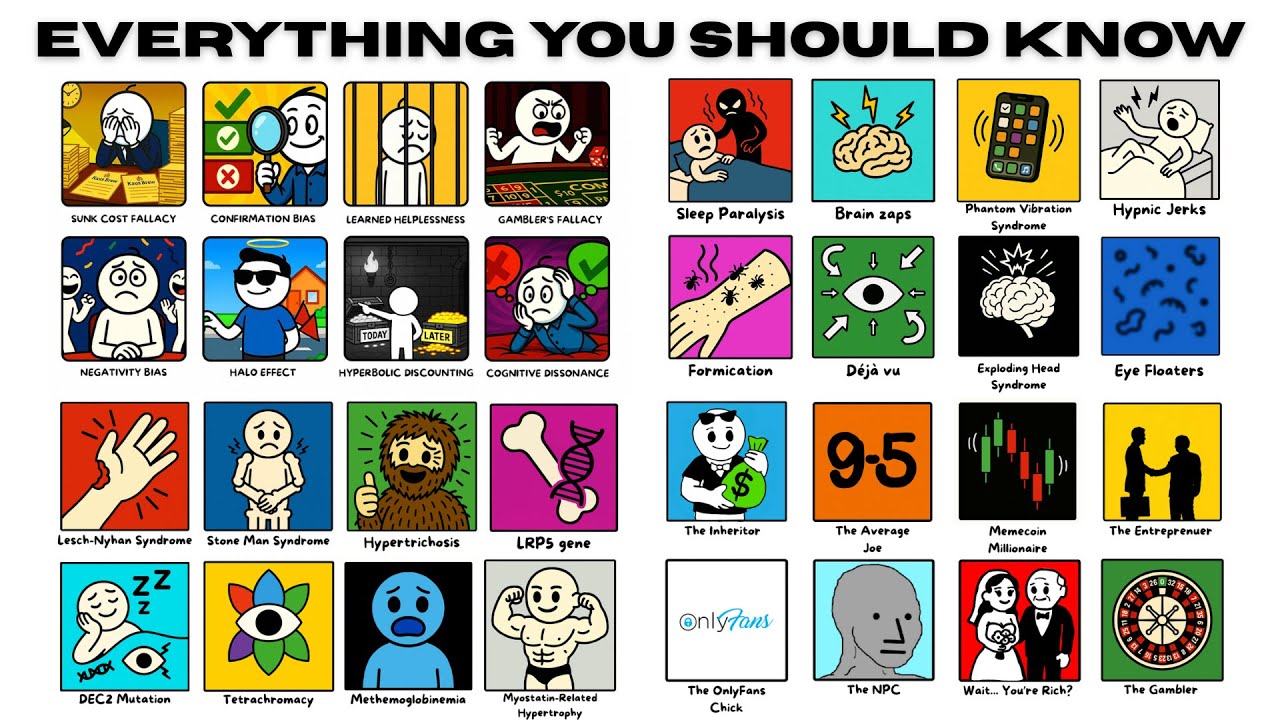
The video is a rapid‑fire, conversational walkthrough of the most common mental traps, cognitive biases, neurological quirks, marketing manipulation tactics, social interaction hacks, and wealth‑building pathways that shape modern life. It opens with classic decision‑making errors such as the sunk‑cost fallacy, confirmation bias, learned helplessness, the gambler’s fallacy, negativity bias, the halo effect, hyperbolic discounting, and cognitive dissonance, illustrating each with vivid everyday examples and offering brief strategies to break the cycle. It then shifts to a catalog of brain “glitches” – sleep paralysis, brain zaps, phantom‑vibration syndrome, hypnic jerks, déjà vu, exploding‑head syndrome, eye floaters, ASMR, benign fasciculations, and rare genetic conditions – framing them as normal but often misunderstood phenomena. The next segment deconstructs how corporations hijack our psychology through illusion of choice, scarcity traps, infinite scroll, social proof, loyalty programs, personalized ads, anchoring, brand humanization, and cause‑marketing, urging viewers to recognize and resist these cues. Following that, a toolbox of social‑skill hacks is presented (compliment combo, name‑drop resurrection, mirror move, 3‑second rule of entry, echo hack, vulnerability vibe bomb, exit portal, callback connection, curiosity catalyst) with concrete phrasing tips. Finally, the video outlines several archetypal routes to financial security – the inherited rich, the steady‑climb “average Joe,” meme‑coin speculation, entrepreneurship, the disciplined NPC, influencer pathways, and high‑risk strategies like OnlyFans or marrying a dying billionaire – summarizing the mindset, risks, and potential rewards of each. Throughout, the narrator maintains an informal, slightly sarcastic yet encouraging tone, aiming to equip viewers with awareness and practical actions to avoid being “glitched” by their own mind or external systems.
Chapters
Every trap that controls your mind. The sunk cost fallacy. You went to law school, 3 years, 6 figures of debt. You passed the bar, landed a decent firm, and you hate every second of it. The work is soul-grinding. The culture is toxic. You dread Mondays like they're a funeral. But every time you think of leaving, the same thought traps you. I worked too hard to give this up. That's the sunk cost fallacy. You're confusing effort with obligation. Because you paid a steep price to be here, you assume the only way to honor that cost is to stay. But the cost is already paid. Staying miserable doesn't get you a refund. It just adds interest. This fallacy turns high achievers You think quitting would make it all a waste. But what's actually wasteful? Sacrificing your future to justify a decision you made 5 years ago, with a totally different version of yourself. You're not walking away from value; you're walking toward alignment, toward sanity, toward a life that fits the current version of you. And no, you're not throwing it away; you're using what you learned to stop sinking deeper. Confirmation Bias: The Echo Chamber of Doom. Imagine this: you believe something, anything. Let's say you think coffee is good for you, so you type, is coffee healthy, into a search engine. First result? Coffee linked to lower risk of depression. Boom! You feel smart, informed, validated. Now pause. Did you search for the truth? Or for confirmation? Welcome to confirmation bias, your brain's favorite self-reinforcing trick. Instead of asking, what's accurate? You ask, what makes me feel right? And then, you subconsciously cherry-pick data, experts, opinions— anything that agrees with you. Anything that doesn't? You downplay, ignore, or declare invalid. It's not just coffee. It's politics, religion, conspiracy theories, dietary choices, which sports team is superior. You think you're being logical, but you're You're literally running an emotional software script that says, never admit you might be wrong. This is how we build echo chambers— tiny worlds made of identical thoughts bouncing off the walls. And the more you hear the same opinion repeated, the more true it feels. But repetition isn't proof. Consensus isn't accuracy. If you want clarity, do something radical— actively seek out opposing views. Ask yourself how you'd know if you were wrong. Truth isn't comfortable; that's how you know it's real. Learned Helplessness. Picture a dog in a cage. Every time it tries to escape, it gets shocked. Eventually, it just lies down. No more trying. The door swings open, the dog stays put. That's learned helplessness. Now imagine you. You fail at something. Once, twice, maybe 3 times. Rejected job applications, awkward first dates, goals that flop. At some point, you stop trying. Not because you can't succeed, but because failure taught you to stop believing in the possibility. You tell yourself, I'm just not good at this. You confuse temporary pain with permanent truth. Learned helplessness doesn't mean you are powerless. It means you feel powerless. And those feelings become bars in a cage that doesn't even exist anymore. The worst part? You might not even notice you've given up. You just start living smaller. But there's a way out. It starts with testing the lock. Do the thing one more time. Apply again. Say what you meant to say. Try badly and try loud. Fail forward. Because once you realize the shocks have stopped, you stop being the dog. And you start being the person who leaves the cage and never looks back. And yes, the door was open the whole time. The Gambler's Fallacy. You're at the roulette table. The ball's landed on red 5 times in a row. People are buzzing. Black has to be next, they whisper, like it's prophecy. You bet big. You're not even thinking. You just feel it. And then, red again. That's the Gambler's Fallacy. It's your brain assigning memory to randomness. We think the universe keeps You might think that the universe is keeping track of your progress on a scoreboard, that it's secretly balancing the scales. It isn't. Every spin is its own independent chaos. Past results don't predict future outcomes, especially in random systems. But this fallacy goes beyond casinos. You think you're due for a good relationship because your last 3 were trainwrecks. You believe this job interview will go better because the last one didn't. You think life owes you symmetry. It doesn't. The universe isn't a slot machine with a guilt complex. It doesn't reward perseverance with fairness. It doesn't track your streaks. And clinging to the idea that it does? That's how you keep gambling time, energy, hope on patterns that don't exist. You're not cursed, you're not lucky, you're just misreading chaos as narrative. The odds don't care how badly you want it. The flip doesn't remember the last one. And neither should you. Negativity bias. 10 people say your idea was great. 1 person calls it meh. Guess which comment keeps you up at 2 AM? That's negativity bias. Your brain is a threat detection machine from prehistoric times where noticing danger was literally survival. Back then, ignoring one rustle in the bushes could get you eaten. Fast forward to now, and your brain's still doing it. Only now, the tigers are tweets. You're wired to give more attention, emotion, and memory to negative events. One bad review hits harder than 10 good ones. One awkward moment at the party makes you forget the fun. You remember rejection way longer than praise, and it's not your fault, it's biology. But if you don't know it's happening, it starts controlling your entire mood. You live like everything's falling apart, even if 90% of your life is actually fine. It also warps your perception of people. You zero in on flaws, you expect disappointment, you scan your inbox for conflict, and pretty soon, your whole world is just filtered through caution tape. The only antidote? Actively notice the Count it. Name it. Write it down. It won't come naturally, but that's the point. You're not being realistic. You're being hijacked by an ancient alarm system that forgot how to turn off. The Halo Effect. You meet someone new. They're charismatic, great smile, amazing taste in playlists, and before you even realize it, they're perfect. Funny, insightful, emotionally mature. Basically a walking TED Talk. Except they're not. Welcome to the Halo Effect. When your brain takes one positive trait— attractiveness, charm, intelligence— and uses it as a shortcut to assume all the other traits are just as glowing. That's how we end up trusting people who shouldn't be trusted. That's how bad ideas become gospel when delivered by someone in a nice suit. That's how con artists and cult leaders work. They start with one beam of light, and your brain fills in the rest. You don't judge people by who they are. You judge them by the glow you want them to have. And this doesn't just apply to people. Companies, politicians, brands— you see one clean logo or clever ad and assume competence, ethics, and value. But shiny isn't the same as good. The halo effect isn't about gullibility. It's about speed. Your brain loves shortcuts. But shortcuts often skip the truth. Slow down. Ask More questions. Don't let one bright spot blind you to everything else. Hyperbolic discounting. You promise yourself you'll go to bed early, eat better, start that novel. But then it's midnight. There's ice cream in the freezer, and Netflix says one more episode, and somehow you say yes again. That's hyperbolic discounting. Your brain's tendency to prioritize instant gratification over future rewards, even when the future reward is clearly better. In theory, $120 next month is better than $100 today. But your brain sees now as real and later as foggy. Future you is abstract. Present you is. Hungry and tired. So, present you wins. Again, and again, and again. That's why we stay up too late, save too little, scroll too long, and skip the gym. Not because we're lazy, but because our brain discounts the value of long-term gains dramatically, especially when the reward isn't immediate. You think you're just bad at discipline? You're not. You're wired for short-term survival, not long-term planning. Future you might as well be a stranger. But here's the twist: you can trick the system. Make the future feel closer. Visualize rewards. Use timers. Set traps. Tie pleasure to progress. Because willpower alone won't win. You need to build a bridge from now to later. Otherwise, you'll keep trading gold for gum. And finally, number 1. Cognitive dissonance. You call yourself a good person. You also just ghosted someone who trusted you. And now, somewhere between your rib cage and your pride, there's an itch you can't scratch. That's cognitive dissonance. It's the mental tension that sparks when your actions and your identity don't match. Your brain hates contradiction, so it rushes to resolve the discomfort. Not by changing your behavior, but by rewriting your story. You tell yourself, they were too clingy anyway, or I'm just bad at texting. You morph from ghoster to justified escape artist in record time. And just like that, the dissonance quiets. For now. But it's not just relationships. You believe in honesty, but you lie at work. You see yourself as rational, but you rage buy crypto because your friend did. You think you're above gossip, then you forward the screenshot. Dissonance everywhere. The truth? Everyone does this. What matters is whether you notice. Whether you stop and ask, do my actions reflect who I actually want to be? Or am I just storytelling my way into comfort? You don't have to be perfect, but you do You have to be awake, especially when your brain is busy rewriting the plot. Every body glitch that you might experience. Sleep paralysis. You wake up, sort of. Your eyes flick open like a security camera rebooting, and your room looks— off. Not wrong, just uncanny, like it was rendered by a new intern at the simulation studio. You try to move your arm— nothing. You try to scream— still nothing. And then, there it is. A shape, a shadow. A figure sitting on your chest like it just clocked in for its night shift as your personal anxiety demon. Your brain is awake, but your body is still stuck in REM sleep. Where it's been gently paralyzed so you don't karate kick your dreams. But now the system's bugged, and the 2 halves of you are no longer in sync. This is sleep paralysis— your mind clocking in while your body is still on break. For thousands of years, people thought it was witches, demons, or ghosts sitting on their chests. Turns out, it's just your brain holding the door open between dream world and meat reality, and letting all the weirdness slip through. It's the most terrifying lag spike you'll ever experience. Brain zaps. You're walking down the street, sipping a coffee, scrolling through your phone. Everything is chill. Then suddenly, zap! Like a tiny lightning bolt shot across your brain, or like someone tried to hotwire your consciousness with jumper cables. It lasts half a second, but it hits like a pop-up ad for neurological instability. This is a brain zap. They tend to happen during medication changes, especially antidepressants. But honestly, they can show up anytime your brain decides to update its firmware without warning. Some people describe them as static bursts, electric jolts, or the sound of your thoughts The worst part? You can't really predict them, and science still doesn't fully get them. It's like your neurons were in the middle of sending a message and just went, oops, all static! Some theories point to serotonin withdrawal, others blame electrical misfiring. Either way, it's your brain briefly forgetting how to be a brain. Phantom Vibration Syndrome. You swear your phone just buzzed. You felt it, on your thigh, in your pocket, maybe in your hand. You pull it out, check the screen. Nothing. No texts, no notifications, not even a passive-aggressive low battery warning. And yet, the buzz was real. Or, at least, it felt real. Welcome to Phantom Vibration Syndrome, the haunting that lives in your pants. It's not a ghost; it's just your nervous system running predictive software on your dopamine cravings. Your brain has learned to associate any small twitch of pressure or movement with a possible message. And since you're always expecting someone to text, ping, or tag you, it just invents the sensation. Think Pavlov's dog, but the bell is slack, and the drool is a desperate need for relevance. You're literally hallucinating feedback because your brain would rather be wrong than miss a notification. Hypnic Jerks. You're drifting, falling into sleep like you're being cradled in the arms of an angel made of warm Netflix fuzz. Then, out of nowhere, boom! Your entire body flinches like you just got sniped in Fortnite. Your leg kicks, your arm flails, your brain lights up like, what just happened? That's a hypnic jerk, also known as a sleep start, or the body's most dramatic way of saying, nah. It usually happens right as you're about to fall asleep, when your heart rate and breathing slow down and your muscles start to relax. But your brain, in its infinite overcaffeinated paranoia, misreads that relaxation as death in progress and slams the emergency brakes. Some evolutionary theorists say it's a leftover from our tree-sleeping ancestors, a kind of anti-falling reflex to make sure you didn't plummet from a branch mid-nap. Now, we mostly just jolt ourselves awake and pretend we weren't almost dreaming about face-planting into the void. It's the body's version of falling for no reason, because it cares. Formication. There's something crawling on you, not just once, constantly. Little feet, tiny claws, like ants marching under your skin. You scratch. Nothing there. You rub your arms. Still nothing. But the feeling persists. And it's enough to make you spiral. This is formication. And no, that's not a typo. It's the sensation of bugs crawling on or under your skin, and it's surprisingly common. It can be triggered by things like anxiety, menopause, stimulant withdrawal, or just plain old overclocked nerves. It's a glitch in the somatosensory matrix, your brain receiving faulty touch data, like it's pulling up corrupted textures. Instead of telling you nothing's happening, it whispers infestation in high definition. For some, it becomes chronic. For others, it's a one-time horror show. Either way, your skin isn't the problem. It's your internal code running debug mode on maximum paranoia. Déjà vu. You're walking through a hallway you've never seen before, in a building you've never entered, talking to a person you've just met, and suddenly you freeze. Wait, this happened already. This exact moment, down to the intonation of a word and the flicker of a light bulb. You know you've lived this before. That eerie glitch in the matrix? That's déjà vu. It's your brain's version of a playback error, where short-term memory gets misfiled into the long-term section of your mental hard drive. So instead of new info, your brain flags it as nostalgia. Some think it's the brain running simulations just a little too fast. Others think it's a hiccup in memory processing, a signal that's duplicated and interpreted as familiarity. But for a split second, it feels like you've broken time. Maybe you have. Or maybe you're just a meat-based time traveler with a faulty compass. Exploding Head Syndrome. You're finally falling asleep. You've turned off the lights, turned on the fan, and turned down the volume on your racing thoughts. And just as you're crossing the border into unconsciousness, kaboom! A noise so loud and sudden you think a bomb went off. You sit up, heart pounding, ready to fight— no one. Because it came from inside your head. That's exploding head syndrome. And no, your head doesn't literally explode. Sorry to disappoint. Instead, it's a type of parasomnia, sleep disorder, where your brain fires off phantom sounds as you're falling asleep. Loud bangs, crashes, Even thunderclaps. No one knows exactly why it happens. Some think it's misfiring neurons in the brainstem. Others think it's a dream element breaking through too early, like a soundtrack glitch in a video game. Either way, it's startling, harmless, and usually leaves you wide awake and doubting your reality. Eye floaters. You're staring at the sky, zoning out mid-walk, or spacing during a boring Zoom call, and suddenly you see them. Little strands, dots, cobwebs, drifting lazily across your vision. You try to focus on them, but they dodge like seasoned NPCs. These are eye floaters, not bugs in the Matrix, but shadows. Tiny bits of protein or collagen floating in the jelly of your eyeball. When light enters your eye, they cast little shadows on your retina. That's what you're seeing. Not ghosts, not microbes, just biojunk. Floaters are normal, especially as you age. Your eye jelly gets a little less firm, a little more goopy, and bits of debris start floating around in it like space junk in orbit. They usually fade or sink out of view. But if they suddenly multiply, it might mean a retinal tear. Which is less quirky glitch and more call your ocular emergency hotline. Until then, it's just your built-in HUD growing moss. ASMR. You're watching a video. Someone's whispering softly, maybe tapping on glass, brushing a mic, folding towels with the serenity of a monk who just discovered lavender. And then it happens. A warm, fuzzy wave rolls down your scalp. Goosebumps ripple across your neck like you're downloading bliss in 4K. This is ASMR. Autonomous Sensory Meridian Response. A totally unintentional cheat code in your sensory system that triggers physical euphoria from nothing. No touch, no danger, no logic. Just sound, attention, and maybe a little digital intimacy. No one fully understands it, but some theories say it's linked to grooming behavior in primates. When someone you trust carefully combs your hair, your body releases endorphins. ASMR might be your brain confusing whispering strangers on the internet for emotionally bonded grooming partners. It's weird, it's soothing, and it's one of the few glitches that feels like a reward instead of a penalty. Your body just gave you a free serotonin buff for watching someone crinkle a wrapper. That's a win in any game. Bonus glitch: muscle twitching. You're sitting perfectly still, minding your own business, when suddenly, your eyelid goes rogue. Or your bicep decides to start thumping like it's trying to escape the party early. No warning, no context, just random Morse code in your flesh. This is benign fasciculation, a fancy name for your muscles firing off without asking permission. Could be from too much caffeine, not enough sleep, dehydration, or your neurons just feeling a little spicy today. It's harmless, but annoying. Like your body installed a twitch stream with no chat filter. And the more you think about it, yep, the more it twitches. Welcome to the paradox of awareness. Your brain noticing the glitch is the glitch. And that's your tour of the weirdest bugs in the human operating system. From misfired neurons to sensory hallucinations, the body you live in is not a finished product. You are not broken, just interestingly patched. So next time your body freaks out, just remember, you're not alone. You're just glitched, like the rest of us. Every genetic mutation you might have, Lesch-Nyhan syndrome, You start noticing the signs early. A strange compulsion to bite your lips, gnaw your fingers, bang your head against hard surfaces when you get frustrated. Not tantrums, reflexes. It's like your brain is issuing commands without consulting you. You want to stop, but you can't. It feels like there's a gremlin inside your motor cortex, pushing buttons just to see what happens. And all of it traces back to a single missing enzyme. One tiny chemical your body failed to make. Without it, your brain chemistry spirals. You build up uric acid like a soda bottle shaken too hard. Your joints hurt. Your emotions are volatile. But the worst part? People assume you're dangerous or unstable. They don't see the fight you're having with your own wiring, every single day. Stone Man Syndrome. You trip over a sidewalk curb and bang your hip. It's sore the next day, then swollen, then it starts to harden. At first you think it's scar tissue, but over time, the joint stops moving altogether. Weeks later, your shoulder stiffens too. You go in for surgery to fix it, only to find out it's made everything worse. That's when the diagnosis drops. Fibrodysplasia Ossificans Progressiva, FOP. Your body has decided to heal every bruise by laying down bone, fusing muscles and joints, like they're part of some post-apocalyptic armor set. Every injury becomes a construction site, every surgery a red flag that triggers more bone growth. Eventually, you can't lift your arms. Later, your jaw freezes shut. You're becoming less person, more monument, an accidental statue sculpted by your immune system's paranoia. You're born with more hair than most men have at 30. It's not just your head; your cheeks, arms, back, even eyelids grow thick, dark strands. As a toddler, you look like you wandered out of folklore. At school, the jokes start early. Werewolf. Circus act. You laugh them off, but it stings. Your body never got the shutdown code that tells most hair follicles to chill after birth. Instead, they're in overdrive— growing, spreading, thriving like tiny forests. You try waxing, shaving, laser removal, but it always grows back. Doctors take photos. Some researchers call it an atavism, a trait from distant ancestors resurfacing. A glimpse into humanity's hairier past. You're a genetic throwback in a modern world, caught between science and myth. Unbreakable bones. You don't realize you're different until your first real fall. Maybe it's off a tree, maybe it's during a football game. Everyone panics, but you stand up, brush yourself off, and keep going. The X-ray comes back with no fractures, not even a hairline crack. That's when doctors notice your bones are unusually dense—2, 3 times denser than normal. It's not just luck; it's the LRP5 gene, mutated in your favor. Your skeleton is like reinforced concrete. Most people break under pressure; you bounce. But strength has its quirks. When you swim, you don't float; you sink. MRIs struggle to read you. Dentists complain You're a walking paradox— invulnerable, but weirdly incompatible with the rest of human hardware. DEC2 mutation. No sleep needed. You go to bed at midnight and wake up at 4 AM, completely refreshed. No grogginess, no caffeine dependence, no foggy mornings. While everyone else needs a gallon of coffee and a motivational podcast to get moving, you've already journaled, worked out, and replied to every email in your inbox. You don't try to be productive; you just don't need the downtime. Your body has a mutation in the DEC2 gene that changes your sleep architecture. Less time in bed, more time in REM. Your rest cycles are more efficient, like an internal Tesla battery that charges in half the time. People call you superhuman. You call it Tuesday. The world moves slow around you. You're not restless. You're just genetically optimized to stay awake while everyone else hits pause. You're the only one in the room arguing about whether the sky is more periwinkle or cornflower. People think you're being pretentious until they realize you're literally seeing colors they can't. Your eyes aren't defective. They're enhanced. Most humans have 3 kinds of cone cells for color perception. You have 4. That Extra cone unlocks a whole new dimension of visual nuance. Gradients invisible to others pop like neon to you. Beige is never just beige; it's wheat, sand, bone, champagne, and 15 shades in between. You see differences that make no sense to anyone else. Choosing paint becomes existential. Fashion coordination? A living nightmare. You live in a world full of colors unnamed, beauty unnoticed, wavelengths unacknowledged, and sometimes you wish you could switch it off. But most of the time, it feels like having a private window into reality's hidden spectrum. Methemoglobinemia. Your skin has a bluish tint. Like you've just emerged from a cold lake or a fantasy novel. You're not sick, you're not hypothermic, you're just blue. It's not makeup, it's chemistry. Your blood isn't carrying oxygen quite like it should. Thanks to a rare genetic hiccup, your hemoglobin's iron isn't binding oxygen normally, so the oxygen just sits in your bloodstream, awkwardly uninvited to the party. The result? Your skin takes on a purplish-blue hue, your lips go navy, and ER doctors panic. You're healthy, just unusually pigmented. In some families, it's been passed down for generations. What's the deal with that? Like the famous Fugate family of Kentucky. Locals called them the blue people. You just call it home. Myostatin-related hypertrophy. You're born with a 6-pack. Not a baby fat roll with optimism, actual muscle definition. As you grow, the gym becomes less of a challenge and more of a joke. You build strength like others build allergies, rapidly and without trying. Your secret? A mutation that blocks myostatin, the protein that tells muscles when to stop growing. With no brake in place, your muscle tissue expands freely. You're stronger than you look, and you already look like an action figure. No supplements, no lifting Regimes. You were born pre-buff. Coaches want to train you. Scientists want to study you. You're living proof that the human body has its own hidden power mode, and you weren't upgraded. You were born this way. Trimethylaminuria. Fish odor syndrome. You scrub, soak, rinse, repeat, but the smell never fully goes away. People wrinkle their noses. You pretend not to notice. You've changed soaps, cut out fish from your diet, avoided eggs, beans, anything sulfur-rich. Nothing works. Your body just can't break down a compound called trimethylamine. The molecule responsible for the distinct stench of decaying seafood. So it builds up, leaks out through your sweat, your breath, your urine. Doctors say it's harmless. Your social life disagrees. You don't lack hygiene; you lack an enzyme. That's it, and it's enough to make every human interaction feel like a test you didn't know you were taking. You become a master of distance, of managing perception, of quiet exits—not because you want to, but because your genes forced you to. EEC syndrome: clawed hands and missing teeth. Your hands are shaped differently—two fingers, maybe three. They curl in ways people don't expect. You were born this way— limbs that don't follow the standard design. Your baby teeth come in late. Your adult teeth? Maybe never. Sunlight burns your eyes. Your skin cracks easily. EEC syndrome doesn't pick just one system to mess with. It disrupts many— skin, nails, limbs, hair, teeth, tear ducts. It's a mutation that treats the human blueprint like a jazz solo, improvising wildly. You adapt. You learn how to hold tools differently, how to read faces, how to push back when people assume your body reflects your ability. The world wasn't built for you, but you build your own way through it. Flipped organs. The doctor places the stethoscope on your left side. Silence. Confused, they check the machine. Everything's normal, just backward. Your heart beats on the right. Your liver sits on the left. Your stomach, your spleen, your entire internal layout has been mirrored like a flipped photo. It's not painful. It's not dangerous. It's just confusing. This is situs inversus, a rare condition where your organs develop on the opposite side from normal. For most people, it's discovered by accident on an X-ray during surgery or when someone panics thinking your heart is missing. Your perfect Perfectly healthy, just spatially unconventional. You live in a body built like a mirrored map, proof that biology doesn't always care about compass directions. Congenital insensitivity to pain. You don't remember the first time you should have cried. Maybe it was when you touched a hot radiator, or when you tripped and cracked your collarbone. Your parents panicked, but you just stood there, curious, not alarmed. Because you weren't in pain. You've never been in pain. At first, it seems like a superpower. You're the kid who doesn't cry at vaccines, the teenager who laughs off sprained ankles, the adult who doesn't need anesthesia for a root canal. But soon, the cracks in that fantasy show. Literally. Your body gets hurt, but without pain to guide you, you don't stop. You don't limp. You don't flinch. You don't learn. You pick scabs until they bleed, bite your tongue until it splits. This isn't numbness. Your nerves still carry touch, heat, texture. You feel pressure, you feel temperature. You just don't feel the alarm. And worst of all, there's no fix. No pill, no therapy. You don't get better. You get careful. You become your own detective. You train yourself to be suspicious of comfort. You build an internal system of checks and balances because the one you were born without can't be downloaded. You learn that invincibility doesn't mean safety. It just means you never hear the fire alarm when the house starts burning. How to make money. The Inheritor. If you're not already rich, this one's not for you. The window's closed. The Inheritor didn't work hard or take big risks. They just got lucky. Like, cosmic lottery level lucky. They were born into money, straight up spawned from a rich person's balls. No grind, no strategy, just boom. Welcome to life with beachfront property and a private chef. It's like winning the lottery without even knowing the lottery exists. And then being annoyed your driver took the long way home. Now sure, people love to say, well, actually, it's not that easy. They'll argue that growing up with everything handed to you can screw you up, makes you soft, kills motivation, makes money feel like Monopoly cash. And yeah, maybe there's some truth to that. Maybe. But let's be real. It's hard to feel too bad for someone complaining about a lack of purpose while they're teeing off on hole 7 with a Rolex tan line and a mimosa in hand. Even if you've got existential dread, it probably hits a bit softer when you're driving a Lambo to your 18-hole golf session on a Tuesday morning. The average Joe. Now, this path to getting rich really depends on 2 things: how you define rich and how fast you want to get there. If your version of rich is yachts and penthouses, this probably isn't it. But if rich means financial stability, owning a house, and not crying when you check your bank balance, then yeah, this could work. The average Joe plays it safe. He goes to school, follows the rules, maybe stresses over math class more than he should. Then he heads off to college, racks up a student loan or 2, maybe does an unpaid internship where he learns how to fix the printer and get coffee. But eventually, he lands his first real job with a salary and benefits. And starts the long climb. Over the next 40 years, Joe chips away at that ladder, promotion by promotion, tax return by tax return. He might not get rich fast, but he gets richer slowly, steadily, safely. And somewhere along the way, he buys a house, maybe gets a 401, takes a few family vacations to places with all-inclusive buffets, and slowly builds a life that's comfortable, predictable, and secure. By the time he hits 65 and retires, the average American who followed this path has a net worth of around $1.8 million. That's not yacht money, but it's not nothing either. That's enough to live well, sleep soundly, and maybe even spoil the grandkids a little. It's the long game, but it works. Meme Coin Millionaire. You're 16. It's late. Like way too late for a school night late. You're in bed, lights off, half asleep, when your phone buzzes with a message from your mate. Bro, buy this coin. Now. You squint at the screen, open the link, and see the name. Boner. You laugh. Of course it's called Boner. Every stupid coin has some degenerate name, and somehow that makes you trust it more. You think about it for 2 seconds, shrug, and chuck in $100. This same guy got you into Fart Rocket a few weeks back, and you actually Made lunch money off it, so why not? You press confirm, toss your phone on the charger, and jump into bed. Fast forward a month. You're scrolling like you do every day, thumb numb, brain half dead, when something familiar pops up on your feed. A finance bro in a tank top says, "Yo, not financial advice, but Boner just rose 69% overnight. I'm fully erect. I mean, fully invested." You blink. Wait, Boner? That rings a bell. Did I buy that? You open your crypto app, half laughing at the idea. You dig through your dusty little portfolio of forgotten trash coins, and there it is: Boner. You tap into the chart, and it's It's not just up, it's vertical. Green candles like skyscrapers. You refresh it just to make sure it's real. The number updates. You stare. Your $100 isn't worth $120. It's not even a couple grand. It's $4 million. You sit there, slack-jawed, feeling like you just accidentally won the internet. And then it hits you. You are now a multi-millionaire because you YOLO'd into a coin named after a penis. You've peaked. There's no topping this. So naturally, you do what every financially literate teenage crypto genius does when faced with life-changing wealth. You immediately buy an M4. The Entrepreneur. You tried it all. Dropshipping? Failed after 3 months. A clothing brand? Launched it, hyped it, sold 3 hoodies, 2 to your mum. A TikTok growth agency? Didn't even finish the website. But through every flop, every awkward pitch, and every time you checked your bank account and saw 2 digits, you stayed locked in. You just knew something would eventually click. Not out of blind optimism, but because the alternative made your skin crawl. The idea of going to college, racking up student debt, and sitting in the same office chair for 40 years, slowly rotting under fluorescent lights? Nah, not for you. You'd rather starve chasing something real than be fed doing something dead. So you sacrifice stability. You ditch the comfort of a guaranteed paycheck, cut costs wherever you can, and start living on 2-minute noodles and black coffee. You work from a crusty laptop in your bedroom, teaching yourself code from YouTube tutorials and hacking away at random startup ideas until one of them sticks. And finally, finally, it does! You launch an app that lets people communicate with their dog. Whether or not it actually works? Debatable. But the marketing slaps, the downloads go up, and a big tech company notices. Suddenly, you've got an offer. $2 million. Just like that. Out of nowhere. After all the late nights, after all the failed side hustles and ramen dinners, you did it. You've made it. You're free. You could chill now. You could take a vacation, maybe buy something dumb and shiny. But you don't. Because the win isn't the money. It's the grind. The OnlyFans Chick. Now, this one might be the riskiest play on the list. Because if you fail at OnlyFans, there's no soft landing, no polite fallback. You don't just brush it off and slide quietly into a normal job interview. Nah, if this flops, you've literally posted your naked body on the internet for no money forever. Like rock bottom kind of stuff. You are the bottom of the barrel and the barrel is leaking. It's the modern version of putting all your chips on one hand in poker, except the poker table is public and your grandma might see. But let's be real, it's not all doom. There's big upside. The top 1% of creators are printing money. People like Sophie Rainn, she reportedly made more last year than any player in the NBA. And that's the NBA. Dunking, sponsorships, primetime games, and she still out-earned them by dropping spicy content from her living room. So yeah, it's risky, but it's also insanely lucrative if you win. Here's the catch though. Making real money on OnlyFans isn't just about looks. It's marketing, branding, constant content creation, fan engagement, paid DMs, emotional manipulation, and somehow still finding time to moisturize. To make more than $20,000 a month, you've gotta be in the top 1% of all creators in the world. That's Olympic-level digital hustling. And for the other 99%? They put themselves out there, raw and unfiltered, and the internet just collectively shrugs And goes, "Nah, we're good." The NPC. The NPC is the silent grinder. No flash, no flex, just pure discipline. You go to school, head down, do what you're told. Then college. Not because you're chasing a dream, but because it's what people do. You graduate, step right into a job, and from there, it's game on. You work every day, sometimes two jobs, sometimes seven days a week. You don't complain. You don't party. You don't chase dopamine or spend money trying to impress people who don't care. You just work quietly, relentlessly. Your life runs on routine. You never eat out unless it's with a coupon. All your clothes come from. Temu or the discount racket Target. You survive on rice, frozen veggies, and whatever protein was marked down at the end of the aisle. You budget like your life depends on it, because it kind of does. Every dollar has a purpose. Every unnecessary purchase is a betrayal of the mission. You're not trying to live your best life in your 20s; you're trying to buy freedom. And here's the twist: after 15, maybe 20 years of this, you do it. You actually do it. By age 40, you're debt-free, mortgage-free, You're mortgage-free, and your investments quietly spit out enough cash each year to cover your simple, intentional lifestyle. You don't live in a mansion, you don't drive a Tesla, but you don't have a boss either. You live in a small, paid-off home, and your days are yours. You read books, you play video games, you go on long walks without checking the clock. Wait, you're rich? You're 23. You're hot. Like, really hot. You've got runway cheekbones, 300K followers, and a skincare routine that costs more than most people's rent. And now, you're engaged. To the love of your life. A charming, wise, slightly older gentleman. He's 75. He has stage 4 cancer, and he calls you Angel even though he forgets your name sometime. When people ask why you're marrying him, you smile sweetly and say, because I love him. Age is just a number, and technically, so is a bank balance. Everyone around you knows exactly what's going on. His friends know, his nurses know, the waiter at your engagement dinner definitely knows, but you keep the act tight. When his adult children pull you aside and mention his $100 million estate, you widen your eyes and gasp like you just found out Santa Claus is real. Oh my God, I had no idea! Cue Oscar-worthy performance. They roll their eyes. You roll with it. This is a strategy that technically can't fail if you get to the finish line. No business risk, no taxes, no startup capital. The asset is already acquired. You're not investing, you're inheriting. But let's not pretend it's easy. You can't just Google how to find a dying billionaire. There's no blueprint, no mentorship group, no rich elderly men accelerator on YouTube. And when the will's signed, the final breath is taken, and the dust settles, Congrats! You just pulled off one of the oldest wealth-building plays in the book. It's not glamorous, it's not ethical, but damn, it's effective. Just don't mess it up by crying too hard at the funeral. You've got a yacht party to plan. The Gambler. You walk into the casino, nerves buzzing, palms slightly sweaty, and the odds fully stacked against you. You hear the siren call of your favorite game, roulette. You make your way to the table, you slap your $100 down and pick black. The wheel spins, the ball clacks, everyone watches. The dealer watches, and boom! Black! You're at $200. Most people would pocket the win. Most people would walk. But you're not most people. You double down. Black again? $200 becomes $400. Your hands are shaking now, not from fear, but from something worse— momentum. You feel it. The table's hot. You repeat the process again and again. $400 to $800. $800 to $1,600. Before you know it, you've got people gathering around, watching this lunatic casually pressing his entire stack onto black every single time. The crowd's growing, murmuring with each spin. You're not just gambling. You're not gambling now, you're putting on a show. $100 turns into over $800,000. You've done it. You've beaten the house in a way that shouldn't even be statistically possible. 13 blacks in a row. The table is silent now. The dealer looks at you like you've summoned dark forces. You're sweating through your shirt. The pit boss is suddenly way too interested in your next— And still, you can't stop. You can't walk away now. Not when black's been hitting like a drumbeat straight from the gods. You push your entire stack forward. Over $800K riding on one Last spin. Everyone's holding their breath. The wheel starts turning again. The ball spins, bounces, hits the little diamond ridge with a sickening click, and dances around the edge. Your vision narrows. It feels like slow motion. It clinks, clinks, then drops. Black again. You just turned $100 into over a million dollars. Your head is spinning. You've somehow bent probability to your will. And this time, you leave. You take your chips, your luck, your shaky hands, and you cash out. Just like that, your life has changed forever. You walk out of the casino a millionaire. The influencer. You start off posting cringe. TikToks from your bedroom. Lip syncs, trends, fake storytimes— whatever gets views. At first, it's just your cousin and a few bots liking your stuff. But you keep at it. Slowly, the numbers go up. You build a following. One day, you wake up, and brands are in your inbox. Your first deal? A print-on-demand t-shirt company selling knockoff Kermit the Frog merch. The shirts suck. They're thin, shrink in the wash, and feel like cardboard. But you make a post hyping it up as limited edition high-quality streetwear. And somehow, it It works. You clear $10,000 from a single video. From there, it's easy. You keep posting, keep growing, keep promoting garbage products with a smile. Blue light glasses, fake supplements, dropshipped everything. And honestly, you don't feel bad. If people are buying this stuff, that's on them. You're just playing the game and playing it well. One of one. Being the best in the world at something, or even top 100 or 1,000 depending on how popular that specific thing is, is a sure way to make money. But there is a very big range here. Think about LeBron James, the GOAT of basketball. He made over $47 million in 2023. Just from his NBA contract alone, then he made another $70+ million from sponsorships and other things off the court. Think about that, over $100 million in a single year just from being the greatest basketball player of all time. And no, Jordan isn't anywhere close. Now for an activity like pool, let's take Efren Reyes, who is supposedly the best pool player. He has an estimated net worth of $2 million. Still great, but no $100 million in a single year. It all comes down to how much money these different sports generate and how much the individual can generate different brands, but the same goes for different activities like chess or poker. It's 2025, and you can make money in a bunch of different ways. Every marketing manipulation technique that's being used on you. The illusion of choice. You walk into a grocery store on a random Tuesday, and suddenly it's like stepping into The Matrix. Rows upon rows of nearly identical products, each screaming for your loyalty. You compare 2 cereals. One has a cartoon One has a cartoon tiger, the other has a cartoon bee. You feel clever, strategic. You're choosing. But behind the curtain, both cereals are made by the same company. So are the granola bars. And the soy milk. And the toothpaste you just bought to balance out the guilt. You were never really shopping. You were navigating a maze constructed by a single corporate minotaur wearing 7 different hats. This is what's called manufactured choice. It's a classic sleight of hand where monopolies wear disguises. You're free to choose, but only between the options they gave you. And when you feel like you have control? You let your guard down. You stop questioning. You think, well, at least I didn't buy the big brand. Spoiler: you did. Scarcity Trap. You're online late at night, doing something dangerous: shopping emotionally. You click on a winter coat even though it's July. Next to it, red text flashes: only 3 left in stock, order soon. Suddenly, your calm consumer brain transforms into an adrenaline-fueled survivalist. You slam that buy now button like you're defusing a bomb in an action movie. Your heart rate spikes. You've just been psychologically mugged. This is scarcity marketing, one of the most primal manipulation tools in the arsenal. Your brain evolved in an environment of genuine scarcity. Food, shelter, warmth— if it was rare, you took it. Because you never knew if it'd be there tomorrow. Modern companies hijack that system. They fake the shortage. They fake the urgency. They fake the panic. Because panic sells. Scarcity flips your mind into do not think, just act mode. The real product being sold isn't the jacket. It's the fear of missing out. And once you learn to recognize that That fear spike? You'll see it everywhere. Infinite Scroll. You're on your phone, maybe TikTok, maybe Instagram. You promise yourself, just 5 minutes, just to decompress, just a quick dopamine hit before bed. 47 minutes later, you're watching a video of a raccoon making pancakes, and you don't even know how you got here. You haven't blinked in 20 minutes. Your soul is tired, but your thumb keeps scrolling. Welcome to Infinite Scroll, the psychological equivalent of being stuck on a treadmill that spits Skittles into your mouth every 10 seconds. You don't stop because your brain thinks something even better is coming just one more swipe away. This is variable reward conditioning, the same psychological system casinos use, the slot machine model. You pull the lever, sometimes you win, sometimes you don't, but the maybe is what hooks you. The content never ends because the goal isn't entertainment. The goal is retention. You're the product, your time is the currency, and your attention is the livestock. It's not just scrolling, it's farming, and you're the crop. Social proof. You're looking at 2 products. Same price, same color, same basic function. But one has 2,000 5-star reviews and the other has 17. Which one do you pick? Exactly. So do millions of others. That's social proof. The human tendency to believe something is good if other people say it's good. But here's the twist. Those people? They might be bots, or fake accounts, or paid ambassadors, or interns with 20 burner phones. But your brain doesn't investigate. It doesn't ask for receipts. Because for most of human history, trusting the group kept you alive. You didn't need to understand fire, you just followed the warm cave. Brands use this instinct to fast-forward trust. They stack stars, inflate metrics, and signal, this is what everyone else is doing. The second you feel like you're missing out on the popular thing, you're primed to click. You think you're choosing the best product, but really, you're choosing the most validated product. And those aren't always the same thing. Loyalty programs. You're at the coffee shop. Again. Not because you need caffeine. Not even because you like the taste. But because you're 12 stars away from a free drink, a free drink you didn't ask for and probably wouldn't You might not have bought it, but now? Now it's a mission. Loyalty programs seem like perks, but they're actually behavior loops designed to turn you into a Pavlovian customer. You spend money to earn points, then spend more money to use those points, then keep coming back so your streak doesn't reset. This is gamification, a feedback loop where spending becomes progress and buying things becomes a questline. You're no longer a shopper; you're a player grinding XP. And your reward? A latte you already paid for 6 times over. It feels like a win. It's not; it's a rerun. The moment a loyalty program turns getting coffee into achieving status, you've officially been recruited into the capitalism battle pass. Personalized ads. You mention something to a friend, let's say hiking boots. The next day, hiking boots appear on every app you open. You didn't search it, you just said it, and now your phone is a retail psychic. Creepy? Yes. Coincidence? No. This is behavioral targeting, and it's not magic, it's math. Every click, scroll, dwell time, and hesitation you show online is tracked. Your digital profile has more data points than your doctor. Companies don't just know what you like, they know when you're likely to buy, what time of day you're emotionally vulnerable, and which headline format makes you more likely to click. The ads feel eerily accurate because they are. And the scariest part? You usually don't remember consenting. You're not being shown what's relevant, you're being shown what's effective. And sometimes that line is the difference between I need this and I was manipulated into needing this. Anchoring. You walk into an electronics store and see a $1,200 TV. You think, no way. Then you see another one, $899. Same size, similar features. Suddenly it seems like a bargain. You didn't save money. You fell for anchoring. Anchoring is when your brain locks onto the first piece of It sees and uses it as the baseline for every decision afterward. The $1,200 TV wasn't meant to be bought. It was meant to make the $899 one look like a steal. This trick works everywhere. Menus use expensive dishes to make the mid-tier ones look affordable. Subscription pages use inflated regular prices to make the now only $49 seem generous. You think you're weighing the value, but you're actually reacting to a fake baseline. It's like a game where the difficulty slider starts at extremely hard, Just so hard feels easy, but you're still getting clobbered. Brand humanization: You're on Twitter; Wendy's just roasted a rival chain. Duolingo is posting thirst traps. Slim Jim is doing memes like a teenager on Adderall, and somehow you're laughing. You like these brands. You feel close to them. You root for them like they're sitcom characters. This is brand personification. Companies figured out that if you see them as people—quirky, relatable, emotionally tuned people—you're less likely to treat them as exploitative. Behemoths trying to harvest your wallet. Instead of giant corporation, your brain sees funny internet friend. You follow them. You engage with them. You defend them in arguments like they're a favorite cousin. But let's be real. Corporations don't have feelings. They have quarterly earnings reports. They aren't your buddy. They're profit-maximizing organisms with a marketing degree and a Wi-Fi connection. The moment you feel emotionally bonded to a logo, take a breath. Then remember, it's not love. It's strategy. The guilt trip. You're buying Buying shampoo. Normal task. Then you see a label. 10% of profits go to saving baby sea turtles. Now it's not just shampoo. It's shampoo with a soul. Suddenly, if you don't buy it, what are you? Some monster who hates turtles? Someone who uses villain shampoo that chokes coral reefs and kicks dolphins? This is the moral manipulation play. Where brands wrap consumerism in a warm ethical blanket and dare you to say no. It's called cause marketing. And it's built to hijack your empathy. By aligning themselves with noble causes. Climate. Justice, animals, they transfer moral weight onto the purchase. But here's the catch: the donation is usually tiny. The impact? Vague. Sometimes it's a straight-up PR stunt to bury bad press. That sustainable-looking paper packaging? Might be greenwashed plastic. That eco-friendly company? Might own a coal-fired subsidiary. Yet your brain doesn't audit the receipts. It just wants to feel good, to be good. So you buy the product, not because you need it, but because it lets you outsource your conscience. And for the brand, that's the most profitable virtue Large companies don't need to force you to buy. They just need to shape the environment so buying feels like your idea. You're not weak. You're not dumb. You're human, and your psychology has been reverse-engineered into a user interface. But now you see it: the illusion of choice, the panic of scarcity, the endless scroll, the fake reviews, the XP grind, the precision ads, the price traps, the lovable mascots. None of it is an accident. But awareness? That's your first real power-up. Because the next time you reach for the product, Pause. Ask, is this me, or is this the code talking? Game on. Every social hack you should know. The compliment combo. Imagine you're at a party. The kind of place where the music's a little too loud, the lighting's just dim enough to obscure familiar faces, and the social battery is already draining even though you just walked in. You don't know anyone. Your brain's scanning the crowd like a radar pinging for anything, anyone, that feels like a safe opening. Then you spot someone across the room. They're wearing a jacket that looks like it dropped straight out of a legendary loot crate in some game that values style as much as stats. It's bold. It's unique. It's the kind of jacket that tells a story before its owner even says a word. You walk up and compliment it, not in a generic, forgettable way, but with purpose. You highlight that specific piece, the way the colors pop, how it fits their whole vibe. Here's the secret: that kind of compliment isn't just a conversation starter; it's a social lockpick. A well-placed, thoughtful compliment cracks open the armor of awkwardness. And the real magic? It's all in the details. Skip the bland, you look nice, or the vague, cool outfit. Instead, zoom in. Compliment their mismatched socks that scream personality, the enamel pin that reveals a hidden fandom, or the way they've layered textures Like they're building a character loadout. People don't remember every word you say, but they remember how you made them feel. Whether you noticed them, really saw them, and gave them a moment to shine. That's what a great compliment does. It gives someone a split second of feeling known. The Name Drop Resurrection. You're introduced to someone new. They tell you their name. You nod, maybe smile, acknowledge it politely, and then, just like that, it's gone. Lost to the abyss. Your brain deletes it with the same speed it clears browser history when it's trying to protect your dignity. It's not even personal. It just happens. Over and over again. Here's the fix. It's deceptive. It's deceptively simple and wildly effective. Use their name immediately. Find a natural moment to work it in— when they mention their hobby, their work, or something they're passionate about. Speak their name like you're hanging a lantern on it, lighting it up in your memory palace. What this does, beyond helping you remember, is something deeper. It makes the other person feel like they've just been elevated, like they've moved from background extra to featured character. We're all wired to respond to our own name. It cuts through noise, activates our attention like a ping on a Personal radar. And when someone uses your name genuinely, early in the conversation, it feels intentional, respectful, personal. But remember, balance is key. Use it naturally, sparingly. Too much, and it starts to sound like a sales pitch. Just enough, and it tells someone, you're not just another face in the crowd; you matter enough for me to remember who you are. The Mirror Move. There you are, mid-conversation, facing someone whose energy is wildly different from yours. They're either all caps and caffeine, or they're speaking so softly and slowly it feels like you're in a nature documentary, narrated by fog. You're not sure how to meet them in the middle, or if there is a middle. It's like tuning into a radio station that's playing static and trying to figure out the song. That's where the mirror move comes in. It's not about copying or parroting; it's about syncing. You adjust your rhythm to theirs, not to manipulate, but to connect. If they're laid-back and slow-paced, you match that ease, letting your words breathe a little. If they're full of excitement and bounce, you bring your energy up, letting your tone match their tempo. It's subtle, it's respectful, it's powerful. Because when someone feels like you're on their When you're on their wavelength, the social walls drop. It feels less like a performance and more like resonance, like a dance where both people are actually hearing the music. But here's the important bit: don't overdo it. You're not a reflection; you're still yourself. This is about harmonizing, not hiding. You're tuning your frequency to theirs, but your signal should always come through clear. The 3-second rule of entry. You spot a group deep in conversation. The circle isn't fully closed; physically, there's a gap. But mentally, emotionally? It feels like walking into a movie halfway through. The doubt creeps in fast. Your brain kicks into Mind goes into overdrive, spinning a worst-case scenario reel like, what if they all turn and stare? What if they laugh? Here's where the 3-second rule becomes your social superpower. The moment you get that gut instinct, that little internal nudge to jump in, count down from 3 and then move. No negotiating, no letting the spiral start. 3, 2, 1, go! Confidence doesn't strike like lightning. It's not waiting for the right moment. It's a decision, a bold click on the mental join now button before your brain can load the hesitation. That 3-second window? That's your portal. If you wait longer, doubt walks in and takes over the controls. Trust the impulse. Push past the hesitation. The longer you stand outside the circle, the harder it gets. But when you step in quickly, cleanly, confidently, you shift the narrative from outsider to participant, and suddenly you're in the scene instead of watching from the edges. The Echo Hack. Someone tells you about a new hobby they've picked up, say juggling. Your instinct might be to nod, say cool, and move on. But that's a missed opportunity. Instead, zoom in. Pick one word like juggling and toss it back into the conversation with curiosity. Maybe ask what they. juggle with— pins, oranges, fire. That small echo, repeating the key detail and expanding on it, does 2 incredible things. First, it signals that you were actually listening— not just hearing sounds while waiting for your turn to speak, but really paying attention. Second, it hands the mic back to them, with an invitation to go deeper into something they care about. It's not about hijacking the moment with your own story of that one time you juggled apples at summer camp— not yet, anyway. This isn't your scene to steal; it's theirs to explore. Think of it like throwing another log on their conversational fire, giving them room to expand, illuminate, and feel heard. Echoing with intent shows presence. And in a world of half-listening and distracted replies, that kind of presence is rare and powerful. The Vulnerability Vibe Bomb. You're locked in the polite prison of small talk. The conversation has all the depth of a kiddie pool. You've already covered traffic, the weather, and how everyone's so busy lately. It's starting to feel like you're just pressing shuffle on a playlist of polite noise. Here's your secret weapon: the Vulnerability Vibe Bomb. It's not about revealing your deepest wounds or trauma dumping over It's about cracking the surface, just a little. Saying something real, human, unexpected. Like, honestly, I wasn't sure I'd know anyone here, and I almost bailed. That one sentence shifts the whole atmosphere. It gives the other person permission to drop their own guard, even just a little. Maybe they felt the same. Maybe they're relieved someone else said what they were thinking. Vulnerability is connective tissue. It's what turns social interaction into bonding. Used wisely, it deepens the conversation instantly. Just remember, it's not a floodgate. It's a spark. Share something small, honest, and human. That spark can light up a real connection. The Exit Portal. You're deep in a conversation you didn't sign up for. Someone's walking you through the multi-generational lore of their kombucha startup, and you're trapped. Your social stamina bar is flashing red. You need out, but without ghosting or looking rude. Here's your escape sequence. Craft a gentle but firm exit. Something like, I'm gonna go grab a drink, check in on a friend, hit the restroom, but it was great talking to you. It's clean, respectful, gives closure without overexplaining. Social energy is a resource. You've got a limited budget, and spending it wisely means knowing when to step away. It's not about being dismissive; it's about pacing yourself. The best exits leave no hard feelings. They offer a graceful fade, not a hard cut. Mastering the exit is just as important as mastering the intro. It keeps you in control of your time, your vibe, and your boundaries. The Callback Connection. You had a brief conversation with someone weeks ago. It wasn't earth-shattering, just a light moment where they mentioned their love for frogs. Maybe it was a passing comment. Maybe they Maybe they had a frog tattoo or used a frog emoji in their handle. The kind of detail most people would forget. But today, you remember. And you send them a frog meme. No explanation, no fanfare. Just a simple callback. And it lands. Why? Because in that moment, you've done something most people don't. You remembered. You paid attention. You saved their tiny detail like it mattered. And now, you've brought it back, like a secret handshake only the two of you know. Callbacks are conversational spells. They say, I heard you. I remembered. You left a mark. They're not about the frog; they're about the connection, the invisible thread that That turns passing interactions into lasting impressions. Bonus hack: the curiosity catalyst. You're mid-convo, and things are starting to dip into autopilot. They're telling you about their job, their weekend— something vaguely interesting but delivered with that polite, just keeping the social gears turning tone. Most people would nod, smile, let the topic drift into oblivion. But not you. You've got a secret weapon: intentional curiosity. Here's the move: listen for the thread that isn't being pulled. The part of their sentence that feels like a door they walked past but didn't open. Maybe they said they were working on something new, or that their weekend was kinda wild. That's your moment. That's the thread. Pull it. Gently, with interest. Ask, what was wild about it? Or, what kind of project? Not interrogating, just opening the window a little wider. Curiosity, when genuine, is magnetic. It signals that you're not just passing time; you actually want to know more. And when someone feels like you're truly interested in their world, they light up. They drop the mask. The conversation deepens. The key is to be curious about them, not just the facts. Ask about the why, The how? The feeling behind the surface? What made them start? What surprised them? What's the best part? These questions don't just keep the talk going; they turn it into something meaningful. And the best part? You don't have to be the most interesting person in the room. Just be the most interested. That's how real conversations start, and how unforgettable ones happen.
More from Henk







Psychology of Polymaths: Why Having Multiple Interests Is an Unfair Advantage

