Seminar with Penelope Easten, 6pm UK time, Use your hands with gentleness and strength
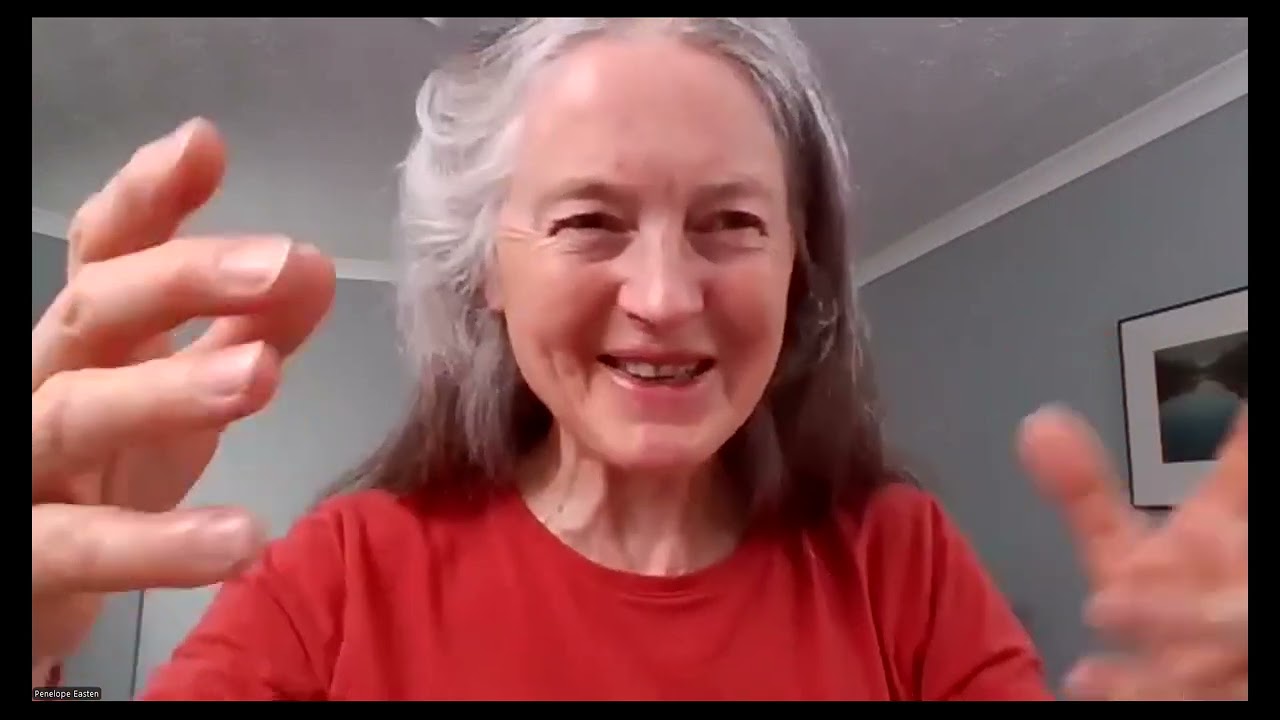
In this recorded workshop Penelope Easton guides participants through the Alexander Technique, focusing on the balance of gentleness and strength in the hands and the back. She shares her personal journey—from a childhood dancer to a zoologist whose back injury led her to Alexander work, through training with Carrington teachers, Misha Magadov, and the pioneering Miss Goldie—illustrating how different lineages shaped her practice. Easton critiques the modern tendency to swing between overly gentle or overly forceful hands, proposing instead a model of "responsive movement" where the moment’s needs dictate tone across the whole body. She contrasts the traditional brain‑centric, pre‑programmed view of action with an environment‑driven, animal‑like responsiveness, drawing on historical sources (F.M. Alexander’s own writings, the Delsarte method) and contemporary biomechanics (tensegrity, myofascial trains). The session includes practical exercises: nose‑feather visual guidance, decomposition/recomposition of limbs, withdrawing the "vital force" from fingers to shoulder, and using spatial awareness to lift objects with minimal effort. Participants report heightened tactile perception, improved posture after stroke, and a sense of the body dissolving into the environment. Easton then outlines her workbook (200 self‑work explorations) and the Book Study Club—a low‑cost, bi‑weekly online group that supports teachers and students in deepening their practice, especially for the over‑50 demographic. She emphasizes the need for teachers to balance hands‑on and hands‑off work, develop precise language, and foster pupil self‑responsibility. The discussion also covers imagery alternatives to the nose‑feather, the concept of responsive tone linked to presence, and the use of gentle myofascial pulls to reorganize entrenched muscle spirals.
Chapters
Bless you. You are absolutely right. Thank you. I will return to the beginning and start again. Apologies to all of you for hearing it twice. So, um, I'm Penelope Easton. Thank you so much, Carol, for telling me that. Um, I'm going to explore using our hands with gentleness and strength, and also about finding gentleness and strength for your back, because you cannot have one without the other. A little bit about me. I loved dance as a child, but I was far too uncoordinated and awkward then to dance professionally. So I went into zoology and trained as a zoologist and started a PhD and nearly cracked up because I was really in the wrong place. My back seized up and that's what took me to Alexander work. And I had lessons for 3 years, mostly with Carrington teachers. And then I found a place at Misha Magadov School. McDonald lineage. So I saw both sides of the, of the, of the main lineages in Britain at that time. So when I finished, I quickly built a practice, but within 6 months everything had gone haywire. I did not know how to look after myself. When we'd asked Misha during our training, how do we look after ourselves when we finish? He said, you get together with other teachers and you work with them. But life's busy and it's not a good enough answer. So that's what took me to Miss Goldie. And I worked with her for 4 years. Miss Goldie was one of the very first of Alexander's trainees. She started with him in 1927. And then she worked at the small school as assistant. So she did an apprenticeship training with FM and also under Irene Tasker. And then she did the first training course when it happened because she wanted to learn how to work with adults. And then she worked alongside Alexander for the rest of his life, and she was very close to him. So back to F.M. According to one of his pupils, F.M.'s hands were soft as a breeze and yet strong as steel. And that quote is from a woman called Miss G.R. in this book, The Philosopher's Stone, full of the accounts of— the only accounts we have of lessons taken with Alexander. from his pupils, and that's on page 59. Another of his pupils, Frank Hand, commented on his strong neck, straight as an arrow. My experience of Miss Goldie's hands also was that they could be soft as a breeze and strong as steel. And how do we do that? Because, um, in my experience— Hi, do you have a question? Can you unmute?
Mute, yes, sorry. So I was curious what the author of the book was that you were mentioning.
Well, it's just called The Philosopher's Stone, and it's Diaries of Lessons with F. Matthias Alexander. It's printed by Moritz. If you go onto the Moritz website, you'll find it. Moritz, okay.
Thank you.
You're welcome. So, yes, my experience is that as modern teachers, we tend to go between 2 extremes. We've often learned on training courses to let our hands be incredibly gentle, and sometimes I think that can almost become too gentle so that we no longer really offer support to our pupils. And sometimes I can find it disconcerting when teachers put hands on me and it's like there's almost nothing there. I like to feel where your hand is so I feel supported. So that's— I'm not the only senior teacher saying that, I know. And the problem is that then also those very, very gentle hands, they're not ready to respond when strength is actually needed. And when strength is needed, I think teachers often worry now that they're doing too much, whether it's to take somebody up out of the chair or for a strong action in life. My experience of first-generation teachers and many senior teachers is that they can go very easily, very effortlessly between very gentle hands and very strong hands. They can flow from one to the other without their hands becoming doing or hard. So what's going on here? And I think it comes down to responsive movement because I think this is what the Alexander Technique really teaches. Learning responsive movement is when we allow the needs of the moment to determine the level of tone required in any part of us. And for instance, when we come smoothly up out of a chair, we ask for responsive tone in the legs, As they slowly take the weight, and in the back as it comes into play to lift us out of the chair, rather than jumping and tightening everything, as pulling the head back, as, as we all did when we started, I'm sure. And when our hands are involved in responsive action, they don't work alone. They always have to work as part of integrated and responsive tone from the whole body. Whether it's taking a pupil out of a chair, lifting the kettle or walking the dog. Responsive tone is efficient. It's beautiful. It's pleasurable. It's meditative. And it's, I think, profoundly healing. And it's crucial for musicians in how they interact with their instrument. And we love it. And I think in many ways it's why we all do Alexander Technique, for that really nice feeling that we get when we move responsively in this way. So the alternative is that we are end gaining. We snatch, we grip, we use imbalanced patterns, often where the extensors are overused and— sorry, the flexors are overused and the extensors are underused. We've imbalanced everything. So what really is going on? So I'd like to suggest that responsive movement is actually organized by the environment. As I said, I'm a biologist by training, and I always ask, how did nature intend us to respond to a stimulus, say, to, you know, pick something up, which in nature might be pick an apple to eat? The old answer that neurologists might have given was that a response was organised in the brain. There's a picking apple off a tree or picking up my remote. program in the brain, preformed from previous experiences, ready to roll out to pick up my phone. And this assumes that my brain has a picking up the phone program which can be set in motion to do the job. And I think in this model, the subject, the person or the animal, was seen as separate from their environment, a self-contained unit. and the Apple or the mobile is another self-contained unit. And this model goes back to the ancient Greeks, I think, to Aristotle and his fellow philosophers, who told us that the brain was the important part and the body was a machine that ferried us around and digested our food and generally kept us going. As if the relationship between brain and body was that of being a driver in a car. separate from the world, navigating us, the driver navigating us through life, but somehow insulated from the world around us. And when we operate on habitual programs, when we just see that remote control and snatch it using a preformed habit, this is pretty well what we do. We don't— we're not in relationship. We are working. as a self-contained unit. And as you probably all know, it doesn't quite work. It's always slightly too much effort or slightly too less— too little effort, or it puts us into an awkward shape. Preformed programs are never quite right for the moment, although the brain does its best to sort of do a best fit from the preformed programs it's got. And that's end gaining. And for animals particularly, Modern biology is beginning to see things differently, that we are actually in relationship to our environment, a part of it, inseparable from it. And that any action— sorry, my grandchildren have given me yet another cold. Not too bad, this one, fortunately. Yes, that we're in relationship to our environment, a part of it, inseparable. Any action we do is drawn out of us. in response to what's happening around us. And think of a midfielder on, you know, a baseball match, and that ball is coming in a curve, and you don't— that curve is different every time. He's got to watch that, watch that, watch it, and coordinate with it in the moment. You cannot do that out of a preformed pattern. A juggler balancing something on his finger cannot be running a preformed program. And think of a cat stalking a mouse. The cat sees the mouse, smells the mouse, hears the mouse. And those sensory impressions draw the cat into a crouch and draw the cat into starting to stalk. It draws the behaviors out of the mouse until— and he's watching and watching and watching and watching. And if the mouse runs, the cat pounces. It's completely in relationship to what is happening in the present that draws the behavior out of the cat. And if we think back to our ancestors running around the forest, running after deer, again, no 2 hunts would ever be the same. It must have been the same as the cat. You have to be aware of low, low hanging branches and what the deer is doing and other smells going on and so on and so forth. It's an incredibly interactive— it's not running preformed programs. But the problem is for humans in our modern world, safe Organised, uniform, the same yesterday as it was, same today as it was yesterday. We can run preformed programmes. We can withdraw inside ourselves and be led by thoughts and ideas only. And that's our starting point. So let's play with this. I want you just to run a turning the head programme first. So just turn your head from side to side to Side to side, just doing a head turn. And notice that one set of muscles on the outside of the neck tightens to turn you that way. Another— the other set opposite turns you that way. And you can feel that actually all the other muscles in the neck are actually dragged along. It's really not a comfortable way of turning the neck, is it? It's quite harsh. So let's do something different. Let's run an interactive program instead, and just be aware of your surroundings, just receiving what you see. Come out of your head and into seeing what's there in the present. Let your pictures on your wall surprise you, or the stuff on your desk. Let yourself actually experience what's around you. And you might like to use a nose feather, just a feather that goes from the tip of your nose It's an extendable feather. And it goes right out to what you're seeing. And the end of it just brushes the surface so lightly. And then it can track along. And you just can track after your feather ever so gently. And so that's giving you very much a present moment of seeing because so often our eyes are slightly ahead of us. You really are where you're seeing using the feather. And also because the object that the feather is brushing is one end, but you are the other end of the feather. So it brings you into the, into the environment, into the environment you're in, because so often we don't actually experience ourselves in our environment. We somehow experience ourselves as separate. Just bring that feather right through to the back of the brain, to the visual cortex. To help this along, and you might notice that now your peripheral vision comes into play. There's a sense of space. Maybe your world has become a bit more three-dimensional than it was before. And so, keeping from the back of the brain, if you can, just let your nose feather continue to brush and to take your head round to the left as your attention. Led by the nose feather draws your head around, and you might notice that now can you even feel anything in your neck? It's silky smooth. There is just no sensation there because the muscles of your neck, of which there are I forget how many. I looked it up a few times. Sixties, a hundred something. There's an awful lot of muscles in the neck. Depending on how you count them, and they're in 5 layers or thereabouts, again depending on how you count them. And every single one of those muscles, when we move responsively in this way, is being self-organized to make a micro-adjustment so that every layer of the neck muscles and the fascia are being readjusted moment by moment by moment to take us smoothly. Where the senses lead us. And are you aware that this is very calming? It invites both your eyes to come into play, and it's much nicer. Now let's take this one bit further. Just let your eyes now come down, and you'll notice that your head nods. on the top joint of the neck and then take them up. And if you keep letting that nose feather lead you up, you can actually lift your head up without pulling your neck back. The head just readjusts easily on the neck. And let it come down again. And this time, let your whole body follow. Now, to do this, just stay with— stay with what you're seeing and let it draw you out of the chair. And onto your feet, being aware of your legs responsively coming into play as you come to standing. Stay with it quietly, quietly, quietly. Just stay present. Let your eyes draw you off the chair.
That's it.
And then let your eyes move around your room and spot something you'd like to say hello to. Like a child might spot a toy, just let your eyes— don't forget your spatial awareness here, keep seeing from the back of the head or you'll tunnel vision and rush— but let your eyes, the vision of what you see, draw you towards what you can see. And you're not being an alexandroid, being terribly careful about how you work— walk. You're just seeing something, keeping from the back of the head. So you stay part of the room as well and just let your eyes draw you into movement. Stay out of organizing the body, stay with the vision. And what do you notice? Just have a few goes at that and then come and tell me what you notice. Who would like to comment? what that was like? Don't be shy.
You can say something.
Did you have—
I think it is so amazing what you described. It's a whole different experience, you know, of how you approach things when you are interacting with your environment and just not separate from it. It's— there's a quality of smoothness, of purpose, purpose of being just the two of you together. And, you know, the thing that you're walking to, you know, there's a connection between the two that is so beautiful.
Isn't there?
Just—
yes, yes. You really come into relationship with what you are seeing. Yes, beautiful. Thank you for pinpointing that. Susan?
Hey, yeah, I, you know, I've— I wasn't paying attention to is my neck tight. I was paying attention to what my eyes saw and the softness of bringing that into my consciousness and then keeping the thought of the— so the feather helped slow down my jumpy eyes and then extending it to the back, of course, just kept me more grounded in the whole space. And so it was very— it's very lovely. Just lovely. Thank you.
Super. Dana, hello.
Hi, Penelope. Hi, everyone. I had the sensation of my body disappearing, kind of. I couldn't feel separate parts of my body. I moved around, obviously, so I was present and doing gently moving. It was very smooth, but I was feeling like separation between any parts. I didn't notice a hand or an arm, just the whole of me moving around.
Beautiful.
Yeah, reminded me of the feeling I had after my first lesson, which was in the '80s in Israel, a long time ago.
Wonderful. Nice to recapture that. And yes, it's quite rare we recapture that sense of a first lesson, isn't it? That's beautiful. You really open to something new there. Yeah. Yeah. Thank you. Anyone else want to say anything? Move on. Yes, I've forgotten your your name. Nama. Yes, that's right, Nama.
I I noticed the breathing. It's a bit easier, and and everything else.
Yeah, very light.
Beautiful.
Thank you. Great. Super. Thank you, Nama. And the person on the screen next to you, who again I've named I've forgotten, Shimon. That it's not.
Tova.
Tova, that's right, Tova. Yes, thank you. It brought me instantly to the very best moments that drew me to the Alexander Technique to begin with, which is silence, ease, and as though I'm part of the environment. There isn't anything there between us. Yes. And I think that is so healing, particularly in our modern society where we're all separated and fractured out. And we need to get this back. I teach this to pupils on lesson 1, always. It's my first lesson. And it gives them something they can work away with straight away at home. It gives them agency right from lesson 1. Thanks, Brenda. That's— thank you so much. Yes, one more person. Mary, was that— was that— no. Julia.
Yes, I just wanted to say your comment about teaching it on Lesson 1 made me think of a recent experience with a— it was an impromptu lesson for someone who was in crisis. And At the end of it, I asked her to just to stand up from a— we did a lie down, which is what she needed, letting her vision, you know, from the back of her head, lead her standing up. And she was so astounded at how easy it was for her to get from a lying down position to standing simply by allowing herself to be led by what she was seeing. Absolutely.
Absolutely. And people can learn to re-trust their bodies by doing this. Thank you for sharing that. Mary, briefly, and then we must go on. Hijab, do you want to put your hand down again? Oh, it's Anne. Right. Okay.
Just saying, and I now I can't remember who said she— you felt as if you disappeared. I felt exactly the same. I just wanted to say.
Yes.
Which is interesting because I hadn't. I was here.
Yes, it's strange, isn't it? And Tats just wondered if there's any First Lesson people that did not feel any difference. What would you respond to that? I've had one pupil, it was a pupil back in Ireland, and I worked with her for a couple of years and she never did get this. She was so locked in herself. The only thing she was aware of was her rasping voice. Things changed. I mean, things just did change. But we never did break through on that one. And I was very sad to leave her behind. I felt another couple of years' work and we might have cracked it. She certainly opened up a lot and we started to be able to get her voice back. But that one we never did crack. So, but I think she's more or less the only one. Sometimes people find it hard to be out and in at the same time. They can't come to the back of the head. If they think about themselves, they have to shut their eyes. And then I just, you know, we just take it gently until it comes. So it doesn't always work on this one completely, but mostly it does. Thank you for asking that. Mary, briefly, and then we'll go on. The only thing different that I haven't heard yet that I experienced is that the things that my eyes fall on have a vibrancy to them. And they almost are— I guess it's an eye thing. They're vibrant. They're colorful. They're appealing. Yes, we come into a part of the brain that experiences the thing as it is in its unknown wonder, rather than the part of the brain that looks at something and says, oh yeah, that's a cup. And doesn't look any further. And that's again what we're doing. We're coming into this other part of the brain, the right hemisphere, I think, is my— in my understanding, that sees things as they are. And that's the side of the brain that allows us to move into the— into allow unknown experiences rather than the left side of the brain that we normally work from, which knows the names of things and what they do and what we should be doing next, is the judgmental side. So this is the way I step people out of faulty sensory perception, is bringing them into this, into this awareness. And then people can work on themselves. And this is a key discovery because Alexander always taught us that we couldn't work on ourselves. And once you put this in, you can, as you've, I think, already discovered here today. So yes, thank you for mentioning that, Mary. So this is responsive action. Oh, Sharon, quickly.
Yes, yes, I just wanted to quickly say that I find looking from the back of my eyes quite a challenge because clearly I'm more used to looking with hard eyes. But what I found was looking from the back enabled me to soften my breath and feel like I had more spatial awareness. But for me, it's a real challenge to slow down.
It took me years. I will freely admit it took me years to open up the back of my head and allow to see from the back of the head easily. Yeah, it's for those of us who are glasses wearers, yes, hearing in front, it can be a challenge. Yeah, and sometimes it can be easier to take those glasses off and do it without. Yeah.
Thank you.
It's something just to keep coming back to. The short-sighted eye does that.
Yeah.
So I define this as responsive action, and as I say, I think it's at the core of the technique. So just to come back to the story originally, I went to Goldie because I didn't know how to look after myself. And she brought me to a place of such quiet presence that the room just came 3D. Now what we've done is done it the other way around. We've came— we've come 3D to come to quiet presence. But she used her hands to bring me to— and her presence, it wasn't just her hands. to bring me to that quiet place. The room would just come present. It felt as if time slowed down, and it brought me to that place of openness where I was present in the process and receptive to change without trying to interfere, and from which new movements could then emerge. Again, some of you might have experienced that you were moving in a different way as you walked across the room, for instance. And she showed me how I usually took my mind into my body to feel out what was happening and micromanage it. And when I first started lessons, that actually was very exciting because I'd been so dissociated, I had no sense of where my hips were. And so actually to be able to take my mind in and go, oh, there's my hips, wow, they feel nice, was amazing. And now Goldie took it the next step and said, out you come, Milas. Your mind is in your brain and your brain is at the top of you. And she would get quite frustrated because I would keep trying to pull down again. No, no, no, no, no, come on. Mind is at the brain, brain is in the head, the head is at the top of you. She defined the mind as that part of you that moved around. The brain, of course, is a fixed organ. She didn't teach this to anyone else. I was so lucky that she taught it to me. I think I was such a mess, she had to pull something out of the bag to get me to understand. And yes, it is the same as Missy Vineyard's coming up to the attic. It is exactly the same thing. Yes. And, um, so she showed me how I was over-involved in sensation, and she would take me— um, oh, I haven't put myself back on speaker view. Let's do that. So, um, she would, um, take hold of one arm, take it out to the side, me staying out of the way so she could do it, bring it back. And then she would say, 'cause this hand would still be down here, she would say, now you do the other one. And of course, to start with, I would be micromanaging it and I'd get told off because she always told you off. When you're 86, you really don't care. And she really didn't care how abusive she was. I had my magic raincoat that I put on. Her anger is her business. I can just listen for what the real message is. You don't know what you're doing yet. That's okay. So, so she would— after a few lessons, I learned I could stay out of the way. I could keep my mind in the brain. And then somehow I could give consent and the hand would move as if by itself onto my lap. And then lesson 6 arrived. I was not to be passive in the process because my first lessons and indeed my training really when I was worked on, I learned to be passive in the process. I wasn't particularly asked to think. I was asked to give my weight to them and let my arm be taken in a way that was heavy and so on. And not given any homework, not really taught to do anything other than lie down. And for Goldie, that was unacceptable. I got really told off if I gave her my weight, and she wanted me thinking. And so Lesson 6, she started with her saying, How many lessons have you taken with me so far? Um, 6, Miss Goldie. I don't know why you bother. You have not begun to think for yourself away from here. And I subsequently learned she often challenged people round about lesson 6. She wanted to know whether you were really going to work for her. And but that lesson she tiraded at me. She just didn't let up once. And I was in tears. And a part of my brain was saying, I could just walk away from this. I don't need this. And another part of my brain said, I can show the old bat. So that when I got home, I went to put the kettle on. And I was about just to leap at it in my usual way. And I went, no, stop. Let's bring myself to this deeper place of quiet that she's been showing me how to come to. Just let the room become still. And just keep my mind, bring my mind to my brain.
Just Just see.
She didn't mention the seeing, but I'd already done a lot of Bates, so I had a sense of that already. And then now just give consent for my hand to move to the kettle. And something completely different happened because my hand came to the kettle by itself and it used exactly the right amount of force to lift that kettle. In those days, there were no little gauges on the side to tell you how much water was in it. So, you know, kettles in those days were always a bit of a guess. You either used too much or too little because you never knew how much water was in there. But my hand knew exactly how much to bring because it was responsive to the kettle and I was in relationship with the kettle. And it was so different. And it was a life-changing moment for me. I went back to my lesson next week all ready to tell her about it, but she already knew. And after that, I was in. So this process that I've just described actually turns the Alexander Technique completely on its head. Because the way I certainly was trained to interact, Misha would, when we asked Misha, how do you say pick up a phone? And he would demonstrate. I mean, the phone in those days was on a low table. It was a landline. And he would say, right, well, you stand there and you see the phone and then you let go of it. And then you organize yourself by thinking your primary control directions. And then when you've got everything going, you take a lunge and you keep your back back and you go into a deeper lunge until you can put your hand out and pick up the phone. Now, that's all very nice, but I have never ever seen a child pick up a phone like that or anything else. It's not really how Animal— well, it's not how animals do things. It's not in relationship to anything. It's back to that self-contained model. And I'd always wondered how Alexander developed the technique. And early on, I asked a senior teacher this when I was visiting a training school. And she said, oh, Alexander was a very clever man. We can't do that. And I thought, fudge, you don't know. And now Goldie started to give me an answer to it. He said— she said that everything that Alexander did, he was in responsiveness, responsive interaction in the moment in this way. So that when the action was called out of him— Oh, there's my neck being free and my head going forward and up and my back lengthening and widening and my knees going away. Every time he moved, he found primary control again. So he didn't impose primary control and use it to move as Mischa described. He turned it the other way up. And Goldie told this quite specifically to Fiona Robb, who also, who wrote up her lessons with Goldie as a diary. And I later used, learnt more about how good use emerges from Erica Whitaker, and it's her see across the room. She taught me that, see across the room and then let yourself come into response. Goldie told me Mr. Alexander would make more discoveries making a cup of tea than most teachers make in their entire lives. Well, that's all very well, but most of us weren't shown how. And that's unless you were trained by Marge Barstow, because she did know more of this process, I think. So let's find another way of balancing the muscle patterns that doesn't involve this rather laborious process that I learned from Misha. And my research on FM's earliest explorations— many of you will know I'm researching the origins of how the technique really evolved at the moment— and it led me to the Delsarte method. Which Alexander was teaching back in the 1900s. We have a business card where he says he's a teacher of the Delsarte method of gestural training. And when one reads the Delsartians, their first exercise is always decomposition and recomposition, which is an ugly sort of phrase, but we'll explore some more phrases in a minute. Del Sarte saw that people's minds were tangled in their bodies and that that created harmful habits. It's interesting that really relates to Goldie telling me my mind was in my body, over-involved in my body.
Excuse me.
Yeah. And the answer to this that Delsarte discovered was that you have to withdraw the mind back out of the body. And he didn't call it the mind. He said you withdraw the will force, the vital force from the body until it is limp. And then the channels are open and you can then flow energy back through those channels and A new pattern of muscular interaction, of a muscular balance, will come about, which if repeated will change your habits for better patterns of use. So let's have a go. If you'd all like to stand up. Excuse me, coughing and blowing. So if you Put your arm out to the side. And to start with, just release the hand. Just let it collapse, as it were, and then bring it up again. And that was done specifically at the point, you might notice. Now instead, I'm— I want you to do something subtly different, which is I want you to withdraw the vital force, withdraw any mentality. Out of just your fingers to start with and see if the knuckles— the fingers will just drop from the knuckles, and then they just might be quite, quite relaxed, quite floppy. But you've left the rest of the arm still energized. Now I'm going to withdraw the vital force back to the wrist. And now I'm going to withdraw it back to the elbow. The lower arm is still just a floppy thing. It's now a floppy thing, but the upper arm is still alive. And now I'm going to withdraw it back to the shoulder. The arm just drops. And now I'm even going to withdraw it out of the shoulder, right deep into the centers of the body. Go. And Delsarte talked about withdrawing the forces from the circumference back to the center. And if you now swing your body around, your arm will just swing. For Harry Potter fans, you might remember that point where Professor Lockhart did a spell which took all the bones out of Harry's arm. And your arm at this point might as well have no bones in it. it. And now we're going to regrow the— regrow the bones, just as Harry had to go through that night, which was a very painful process, using Skelegrow, I seem to remember. Oh gosh, I know far too much Harry Potter. And just send the energy now from the centers back to your shoulder and feel it come alive again. Send it back through your upper arm. Lower arm is still decomposed. Send it through your lower arm as far as your wrist. You're very specific in where you're sending it. You're sending the energy now through to the knuckles and then through right to the fingertips. Do it again. Just withdraw that vital force, keeping the mind in the brain. Just withdraw any vital force, any over-involvement, any involvement out of the fingers. They will just fall as if lifeless. Withdraw it back to the wrist. Withdraw it back to the elbow. Withdraw it back to the shoulder. Withdraw it right into the center of you. Feel the collapse of that shoulder. And now send it back again. Feel the shoulder just enliven. Send it back through your upper arm just as far as the elbow. Make sure you've not gone any further. This is great body mapping. Send it right through to the wrist. Send it right through to the knuckles. And then send it right through to the fingertips. Feel them all wake up joint by joint by joint as that energy flows through right to the fingertips. And now take your arm for a little exploration and just being aware of the quality of the arm now. It And maybe now pick something up and see what it's like to pick something up. Touch something, use your hand in some way. And what do you notice? So if anyone would like to share.
I noticed that the, um, The haptic senses sense was greatly enhanced, so that I I really felt the the quality of the of the stuff that I was contacting.
Yeah, really woke up your touch. Beautiful. Thank you. Yes, anyone else want to comment?
Yes, me, Margaret. Margriet. Margriet, ja. I think it was more floating and it really came from my center or my body in connection.
And I teach horse riders and Alexander Technique, so I think it's a great tool to do with horse riders too. Yes, absolutely. Thank you. Lovely.
Hijab or Anne? Go ahead. Okay. Anyway, it was just the same. I noticed that You can really— you feel the responsiveness once you flow the energy again. You really feel it's a different hand almost, you know, which is before it was automatic. Now you are, you know, kind of, as you said, responsibly molding it to pick up the thing that you want to pick up. And also you feel the textures, the, you know, everything is more Alive.
Super lovely. Thank you. And did you want to say something?
Well, just thinking about it, I kind of felt myself disappear again. And then I was surprised that I was picking up a pen.
Right. Nice. And Dana comments that I notice a huge difference between one arm and the other to pick up the same cup. Nice, thank you. The same object. Rosa, the other hand.
Hello everybody, it was a very lovely experience of directing, following your directions and experiencing the freedom in my finger and hand and arm. And because I had an accident last year, I have now a wish to explore what happens in my walking if I begin this process. I might be able to undo the stress which I have in this healing process and to undo the unnecessary effort for the walking which I have to relearn again. So thank you very much. This is, I think, a very— it will bring me a good discovery.
It's a profound process actually, yes. And you can decompose any part of the body. The Delsarte books give instructions for decomposing the legs, the backs, the eyelids, the lips. I mean, they decompose everything and then recompose. And somebody this morning People were saying this morning in this morning's group that decompose is a bit of a— I mean, to us it means like decomposing rubbish. And that perhaps deconstruct and reconstruct might be friendlier because what you're doing is you're breaking down the existing structures, the existing patterns, and then rebuilding them again. That's what those words actually mean. And those of you working in a foreign language, that, you know, you may need to find a different phrase for that. It is a very powerful process for Some— there were people this morning again who had injured arms and were finding it really, you know, allowed the arm to wake up and work again in more balance. Yes. And Sue, of course, I don't know if you're willing, Sue, to tell what happened to you a few months ago when you did this for the first time.
Yes, I am. It was amazing. I'd had a stroke and I couldn't use— I couldn't knit anymore. For knitting you need 2 hands. And suddenly I did this exercise and it all came back. And so after the class that I was in, I went to try the knitting and I could knit again. It was just amazing. I hadn't knitted for about 4 months.
Wow.
And I tried, but I couldn't get anything. But now it just sort of I admit it's just amazing, that exercise. I do it all the time. I do it for both arms. It's just one of the things that I keep doing. So thank you.
Thank you.
No, it's, I mean, that's just, it was just amazing to see that happen. It was. Yes. I use, Tat says, I use the word remember for our body parts for a similar thing. That's nice. Yes, remember. And Tessa says deep arm workout vitality.
Nice.
Yes, thank you. Okay, so Effa, this work I think may well have been the basis for Inhibition and Direction. Miss Goldie told Fiona Robb on her very first lesson, I don't like the words directing or thinking. I think they've lost their meaning. Mr. Alexander was always searching for simpler words. It is about decisions and energy. And I don't know if you've been aware, you have noticed the energy you've just been flowing. You also took some very clear decisions. I'm flowing it here, but just to here, and so on. So I'm flowing, I'm letting it go. It's, it's very precise brain work, this as well. Because our bodies are heavy, they're weighty, and it's energy that mobilizes our weight. Carrington talks about this in his little book Thinking Allowed. those nice talks on the technique that he gave. And he points to a footnote in The Use of the Self where F.M. writes, when I use the phrase, I directed the use, I'm meaning the process involved in projecting the messages from the brain to the mechanisms. And he means the mechanisms of movement. And then in conducting the energy necessary to the use of these mechanisms. So it's not just about thinking about a part of the body, sending a message to it. To make something happen, to move, you actually have to flow energy through it. And again, I think sometimes in the modern work we forget that. It's become a bit too non-doing and it's become not doing. and it's lost this enlivening. Goldie hated the word release. When I released my shoulders, she saw that I collapsed them. And she would tell me about them in no uncertain terms. She would say, you've just collapsed your back. And in effect, I was decomposing them, letting them become lifeless. And she saw herself as bringing the gift of life. For instance, no ego trip there, but that's what she said to a couple of people. I give you the gift of life. But she did. I mean, it was true. So for instance, I wasn't to release my legs sitting. She told me that FM would go around the first training course saying, you've got intelligent knees, you haven't got intelligent knees. And what on earth did he mean? Now Goldie helped me see that my legs, my knees had to be in intelligent communication with the rest of me. So let's play a game on this. Just as you're sitting there, can you see me, by the way? Can you see my legs? No? Let's put the video down a bit.
It's better.
See me now?
Yes.
Good. So as you're sitting there, just— and you've probably got your legs beautifully organized, I hope, you know, flat on the floor, knees pointing forwards and away and all that— but just check out whether they've actually got any life in them in this moment. And just let's check that out by actually bringing them into some drumming. And just drum them up and down. And then let them come back to rest very gently so that the life stays. Now, what do you notice is the difference in your back? Do what you might normally do again and just let the legs go. And again, just drum them and bring them back to life. And what changes? What changes in you? What changes in your back? Anyone like to comment? Hijab?
The back becomes alive immediately. It just switches it on completely in one second.
Yes, absolutely. Anyone else want to add to that? I don't know how to say it.
It— I got more space in In my back. And I guess not a decompose, but a release with more energy through it.
Yes. Yes. But it integrates, doesn't it? Sue, do you want to add to that?
It becomes straighter.
Straighter. Nice.
I sit up.
Yes. Yes. It sits you up. Your legs support you, don't they? Susan? Did I say something? You did. I saw you unmute, but maybe you didn't. Oh, I'm unmuted. I didn't. Right, okay, no worries. Yeah, support, says Tessa. Lovely. So let's play a second game around this. And Goldie was always telling me about legs need to be alive, they need to be interactive with you, that we tend to think of them just as tree trunks to stand on, but they are for movement. So here's a second game. Let's play with releasing the shoulders. So what I want you to do to start with is lift your shoulder right up, nice and tense, and then think, I can release my shoulder, I can do less with my shoulder, and let it drop down. Plonk. And release happens like that, doesn't it? Now lift it up again. And she would tell me, don't release. So I want you to think the phrase, I can do less with my shoulder, I can do less with my shoulder. I can do less with my shoulder. But choose not to let the shoulder just release in response to this, but do let it respond to what then happens as you keep saying this phrase. I can do less with my shoulder. I can do less with my shoulder. Notice what's happening in the shoulder, but also in the rest of you. I can do less with my shoulder. I can do less with my shoulder. I can do less with my shoulder. I can do less with my shoulder. And what's that like now? Who would like to comment? Wider, Gertrude. Nice. Thank you. Anyone else want to comment? Yeah, my, my breath. I mean, it gets quite easy, free.
Upright.
Yeah. Beautiful. Thank you. And nice to see you here, by the way. Yeah. Hijab.
I felt when I was holding my shoulder tense, it was like standing away from, from me. It wasn't very part of my integrated body. When it came back, you know, kind of when I was doing less, it was more integrated. There was more tone equally distributed. I felt more like a transeguity, you know, that unit versus one whole Yes.
So, so there's 2 processes going on. One is that some muscles are letting go, but it's— they're happening in the context of other muscles switching on, aren't they? That's right. So it's very much a balanced process. Julia, very quickly.
Yes. The second time I could feel the nerves and the skin coming alive as the arm was released. And as if more blood flow was getting to the area, whereas with the sudden release, the dropping, it was almost like an impact that tended to dull sensation.
Yeah, nothing really changes, does it? Sharon?
Yeah, quickly, yeah, I obviously have some work to do here because my mind kept going down into my body. I couldn't stay up in my brain.
So yeah, Yes, that's something, as I discovered, takes a bit of work to get. Thank you for sharing that. That's honest.
Yeah.
So, you know, if you're not there yet, as you say, there's work to do. We think of Alexander lessons as relaxing. Goldie's lessons were not relaxing. They were precise, exacting. You were there to work, to think, and a lot of people have written and talked about the fact that she got you thinking. But I think her work was not just about thinking, the difference of her work as is often portrayed. I mean, she saw that my strong back, 'cause I was very good at sitting with feet apart and, you know, hands on legs like a good McDonald person. And she saw that when my back was fixed and she just released it and it collapsed. I didn't know how to sit up. And then over the next 6 months, she rebuilt it slowly from the inside. She rebuilt it from the core so that every single muscle was involved. Every single— so she didn't name it in that terms, but that's now how I understand it. Until I had a truly strong back. And she, it seemed to me that she was using a very different biomechanical model in this. She used moves I'd never met. I think people in other lineages may have known those moves, some of them, but certainly I didn't. I now know they were first-generation procedures. She told me not to release, but instead I was to maintain tone. And she didn't focus so much on my head as previous teachers had done, always working around the head-neck joint. She worked much more on the torso, bringing that strong, integrated, and into play in a balanced relationship. And with the legs, of course. She didn't lie me down once except Once with a specific learning goal of how to connect my legs with my torso, she worked with chairwork and other upright procedures so that every part of me supported every other part of me. This is the tensegrity— thanks, Mary. This is the tensegrity model, that every part of the tensegrity model is self-supporting. It doesn't weigh on the next part down. Every part is part of a self-contained unit that actually then operates in a whole integrated way. And this is particularly important, I think, for people who tend to be a bit scattered, falling apart, collapsed, hypermobile. Goldie really put me back together, whereas previous teachers had loosened things apart. She put me back together. And she was not afraid of doing too much. At times her hands could be very strong indeed, despite her being 86 when I first went to her. And 90 by the time I finished. And so let's have the full quote now from Miss G.R. that I read out at the beginning. And this was in her 20th lesson. Alexander began by showing me how amazingly flexible his joints are. Each separate part of his fingers seems to be coming out of its joint. And his hand seems to be coming out of the wrist joint, and his forearm out of the elbow joint. Such suppleness, like elastic. How I envy him his supple joints. They make his hands soft as a breeze and yet strong as steel. So it seems that another aspect of this gentleness-strength equation is extension throughout the arm, brought about— what? I'm going to call a pull-off the joints. And I've got this phrase from George Trevelyan, whose diary is also in the, the Philosopher's Stone book. Contraction and pressure onto joints is brought about by the overaction of certain muscle sets. The message gets first to the wrong set. When it gets first to the right set, you get what we loosely call a pull-off the joint. To change the message involves inhibiting the end And sending the order for the use, which involves the lengthening pull. So how do we do this? And here's my way of finding the pull-off, the joints in the arm. And while seated, That's right. Can you see my hands and my knees there?
Yep.
Um, so put your hand on your thigh. I suggest you just use one hand at a time. You might like to use the one you didn't decompose and get— give this side a chance as well. Just pointing your fingers down towards your thigh. And let's start by finding spatial awareness, letting yourself receive the room across the space, your nose feather tickling the, the room, brushing the room, seeing right through to the back of the head so that you come into spatial relationship with your room. You might be aware even of the volume of your head that you're seeing through, and then the volume of the room that you look through until you see the chair or whatever it is that you're looking at, and even being aware of the volume of that thing you're looking at. Everything is a series of volumes, not just point references with names. And once you've got that spatial sense, being aware there's a spatial sense within you as well. And so from the mind in the brain, your hand is actually a long way down. And so just see if you can get that sense that your hand is a long way away from your brain. And then send a message to your hand that the fingers are going to lengthen away from the knuckles. Don't do anything yet. Just connect the message from the brain to the muscles and to the fingertips. And now give consent to energize that. Send some energy through. Don't think about it that way. If you go straight to the hand, you'll put your mind in your brain. Staying with the mind in the brain and just letting the energy travel down the arm like we did when we recomposed, and let it flow into the fingertips until your fingertips actually Extend away from each other. Those joints of the bow— of the fingers extend away from each other, and the fingers lengthen off the thigh, but not the knuckles. And now let those fingers continue, send— continue to energize them that way so that they exert a lengthening pull, and they start to lengthen the whole hand off the thigh, but not the heel of the hand. And now keep that lengthening pull going to the fingertips. And the wrist lifts off, the lower arm starts to extend. And now keep it with the fingertips, and if the fingertips keep lengthening away, the whole arm will follow. So now take this arm for a little walk in the air, and it's very easy to let the shoulder or the upper arm or the elbow or the wrist take over doing the movement, or even the knuckles. Keep the energy right through to the fingertips, which we very rarely do. And it can help to imagine a cat in the air that you're stroking, just being aware. It's like the nose feather, but now your fingers are stroking an imaginary cat. And if you don't like cats, make it a silk thread or something else that you like. And that can just feel these just stroking the air, being aware of being with the fingertips. And you might notice that your hand just Your hand and your arm just follows along. And I always have to sense myself that my fingers are a little engine. I'm thinking of my grandchildren's train sets, and the little engine sets off, and first one coach, and then another coach, and then another coach is drawn after. And they have no motive power of their own, but they have to follow where the engine leads. So just see if you can find that, that they The fingers stroke the air. That's where— but staying with mind in the brain, you're watching them almost as if they're not your fingertips anymore. And the rest of the arm follows as if it's rope, as if it's that arm without bones that we found earlier, except now it's vitalized. It's vitalized but yet non-doing. Now put a little string on your elbow. Keep your fingers stroking the cat, put a little string on your elbow and just give a little pull, and you might find that the— there's a lengthening pull put on the forearm. And then you can put a string on the wrist and take it across that way and let the wrist— if the elbow still has its string going that way, there's an oppositional pull and the forearm is lengthened. Alexander talks about that one, of course, in Hands on Back of Chair, the pull off the wrist. But let's explore the fingers. Send a little finger away. Send your little finger away. What happens? And now send your thumb away. Don't thrust it, but let again there be a lengthening pull off the thumb which draws the hand after it. By the middle finger, let there be a lengthening pull off it that draws the hand after it. Take the elbow back so you've got space. By the index finger, Let there be a lengthening pull. Let there be a lengthening pull off the ring finger. Let's look at this image of FM working and just look at how alive his fingers are. Every single finger has a direction. It's lengthening. It's lengthening. That one's lengthening onto her cheek. The thumb is doing something at the back of her head. That one, I think, is onto the side of her neck. Those are onto the collarbones. They're very precise. And yet the hands are clearly lengthening away. And he has— he's staying back, isn't he? There's full of space. And his hands are strong. And yet I'm sure gentle, connected, strong. So anyone like to comment on that little game on FM sounds? Nope, you've all gone shy. Did you find it? Hidjab?
I found it very amazing because it was very interesting to have that pulse in a different direction and to feel how, how the lengthening across the jaw joints was happening. It was something I have never experienced before. I've been told this, you know, before, but I've never experienced it myself. But this was my first experience of it. Thank you. Amazing. Thank you so much for that. I really appreciate it. So like the lengthening and the pulling in different directions was just like, whoa, whoa is the only way I can describe it.
Thank you, Heejung. Thank you, Susan.
Yeah, I— part of me is getting it, and part of me is feeling like I'm overworking in my upper arm, and I don't understand what I'm not understanding. But I do sense what you're saying about the— I love the idea of the different strings pulling the fingers in different directions. That really helps me. But I wonder what's going on with my other part of my arm and all that.
I think we're very used to overusing the upper arm. I took months and months and months and months and months to be able to do what I've demonstrated today. It was a lot of work, you know, thinking about going up to the coffee cupboard and being aware my shoulder's led, my wrist has led, something else has got involved, and actually to let the whole arm follow. It does take a lot of work to find it. Yes, and we will be doing it in the Book Study Club. Bill?
And then I think there's a danger. I love the decomp book.
Come closer to your microphone, Bill.
Sorry.
Can you hear me now? Yes. Okay.
So the danger is if you do this pulling to the elbow thing, you get exactly what I think it was Susan just said. that the humerus, the upper arm, shortens. And I think it's very important to keep the lengthening going all the way from the sternum through the collarbone, through the humerus, through the— so that the lengthening that you've been working so beautifully to establish Isn't that— doesn't get short-circuited By pulling to the elbow. And I see that a lot.
Interesting. Thank you. And of course, I'm doing this on an introductory workshop rather fast. I mean, really, this is an hour and a half's lesson in itself and looking at individual people. Thank you for your— thank you for saying that, though. That's good to hear.
Sue.
If you compare the arm that we've just done that exercise with With this hand, which is the other hand in my case, it's physically grown.
Lovely.
And this is, this is all relaxed. And this one isn't.
Super. Now let's take this to the big one, which is I want you to get a weight. Keep tipping the speaker. Now I've actually got a dumbbell here, but take whatever weight you've got to hand. It might be a water jug or a big stone or a heavy book, anything that you can find that's heavy and that is going to challenge your arm a bit to lift it. And give you a moment to find something. We're running out of time here as usual. That's it. Good. Everybody got something? So to start with, just do what you might normally do of take hold of it and pull it in towards you. And you might see I've actually contracted my flexors of the hand. My bicep is now really overworking. I've hunched my shoulder. It's into my chest. It's up to the side of my neck. I've had to tighten my jaw a bit. So that's what we might normally do if we don't pay attention. And the second one, I'm going to think I can do less with my neck. I can do less with my neck and do the same thing again. Well, that's certainly nicer. And now we're going to try a third way, which is we're going to come back to spatial awareness and use the hand that we've just been finding the lengthening in. And just this time, Sending it away from your head, just finding that spatial awareness that way and that way, and sending your fingers away from your head so that they just lengthen down. And then if you keep sending them down, if you keep energizing them right from the collarbone, this, uh, and the sternum, this, uh, Bill has just reminded me, um, and let them stroke a cat in the air, let them lengthen. And now we're going to let them land ever so softly on our weighty thing, but just not do anything yet. They're just going to have an encounter with it as if they've never experienced this object before. Experience it as an unknown thing. I'm aware of its texture. I'm aware of the angles of it. It's got a slightly rough texture. It's got these amazing angles to it. And I'm just letting my hand Just have an encounter with this thing. And after a while, my hand just might just roll around it, just fold around it. Now, I'm not— when I fold around it, I'm, I'm letting the hand literally just fold around like that rather than tighten in. So just let your hand flow in such a way that it just Flows around, and it's just there. But you can't lift it at the moment because your hand is in this lovely, gentle, perceptive state, and it can't do anything. It's too— there's not enough power there. So we're going to send some energy down the arm, send some energy into the arm, and there's still not enough to lift. Send some energy in, and now I become aware that the rest of my body needs to get involved. So I'm going to Send energy all the way down my legs and all the way up my back, and in fact even all the way up into my neck, and then the weight just somehow comes with me, and it's a very different sensation. So again, would anyone like to comment on that?
I just love this sensation because I— my inclination is always to grip my dumbbells and say, ah, got to do it. When you gently move this way, you're just using only the muscles that are needed, the power that's needed, kind of flowing right amount of energy and just not, you know, getting jumping at it.
It's absolutely— and the arm works out how much energy to use, doesn't it? It seems like it became lighter, says Gertrude. Very nice. Bill?
The better I do that, the more I succeed in what we're working on, the less my arthritis hurts.
Isn't that wonderful? Isn't that just beautiful? Yes. Thank you. Believe me. Yes. It's well worth doing the work if you have pain. It really is. Yes. Thank you. I'm going to carry on because we're running out of time. I spent 30 years trying to work, exploring how and why Miss Goldie's work was so very different to the other teachers I'd encountered, and it took me to very many different teachers and also other disciplines. Now, I've also heard that teachers in other training schools didn't always find her work so different. But for me it was, it was startlingly different and it really woke things up. From Erica Whittaker, I learned to use the eyes and our attention to lead us into responsive movement, as we did today with walking. I first explored Alexander's early breathing work with John Hunter and found out how breathing is a responsive activity as well. The body does for itself. Much later, I worked with Xandeu Mazuero, who had been exploring the pulls that FM mentions occasionally and the alignment or whole body coordination seen in his photos that accorded with what I experienced of Miss Goldie's different biomechanical model. Um, it was Jando who put me on to exploring the Delsartian work, and from all this input, I linked the work to tensegrity, to Myers Anatomy and myofascial trains, I worked with Philip Shepherd and deep embodiment that brings in whole body intelligence that I felt linked back to Goldie's work of bringing consciousness into the whole body. And more recently with my historical researches, I found the same directions and qualities in the writing of other first-generation teachers. And from all these inputs, I've developed self-work procedures where you can bring these qualities about for yourself, as you've hopefully experienced today. And my book is, you know, it's a workbook. There's 200 explorations, each of which work on a different area and get every part of you working. I noticed that more and more pupils want to know how to work on themselves at home. They're not any longer willing just to be passive in the process. And they also want to to know how to link our work to their fitness routines, their yoga, their Pilates practices, their dance, their athletics. And I think the importance of gaining and maintaining strength is being emphasized, particularly for the over 50s, a lot of whom are lifting weights. Look at how many people actually produced a weight today. That wouldn't have happened 30 years ago. And then the over 50s are our target market often. So if we are not dealing with this, We're missing out. We've been helping them do running for years. We need to help them lift weights. So let me summarize what we've done today. We've discovered responsive action, the core of the technique, which comes out of this deeper level of inhibition, so that when you move, you allow yourself to be drawn into movement by choice, intention, consent. And yet you're still in a state of calm. Just as we did allowing our necks to turn following our attention and then to be drawn to walk across a room. We are self-organized by our attention from a deeper place in the brain. Natural breathing also comes out of this process. And in this we come into a different relationship with our world, out of being self-contained and into a relationship with what is around us and also into a different relationship with our own bodies. That brings us out of judgment and anxiety to get things right and into just quiet openness to experience the unknown. And you can then work on yourself. This is the key to working on yourself. And all this allows you to build more tone. We're not releasing it. We're integrating and balancing just like we did with our shoulders. And did anyone notice when we moved our fingers through the air that tone involves presence? If you switch off, your fingers will switch off. Tone and presence absolutely go together. And this is why this work is so meditative. It's mindful, to use the modern word. And now we have responsive tone. We can increase it to greater levels when needed, drawn not only from one part but from the whole body, as you experienced when you picked up your weight, hopefully. And with tone, we can then use gentle responsive pulls to the myofascial lines to help ourselves sort deeper problems that maybe the work so far has not touched in us. We haven't got time to explore that today, but I'm thinking perhaps of a couple of dancers who danced professionally all their lives and their legs were a complete, you know, imbalance of muscle spirals. And while a teacher can unwind your legs to a degree on the table for us, You can get a much stronger effect for yourself by using pulls to bring about this reorganizing of the muscle spirals. So we can get really quite deeply into our own process. And the brilliant thing is then we can do it every day until the— and you couldn't take lessons that often. You, you, you, you can do it for yourself and you really can get change. So this is a deep process. The senses and the head lead the movement, as Alexander taught us and as we discovered today. But it's powered from the legs, the torso, the back, and the pelvis. And that's not something Alexander talked about, although if you read his early writings, it's clear that's what he was doing. With the use of the self, it all became about the head-neck-back relationship. And I think we lost that earlier connection to the lower body that was there earlier. And again, this needs exploring. Elizabeth Walker was heard to say, it all comes from the feet. Erica Whitaker told one pupil, free your neck right down to your feet. They saw the whole thing in this integrated way all the time. And this is the process my book describes, whether for life activities or Alexander procedures such as coming on toes or sitting and standing. And this is what you will learn to an even greater depth if you join the Book Study Club. So let me just describe the club. Anyone with a commitment to working on themselves is welcome. And we work systematically through the whole book because it's a big book. It's heavy. It's physically heavy. And there's an awful lot in there. And each— we meet every 2 weeks. Each time we meet, we— there's a number of pages that people have read and played with. Because if you just read it, it's a waste of time. You've got to experience it. You've got to actually discover it in the body. And in sessions, at least half the session is exploring these and working through the explorations together. There's time always for asking questions, whether it's questions about somebody's individual experience, about a problem they're having, or people bring problems they're having with their pupils. Or with their mother trying to get their mum to stand up straight, whatever. So it's a real, it's a real learning environment. It's a learning adventure. And we work at the pace each group wants to go, which is why I can never say in advance how long a group is going to last. It can last anything from 20 months to 2 years. And that sounds a long time, but It's actually a whole retraining. It's a deeper level of training. Somebody who's just finished just sent me a video in which she described it, that she said she was very proud of herself for doing the whole thing. And she said she felt like she'd just completed a master's in the technique. She said her first training, the 3-year training, was her bachelor's. And now she'd done the master's and she felt so much more confident, so much more equipped. And a lot of teachers have commented this to me, and people have seen profound change in their own bodies, their own relationship to their lives, and so on. And we take time to ensure that every aspect of our vision, every aspect of our breathing, every aspect of our musculature is working well. And incorporating. So we look at individual bits, and then always we reference it back to the whole use, because of course bits do not work separately. We're waking up each part in order to wake up a better integration of the whole. And in the book study club we go into greater detail of this than I'm able to go through in the book. Yes, it's fine to work with the German text. That's just fine for those who Have the German text. It's wonderful we now have that. And we work on detail of everything to do with the hip joint. There's all sorts of muscles in the hip joint. We get them all switched on, all the deep core muscles, everything around the shoulders and so on. And it's just amazing to wake everything up, everything in the neck, everything in each myofascial line. Everyone who wants takes a study buddy. You can join with a friend, as Anne and Hijab did, or you can— or I can sort somebody for you from the group. And that means that after every session you then get together with your study buddy, and you go over what's happened and play with it, playing the role of teacher and pupil. And for teachers particularly, this is extremely valuable. Because it helps you articulate often a different language. Because our trainings often didn't teach us how to verbalise how pupils should bring about change for themselves. And if we don't have that verbalising, we can't teach them how to do it for themselves. So you'd probably be working online, and even if you have no intent of ever working online again, online work is a tremendous discipline. Because you can't use your hands. You have to observe in order to see what your pupil is doing. And then, having seen what your pupil is doing, you then have to work out what to say in order that they can bring about a change. And then you see what happens. You watch the phrases you use which enliven your pupil, which get something changing. And also you watch the phrases you use that switches them off. So It's a fascinating process of observing and articulating. And then you have to get them to articulate back to you, which is again a very valuable part of teaching that I think the original teachers didn't do because they just saw, you know, everything people experienced as faulty sensory perception. And I think that does pupils a disservice. Their experiences may be a faulty sensory perception, but there's nothing wrong with that. And they may have some real genuine experiences that it's helpful for them to articulate, and then a means whereby first principles of how to recreate that for themselves, or not, because you can never quite recreate it, of finding their way to it again. So for practice for pupils, if we can, we join you with a practice teacher, because again, then teachers can practice, or you just We get you together with another pupil so that you can play with it together and work things out. It depends on numbers. And teachers tell me this builds confidence in their work. They know what they're teaching. They know better how to deal with specific issues. They can direct their pupils better, whether with or without hands. And they can— Thank you. Thank you, Astrid. And they can get their pupils better engaged, and they can get them working better at home. Happier teachers, happier pupils. I've met too many people over the years who've said, oh well, I did do some Alexander lessons, but every lesson was the same, and I didn't see where it was going, and I didn't see why I should continue, so I stopped. And that is such a pity. And this way of working actually brings more variety in for teachers, for pupils, and that keeps them coming so that they stay long enough that that underlying process of integration that's also going on gently is happening. So it's the same process that the old teachers are using, but with more work that the, that the people can interact with. And they learn right from session 1 that they are part of the process. They've got to do the thinking. They are responsible for what happens. I'm not against hands-on work. Let's be very clear about that. If I'm in a room with somebody, I'm itching to get my hands on. I love hands-on work. But we can overuse our hands, and that's the danger. And it was never intended that way. Apparently Alexander used to say, only use your hands when they're needed. And Marjorie Barlow— this is something Marjorie Barlow comments on in her writing— and we need to find out how to get the hands off more, get our pupils working more. And as a pewt, as a teacher, it's crucial we work on ourselves. both as procedures and in activity to a much greater degree. And then we've got more to give. If we've had experiences, we have more to give our pupils. So the Book Study Club starts again on Monday the 19th, which is not this Monday, but Monday coming. And each session runs for 90 minutes, except that I always overrun, which I usually do, as I'm a hopeless timekeeper. And it's only €25 a month or €20 a month if you're hard up. And it's ridiculously cheap. I should be charging double, but I want people to be able to afford it and to be able to keep affording it over time. And so there's no upfront commitment because it's a monthly subscription. There's no upfront commitment, which means that you can jump in, see what it's like, see if it's for you. And it's amazing actually how many people do stay right through to the end. Every session is recorded. So if you can't make sessions, then you, you can follow along in your own time at home. And a lot of people take longer than the group. But once the session's finished, once the group is finished, the recordings are yours for life. So you can take your time over going through it if you get behind. And And you can come every, every session is recorded. Every session the recording goes to everybody. So even if you attend regularly, if you miss a session, you can catch up. So after this session, I will send you all the recording and the link to learn more. So questions? And Hijab, would you like to say something about your experience?
Yes, I did want to say something because I thought that it was the best thing I've done in my life to take lessons with you. I'm so glad that I got to know this book and had this journey and continuing to have this journey with you, because I had taken lessons before, but I didn't understand them. I didn't understand the rationale. I didn't understand, you know, what was happening. This has been such an in-depth understanding of everything, you know, as much as I can understand. Of course, I'm just starting out, but it has truly been an amazing experience. Thank you so much for doing so much work so we can easily follow you and kind of do this with you. I really love it. It's been amazing. Amazing. Thank you very much.
Would anyone else like to comment or ask questions? Sue? Thank you, Robin.
I would just like to echo what the last speaker said. It's wonderful.
I encourage everybody to do it. Thank you. Thank you. Anyone else? Any questions? Julia, do you want to comment on it from a teacher's point of view?
Yes, I was just about to raise my hand, and I wanted to second what Penelope has said about the value for teachers of this course. It's been absolutely life-changing. And if you're committed to doing all of the exercises or most of them, it's transformative. It has transformed my understanding of the vastness of the technique.
Thank you.
Thank you. So please do sign up. Please do. Susan.
Thanks. I really enjoyed this, and I'm looking forward to taking the— joining the book club. And I had a question about, do you address how we teach online?
Oh, yes. Yes. Yes.
That's part of it.
Is that part of the whole fabric of it? Because we're doing this online anyway.
Yes, we're doing it online. So for those who want to learn online work, absolutely, this is a perfect medium to do it. And it's great to work with a buddy that you practice online because then you get that experience. And in fact, there's a whole set of notes that are available to download from when I was running the course during COVID on how to work online, on, you know, setting the camera and all the physical aspects of actually working online and tips for it. So yes, there's a whole package in there about online work.
Right.
Because it's part of our modern reality for those who want to embrace it. It's amazing what can happen online with the right people and the right conditions. Yeah. Anne?
Just, I agree with everything you said, Pecha. I want to say that. But I also want to say that the pace of this has been enlightening. I've been in the book club and how in the beginning I did have Alexander lessons for a few years. before, and I don't think I could have done this class without those. But starting with awareness was very interesting. And today, learning about this responsive action, it makes sense. And it sort of— the light can shine. So thank you.
Yes, yes. I mean, I do want to mention responsive action, of course, quite a lot. But we've really focused it today in a way that perhaps we haven't before. Thank you.
Um, Donna, engine you mentioned was so cool. I just couldn't— I just love that little engine that could kind of going, you know, with the fingers. It's so cool. Just so lovely.
Nice. Thank you, Donna.
Yeah, um, I just wanted to say that I really enjoyed the experience just today. Just being here was lovely, and I had some nice experiences, and it's coming to mind in terms of dance.
Yes.
Or musicians with the arms. All of this work is so important. Working in person, it doesn't matter. I mean, it doesn't have to be online because of course I met you during COVID in your courses on teaching online. And the other thing was, the thing that first caught my eye even to sign up today was the photograph that you posted. I mentioned it to you. With taking the— thinking head away from hips and back away from knees and knees forward from the back.
Oh, the lifting, the lifting picture.
Yeah, yeah. In the— with the— I think it was— I don't remember.
Bag of dog food?
No, 2 teachers working.
Oh, Miss Goldie. Miss Goldie. Yeah, yeah, yeah.
We're working with her back, back and knees forward and head away from hips.
It's just staggering, that picture, isn't it? Goldie absolutely is drawing the back away from the knees.
Yes.
So I used those directions consciously while dancing Argentine tango last night, and it was quite an interesting experience. I couldn't dance that way all day. I wouldn't want to. But it was just— I was playing, experimenting. But the idea of coming more with the Alexander Technique to an integrated whole that's responsive and moves as a whole is very appealing, and I think it's right. It makes so much sense.
So thank you.
Yeah, thank you for your work. Nama. Thank you, Jenny. Nama. Anya? Okay.
Yes, I think you're there. It didn't work. Um, thank you very much. It's so interesting. And, um, what you're saying is, is familiar to me, as my teacher also studied with Goldie, with Mrs. Goldie, Miss Goldie.
Miss Goldie.
Um, for a year in London when she, when she did. Um, so everything from the first, from the first lesson, I remember her speaking about quiet and what That's very much part of your teaching, and I definitely want to be in the seminar for the course for the book. Definitely. Yes, it's very interesting, and it's great for musicians. I'm a piano teacher as well.
Yeah, yeah, it is fantastic for musicians. Yes, thank you. Oh good, I look forward to seeing you there. And Onya?
Hi, hi, Natalie. So I really enjoyed that. Well, I've only had a few lessons, and so I'm concerned about— like, I get that most people are, you know, much more experienced than I am. And so, like, I could— I really got the first thing we did with the neck and that, And I was, that was wonderful. And, and I couldn't quite get all the other things. I, I loved the sound of it and I'm kind of, oh, that sounds great. Maybe, you know, maybe I get it next time. So I'm just kind of concerned of, you know, the fact that I have very little experience and would I be able to keep up or, you know.
I think you give it a go because I have had people join who have never taken a lesson because they're in another part of the world where there aren't any teachers. And some people have done just fine. So, you know, as long as you're prepared to put some work in, and we link you up with a practice teacher or some sort of practice situation so that you're working with somebody as well, and then they can spot and see when you're doing things that you might not spot for yourself. And, you know, have a go and see how you get on. Yeah, because presumably you're too far from any teacher where you live. I forget what you told me.
Yes.
Yeah, yeah, yeah, yeah. I mean, Ireland's a big place and there's not that many teachers. Yeah, super. Yeah. Yes, I'd be very, very happy for you to have a go and see what happens. That would be great. Thank you. There was another person putting their hand up. I can't— didn't see who it was. Jenny said, Yes, Peter said, thank you for a very helpful session. I'm a musician, so this session is very encouraging. Lovely and good. Just one minor question. Any imagery other than the nose feather? asks Tat. Yes, some people don't like imagery. It's a Bates technique that uses the nose feather. It's a New Zealand woman. I forget her name. that used the nose feather. Peter Grunwald has gone to a paintbrush. And, but I had a pupil once, an autistic boy who absolutely would not take any imagery. And I just invited him to name what he was seeing. I'm seeing my spectacles case. I'm seeing across the spectacles case. Now I'm seeing my hair bobble. Now I'm seeing the side of my cup, the detail across the cup. So you can actually It's useful if you're doing that to verbalize it out loud to start with, and then just to make very clear what you're seeing, to be conscious of what you're seeing. So you don't have to use imagery at all. A lot of people find the imagery helpful, and some people don't want it. And yes. So, and also in the end, we want to get away from imagery, but we want it to be happening without imagery. But it's a very useful starting point. Does that help, Tat? I can't see you on screen at the moment. Any other questions before we finish? No? Well, thank you. Oh, Nama, could you send that picture of Goldie, Miss Goldie, with the—
that you were talking about?
I can do that. Yes, I can do that.
Yes.
It's a still from a video. If you Google first training course or Alexander Technique, I forget, but I can, then there's a whole video which is a bit strange. They're all walking around. It's a bit random, but that's one point. And you see when she takes George Trevelyan into the chair, you really actually see her hips pull back. And I just took a still from it. So it's worth finding that. Okay, well, thank you so much for a great session, and I really enjoyed working with you all. And there's some great comments and participation. Thank you. And so I hope to see you online soon. And yeah, thank you. And yes, Michael, this cold will be gone soon. I think it's— Good night. It's very late for you. I'm impressed by your stamina. I did have a rest this afternoon, I have to admit. But yes, it draws the energy out of me, this work. Yeah. Thank you.
Thank you.
Thank you so much for all your wonderful work. Bye-bye. Thank you.
Thank you, Jenny.
Thank you.
Thank you so much. Thanks, Kevin. Thank you. Thanks, Susan. Stay in touch. Thank you. Bye-bye. Thank you. Bye, Heidi. Bye, Nama.
Bye.
Bye-bye. And, um, bye, Tove, as well. There we go.
More from Henk







Psychology of Polymaths: Why Having Multiple Interests Is an Unfair Advantage

