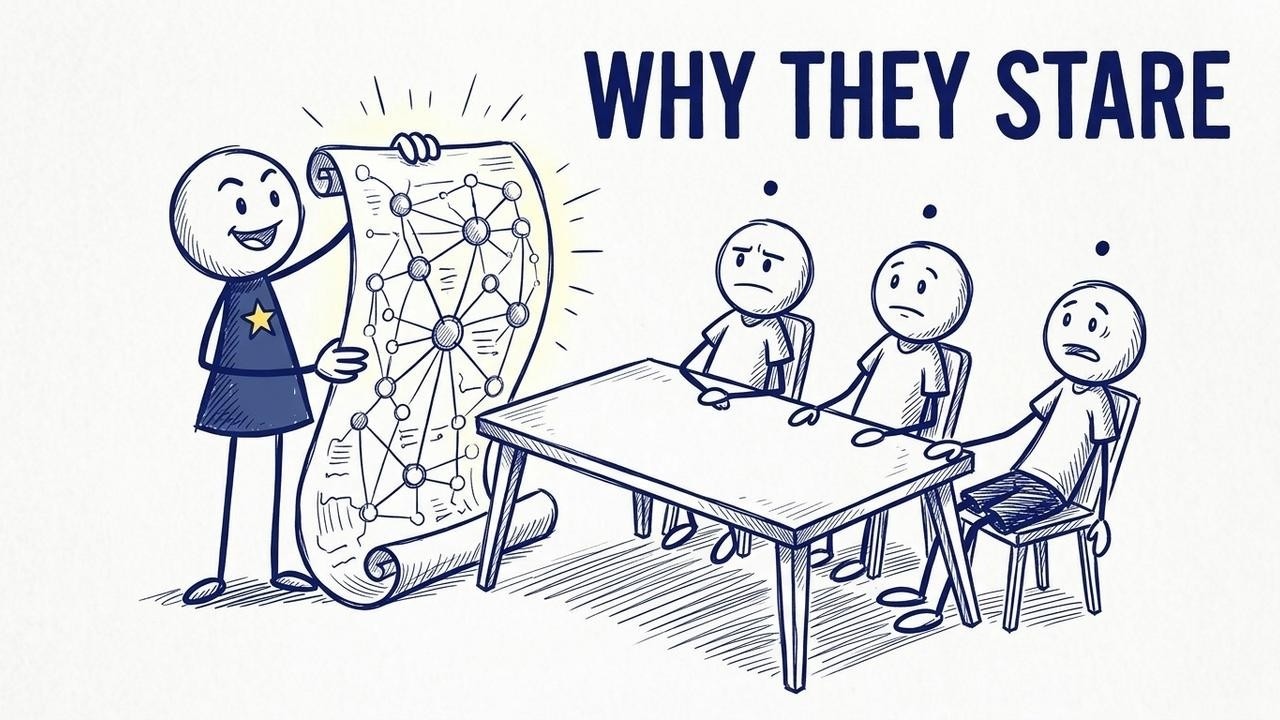
In this talk, the speaker explains why people with polymathic, fast‑connecting minds often cause a silent, uneasy reaction in meetings. The core claim is that the intimidation stems not from tone but from the ability to link disparate concepts in seconds, producing a “shape” that overwhelms specialists who view problems through narrow lenses. The talk draws on several strands of research: Elizabeth Newton’s tapping study illustrating the gap between internal knowledge and external perception; Abraham Tesler’s self‑evaluation model showing how success across many domains triggers comparison rather than pride; the illusion of explanatory depth demonstrated by Rosenblit and Keele; and classic conformity experiments by Asch. Historical and contemporary examples (the 1902 Hanoi rat‑tail bounty, product‑loss meetings) illustrate how polymaths see second‑order effects that others miss, making their insights uncomfortable. The speaker outlines the personal costs of this dynamic—accumulating labels like “intense” or “overthinker,” forced translation of ideas, and a unique loneliness where only a few understand the full shape. To mitigate these costs without shrinking, three practical tools are offered: (1) the one‑step bridge – explicitly showing the intermediate step between the audience’s current view and the insight; (2) ask‑don’t‑announce – using targeted questions to let others discover the shadow themselves; and (3) choose your rooms – maintain at least one space where you can share the full shape with a true “continuing” ally. The talk concludes by promoting a short book, The Translator’s Handbook, which provides scripts and deeper guidance for polymaths seeking to translate their insights without losing themselves.
Chapters
You said one sentence in a meeting— nothing rude, nothing loud— and the room went quiet. Somebody changed the subject, somebody else looked at their laptop. Later in the corridor, a colleague told you, kindly, that you can come across as a bit intense. And you replayed that sentence for the rest of the night trying to find the part where you went wrong. Here is what nobody told you: they were not reacting to your tone. They were reacting to the fact that you had connected 3 things that nobody else in the room had connected in about 4 seconds and then said it out loud as if it were obvious. A polymath's mind does something to a room, and most polymaths spend their whole lives thinking it is their fault. Today we are going to look at exactly why a broad, connecting mind quietly intimidates people, what it costs the person who has it, and, at the end, How to stop paying that price without shrinking yourself to fit? Let's start in that meeting because it is the same meeting everywhere. There is a problem on the table. A product is losing customers or a project is late. Or a team keeps having the same argument. Everyone at the table is looking at the problem through the one lens they were trained in. The finance person sees cost. The engineer sees the system. The manager sees the people. Each of them is right about their piece, and each of them is waiting for their turn to say their piece. Then the polymath speaks, and what comes out is not a piece, it is a shape. The customers are leaving because the system was designed around a cost assumption that stopped being true 2 years ago, which is why the team keeps having the argument because they are arguing about a symptom. 4 seconds, 1 sentence, and the room goes quiet because every person at the table has just had their piece absorbed into something larger by someone who did not seem to be trying very hard. That silence is not agreement. And it is not admiration. It is the sound of several people deciding at the same moment that they do not know what to do with you. Now let's look at why. The first reason is the speed of connection. Most people think in a line. A leads to B, B leads to C, and if you want to get to D, you walk the whole way. The polymath does not walk. The polymath has already been to A and to D, in different years, in different fields, and the moment the problem appears, the 2 points simply light up together. From the inside, this feels like nothing at all. From the outside, it looks like a magic trick. And people do not like magic tricks performed on them. When a card appears in your pocket, the first feeling is delight, and the second feeling, a half-second later, is a slight Unease. How did they do that? What else can they see? The polymath in the meeting has just produced a card from someone's pocket, and the room has moved straight to the second feeling. There is a well-known piece of research that explains the gap. In 1990, a Stanford graduate student named Elizabeth Newton ran a study in which one person tapped out the rhythm of a famous song on a table and another person tried to name the song. The tappers were asked to predict how often listeners would get it. They guessed around half the time. The real success rate was about 1 in 40. The tappers could hear the whole song in their heads while they tapped. The listeners heard knocking. That is the polymath in the meeting. They can hear the whole song. They tap out one sentence and they cannot understand why everyone else is hearing knocking. The second reason is that they cannot be placed in a box. Human beings manage each other with labels. The finance guy. The creative one. The engineer. The labels are not insults, they are how a social animal keeps track of 50 colleagues without having to think about each one from scratch. The label tells you what the person is for, what to ask them, and how seriously to take them on any given subject. The polymath breaks the label. He is the finance guy, but he is also, it turns out, A serious amateur woodworker, and he reads physics for fun, and he used to play in a band, and last week he quietly fixed a problem in the marketing plan that the marketing people had been circling for a month. Every new thing you learn about him makes the label fit worse. And a person who does not fit a label is a person you cannot predict, and a person you cannot predict is, at some animal level, A threat. Psychologists have studied this in a specific form. Abraham Tesler's model of self-evaluation, published in the 1980s, found that when someone close to us succeeds in an area that matters to our own identity, we do not feel pride, we feel comparison, and the comparison lowers how we feel about ourselves. When they succeed in an area that does not matter to us, we feel the opposite, We bask in it. The polymath's problem is that over time they succeed in everyone's area. The engineers, the marketers, the managers. There is no colleague at the table for whom the polymath is safely irrelevant, which means there is no colleague who gets to feel pride instead of comparison. Nobody chose this. It is simply what breadth does to a room of specialists. And notice what the comparison does to the language people use about you. Tesser found that one of the ways people restore the balance is to quietly downgrade the thing you were good at. If your connection cannot be dismissed, the ability to connect can be renamed. So it becomes overthinking. It becomes going off on tangents. It becomes, in the kindest voice, you're clearly very smart, but— Every one of those phrases is a label being stretched back over a person it no longer fits. The third reason is that they see the second-order effects. Every plan has an immediate result and a shadow. The immediate result is what the plan is designed to do. The shadow is what the plan sets in motion afterwards, and most people never look at the shadow at all. In 1902, the French colonial government in Hanoi had a rat problem, and they came up with a plan: pay the public a bounty for every rat tail handed in. The immediate result was a flood of rat tails. The shadow was that people started catching rats cutting off their tails and releasing them to breed because a living rat produces more tails than a dead one. Inspectors eventually found rat farms outside the city raising rats for their tails. The plan designed to remove rats had become a plan that manufactured them. The polymath is the person in the 1902 meeting who says, before the bounty is announced, wait, what happens to the rats after you pay for the tail? And this is deeply uncomfortable for everyone else. Because they had already felt the satisfaction of a solved problem, and the polymath has just taken it away. Being right early does not make you popular. It makes people feel exposed because they were about to be wrong in public and you saw it before they did. There is a reason the room was so confident in the first place, and it has been measured. In 2002, 2 psychologists at Yale, Leonid Rosenblit and Frank Keele asked people to rate how well they understood ordinary things: a zipper, a flush toilet, a sewing machine. People rated themselves fairly high. Then the researchers asked them to write out, step by step, how the thing actually worked. And after trying to explain, people's ratings of their own understanding fell sharply. They had felt that they understood the mechanism, and the act of explaining revealed that they understood only the picture of it. The researchers called this the illusion of explanatory depth. Most plans are approved under that illusion. The room can picture the result, so the room feels it understands the mechanism. The polymath, who has actually traced mechanisms in several unrelated fields, is less fooled by the picture. That is a real advantage. It is also, socially, like being the person who asks Everyone to write out how the zipper works. The 4th reason is that they do not need the room's approval. Most of what happens in a meeting is not about the problem. It is about status. Who speaks first? Who gets agreed with? Who gets the credit? Whose idea quietly becomes the plan? These games work because almost everyone is playing them, and almost everyone can be moved by them. The polymath is often strangely immune. Not because of some moral superiority, but because they learned the things they know for the pleasure of learning them, not for the credit, and so credit does not pull on them the way it pulls on others. When you cannot be flattered into agreement or shamed into silence, you become unmanageable in a small, quiet way. And people who run on status Find that very unsettling. Because their main tools do not work on you. The research on conformity shows how unusual this is. In the 1950s, Solomon Asch asked people to compare the lengths of lines, a task so easy that alone they got it right almost every time. Then he put them in a group where everyone else, secretly working for the experimenter, gave the wrong answer. Under that pressure, people went along with the obviously wrong answer in nearly 37% of the trials. Only about a quarter of participants never yielded at all. If you have sat in a meeting and watched the whole room agree with something you could see was wrong and felt no pull to join them, you now know that you were in the minority that Asch found. If any of this is landing, If you have sat in that quiet meeting and gone home blaming yourself, then I want you to know that there is a whole community of people here who have had the same night. Subscribe to this channel. This is where polymaths come to find each other, and we are only halfway through. Because now we have to talk about the cost. The cost of all this is not dramatic. Nobody gets fired for being too connecting. The cost is a slow accumulation of small labels. Intense. Overthinks. A bit much. Hard to read. Doesn't know when to stop. Each one is delivered gently, usually by someone who likes you, and each one teaches the same lesson: hide half of yourself. So the polymath learns to translate. They learn to say one-third of what they see, in a slower voice, with a question mark at the end so that it sounds like a guess. They learn which colleagues can handle the whole shape and which need only the piece. They become in every room a smaller version of themselves, and they do it so well that after a few years they are not sure which version is real. And the loneliness that comes with this is specific. It is not the loneliness of having no one, it is the loneliness of being surrounded by people who like the translation and have never met the original. Picture it at a dinner. Someone mentions that their company is cutting staff to save money. And in your head instantly the whole chain unrolls. The remaining people doing the work of 3. The best ones leaving first because they have options. The cost of replacing them, which will be higher than the saving. The product getting worse. The customers noticing. You see the entire shadow before the person has finished their sentence, and you say, oh, that is tough, and you pass the bread, because you have learned that the whole shadow delivered at a dinner table costs you more than it is worth. That is translation by accident. It is the smaller version, and it is exhausting precisely because nobody can see how much you are holding back. So let's talk about what to do. Because the answer is not to stop seeing the shape, and it is not to blurt it out either. The answer is to become a better translator on purpose, rather than a smaller person by accident. 3 tools. Tool 1, the one-step bridge. The reason the room went quiet is that you went from A to D and skipped B and C. The people in the room were still at B, so go back and show them the bridge, not the whole route, just one step. Here is how I got there. The cost assumption changed 2 years ago, and everything downstream still assumes the old number. That is the step. It costs you one sentence, and it converts the magic trick into a map that other people can follow. Once people can follow you, the unease turns back into the first feeling, the delight. Tool 2: Ask, don't announce. The polymath's instinct is to announce the conclusion. What happens to the rats after you pay for the tail is a far better sentence than this plan will create rat farms, even though they contain the same insight. The question lets the room discover the shadow themselves. It gives them the credit for seeing it. And credit, remember, is what most of the room is actually there for. You lose nothing, because you were never there for the credit anyway. You gain a room that now wants you in the next meeting. There are 3 questions that do most of the work. The downstream question: if we do this, what does it make people do next? The assumption question: What are we assuming stays the same for this to work? And the gentlest one of all, the explain it question. Could you walk me through how that part works? That last one is Rosenblatt and Keel's experiment, run in a meeting. The person explaining discovers the gap themselves, and nobody has to be the one who saw it first. Timing matters. Ask before the room has fallen in love with the plan. Once the satisfaction of a solved problem has arrived, a question feels like theft. Early, it feels like help. Tool 3: Choose your rooms. You cannot be the full version of yourself in every room, and you should stop trying. But you must have at least one room where you never translate— one friend, one forum, one group, one comment section— where the whole shape comes out at full speed and nobody flinches. Asch found something else in his experiments that matters here. When he gave the lone participant a single ally, one other person who also gave the correct answer, the pressure to conform fell to a quarter of what it had been. One ally, that is all it took. You do not need a roomful of polymaths, you need one person who can hear the whole song. How do you find that person? Look for the one who, when you make a connection, makes the next one. Not the person who praises you, the person who continues you. Praisers are common and pleasant and they leave you exactly as alone as you were. Continuers are rare and one of them is worth 100 of the other kind. And when you have found them, do not translate in that room. Translation is a habit, and once you have it, it wants to run everywhere. The one room exists so that the original gets used, and anything that goes unused for long enough quietly disappears. I have put all of this— the bridge, the question, the rooms— together with the research on why rooms react the way they do, and a set of word-for-word scripts for meetings, families, and the colleague who calls you intense, into a short book called The Translator's Handbook. It is for people who are tired of being misunderstood and refuse to shrink. It is linked in the description. Let's go back to the corridor. Your colleagues said you can come across as intense. Here is what they meant, translated: You see more than I do, faster than I do, and you say it before I am ready. That is not a flaw in you. It is a gap between 2 speeds. And a gap can be bridged by the faster person in one sentence, without the faster person having to slow their mind at all. You were never too much. You were early. So tell me in the comments, what is the sentence that made a room go quiet for you? The exact words if you can remember them, I want to read them and so does everyone else here, because every one of us has one. And if you want to stop paying for that sentence, the Translator's Handbook is waiting in the description. Thank you for watching.