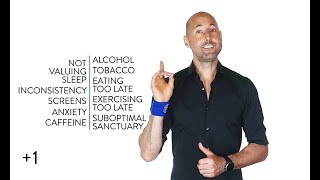
Brian Johnson breaks down the top 10 sleep killers, from inconsistent schedules and late caffeine to screens before bed. Matthew Walker's research shows most people get under the recommended eight hours, raising cancer risk and suppressing immunity. Each problem gets a quick fix: digital sunset, caffeine curfew, cool dark bedroom.
Questions this video answers
Five to six hours.
Create a caffeine curfew (examples given: stop consumption after 2:00pm or noon, depending on individual).
At least two hours before bedtime (host suggests professionals may test four hours).
At least three hours before bedtime (host notes exercise gives a ~12-hour mood boost).
Around 65 degrees (Fahrenheit).
Chapters
Hi, this is Brian. Welcome back to another Optimize plus one. In our last plus one we talked about why we sleep again. And I made yet another strong recommendation to buy that potentially life changing book again. Today we're going to talk about why we don't sleep. We'll take a quick look at the top 10 sleep Kryptonites. But first, here's another gem from Matthew Walker's brilliant book. I quote once more 10/2 of adults throughout all developed nations fail to obtain the recommended eight hours of nightly sleep. He says, I doubt you're surprised by this fact, but you may be surprised by the consequences. Routinely sleeping less than six or seven hours a night demolishes your immune system, more than doubling your risk of cancer. Where do you fall in those statistics? And now for the top 10 sleep Kryptonites. Number one, simply not valuing sleep. This is where it all starts. If you don't really get just how important sleep is, then you'll never change your priorities to make sure you're getting enough sleep right. Number two, inconsistency. All the leading sleep gurus, including Matthew, tell us that consistency is key. In fact, this is his number one tip. I quote, stick to a sleep schedule. Go to bed and wake up at the same time each day. Set an alarm for bedtime. Often we set an alarm for when it's time to wake up, but fail to do so for when it's time to go to sleep. If there is only one piece of advice you remember and take from these 12 tips that he shares, this should be it. Number three screens. 90% of adults are are on their electronic devices within one hour of going to sleep. That's a really bad idea unless you like having a bad night of sleep. Solution is easy. Digital sunset. Make that solution as simple but not easy. Number four, anxiety. This is a top reason people give for why they can't sleep. We're too stressed. Well, guess what? If we structure our lives such that we're basically redlining our energy all day, every day, we're going to have a lot of enervated anxiety and it will be really hard to magically flip the off switch when our heads hit the pillow. Solution. Train yourself to flip the switch and get really good at creating a sense of energized tranquility. We'll talk about that more in a few days. Number five, caffeine. Caffeine works because it basically masks your fatigue. It has a half life of five to six hours, which means that if you have 100 milligrams of caffeine at 4pm around half of that caffeine is still having a party in your brain at 10pm not helpful for sleep solution. Create a caffeine curfew. Stop consumption after two o' clock or noon or whatever is your ideal. Number six Alcohol. Sixth Kryptonite. You may think you sleep better after drinking, but well you don't. Number seven Tobacco. Tobacco is a stimulant. Are you still smoking? Quit seriously. Number eight Eating too late. If you eat a big meal before bedtime, your body needs to work too hard digesting food when it should be doing all the important repair work. And your brain minimum goal should be to eat your last meal at least two hours before bedtime. Professional optimizers might want to run the four hour before bedtime experiment to see if you can get glymph for the win. Number nine Exercising too late. Exercise is obviously awesome, but we don't want our core temperature jacked up before bedtime. Basic recommendation is to exercise at least three hours before bed, but professional optimizers know that exercise gives us a 12 hour mood boost. So we architect our days to get our natural little hit of Ritalin and Prozac in the first half of our days and our 10th Kryptonite. Here is suboptimal sanctuaries. Your sleep environment matters a lot. Key things to optimize. Your temperature should be around 65 degrees. It should be super dark. Blackout curtains for the win. And of course make it quiet. Oh, and move the TV out of your bedroom. Unless you want to be part of a statistic that correlates depression with bedroom TVs. That's today's plus one. The top 10 sleep Kryptonites. Which one can you optimize tonight? Yeah, how.