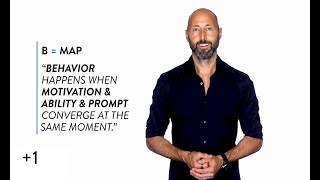
A short YouTube "Optimize +1" episode by Brian Johnson introducing BJ Fogg's Fogg Behavior Model. It explains the formula B = MAP (Behavior = Motivation × Ability × Prompt), describes the model diagram (motivation Y-axis, ability X-axis, action line, prompt placement), and invites the listener to map a personal behavior to the model to design habit change.
Chapters
Hi, this is Brian. Welcome back to another Optimize plus one. BJ Fogg founded the Behavior Design Lab at Stanford University. He's one of the world's leading authorities on the science of behavior change and has deeply influenced how we think about habit change on both a product development level and a personal level. To put it in perspective, his former students created Instagram. He's also the author of Tiny Habits, a great book that's all about the small changes that change everything. Now, mastering the process of changing our behavior is arguably the most important skill we can acquire in our lives for ourselves and for our families, colleagues, clients, etc. So you could make a very strong case that this subject should be at the top of your list of most important subjects to master. And by extension, this book would be as close as it gets to a must read. And while you're rocking the habits theme, I also highly recommend the uber bestseller Atomic Habits by James Clear and Mini Habits by Stephen Gies. Now back to BJ Fogg. He's the guy all the other aspiring habit experts go to. Here's what he has to say. I quote, you can change your life by changing your behaviors. You know that. But what you may not know is that only three variables drive those behaviors. The Fogg behavior model is the key to unlocking that mystery. It represents the three universal elements of behavior and their relationship to one another. It's based on principles that show us how these elements work together to drive our every action from flossing one tooth to running a marathon. Once you understand the behavior model, you can analyze why a behavior happened, which means you can stop blaming your behavior on the wrong things like character and self discipline for starters. And you can use my model to design for a change in behavior in yourself and in other people. B equals map. B equals map. Behavior happens when motivation and ability and prompt converge at the same moment. Those are the first words from chapter number one, the Elements of Behavior. You want to understand why we do any and everything well. BJ tells us that we need to understand this simple formula. B Map B equals map Behavior is is a function of our motivation plus ability plus prompt as BJ tells us. I quote again, a behavior happens when the three elements of map, motivation, ability and prompt come together at the same moment. Motivation is your desire to do the behavior, ability is your capacity to do the behavior, and prompt is your cue to do the behavior one more time. Be equals map. In the book, he presents a super simple and equally powerful little diagram to bring the point home. You can find his model linked in this plus one. And as it turns out, I walked Emerson through this model the other night while we were talking about how to rock a digital sunset. More on that in our next one. For now, let's take a quick tour through the primary elements of that diagram. First, on the Y axis we have our motivation. It can be either high or low. Then on the X axis we have our ability that can be either low or high as something can be either hard to do or easy to do. Then we have a prompt. The prompt can show up either above or below what BJ calls the action line. If our motivation is high and our ability is high, it's AKA it's easy to do. The prompt will fall above the action line and we'll do it. If on the other hand, we have low motivation and our ability to do it is low, AKA it's hard to do, we won't do it. That's it. Super simple and equally powerful. You can run all behaviors through that model. Of course, BJ spends the entire book walking us through how to use that model to install the habits we want to rock while deleting those we want to get rid of. For now, how about you map Map Motivation Ability. Prompt one of the behaviors in your life on that handy dandy model. Sketch out the Y axis for motivation and the X axis for ability. Draw the action line. Notice the potential placement of your prompt. Now, seriously, pick a behavior you'd like to analyze. How's your motivation? Is it high or is it low? How's your ability? Is it high, making the behavior easy? Or is it low, making your behavior hard? And where's the prompt showing up below or above the action line? Remember, B equals map. Here's to using wise maps to minus 1, minus 1, minus 1 and plus 1 plus 1 plus 1 our way to optimized awesome. Today.