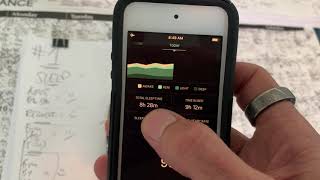
Brian Johnson tests daily tweaks to sleep and productivity, from a 4pm work cutoff to evening recovery tools. He logs the results: one optimized night brought 8.5 hours of sleep, 92% efficiency, and a resting heart rate of 39 bpm. The pattern is constant small experiments, journaling what works, and protecting time for recovery and family.
Questions this video answers
August 29, 2020
4:00 p.m.
In bed: 9 hours 12 minutes; Total sleep: ~8 hours 30 minutes.
Hey guys, what's up? This is Bry fired up this morning. Got lots to share on some epiphanies that I've been making. I'm trying to figure out the right length for these. If you got some feedback on kind of an over under that you want to see, I can do these super quick get done in like two or three minutes. Or I can go a little bit longer for four or five minutes or I can go off for you know, 10 to 15 minutes. Let me know what your ideal is. We'll probably run a survey at Optimize 2, but let me know in the comments if you're feeling it, please. So sign this. Boom. Recommitting. And then just quickly. I love the thank you Timex watch. Yes, a thousand seconds has gone. I love my wall calendar at the end of a month. So I'm about ready to flip the page and I know I had a good month when it looks like that and I realize you can't read it and that's fine. It's not for you, it's for me. But that is just pure hammer time. The density of that page as I talk about in journaling optimize me journaling 101 class. This is what it's all about for me. So anyway, the last three days have been amazing, right? Just to kind of test different things constantly and never ending constant and never ending improvements is what Tony Robbins calls it. Can I Kaizen? Same thing. You're always seeking excellence. The next marginal gain. We call it canoeing. Constant and never ending optimizing experiments. Always running experiments. Right? So if you recall, we looked at my data and the thing that needed work was sleep, right? So several days ago I had inputs all day and my sleep was poor. I'll walk you through that in a moment. Then I recovered the next day and I had a better night of sleep. Then I filmed late. Didn't do as many inputs but I filmed late and that reduced my REM sleep, etc. So then yesterday my number one was to make a commitment to be done with the studio. I did six PNTVs, three and then three but I wanted to be out of the studio by 4pm so I've got my last input food wise at 4pm and my last output intense creativity by 4pm I needed to do that in order to settle my mind down. Was my hypothesis that if I did that I would have a better night of sleep. Nothing else changed between these two days other than that. I front loaded my intense work and I had a cutoff of 4pm so I'm going to run the experiment, right? Let's see how it worked. First we're going to review where we were. Okay, so this is Wednesday. This is after the morning after I blew myself up with inputs. This right here, inputs all day. Now, I had a crazy great, productive day, but my mind was hopped up and I got up early and I only got six hours of sleep, which is not good for me. So then the next day I literally just stopped working at like 4, 4:30 maybe, and I took the kids to go get mundane things. You know, I needed to get shirts for pntv. So I just did that. Turn the brain off, got a great night of sleep, much more REM, much more deep sleep, etc. Then the next day, I didn't have any inputs, but I worked hard in the studio, right? I filmed late and boom, I got less sleep than I'd like to see. And again, look here, my REM sleep was only an hour and they told me, you need more REM sleep. Deep was actually really good, right? But my REM was up and I was just too hopped up and I got up early. So then I ran the experiment that I just mentioned, right? And so I crushed it yesterday. Just a great day in the studio, but I was done by 4pm and then I went online. I did simple stuff. My brain was mush. It's Friday afternoon. I just hammered this week. So I welcomed dozens of coaches on our social platform. New coaches and coach class three starts in two days. By the way, fired up, I'm welcoming them. You know, they're introducing themselves. It's just amazing. That's what I do. Check in with the team. And then I took from 5pm to 6pm and I watched a documentary on Usain Bolt while I sat here on the PEMF machine and used the Nano V recovering. But I turned my brain off. Wonder how I slept. One of my best nights of sleep in a very long time. Well, not a very long time, but one of my best nights of sleep in the last week, right in bed for nine hours and 12 minutes. Eight hours and 30 minutes of sleep. 92% efficiency is very good for me. Resting heart rate 39. Boom. And again, it's hard to have a better night of sleep than that. For me, total sleep of eight and a half hours. Efficiency was there at 92%. Restfulness was good. I had two hours of REM sleep. Again, let's look at this. The night before, I had an hour. So I made this little tweak and I got an extra hour. Part of that is catch up of REM sleep. How do you think I feel today? Feel great. Deep sleep of an hour and 53 minutes. Boom. Latency was spot on. Timing was optimal, by the way. We went to bed at 8:15 last night. It's a sport for us to go to bed early and to get a good night of sleep because I am more committed to being actualized than I am to being entertained. We don't have a tv. We don't do any of that stuff at night. I know what I'm here to do, and it's not be entertained by other pseudo heroes. I want to live heroically and I want to empower other people to live heroically. So I prioritize things like this. And watching the documentary on Usain Bolt, we're watching the Jordan documentary on the last dance. Greatness is all about consistency on the fundamentals. Although Usain was pretty funny and that guy liked to have fun. So just quickly checking in here. My readiness would be in the 90s, like mid-90s, if I wasn't still repaying some sleep. Debt started a week ago with Eleanor waking up and then with me pushing super hard. But I'm thrilled with these numbers. 39, resting heart rate. Again, I'm not going to beat that, except when I do at 38, but whatever. 39, 40, 41 and then 86. Heart rate variability remains exhilarating for me. You look at the trend on a weekly basis, it just went up from 68, 70, which is. These are all great numbers. Boom. I just hit a new level, as we've discussed. That's really exciting for me to lock in that new best as a new baseline. So there you go. It's fun to see the data. And it's interesting too, because I did a video recently on Anders Ericsson. This is what he and I were talking about is can you translate diary notes of what you're doing with data, quantifiable data that shows that when you do this, you see shifts in that. And again, I did the number one on the fact that we lost him 72 years old. But literally, this is what he and I were talking about researching on a broader level with Optimize. So it just inspires me to take it to the next level. Simple changes, big results. Remember, your night starts the day before. Constant and never ending optimizing experiments. What are you going to run today? Go get on that. Let's get a little better. Make today awesome. Now I'm off. Full day with the kids. I worked hard. I'm going to recover hard. And I do that by spending time with my family. Deep work. To deep love. Let's go. Have a great weekend.