#1: Feeling a little less than awesome? Use the data!! (Here's how I am...) (#9)
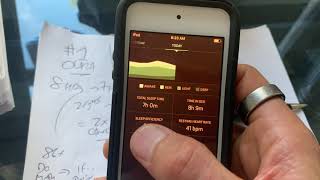
Brian Johnson finished a 25-session Mastery series and tracked his sleep with specific numbers: resting heart rate of 41, HRV of 75, and sleep efficiency around 86-87%. He tested 8 versus 9+ hours in bed and found he feels sharper with more sleep, so he's committing to staying down longer.
Questions this video answers
4:54 AM
41 bpm
75 (units as reported by his device)
In bed for a little over 8 hours; got 7 hours of sleep (86% sleep efficiency).
Prior night: in bed 9 hours 24 minutes; got over 8 hours of sleep (87% efficiency).
Chapters
Hey, guys, what's up? This is Bry. Happy Wednesday. Start of the day. 1, 2, 3. What can I learn? Ran a little experiment for us that I'm excited to share. Then I did a one, two, three hero bars. Got some fun notes from the last 24 hours that I feasted on and I just blew myself up in the studio yesterday doing a recap. So we just. I just finished the very last session of our Mastery series. That is the stack of my notes. Basically 25 sessions over 300 days and I walk through every single idea. Over 200 ideas from well over 200 ideas from each of the sessions, starting at the very top. Eudaimonology, Hero Ology, Big 3 times 2, Carpe Diem algorithms, fundies, and then Optimus U. Practicing your philosophy. Super fun. Left it all on the court. Taking today off, I'm going to read. I'm so fired up. I got some great books. Alexander got this one for me. Abraham Maslow's unpublished papers together. Looks extraordinary. Then of course, we've got Ben Greenfield's Encyclopedia I've been meaning to get to, but it's just so darn big. I'm like, dude, I'm not going to be able to do a note on it. We've been trading tax to do like 20 notes on that thing. Anyway, I'm so fired up to be done with Mastery Series and focus on Philosopher's Notes. We're setting up a new studio right now and I spent this morning mapping it out. But basically I have hundreds of books that I have done. Actually the stack's over there. Hundreds of books. And in my barn, which is currently the library. Hundreds of books I've read and done Philosopher's Notes on that I have not yet done Philosopher's Notes TV episodes on. So I'm literally going to hit the studio and all I'm going to do for a month is record Philosopher's Notes TV. And the current very audacious goal is 150 Philosopher's Notes TVs in 150 days between Coach Optimized, Coach Class 3, which launch is in a week and a half. Coach class four, which launches in February. We're going to have three videos a day, plus ones. These number ones. And then the PMTVs fired up. So I just have to share this. This was from a feast from this morning. Someone just said they love the way my mind works and synthesize ideas. They love the recent videos. Add that to your highlight reel. Nice, Karen. I have. It's so good. And yes, I appreciate Michael's enthusiasm as well. Our head coach and Alexandra's beauty is radiant. I appreciate your kind words. Then had a note this morning on YouTube which earned the highlight reel. Someone just said, hey, I really enjoy what you're doing. I wonder, have you seen a book about the modern Buddha? I wonder how Buddha or Jesus would create a valuable life in today's modern world. I feel like they would be preaching the same things you are in Paula, I could completely agree. In fact, I often think about that. How can I channel the essence of the greatest teachers? Ancient wisdom, modern science, practical tools, and it's one of the things I'm most proud of is that we have people from a range of faith traditions that use our work to become the best version of whatever philosophy or religious practice they follow, whether that's Buddhism or Christianity or Islam or, you know, more of a yogic Hindu philosophy. Let's they all say the same thing. Taoism, etc, let's be the best versions of ourselves in service to the world, period. I personally like to channel Epictetus, the ancient Roman Stoic philosopher. Here we go. Okay, so prelude to today's experiment. So again, I crushed it yesterday. I was had a great chat with our head coach Michael, then hit the studio for like, I don't know, three or four hours. And I went late. I never film until like 5, 5:30. But I was hitting it yesterday because I just wanted to get it done and that required some focus. So it wisely told me, hey, strive for some balance. Your overall readiness is good, but let's balance activity and rest. Right? But the real experiment here and why I got that message was I ran an experiment on getting out of bed earlier. So I got out of bed this morning at 4:54 and it said late workout. Yeah, I was working out in the studio filming for our optimized coaches, so I didn't get as much REM sleep as they would like to see, which makes sense because you get REM sleep later in your sleep cycle. I'm actually really happy with the deep sleep. Two hours and five minutes is a fantastic number. But the REMs, that happens earlier in your sleep cycle, which is why if you eat late, you won't get as great of deep sleep because your body's working on digesting your food, not putting you into deep sleep or your glymphatic systems going to work cleaning out your brain so you're less likely to get Alzheimer's, etc. Powerful stuff. But if you're not in bed long enough, then you won't get adequate amounts of REM sleep. So I usually. I'll just go through. Actually, I go to readiness real quick. I'm actually really happy with the readiness score. I'm sorry, the heart rate variability, that's again, off the charts awesome. I'm stoked about that. Resting heart rate, 41. Heart rate variability, 75. That's great. Whatever. And then here's the experiment. The experiment is I usually target spending nine hours in bed, right? There's been sleep studies out of Stanford where they had Stanford athletes spend 10 hours in bed and they increased the amount of sleep they got by a couple of hours. And their performance in their sports went way up, like up to 10%. Improvements on speed tests, you know, free throw shooting, stuff like that. So getting an adequate amount of sleep matters. And simply being in bed longer doesn't mean you're getting all that sleep. So important data point here. I was in bed for a little over eight hours. Oops. And I got seven hours of sleep. That's an 86% efficiency. Now. That's. That's good. It's not great. It's above. It's above whatever their goodness schedule. 85% is the cutoff. But the point here is that just because you're spending eight hours in bed doesn't mean you're getting eight hours of sleep. Right? And if you're only spending seven hours in bed, you're definitely not getting seven hours of sleep. You're getting less than that. And you want to remember, we talk about this a lot in our sleep class. You want to do the math on that and know how much sleep you're actually getting vis a vis how much time you're spending in bed. And know that the recommendations from guys like Matthew Walker at UC Berkeley, leading sleep scientist and neuroscientist. Two thirds of the US Adult population gets less than the recommended seven to nine hours of sleep, and they double their risk of cancer. If you get less than 7 to 9 hours of actual sleep, not time in bed. You 2x your risk of cancer. So we encourage our coaches, their clients, do the math. How much time are you spending in bed? If you use it again, a technology like this, it'll do the math for you, roughly approximating it. You can do the math if you're just spending, you know, six, seven, eight hours in bed. We'll do the math. Times it by 85%. That's how much sleep you're actually getting if you're a rock star. 90%. Alexander broke the scale at 95%. The other day. That's like, that's crazy. Not typical. Anyway, so I usually would stay in bed for nine hours. This morning I got up after eight hours and I'm like, you know what, I'm going to get up, I'm going to run the experiment, I'm going to see how I feel and then you and I will be able to talk about the data I get from it and what happens when I do that is I don't feel quite as sharp on seven hours of sleep. Had I stayed in bed for a little longer, I would have gotten more REM sleep. So yesterday I was in bed for 9 hours and 24 minutes. I got over 8 hours of sleep. I feel better when I get 8 hours of sleep. And again, in a lot of the sleep notes that you can check out at Optimize Me, Optimize Me Sleep. We've got a ton of this stuff. A lot of, you know, world class entrepreneurs, et cetera, say, look, I just don't feel right at less than eight hours of sleep. Seven, I'm atrophying. Six, five, I'm a zombie. So we want to be really self aware again. Jeff Bezos says eight hours of sleep, boom. That's what I need to function. Well, then of course the elite sports athletes. LeBron James clocking 11, 12 hours of sleep. Roger Federer, 12 hours of sleep. Tom Brady going to sleep at 8:30. These are professional optimizers crushing it. Anyway, two nights ago I followed my normal protocol and I stayed in bed for over nine hours. I got eight hours of sleep, 87% efficiency, got a higher sleep score and my REM was significantly higher. I went from an hour and eight minutes. I think I was at today an hour and eight minutes. I got an hour and 45 minutes. Nearly the same deep sleep again. That's a great number, an hour and 50 minutes. I feel different with that extra 40 minutes of deep sleep, 37 minutes of deep sleep, which is why they're telling me, hey, get a little more rem. Powerful stuff. Ran the experiment, got some data, winner learned. 1, 2, 3, what's working? I feel great, the heart rate variability is still great, etc. What needs work? Oh, interesting. I do better with a little more sleep. So I'm going to stay in bed a little longer again. Had I stayed in bed, I would have gotten that extra chunk of rem. Boom. What am I going to do differently? One, two, three. I'm going to stay in bed for nine hours tomorrow. That is how we. One, two, three. There you go. Oh, and then here's another fun line. You won't be able to read my chicken scratch. Sorry. Seneca tells us the worse you are, the less you feel it. Matthew Walker says, the more sleep deprived you are, the less aware you are of how sleep deprived you are. You have what he calls baseline resetting. You're just used to feeling not great. I like feeling great. I know when I'm just subtly off. And then I like to do the analysis to see what I need to do to make it work. There you go. I'm excited to read a book. I think I'm going to read this one today. Driven. That looks really good. Alexander got it on Ben Greenfield's recommendation. Understanding and harnessing the genetic gifts shared by entrepreneurs, Navy SEALs, pro athletes, and maybe you. Boom. All right, philosopher's note. Philosopher's notes. TV coming on. That soon. Abraham Maslow, I love you. Great, Great book. The unpublished papers. It only has one Amazon review, but this thing is epic. Philosophy Philosopher's notes coming soon. Together. Surgeon General on the healing power of human connection in a sometimes lonely world. I'm going to create a note on this before we launch our optimize coach class three program on August 24th. Because one of the things we do is we pair up everyone with what we call an optimized buddy, based on the Navy SEAL swim buddy idea. And then our swim buddies, our optimized buddies become like best friends. They pair up and then they support one another through our 300 day program. It's one of the most powerful aspects of our program. We've got the Mastery series. We've got Michael doing his how to Build a Coaching Business thing. We've got the luminary sessions with Cal Newport, Tall Ben Shahar, Mark Devine, etc. But it's the swim buddies being together that we've gotten so much positive feedback on. To be with someone who shares your values and who's really there for you in your corner, it gives me tears in my eyes. Is awesome. And then Ben Greenfield. I've always said he's encyclopedic in his wisdom. So he puts out a book, and what does he do? He throws 600 big old encyclopedia pages at us. I'm excited to dive in, pull out a few big ideas and crush that as well. All right. Make today awesome. See you.






