Conquering Depression 101
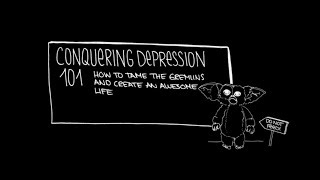
Brian Johnson presents a YouTube masterclass titled "Conquering Depression 101," sharing his personal history with severe depression and an overview of ten practical strategies to improve mood and resilience. The talk emphasizes hope (you can get better), self-compassion, fundamentals (sleep, movement, nutrition), mental training, project-based purpose, reducing harmful media exposure, building robustness/antifragility, and consistent practice.
Chapters
Hi, this is Brian. Welcome back to the Optimal Living 101 Masterclass Series. Today we're going to talk about a really important subject. Conquering depression 101. How to tame the Gremlins and Create an awesome Life. Now we talk a lot about how to optimize and actualize from the Greatest Year Ever to Masterpiece Days and habits and Procrastination 101. But the reality is that a lot of us are struggling and we've had requests for classes on people who might be experiencing some depression or anxiety. And as a guy who used to experience extreme levels of depression and anxiety, I feel particularly qualified to talk about the subject and to share some of my favorite big ideas on how we can go about, as the subtitle suggests, taming those gremlins in our minds and creating a sustainably awesome life. So I'm really excited to chat about this. Whenever I share my story, I get some of the most positive feedback. A lot of people assume that I was born with a silver spoon in my mouth and had just a perfect upbringing and all this stuff. And that's not the case. I was raised in a conservative blue collar family. My father struggled with alcohol. His father struggled with alcohol and killed himself. And I like to joke these days hasn't always been funny, but these days I can joke that that I think I kind of lost the genetic lottery and I didn't do as well as I could have in the environmental conditioning part of the equation either. And as a result, and as part of that, I suffered in my own ways and significantly. So I know what it's like to want to end my life. That's how deep I went into despair. I couldn't see beyond today. I couldn't see how I could improve my life and create meaning and purpose that that would sustain me. I had all kinds of energy and I like to say it was like I was a fire hydrant splashing my water up against a clear glass. It was just spraying back in my face. I couldn't figure out what to do and I had no hope that I could figure out what to do. So I get that and I also get, as I've built, and we're going to talk about this today, the scaffolding in my life so that I no longer fall down to those depths of despair. Of course we all have highs, we all have lows. But we're going to talk about how to systematically make your lows higher. You're still going to have highs and lows. We want to make your Lows higher and your highs more sustainable. And when you fall off, which you inevitably will, you know how to get back up. So again, a lot of personal experience here. And if you've experienced depression in your life, or if you know someone and love someone who's currently experiencing depression, I hope that you get at least one big idea that can literally truly transform your life. So with that, let's take a quick look at my favorite top 10 big ideas. We're just going to do a quick pass and then we'll go into detail on each of them. All right? Our first big idea is that you need to know, absolutely know, underlined all caps, that you can feel better. Because the real danger with depression, especially if you teeter toward the suicidal thoughts, is the idea that you think you can't get any better. Right? You know that you're not going to get any better. That form of pure helplessness and powerlessness is something we need to address head on. You need to absolutely know that you can get better. Now, you may not be the happiest person on the planet, right? You may not be the happiest person you know, but you can be a happier or more fulfilled, more flourishing version of you. And we're going to talk about how to go about doing that fixed versus growth mindset. Again, it's huge. We're going to talk about motivation and the importance of, again, knowing that you can improve your life, whether you think you can or you think you can't. You're right. There's a ton of wisdom in that wit, and we're going to unpack it. The second big idea is self compassion and self acceptance and self absorption. We're going to talk about Kristin Neff's idea of self compassion. One of the biggest things that hampered my moving through depression was the idea that it was all about me, that I was the only one that was suffering, that something was inherently wrong with me, that I was feeling down. As she says, we need to embrace common humanity. You're not alone. Other people are struggling. It's not just you. Then we need to have that deep level of self compassion. Quit beating yourself up. Super important. Being overly harsh with yourself is not helping the process. Science is unequivocal. But then we also need to have self awareness and we need to see what we're doing, what behaviors that aren't serving us. We need to be willing to be a little bit harsh with ourselves at times, compassionately. So then we're going to talk about self absorption and how we need to get out of self absorption. If all we're thinking about is what's wrong with our lives and this and this and this and this and this, we're going to suffer more than if we say, look, how do I perform an act of kindness? How do I do a little service? Science, again, shows the quickest way to boost your mood. Do something nice for someone else. We'll go into detail on all that. The third Big idea fundamentals. You could not pay me to not properly eat, move and sleep, period. I know what I'm like when I'm eating horribly, when I'm not sleeping adequately and I'm not moving my body. And you literally could not pay me to not do those things. I know what I would be like if I did not do those fundamentals. We're going to talk about that in depth. There's some huge research on the importance of eating, moving and sleeping. The fourth Big idea. You need to train your mind. We're going to talk about helplessness. Helplessness is one of the quickest routes to depression. We need to gain control of our mind. And the reality is you. If you're feeling depressed right now, you kind of suck at controlling your mind right now. I say playfully, and again, as an expert in not having control of my mind, we're going to talk about some practices to systematically train your mind to put your attention where you want, when you want, rather than do all the ruminating and other toxic things that you might be doing these days. The fifth Big idea. Highs and lows and zigzags. Talked about this already a little bit. We're going to talk about it more. One of the other things I made the mistake with in the past was I thought that I should always be at a high. I should always be at a 10. Something was wrong with me. If I had ups and downs, guess what? Everyone has ups and downs. You're never going to be a 10 every single day. Letting go of that is huge. Then you learn how to play poorly. Well, when you're at a low, you don't do things that cascade you down into a deeper low. You build scaffolding such that you can't fall so high. Fall so low. Rather highs, lows and zigzags. The sixth Big Idea is targets and dishes. Happy people have projects. Sonia Lyubomierski tells us, one of the world's leading positive psychologists. Do you have a project that inspires you? The more depressed you are, the less likely you do. We need to create targets. Telos. We are teleological beings. When you don't have a target, you're aimless. That doesn't feel good. We need to create the right types of targets and we need to do the next thing. Byron Katie says you only ever have to do one thing. She calls it doing the dishes. Just do the dishes. What's next in front of you? Do that whether you feel like it or not. That's a huge practice. The seventh big idea. Turn off the tv. Turn off the tv. The TV is correlated. How much talk show you watch or how much news you watch is directly correlated to your level of depression, meaning the more TV talk show and other nonsense you're watching, the more likely you are to feel depressed. Your limbic system can't handle all the stimulation you're giving it. Some researchers say we have more stimuli in one week than these days than our ancestors did in their entire lifetime. Your limbic system can't handle that. If you're depressed, you have a sensitive limbic system. We're going to talk about how to deal with that. The eighth big idea is to become antifragile. If you're depressed, you're going through life with a bit of fragility. Hard things happen and you break. We want to talk about strengthening that up, making you more robust, where you can handle challenges. And ideally, we want to get to a place where we're antifragile or hard things happen to us and we don't break, we get stronger. One of my favorite ideas, the ninth big idea, is to act like the best version of you. Act like the best version of you. You have a sense of what you're capable of. Even in your darkest moments. There's a slightly better version of you in this moment. We want to act like that version of you and then act like that version again and act like that version again. We're going to talk about the research behind this. It's powerful stuff. And then the 10th big idea. Practice, practice, practice and consistency, consistency, consistency. The fact is, if you experience depression, you have a smaller threshold of error than other people, God bless them, who don't or have never experienced depression. You need to be more consistent on your basic fundamentals, on training your mind, on doing the right things, moment to moment to moment. Now, you're not going to be perfect, but you do need to commit to being more consistent and then again show up as the experimenter collecting data. You either win and have a great day or you learn when you have an off day, then you get back at it day in and day out. That's a quick look at our top 10 big ideas. I'm really excited to jump in, so let's do so now.






