Heroic Chat with Pilar Gerasimo: Being Healthy Deviants
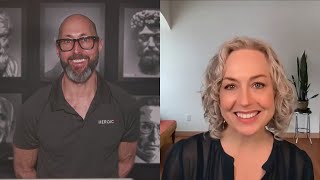
Pilar Gerasimo talks about being a Healthy Deviant: someone who breaks unhealthy social norms to get healthier. She walks through daily rituals like Morning Minutes and ultradian rhythm breaks, workplace tactics like five-minute restorative pauses, and leads guided meditations.
Questions this video answers
September 12, 2023.
HealthyDeviant.com.
97.3% of US adults (quoted in the talk) are not practicing even the most basic healthy patterns/behaviors.
She cited CDC-derived figures rising from ~80% to ~89% of people not flourishing (phrased as numbers climbing from 80% to 89% during COVID).
Chapters
Foreign. Heroes. It is 1:01, actually. Technically it's 1:02pm today, Central Time, but it is officially day one. I am thrilled to have a special guest. Today we had some of my favorite wise elders, some of my favorite wise brothers. Today we've got my favorite, like, favorite period wise sister, Pilar. Welcome. So excited to have you here. I'll give you a more full introduction, but great to see you.
Oh, great to be here with you, Brian. Thanks. What an honor.
All right, so one of my fun things is to say hi to my first screen. Just being able to say your names always warms my heart. Amy, great to see you. I've been thinking about you a lot since our chat. Damiano, always great. Heidi, Alex, Georgina, Vinnie, Anthony, Jessica, Lisa, Rob, drive safely. Dave, good to see you. Shanti, always great to see you. Daniela, Robin, Ryan, Jared, Sarah, who's hiding behind there. Rob, Kyle, great to see you. Shannon, Dennis and Timothy, welcome. Today, Pilar is joining us. I'll go ahead and do the quick intro and then Pilar is going to guide us through a meditation. I loved it when John Mackey did it, when Tal did it at the end and then when Mark did it at the beginning last week, I thought that was so cool. So Pilar is open to doing that with us, which is fantastic. So pilar, we met 15 years ago or so 16, 17 years ago now.
I think it's closer to the 17. Yeah, I think it is.
It was before I met Alexandra. You were running Experience Life magazine, which if you're familiar with Pilar and her work, you know that she created the award winning Experience Life magazine. Millions of people have been inspired by that. And I think you interviewed me for something in that or maybe it was your radio show you had at the time. We hit it off. Yeah, we hit it off. And just to go straight at it, Pilar is the human being I trust most full stop to give me the most grounded, spacious answer to any question I have to put it directly. So if I got a question about know nutrition, it's Pilar that I go to because she's not in any dogma. She does not need to be right about anything. She's incredibly thoughtful, incredibly grounded in the science and the common sense of everything. I mean, when we talked about some of the coaching decisions we made, you were one of my greatest influences and one of my greatest prides is that a lot of people have told me that they feel like I am a masculine expression of you and vice versa. So there's been a really playful Kind of complimentariness there as well.
I heard that a lot.
Yeah. And literally, you are the first person I call when I need a really thoughtful answer on that. So bless you. Thank you. Pilar is also the author of Healthy Deviant. And I realized I was doing a search for you, Pilar, and I gotta just blow your wisdom up in plus ones. I've only referenced you in two plus ones, which is not okay. We gotta have. I'm going to create a series of plus ones featuring Pilar's wisdom. We, of course, have the Healthy Deviant as a philosopher's note. So check that out. It's a phenomenal book, subtitled Rules Breakers Guide to Being Healthy in an Unhealthy World. Of course, I share some of my favorite ideas. Pilar has also joined us in our coach program, etc. So I can continue my praise. But I will pause there and invite you if, well, you've already confirmed you're up for it. To ground us, help us connect to the best, most heroic version of ourselves. And then we'll have the next phase of fun.
Absolutely. Okay. Well, I want to begin by encouraging folks to envision yourself and in a pod. Kind of a big, amorphous, blobby pod. And I want you to just imagine that you're floating there in this kind of weird, miasmic space and that you gradually come to consciousness and waking and find yourself feeling contained within that blobby space and feeling a longing to exit it. The blob itself is just kind of a neutral holding space. But outside of the blob, there's sunlight, there's a sense of opportunity, there's the sense of your better self calling you. I would like to imagine each of us extending our arms out to the edge of that blobby membrane and pushing against it, feeling a little resistance and pushing against it a little bit more, feeling the resistance. Let's take a breath. Because you can breathe inside your blob. Take a nice breath in and center yourself as you exhale in the comfort that while you are in the Blob, it is possible for you to escape the Blob. You can explore a space beyond the blob that is containing you. Almost like an amniotic sac or something. Currently within a safe space blob. But it's not that interesting what's calling us outside. And with your next breath in, I'd like you to set the intention that you're going to exit the blob and enter the next phase of yourself and your life. We'll take a breath in together. And as you breathe out, imagine it's almost like a blowhole with a dolphin or a whale that you can just blow that air out to the top of your head and blow a little hole in the membrane. Through the membrane's hole, you can reach your arms and poke your head out and feel the fresh air and feel the fresh life that is surrounding you. You're going to wriggle your way out, pop yourself entirely out of that blob, and then take your first fresh breath with the opportunity of you, yourself, autonomous and free in this day. Let's take another deep breath in together to welcome the opportunity that is now available to us outside of the Blob and in the higher space of our choosing. Big breath in and a big breath out. Welcome to your world today, right here in this moment, everybody. Life outside the blob.
Life outside the blob as a healthy deviant. Let's go. So good, I'm reminded, Pilar, we're going to finally launch Alexandra's meditation. She's done literally hundreds of them over the years. And I've just as I've been thinking about that. Remember the one that you did with us, the Blissitations, way back in the day. And I know you've got your own series, but can't wait to invite you back and to have your guidance, if you're up for it, of certain meditations and declarations and also, of course, get you in as one of our very first guides that can help share your wisdom with healthy deviants and all that good stuff. Let's actually, let's start there. So tell us what a healthy deviant is. And then I want to get into your hero's journey and all the other things that we've discussed, that we will discuss. But let's start at the top. Healthy deviant.
All right. Well, let me talk first. The term deviant in general, I want to recognize for anybody that's having a negative reaction to that term, there's a reason, which is that we've been trained to think of the deviant as a bad thing, criminal or insane, or just somehow dangerous to us. But the term deviant as a sociological term, or if you look it up in the dictionary, you can find a more objective term which is really anybody who is differing from accepted standards of the day, social standards more as matter, you know, patterns and manners and things. The thing that I like to make people aware of is that in the society that we're living in today, the majority, the normative Majority are people who are unhealthy and unhappy. We know this data from the CDC that says the numbers climbed from 80% to 89% during COVID of people who are mentally and emotionally not flourishing, not thriving physically. Very similar numbers. We see 68, 75% of people, depending on who you're talking to, dealing with some level of overweight or obesity. Obesity. 70% of humans right now in the US adults are taking at least one prescription drug on a pretty regular basis. And 97.3% of US adults aren't practicing even the most basic healthy patterns or behaviors that they would need to be living in to stay healthy and happy for the long haul. Now I'm going to say that number again. 97.3% are not doing even the most basic behaviors. They aren't counting what I consider to be basic behaviors. Healthy behaviors like sleeping enough and having good supportive social connections, managing stress, which are essentially as if not more important than the things I did count, like basic balanced ish nutrition, moderate exercise, not smoking, things like that. So if you're going to deviate from any kind of norm, it seems to me that deviating from the unhealthy deadly norms of our society would be a good place to begin. And that's what I advocate for. So my definition of a healthy deviant is any person who willingly defies the unhealthy defaults and norms of our society for the purpose of becoming healthier and happier than average. Which is a pretty low standard right now. But in this group, I think generally we want to be exceptionally healthy and happy and available to give our best gifts to the world that we're living in right now. I'll just say to wrap up with that, that while I often speak about healthy deviance as an individual pursuit, each of us can become a deviant from the circumstances we're living in. Collectively, we need a lot more of us deviating from those unhealthy norms in order to confron the societal challenges and the global challenges we're all facing and to give our best gifts and enjoy the lives that we've been given an opportunity to live. So I love being in this community because it's such a self selecting group of people who are deviating in really positive ways.
Beautifully said. And I'm thinking of, I don't know if you started your book with the Krishnamurti quote, but our affinity to the Krishna Murti quote that we talk about again and again and again in our coaching program, and I haven't actually said it out loud in a while. But share with us that quote. And I think it just makes the point so beautifully. In his own way.
Yeah. The quote is, it is no measure of health to be well adjusted to a profoundly sick society. And I love too what Martin Luther King Jr. Says that, you know, he talks about creative maladjustment. If you want to be maladjusted to a sick society, you want to be well adjusted to a well society and a well set of circumstances encouraging people to deviate and be maladjusted to our society, choose a better way forward. I love that you love that quote as much as I do, Brian.
Oh, it's so good. Yeah. So let's go to your journey. So let's talk about your hero's journey, heroine's journey that you've been on and any, any moments of deviance, perhaps that you would like to share with us that have most informed your journey that you think might be most helpful for us to have in mind as we navigate ours.
Sure thing. I'll start by saying that in my book I describe something I call the healthy deviant hero's journey, which is a pathway that I find most of us follow. And in the book I describe it as, you know, this is the making of a healthy deviant, my journey and yours. So I would invite each of you to consider the extent to which my little mini journey I'll tell you about now relates to yours. Like most of us, I was blessed and privileged to come into a reasonably healthy, happy body. As a baby. I was born without a lot of congenital problems. I was just me, popped out into the world. And for the first part of my infancy and childhood, I was sort of interested in the world around me and just did what came naturally and got to discover my natural self and had a pretty good time being me. And then as I entered school and became more aware of the influences around me, media, tv, magazines, other people, I got enculturated. I got conditioned to believe that I should be a certain way. And some of those were social norms, like saying please and thank you, which I think are healthy standard, good norms, good behaviors to have, considering that other people had needs and feelings, those are good things. But there were a lot of things that I was encouraged to comply with. Standards of beauty and my appearance, the idea that my body should look and sound and be a certain way and what I should have, the kinds of toys and clothes and the things I should eat or not eat, and what happened to me during what I call my compliance phase and compliance is a part of the healthy deviant heroes journey. The more I complied with the standards of my society and tried to be normal and fit in, the less healthy and happy I got. And I grew up in a very unconventional set of circumstances. I had a sociologist dad, I had a back to the land farmer mom. They raised us to believe we could be and do whatever we wanted to be, that we didn't have to conform. I also was born in the late 60s, which was a very experimental time. So I had a lot more permission than most people to deviate, to be non conformist. But my rebellion against that was to conform. So I tried really hard to fit in with, you know, what I now see is the crazy that passes for normal. But at the time I was very concerned with fitting in and matching what other people were doing. So this part of my journey too was very similar to a lot of other people's. The more I sort of ate what was put in like front of me as desirable food on, you know, advertisements, the school lunch program. Everyone else was eating lots of processed foods, more prepared foods and microwavable foods, foods in little packages. Those seem like cool, sexy things to me. They weren't the things I was raised with, but they were presented as attractive. So I went into that initially of like all the Twinkies and the fried chicken and the diet sodas and who knows what plan I was following. Just the dominant culture plan. The more that I did that, the less healthy and happy I got and the more my body started reacting with. I had started having weight fluctuations in my adolescence when I hit puberty. Like a lot of young women, I gained a little weight and then panicked and then immediately started dieting and went on this series of yo yo diets I will not describe because the indignity of them is too much to relive for me, but also crazy exercise programs that I didn't really have the energy or vitality to sustain. I would injure myself over exercise. It became very compulsive and generally my self esteem, my self confidence, my own sense of who I was as a person, who I wanted to be. A lot of that fell apart. And this led to the phase that I will describe next as descent dissent. Some of you may recognize this too is when you're casting about trying to figure out what the heck is going on and nothing is really getting better, but the energy you're putting toward improving yourself is actually backfiring on you, you or getting really frustrating and not sustainable. And then you start wondering what is wrong with Me, this was the phase where I was heavily into health and fitness magazines, for example. And I often show in my presentations the COVID of a magazine that has a bikini body lady on it, which was basically what I was hoping I could somehow become. And then there was like a headline like 860 moves for a hot upper body. And like those headlines would be the thing that would suck me in. You know, like no flab in five days or your best body ever. But it was like this incredible wish self that I had wanting to do that stuff. And the reality of myself was that it wasn't working for me and it was making matters worse. This led to the darkness phase of my healthy deviant heroes journey. And the darkness phase is typically where we hit a kind of rock bottom. For me, this occurred over the course of several years. But what happened was I began accumulating the inflammatory results of the way I was living. My level of stress, undernourishing, over exercising, under sleeping, overstressing. And I started getting rashes on my face and body. I started getting joint pains, digestive trouble. I had hair falling out, I lost the eyelashes on one eye. I was having crying drags and mood disturbances. And I was like so far from being my best self ever that in a fit of frustration one day in my house with myself, I didn't like the way I looked, I didn't like the way I felt. I didn't think I was getting enough done. I didn't make enough progress against my goals. The day before. This day wasn't going any better. Just one bad day. I stomped my foot on the floor of my apartment to kind of blow off steam. And I stomped it so hard that I broke it and literally broke my fifth metatarsal bone just stomping like that. It was extremely physically painful. But it was also for me, the beginning of a turnaround period. And from darkness I moved into divergence. From this point, divergence is when you start going up bad as that rock bottom moment was for me, it came with three enormous insights. One insight was that, oh my God, I just broke myself, physically broke my skeleton. And that is freaking terrifying. Like, how did I do that? I have enough self violent act like possibility and potential within me to break my own skeleton. That was a wake up call. But the second insight was that this was not new, that I had been breaking myself. And this is something I would love for everybody here, even though I know many of you are already deviating in healthy, happy ways. How many of you can feel there are ways you have been Breaking yourself, asking more of yourself than you can really deliver on, or allowing other people to demand of you more than you can deliver, feeling fractured and pulled apart and maybe presenting with some of the same types of inflammatory symptoms. I have a part of my book I devote to talking about pissed off body syndrome, which is just like all the signals and flares our bodies send to tell us that they are not happy with the way we are living and we are breaking ourselves. So the third insight that came in that self breakage moment for me was a realization that I was not alone. And I think for me this realization that a lot of my friends and my family members were suffering from some combination of the same types of inflammatory maladies and unhappinesses, were dysregulated and discombobulated and suffering if they hadn't already hit a darkness, they were coming up against it. Form of addiction, depression, anxiety, trouble. And I decided I wanted to do it differently. So for me, divergence was about. This was partway into experience Life magazine, I sort of shifted the emphasis into more mental health and more psycho, spiritual and social health. Started looking at what was actually making it so hard for people to do the things that they all thought that they should do. Yeah, everyone knows we should eat whole foods, everyone knows we should. Eight hours of sleep, six hours glasses of water, whatever it is, but almost nobody can do it. In reality. We're being pulled too many different directions. We're chronically depleted and overwhelmed and burned out. So that was the beginning of the work that ultimately became revolutionaryact.com and the 101 Revolutionary Ways to be Healthy, which was a mobile app still in existence, very outdated, but it does work on an iPhone I discovered the other day. And that that was just like, I think in some ways the preparatory work for what became healthy deviant. The idea that being healthy is a revolutionary act in a society that makes it so difficult that only a single digit percentage of the people can pull it off. Choosing to be healthy requires all of these different unconventional choices and patterns. And that ultimately led me into the next phase, which I call rebellion, which thank goodness for me was a relatively short lived period where I was just angry. I was angry at the military industrial complex. I was angry at everyone who told me I had to do it a certain way. I was angry at myself. And ultimately that passed then into a more sustainable phase, the one I'm living in now, which I consider to be healthy deviance, which is finding that balance between yep, the world is kind of a hot mess and yep, I can still choose my own way. And yes, I do need to devote a lot of attention and energy to the decision to be in a different relationship with the culture, not just with my own willpower, not just with the powers that are on high, but, like, I have to relate differently to the culture I'm living in. And that is at the essence of Healthy Deviance is recognizing we are the first generation in the history of humanity to be living lives remotely like the ones we're living. There are parents, our grandparents, our great grandparents. They could learn a lot more from their parents and grandparents that was relevant to their way of living today. The combination of technology, environmental change, and many, many other social changes, that is no longer true. So we are literally a living experiment. And to me, that is a big part of healthy deviance is navigating and experimenting our way forward. So I will say that my Healthy Deviant Heroes journey as of today is actually in the next phase, which is called the return, Moving from healthy deviance back to the natural state and bringing with you all of the lessons and insights and gifts and nuggets of wisdom that come from having lived through this experience. Each of us goes through it in our own way, but all of us come with gifts to share. And that really brings me, I think, back to the heroic world that you have been creating out of the gifts that you brought from your own hero's journey. Brian and the folks who are in your organization, I know, have all lived through their own. And now we're in this fun phase where we get to, like, bring back the goods. It's like the best part of the Hobbit series, you know, all the Tolkien books. You have an amulet, you have a magic ring. You have some stuff you can work with, a bag of beans, I don't know. But that, I think, is where the real fun begins. But you got to go through the journey to get there.
Amen. And that journey is a lot more fun with buddies, which we're all blessed to have here today, and with guides. So that that perfectly leads us to the next thing. I'm excited to hear from you, and we can kind of define them differently. But how would you describe your heroes and who have been your kind of strongest guides?
Well, I'm going to begin by saying that for me, heroes are often unsung. My favorite folks are not the most famous people. Now, everybody who's on your wall, I would say, could be a hero of mine. Also, many of the times, the people that I feel that I've been most influenced by and wanted to follow are the ones who followed kind of rocky, experimental paths and often were the first folks doing what they were doing. And they really weren't the folks who became famous for doing it. And they're people that you wouldn't recognize their names. They're researchers, they're professors, they're friends and family. They're mentors of mine. But they're folks who insisted on finding. Finding a better way of living that felt true to them. And they didn't have necessarily a person ahead of them, like making it easy. And so truly, you are both a hero and a guide for me, Brian. And I think the willingness to kind of fight past the turkeys, that will tell you that it's not done that way, that there's a better, simpler, faster, cheaper, easier way to get rich, to get famous, to whatever I like the people who are willing to kind of damn the torpedoes and figure it out anyway. And to be honest, I think I have wanted to model my own life and career after those people much more than the folks, I think, who have often figured it out and gotten famous. And sometimes they have very admirable paths. But they've also benefited in many ways from experiences that aren't repeatable circumstances that gave them a wonderful leg up and helped to elevate their platform. And yay, that's wonderful. But I really admire the people who just keep working on the path forward, whether or not they're being recognized. And I'll give you one example. For me, a lot of creative people fall into this category, and Joni Mitchell is one of them. And Joni has had this huge resurgence of interest since her Blue album went through its 50th anniversary. And then she got elevated by Brandi Carl Carlisle, who is another singer songwriter of great fame. But Brandi hit the big time at a time where Joni was sort of had been kind of disappearing from out of view. She'd stopped playing because she was having all kinds of mobility issues and neurological challenges from an aneurysm. But she made music that was completely unprecedented, particularly for a woman singer songwriter. She did a lot of what Bob Dylan was doing and getting very famous for. But at a time there were no models for women telling their own stories and songs and singing and composing and instrumentalizing. The way that she. And she kept making music that wasn't popular after she had huge hits that were, she made some money. And then you can hear the lyrics in a lot of her songs where she's like, I made a little money. I'm Going to go and split this crazy scene or whatever it is. But she also made a bunch of albums that really didn't go hardly anywhere. And she was true to her own aesthetic interest. She was true to her own poetic soul. And I think she made music that affected millions and millions and millions of people's lives. So I've been really gratified to see her re elevated and excited, experiencing another round of fame. But I also know that that is. Well, it's gratifying to her. That's never been the reason that she's done it. And so I would just say that would be my kind of category of heroes that fall into that. And I believe you are in that category as well because I've seen you go through the tough times too, of like, how do you do this thing that I feel compelled to do? Yeah.
Bless you. And again, so beautifully said. And to say, say it right back to you as I did in the beginning, you as well. I mean, it's been such a blessing to have again, your wisdom, your perspective, your, again, iconoclasm is an interesting thing because you can get, you know, off balance with it and you've always had that centered point of being able to push the edges and expand that membrane as you described, yet not do it in a manically over the top way, but in a very grounded, very thoughtful, very deliberate, conscious, mindful way. So before we go to your specific practices and protocols, favorite books, does a title or two or three come to mind?
Well, I'll sell, I'll share a title that I often recommend to other people. This is hard. Whenever people ask me favorite questions, I want to climb into a hole because it's.
You're welcome.
Thank you. I was thinking I might even have a copy of it here somewhere. But. So there's a book that I know, you know, by a person we both know, Gay Hendricks, called the Big Leap. And the reason that I like this book a lot is that I find it meets people at a gentle level of confronting their own self limiting patterns. This is something that almost any positive psychology book can also explain in terms of Immunity to Change, for example, by Robert Keegan. Oop, I think we got a mic on there somewhere. Immunity to Change.
You have Emerson coming in and saying, hello. Hi, Emerson, we're watching you. So apparently they're watching us from the other room. Fantastic. Thanks, buddy.
Appreciate that.
My God comes back. Yeah, exactly. Bless you. All right, Gay Hendricks, Big Leap.
Immunity to Change was another. Immunity to Change is not a very readable book and it's one of the reasons I don't often recommend it is like, go out and read this book immediately because only pretty much wonky people actually enjoy the book. But the methodology is incredibly helpful and it really talks about how we want to change and when we don't, we have a foot on the gas and a foot on the brake and we have big assumptions and beliefs and worries and competing commitments that keep us holding back. So in my way, I think Gay Hendricks sort of writes about immunity to change in a language that is more lay friendly. And right now those are top of mind because I've been teaching a course I call Refine youe Life or Change It Completely. And I'm also teaching an ongoing program called Healthy Deviant you, which is about the art of being healthy in an unhealthy world. And a lot of what people run up against in both of those groups of students for members is a very they have a clear sense of how they'd like to change their lives, but they always run up against the same obstacles. And rather than just, you know, bludgeoning themselves against those obstacles, I really like to think of. And you know, Ryan Holiday puts it this way, stoics talk about this in many ways, that the obstacle is the way and that the answer that you're seeking is probably inside the obstacle. And if you're willing to approach it in a gentle, self compassionate, curious way, it often holds the key to the next phase of your life. If I may, because I just happen to have this thing sitting here today. This is a little graphic I often use in my work. And it sort of talks about that we have individually a sense of where we're going typically, and we can only see so far far. We see the next horizon in front of us, but we have to get to this horizon to see the one after that. And that until you get here, you really can't tell what's calling next to me, the initial goal you're going after. You know, whether it's a Spartan race or, you know, managing your day better, until you get to this point, you're probably going to be pretty blocked in seeing what the next vision, the next big leap will be. But the value of moving forward toward that next horizon is really, that's where the magic happens. And I think the more we get too harsh on ourselves for not just blasting through, you know, why can't I just willpower my way to my next goal? I think we miss those wonderful magic beans, those amulets, those hobbit rings that would get us places that we really want and need to go that might be beyond what we can even imagine right now.
Yep, yep. And then to have your buddies, to have your guides, to have your own relationship to culture such that you're taking that next step with joy, with again, the wisdom, the discipline, the love, the courage, etc. So Pilar Gerasimo is the best place.com best place for people to learn more about you and your work. Right. Just to make sure that's explicit, I.
Would go to HealthyDeviant.com let's go to HealthyDeviant.com perfect. HealthyDeviant.com yeah, because there's a quiz there that you can take called Are youe a Healthy Deviant? There's a pre pre preview of my book. You can also get a free sample of the audiobook if you want to, and a bunch of other goodies that are free and available for the taking. And links also back to my Pilarger CMO site if you're interested in knowing more about the history of my work and how I got to this cockamamie place that shows kind of the body of work. But Healthy Deviant is where most of my current work is sitting.
HealthyDeviant.com and then as I say that too, I cannot wait to for Heroic us Pilar or Healthy Deviant. And to have our we're finally getting ready to really lean into the social platform. So we had it designed. We're excited to roll it out. And as you know, you know, you are a template for one of the guides I am most excited to empower and to have your community connected with you, to have your community connected with our community, with Cal Newport's community, Mark Devine's community, and to come together in an environment in which the toxicity of the social dilemma and all the other things we've talked about so many times and again, you've offered your counsel on so many times is exhilarating for me. So team, make sure that Pilar is reserved for Pilaric us Pilar coming soon. Let's go. All right, cool. So we've got your heroine's journey, hero's journey, your heroes and guides. And I love the humanity of your heroes and guides. And it's why I'm so excited and why, you know, I've got this here is that we're all called to be that for those in our lives, independent of whether we're recognized on Oprah or whatever other extrinsic I'm now famous and all these other things, outcome goals come to fruition. So I love that. Appreciate you going where you didn't want to go. Sharing us a few titles and let's talk about you and your days. So as you know, Masterpiece days is a big part of our work. Knowing the game you're playing obviously is where it starts and getting out of that cultural conformity and saying, no, no, no, I'm going to play a more important game, et cetera. But when you think of your days and you think of how you structure them with your AM and with your pm, how do you approach your days such that you're in the best position to bring your best self more and more consistent? What are your top practices?
Well, I have three, what I call renegade rituals. And I practice them with a fair bit of flexibility, but they are pretty much bedrock in my day. The morning and the evening practice I'm sure almost everybody talks about, which are effectively how to move into accelerating mode on the front end. I have a three minute morning practice I call the morning minutes. I think one thing that's unusual about my practice maybe is that it's extremely modest. The idea is the initial goal is the first three minutes before you wake, before you touch anything electronic, before you go to any media, turn on the radio, the tv, even have a phone conversation or a chargy conversation with your partner, take the first three minutes to come into waking and move out of your theta state gradually. The theta state being that state between sleeping and waking where we have access to our subconscious in ways we don't normally, also where we're very impressionable. And so if you take the first three minutes of your day and you go straight to a device or you go straight to media, you're letting what I call the unhealthy default realities agenda, the world's agenda for you come straight into the most vulnerable part of your body, mind. And if you can just take the first three minutes to come to, great. To come to waking gradually by doing anything that's low key that you enjoy. And it can be different on different days. This is another thing that makes my approach a little different. My only obligation is that it's something that feels good to me to do that day. And then some days it's petting my dog or playing my guitar, and some days it's walking out and just looking at the sky with a cup of coffee. Sometimes it goes from three minutes to 30 minutes without my even realizing what happened. But that allows me to have a bedrock moment every day where I come into myself first and I get to Decide how my day is going to go from that point. I set my intentions during that practice. I do other things, but that's big. On the other end is a nighttime wind down practice which incorporates digital sunset, a kind of bringing down. And I keep always telling people if you can't remember anything else, wind down means down with volume, down with the temperature, down with the lights, down with intensity, down with pacing. Every kind of thing you can bring down, bring it down. And that deceleration prepares you for sleep and ways I'm sure many of your other luminary type people have talked about and that most sleep hygienists will say it's very important. The other thing about that though, one piece I'll give you that's maybe a little bit unique to me. I do something called the evening ablutions. And ablutions is an old fashioned word for a kind of self anointing, a kind of a sacred or ritualized self touch. And I do my evening routine like taking off my makeup and putting on my moisturizer and brushing and flossing. I do all of that in a more slow, conscious way. Sometimes I will bring a candle into the bathroom or bring the lights way down and I just do it in a very thoughtful pace way. How many of you, I'm curious, use a Sonicare toothbrush, one of those electric toothbrushes that has a self paced timer, goes two minutes, you might not actually know it goes two minutes because most people never get to the two minutes they go and that's it. But it actually turns out, and this is explained to me by a very helpful dental hygienist one day, that you're supposed to keep it in one spot for like 15, like five seconds. Five seconds. Five seconds. It's like this very careful pacing where you don't move it. And that practice combined with my intention of decelerating slows me down. It forces me to calm and move more slowly. So those are the two on the other on the outside, in the middle though I have a practice I call ultradian rhythm breaks, urbs for short. Ultradian rhythm breaks are an observation of the natural cycles, that energy that our bodies go through. There are 90 minutes of peaking energy where we're productive and focused, followed by about 20 minutes of what feel like stress and fatigue and incapacity to focus. But those are just signals our bodies are sending us that we actually need about 20 minutes to recover, to repair, rebalance, replenish all of the chemical cascades and some of the neurological systems that are required for us to move back up into productivity. So practicing that. And I'll say that those are in my book. I talk about them often. There's a podcast episode of the Living Experiment called Pause, which I could share with your group where I explain how this works. The most important thing to understand, though, this is not just like take a break when you're tired. You actually need to preemptively prepare for the fact that this will happen to you. An hour and a half to two hours after you kick into gear, you're going to hit a low point and it's going to feel like distraction fatigue, lack of capacity, might feel like irritability, might feel like cravings for food. It might feel like I need to go to the bathroom. I'll say that too. That is a practice for me, noticing when I need to go to the bathroom and then going then not five minutes later, not ten minutes later, not when I'm done with the project. That's a consciousness raising practice. One of the nonconformist confidences called amplified awareness. If you are willing to be in partnership with your body and start to notice those patterns when your energy is lagging, when you need to go to the bathroom, when you're thirsty, hungry, tired, lonely, it will serve you so much better. The military science on Ultradian rhythm break is amazing and I don't know why it hasn't gotten further into the popular culture, but I have a blog topic called All About Ultradian Rhythms where I illustrate them and explain the science and the logic behind them and I strongly encourage people to steal that practice. Life changing. Oh, and one more thing. Hey, this is something cool. This is. I realized afternoon coffee was one of the things that was messing with my sleep and was also part of a lot of people's like afternoon routine for taking a break is going to get coffee or sugar. This is something I've just started doing more this year and it's a I have a lemon and I have a. I cut in half a lemon and I cut in half like a cutie or a tangerine. I slice up fresh ginger, a little bit of fresh turmeric, those are optional. I might throw in a clove and maybe a half a teaspoon of honey in this whole jar and I just keep putting hot water in it throughout the rest of the day and I stay hydrated and energized. I get phytonutrients without all the caffeine, no sugar, and it makes me drink twice as much water as I would otherwise. So you can Steal that too.
And then you get to pay attention when you need to go to the restroom. And I'll tell you what, you're in my head. Often when I'm in the middle of something, I'm like, oh, you know, I need to use the restroom, literally. Pilar would say, be mindful of that. So here you go. So good. Mike, are you here? Is now. Can you tell if Michael is here? He's often. Okay. Yeah. He may be unfit for video presentation, but this is an example, Pilar, of you know, your habits. Do you have a Name for your 3 Minute Morning accelerating kind of connection, Practice? What do you call that again?
I call it the morning minutes. Practice.
Morning minute. Okay, cool. So this is. This is a really cool example of how we want to empower our community. As you know. You know, we created the app such that you can identify who you are at your best in your energy, your work and your love. What virtues you want to embody and then what targets you're committed to hitting. So one of the things we're most excited to do is to see your protocol. So what you just shared is beautiful. But imagine our community and yours being able to see, oh, yeah, here's your morning minutes and what you chose to do this morning when you choose to share what you did. But then we can encourage our community to add your target to their protocol. So your three minute, you know, the morning minutes is just so cool. It's so BJ Fogg stamp approved of simple, tiny habits. You know, you can. You can do without a huge lift. So, Michael, that's an example of a guide recommended practice that I'm excited to see in the app. I share that because Michael, being a ninja, it might be up and something that we can commit to by the end of our call today. So, Michael, if you feel so inspired, let's see what we can do on that.
I love that.
Morning. So many more ideas there. Morning minutes. Number 1pm turning everything down. I love that.
Nighttime wind down.
Yeah, that's so cool. But just the way you described it. The temperature goes down, the pace goes down, the volume goes down, the lights go down. Beautiful frame there. And then, of course, the ultradian rhythm breaks. You and I are both huge fans of that practice and love it. And you knowing there's so much more we can unpack there, let us move on energy, work, and love. So my joke, as you know, is I don't agree with Freud on a whole lot, but I think he got it right when he said a good life essentially comes down to your work and your love. If you can show up powerfully as your best in your work, your love, I like to say you're probably 80, if not 85, 90% there yet. If your energy isn't where it needs to be, then good luck showing up powerfully in either your work or your love.
Yes.
So energy, work and love are big three. And you've talked a lot about different energy protocols. We might have already checked the box on that. But I would like to know your most life changing distinctions that you have moved from theory to practice on. And of course we're always aspiring to mastery on any given practice in energy and in work and in love. So what arises for you when you think about that?
Well, energy. I definitely feel that my willingness to take note of my flagging energy and the patterns that either improved or reduced my energy and, and then live by that as opposed to fighting it has been a huge change for me. I used to attend, I'd start work at 8 in the morning and by 10 I was starting to flag and I would fight that. I would be like, there's something wrong with me, I should have more energy. It's only 10 in the morning, why can't I keep going? I've got to keep going. And like everybody, I would then go to external energy boosters or I would just force myself to keep going through willpower. But the cost that that came at to my body mind was so high and I assumed I was getting more productivity out of that by just forcing it. And nothing could have been further from the truth when I started being, you know, when you, anybody goes fishing, there's this moment where you're kind of aware that there's something tugging on the line and that you have to like pay attention to it or you're going to lose the fish or it's going to eat your bait or whatever. I don't know if anybody fishes anymore. I'm a country girl. But it's like I now watch for that bobber. When my energy starts to go down. I'm like, oh my God, there it is. I feel it, I feel it, I can see it. My eyes are starting to kind of go foggy or get sticky or feel heavy. My posture is starting to go slack. My tension is wavering. Now when that happens, instead of going, oh my gosh, Pilar, your day is screwed up. This is never going to work, I go to like, oh, it must be time for an ultra radiant rhythm break. And even if I can't do a full 20 if I can lie down flat on my back for even five or 10 minutes, I can feel my energy system coming back together. It comes back online and then I can do a bit more. If I take a full 20 minutes, I get a full 90 minutes back. If I take 10, I'm probably going to get more like 40. But I know now that my body actually takes advantage of the rest breaks to do important stuff like managing my blood sugar, managing my hormones, managing my adrenaline, my cortisol connecting neurosynaptic circuits that were getting disconnected and overwhelmed. So that energy management for me has become life changing. I think it's become personality changing honestly, because my patience has improved my self compassion, my curiosity, my capacity to think straight, make better decisions. So that would be energy and I guess for work. My work has always been enormously central in what I do. I feel like when I connected with the change I wanted to make in the world and myself and for other people, that sense of purpose infuses everything that I do. There are days where I can be very workaholic because I get stuck on like I want to finish this thing because I want to put it out into the world, whether it's a book or an article or a podcast or a meditation or an app or an email. And it's sometimes tricky for me to remember that the person who is doing all of that, the body, mind, who is doing the work, is the vessel that I need to be a steward of. And that then comes to my love. My ability to love other people comes right through that same set of facilities. And I am not a very good friend or lover or partner or parent or caregiver when I am in a reduced state of capacity, when I'm frenzied or freaked out. So for me, the energy, love and work can take those, those things, they're fused together, much like our body, mind and spirit are fused together. And so the practices that I do to safeguard my energy, the amplified awareness practices, they serve my work and they serve my love. And if I ever find myself completely out of balance, I know the answer is to return to the energy management first. That just has been my experience. The work that I create from a not balanced energy place may be very good work, but it comes at too high of a cost and it often doesn't really pay off. A lot of it ends up being overwork that I never really, I never recognize the value of fully, whether it's revenue or impact, it just becomes this thing I've created that I've not had any time or energy to tell anybody about. I'm not even all that enthusiastic about because I have negative associations with it now. So I don't know if that answers the question, but those for me are.
How those relate perfectly and wonderfully. Well, that was fun. We covered a ton. We could obviously talk about this for a weekend, but we also get a lot out of. Great to see you, Wendy, by the way, you just popped up on my screen. We often get a lot out of questions. So if you have a question, Pilar has graciously let us know that she has a little bit more. More time after our planned hour. So if you would like to ask Pilar a question, please raise your hand and we will have fun with that. I also did notice a question that may have already been answered in the chat, but what rhythm was Pilar referring to? Ultradian rhythms. And we can follow up with links to anything you want to share. Pilar, please send us a note and then Michael will send it out in the weekly to make sure that we've got a great recap and kind of good show notes and all that. So I saw someone raise their hand and then they disappeared. But I see Wendy and Diane have their hands up now. Wendy would love. There's Laura as well, but let's start with Wendy.
Hello, Pilar.
Hi, Brian. I am so excited about this call and everything you shared. I'm going to do that water hack that's. That's really important. Yesterday I did a weird thing where I got frustrated about something. I didn't take a break. So these ultraneum breaks are going to be super important for me because I'm just powering through for hours on end and it's not helpful. But the one thing I'm talking that you talked about and I guess I just need to hear a positive way to do this. So I'm being called for something higher. And. Yeah, there's things going on that just aren't okay.
And.
What Brian's doing here is great. And, and I'm all in. All the time. I'm trying to figure out how I get into my. This thing that I'm being called to do. And so instead of, you know, the, the be fitting in with all of the other, the, you know, getting deviant, I guess, how best do I get deviant?
Yeah. Okay, good. This is great. First of all, I think something that you said earlier about being all in 150%, I don't remember what the exact term was. I think that it's really important to. When you're approaching any big decision in your life, actually take, allow yourself to take a step back. My mom often says step back. To leap forward, sometimes it's necessary to actually ease up on the level of like confronting full force. You know, whether you're opposing something that's injustice that you don't like, whether you're trying to like, raise your own game. To be able to have enough energy and resources to like go full force after something I find and what I counsel people in my healthy deviant you group to do is first amplified awareness, have real clarity about what it is you're choosing. You know, again, that next horizon, once you have that, the next big piece is, is actually reclamation of mojo. It's going to take mojo to deviate, to make change, to rise to a higher level requires vitality, capacity, resilience, enthusiasm. And if you're going to want to enroll other people in this effort or if you need to convince other people that this is a good idea, if you need to. I have a term I call renegotiating reality, where you're actually trying to get other people to see see something that they're not seeing yet, or to accept a new solution they might not be prepared for. Even family and friends. Sometimes you have to enroll if you're going to change your life. It's so helpful to do that from a place of like, centered, calm, nourishment, peacefulness, clarity. If you come at a desire to change a situation or people with like, the rebellion energy, like, come on, it's a mess, we got to do something. It will alienate people and it will wear you out before you are able to give your best gifts. So a big part of what I talk about in Healthy Deviance, there is a section, oh gosh, I am wrapped up in my own earphones. There is a section at the very beginning of the book. It is like a little invocation called Healthy Deviants Wanted. And in this invocation I say, currently seeking bold, adventuresome, healthy, motivated individuals to buck deadly trends and to disrupt unhealthy social norms. Must be willing to defy convention, question authority and absurdity, sidestep conformity and master a wide variety of healthy person skills, including the art of illuminating the best within them. No experience necessary, training provided, desire to explore and willingness to explore experiment. Helpful, generous benefits package includes increased energy and resilience, radiant health and vitality and a dramatically expanded sense of what's possible. To me, both that dramatically expanded sense of what's possible and the illumination of what is best within you comes from the building up of your capacity first. So I think knowing that you'll have more clarity about when to make that leap, having more confidence that you have the resources available to. To get through that transitional period and to ensure that what you. That when you come to that doorway, you're prepared to go through it with yourself intact and illuminated. That is going to be what attracts other people, makes them believe and want to follow you through that door. And believe me, you don't want to go alone, even if it's just like this group of people. Like. Like. Yeah. But don't allow yourself to do it from a place of depletion and overwhelm and exhaustion, no matter how important. In fact, the more important the cause is or the challenge is, the more important it is to go into it from a rested, well place. That would be my best counsel. Thank you so much.
I'm so grateful that I got to have this question.
Thanks, Bea. I love you. You're welcome. That's lovely. Thank you for asking.
I said on mute. Love you, too. Wendy, great to see you. Thanks for your wonderful question. Thanks for your wonderful response, Pilar. Diane, you are next up on my kind of screen here. And then Laura, time permitting. Diane, how are you? Great to see you.
Host and I were fighting on the meeting. Sorry about that. It's so great to talk to you.
Pilar.
I kind of wrote it down. I'm looking for a better work breaks, better recovery in my life. I was intrigued by what you were talking about. The first thing I realized I need to do is stop at 90 minutes. Don't try to power through. But when I think about the two different kinds of breaks that I like to take, I want to know which one's better. One is 20 minutes of quick yard work, like picking up pine cones right now. The other is laying flat on the couch, which is really the better.
Question. Okay. So I would say it would depend on two things, what you've been doing leading up to that. So often I say your ultradian rhythm break will be best if it is least like whatever you've just been doing. So if you've been active and you're feeling like you've been in go, go, go, go mode, it might be better to just lay down. I have an exercise called just lie down, which is harder than it sounds. But stillness from a place of movement and frenzy can often be the most relaxing thing. On the other hand, if you've been sedentary, if you've been sitting and you've been feeling like you're kind of trapped in one place and your mind has been overdoing it. It may be easiest to do something physical and brainless, like picking up pine cones. That might feel the most gratifying. Also, if you've been indoors all day, getting outside is good. So you have to kind of take. You have to first tune into your amplified awareness. What is my body asking for? And when you're sitting there and you think about, like, ooh, going out to get pine cones, if that feels like yes, then that's probably the way to go. If you think about lying down and your body goes, oh, yes, please, yes, that's the way to go. And so there is no right or wrong way. Both of them would qualify as an excellent ultradian rhythm break. But brainless manual physical tasks and movement is probably going to be more appealing. If your body is needing that break physically. It also will help to move lymph around. It will help to work with muscles groups and things that can be oxygenating and wonderful in ways that just lying down may not be. I would trust your instinct and give yourself that menu. I am now going to take a break. Two things are on the menu, or five things are on the menu. Which does my body feel like it would most like to do? That's one of the reasons that for my morning minutes practice, I don't make a rule that I have to do 30 minutes of yoga or 30 minutes of running or 30 minutes of anything. It's like I'll do three minutes of something that feels good, and then I'll let my body decide what comes next. Great.
I like that flexibility.
Thank you. You're welcome.
Thank you. Diane, great to see you again. Thanks for the great question. Laura, how are you? And great to see you.
Awesome. Thank you so much, Brian, for bringing Pilar on. This is fantastic. I identify with your hero's journey 100%, and thank you for sharing it. My question for you is I work with women in dentistry, a lot of whom are not in control of their workday schedule. When I speak of ultradian rhythm, which I get 100% as a former dentist myself, I wish I would have implied it when I was working, but they just don't have the control when their body gives them those signals to take a break, what would your advice be that I could give to them?
Yeah, first of all, I think it's really important to acknowledge that that is the truth for most people. Most people either don't have or don't feel that they can get enough control over their daily schedule. To be able to take the breaks that their bodies and minds are screaming for. This is a problem of ourselves society, not of any one industry or any one individual. But this is the predominant set of conditions that have produced inflammatory disease states like the ones we're seeing. So first of all very true and thank you for raising that as a limiting factor. Second, most places allow for things like bathroom breaks. And my theory is that if you can get a five minute bathroom break, you can get something that begins to feel like an ultradian rhythm break if you make a choice to have it be that. The problem that most of folks I have initially, even with five minute breaks is that they go to their phones and their phones become the thing that it's like the relief get valve of like just distract me or tell me something good or I'll try to accomplish something I need to order off of Amazon. And it's exactly the opposite of what the body mind needs. I will say that this, which is that I call this enduring the unendurable. We tend to presume that somehow we should comply with this unendurable set of conditions rather than bonding with other people who have the same body mind needs as we do. Because this is programmed in, right? This is just like breathing. If someone said we're sorry, but we only allow you to exhale on Tuesdays and inhale on Wednesdays, that's our policy. That's the problem. We wouldn't, no one would do it. But we're slowly breaking down because we're allowing for this. So that would be the second piece I would suggest would be thinking about how you could get a group of those folks together to advocate for a renegotiation of reality. Renegotiating reality is interesting. When I looked up renegotiation or negotiating on the Internet, all I could find was business negotiation around money deals. And I wrote up a little piece I'm actually very happy to share with this community. Brian, if Michael or somebody can remind me, I'll link to this little renegotiating reality course I put together that gives you an opportunity to sort of approach different influencers or decision makers or stakeholders and articulate that this is not working. This is actually not working. It's not in the best interest of the business, it's not in the best interest of our patients, it's not in the best interest of us. And here's what we would propose as an intermediate strategy. That taking of control, that reclaiming of not just your own mojo, but your own autonomy in a way that helps to Change, even in a small way, the world you're living in is useful. And I've gotten the same question, by the way, from factory workers and unions, from teachers, doctors, nurses. I mean, it's very interesting to me that we don't let jet pilots fly planes after a certain period of time. We won't let air attendants, people who are like, you know, the people serving us on planes, they have to like start a new crew at some point because they've been on too long. They won't let them practice anymore. But we'll let people who are like drilling into our mouth do it. It makes no sense at all. So I would say that. And the other piece is, I think sometimes there's a lot of grief that is underneath this feeling of having been put in a position where you cannot advocate for yourself, your own body, mind. In a healthcare space, we see the degrading levels of health and happiness, the suicide rates that are elevating in all private practices, all primary care realms. I think elevating the importance of this to something like a crisis is important. This is not a form of self care, that's like a bubble bath. Audre Lorde, whose birthday recently passed, said that self care is not self indulgence, it is self preservation. And that is an act of political warfare. And by politics she means power that we need to reclaim, enough power to. Have sustainable conditions for our. But the five minute bathroom break is a place to begin the renegade act of taking those five minutes. And if you need to just lie down, just lie down. You know, if you need to go sit on the toilet in the bathroom and close your eyes and put earphones on and just sit there and notice what's happening inside your body. I think that's a good start. Yeah, you're welcome.
So good. I love that. Again, so many things to comment on there. But briefly, I like your point on what we're not going to do. So having a list of things that we're not going to do at that 75 or 90 minute kind of oscillation break time, we call them enervators, vis a vis, energizers. So you can do the things that will just actually make you feel more enervated or the things that will make you feel more energized. So whatever you do, on the plus side of it, know what you won't do that will actually lead you more to be more depleted, etc. And then I liked Talbin Shahar joined us a couple weeks ago and he talked about minimum viable interventions and even just finding the one minute alternative, you know, in the breach, breathing patterns during the little micro moments that, you know, we talk about ultradians, we've extended that to Micradians. Like there's even smaller little rhythms that we can find that centeredness in, you know, throughout the day. But again, so much there. I love it. And you. And let us conclude our time together, if you are open to it, by bookending with your presence, guiding us to connect to ourselves via another one or two or three breaths together, if you're open to leading that and then that will connect our community. We do a little breakout group where individuals can connect with one another, talk about what they most got out of today's discussion. But if you're open another minute or two of connecting together, that'd be fantastic.
Absolutely, I will. Yeah. And I will say one more thing if I may before I go there, Brian, for anybody who was listening to what I just said about that frustration about a workplace that doesn't acknowledge the human limitations of the people who are there making it happen. I do have a program I call Healthy Deviance at work where I translate a lot of these concepts into workplace dynamics. And not just consultations, but experiences that groups can do together. Because I do think we are all in this together. And it really works better when we're not pretending that it's an individual problem. It's not a me problem, it's an us problem problem. So with that in mind, let us begin, let us go. Rather than imagining ourselves in a blob of self contained space, let us imagine ourselves connected. So let's close our eyes and just acknowledge that in this moment today we've had the great pleasure and privilege of being in each other's space and in each other's energy. And to be bonded together by a set of common goals, a set of common values, in many cases a desire to show up better, to be able to contribute at a higher level, to be able to connect with other people who are working on similar aims for similar purposes. That that is a nutrient. It's a really important form of nourishment that we often miss out on. Let us breathe in together and breathe in the goodness that comes to from being in each other's spheres, being on each other's team. Big breath in and let's just breathe out the feeling of blessing that comes with that of being blessed and of blessing others. Not by effort, just by showing up. Let's breathe in again through our nose, replenishing and breathing out, releasing, releasing Stress releasing the sense that we have to do it all by ourselves. Let's breathe in one more time with a sense of gratitude. Being able to go at our own pace, find our own way, reclaim our mojo both individually and together and just be in a centered space from here on forward. If you lose your center, come back to the space, take another deep breath in and out and you can refine that same connected, blessed spot. It's lovely to be with you all here today. Thank you.
Bless you Pur. Look forward to connecting soon.
Me too. Thanks, everybody. See you.
So if you want to add it, it's there. I hope I did it justice. Yeah, lunch. But community can add it. That's why I was. I love it. Dude, let me go see. Where do I go? It's an energy target. I didn't know if it fit better in energy or love, but it's an energy add new morning minutes. And that's Pilar's morning minutes encouragement. Yeah, it's down there. That's alphabetical. I think it's automatic alphabetical. So morning minutes, let's go. I'll add that. How you doing? That's what I'm talking about, folks. That is so cool. Well done. It'd be fun to get, you know, get targets and tools from, from all the chats with masters and have them in there. So, yeah, I mean, this is just so exciting for me to see this coming together. And again we. We're now leaning into the social development, launching it in Q2. And you know, the vision has always been that I'm the first and prototypical guide, but I'm not the only guide that's always been. The vision is how do we create the infrastructure such that we can scale out from there. And then there's two tiers of guides. There's the coaches that we're honored and blessed to empower who will be on the ground, really important. Thousands, tens of thousands, hundreds of thousands dollars. Valente, serving in your local communities. And then there's the more, you know, globally known, perhaps best selling authors like Pilar or Cal or Mark, who are another form of guides. But again, the vision is Pilar comes in, shares a lot of her wisdom in the context of our studio, et cetera and her practices and has that community that can interact with our community and we can all look at what she's doing, what people in her community are doing as we sort of support one another in showing up as our best selves. So I love that, Michael. And then the meditation, you know, I sit there and I'm like, oh, shoot. Already seeing Pivar's album to go with Tal's to go with John's to go with Phil. Imagine Phil guiding us in a tools meditation. I mean, there's so many opportunities that again, we've been working hard on the foundation, but excited to continue to build this thing up and blessed to do it with all of you. Nat, if you will connect us, that would be fantastic. Look forward to seeing you tomorrow. Michael, great work. And day one, let's go.






